On this page
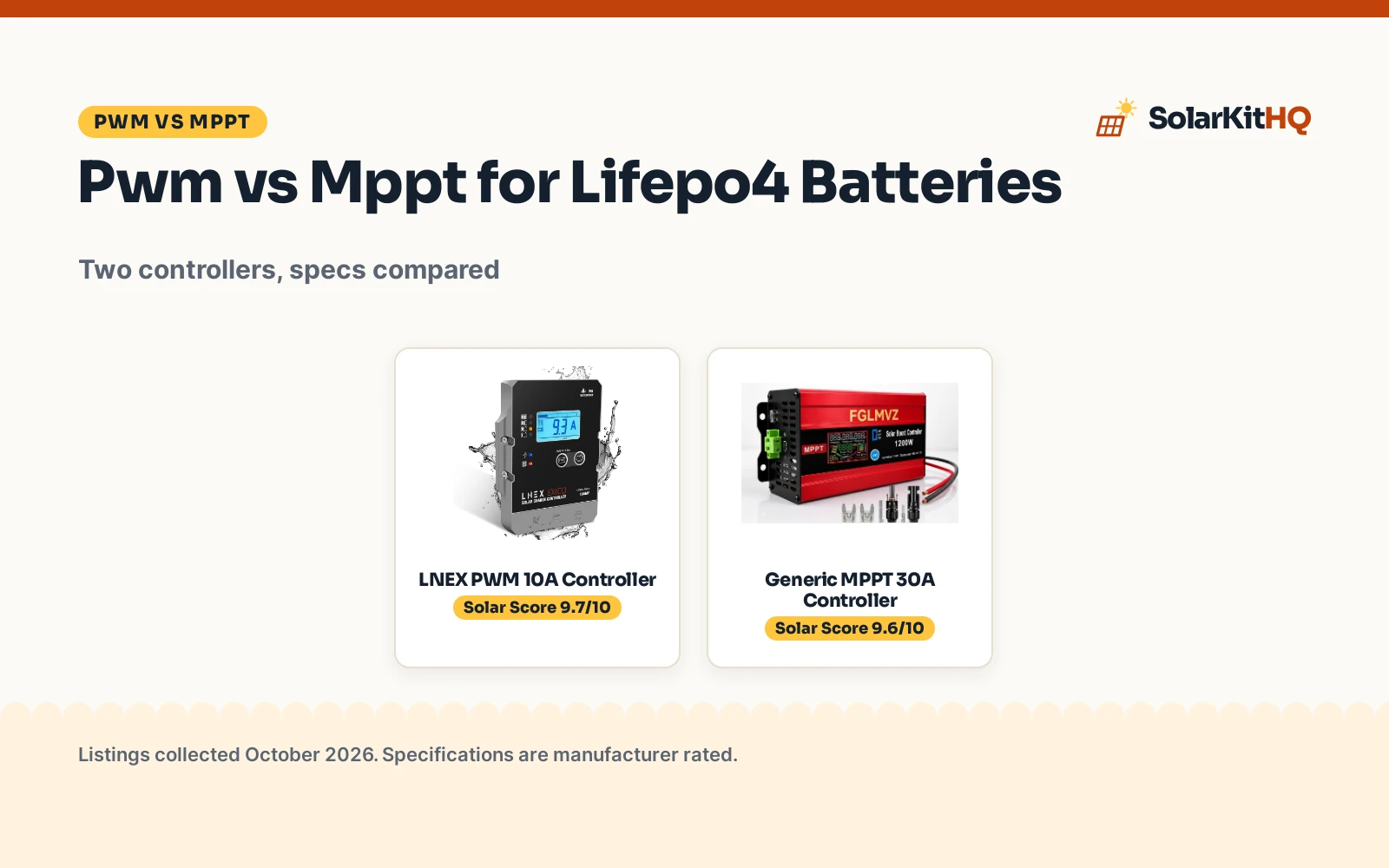
The short answer on pwm vs mppt for lifepo4 batteries: the PWM example fits the smaller battery banks most campers and RV owners run, while the MPPT example is a boost controller built for larger banks, so battery voltage decides before controller tech does. We compared the two controller listings on what each one states: technology, current, battery voltage, display, protections and warranty terms.
SolarKitHQ earns a commission when you buy through links on this page, at no extra cost to you. As an Amazon Associate I earn from qualifying purchases. Affiliate disclosure.
PWM vs MPPT: side by side
| Controller | Solar Score | Technology | Battery voltage | Warranty |
|---|---|---|---|---|
| LNEX PWM 10A Controller | 9.7/10 | PWM | 12V/24V | 90 days |
| Generic MPPT 30A Controller | 9.6/10 | MPPT boost | 48V, 60V, 72V | Not stated |
Specifications are manufacturer rated as listed, collected 25 October 2026.
Battery voltage first
Battery voltage is the gap that matters most here, because the two examples do not serve the same bank. The LNEX PWM example automatically detects 12V or 24V DC system voltages and lists LiFePO4 among its battery types, while the Generic MPPT example steps low-voltage panel output up to charge 48V, 60V or 72V battery banks and lists LiFePO4, lithium, lead-acid and AGM among its battery types. A buyer with a 12V or 24V LiFePO4 bank has one example here, and a buyer with a 48V bank has the other, so the choice starts from the bank voltage, not from the controller label.
Current and power
Current figures look comparable until the voltages beside them are read. The LNEX example is a 10A controller with a maximum PV voltage of 50V, while the Generic MPPT example states a maximum input current of 30A, a maximum output current of 15A, 1200W rated power, and panels from 10W to 1200W. The MPPT example is a boost unit, so its input and output currents describe different sides of the conversion, and the two current figures do not describe the same job. Read current beside battery voltage, and the gap between the examples narrows to what each bank actually needs.
Protection and display
Both examples state protections and an LCD display, so neither side is bare on those lines. The LNEX example states over temperature, over voltage, over current, over charging, over discharging, over load and short circuit protection, plus an IP65 code, a backlit LCD display, multiple LED indicators and an auto memory function. The Generic MPPT example states a six-layer protection system against overcharge, over-discharge, overcurrent, short circuit, reverse polarity and overtemperature, plus a clear LCD display, a metal shell, a built-in cooling fan and an aluminum heat sink block. The MPPT example states no IP code, and the LNEX example states no fan, so each listing leaves one cooling or sealing line to the other side.
What the listings leave unclear
Two figures need care. The LNEX title states 10A, while its spec table lists a charging current of 10A/20A, so the review trusts the title and bullets at 10A and treats the spec table figure as unclear. The Generic MPPT listing claims better utilization of solar panels compared with traditional PWM controllers, but the LNEX listing states no matching efficiency figure, so that claim cannot be scored from these two listings alone. The LNEX listing also claims 15% to 30% performance to charge the battery, without stating what the percent measures, so that claim is noted here rather than scored.
Two examples

LNEX PWM 10A Controller
A 10A PWM solar charge controller for 12V/24V systems with a 5-stage charging profile, LCD display and an IP65 code stated.
Pros
- Automatically detects 12V or 24V DC system voltages
- 5-stage charging profile with automatic equalization every 28 days for calcium and EFB batteries
- Backlit LCD display with LED indicators and auto memory function
- IP65 code with over temperature, over voltage, over current and short circuit protection stated
Cons
- Spec table lists a charging current of 10A/20A against the 10A title
- 90 days warranty term is short beside longer terms elsewhere
- No fan or heat sink cooling stated
- 15% to 30% performance claim does not state what the percent measures
Detailed Review
The listing states a 10A PWM solar charge controller for 12V/24V systems with 5-stage charging across soft start, bulk, absorption, float and equalization, automatic equalization every 28 days for calcium and EFB batteries, a backlit LCD display with LED indicators, an auto memory function, 6 battery type presets, a maximum PV voltage of 50V, and an IP65 code. It states a 0.87 inch profile, dimensions of 4.25 by 0.87 by 5.15 inches, a weight of 10 ounces, and a 90 days warranty from date of purchase. One conflict sits in the listing: the title states 10A, while the spec table lists a charging current of 10A/20A, so the review trusts the title and bullets at 10A.
Who it's for: owners of 12V or 24V LiFePO4, AGM, gel, flooded or lithium banks wanting a thin PWM controller with a display. Who should skip it: anyone with a 48V bank, or anyone needing a longer warranty term than 90 days.
Its Solar Score of 9.7/10 comes from performance 30/35, build 21/25, value 21/25, safety 8/10 and warranty 1/5: 81 of 100 points, placed on our 9.2 to 9.8 scale.
Key Specifications
| Technology | PWM |
|---|---|
| Current | 10A |
| Battery voltage | 12V/24V |
| Display | Backlit LCD with LED indicators |
Figures as published on the retailer listing, collected 25 October 2026. Performance figures are manufacturer rated.
Safety and Warranty
What this listing states. IP65 code and over temperature, over voltage, over current, over charging, over discharging, over load and short circuit protection stated, so safety scores 8 of 10. 90 days warranty from date of purchase stated. It does not say everything a buyer needs, such as who pays return shipping, so warranty scores 1 of 5. See How We Pick.
Stay under the input limit. Keep your panels' combined open circuit voltage, with cold weather margin, under the controller's stated maximum PV input, connect the battery first unless the manual says otherwise, and fuse both sides as the manual directs.
This is general buying information, not professional advice. Follow each product manual and local rules, and see our Safety Disclaimer.

Generic MPPT 30A Controller
A 30A MPPT boost charge controller at 1200W that steps 12-60V panel input up to 48V, 60V or 72V battery output.
Pros
- Boost charging from 12-60V panel input to 48V, 60V or 72V output
- 1200W rated power with panels from 10W to 1200W
- Six-layer protection against overcharge, over-discharge, overcurrent, short circuit, reverse polarity and overtemperature
- Metal shell with a built-in cooling fan and aluminum heat sink block
Cons
- No warranty term is stated
- No IP code is stated
- Outputs suit 48V, 60V or 72V banks only, not 12V or 24V banks
- Boost role means input and output currents describe different sides of the conversion
Detailed Review
The listing states a 30A MPPT boost charge controller at 1200W rated power, with a 12-60V panel input range, adjustable 48V, 60V or 72V output voltage, a maximum input current of 30A, a maximum output current of 15A, panels from 10W to 1200W, a clear LCD display, a metal shell, a built-in cooling fan, an aluminum heat sink block, and pre-drilled mounting holes. It states a six-layer protection system and compatibility with lithium, LiFePO4, lead-acid and AGM batteries across 48V, 60V and 72V systems. It states no warranty term and no IP code, so those lines stay empty on this card.
Who it's for: owners of 48V, 60V or 72V banks, such as golf cart or off-grid setups, whose panels run below bank voltage. Who should skip it: anyone with a 12V or 24V bank, or anyone needing a stated warranty term.
Its Solar Score of 9.6/10 comes from performance 30/35, build 22/25, value 20/25, safety 8/10 and warranty 0/5: 80 of 100 points, placed on our 9.2 to 9.8 scale.
Key Specifications
| Technology | MPPT boost |
|---|---|
| Current | 30A input, 15A output |
| Battery voltage | 48V, 60V, 72V |
| Power | 1200W |
Figures as published on the retailer listing, collected 25 October 2026. Performance figures are manufacturer rated.
Safety and Warranty
What this listing states. Six-layer protection against overcharge, over-discharge, overcurrent, short circuit, reverse polarity and overtemperature stated, so safety scores 8 of 10. No warranty term, so warranty scores zero. See How We Pick.
Stay under the input limit. Keep your panels' combined open circuit voltage, with cold weather margin, under the controller's stated maximum PV input, connect the battery first unless the manual says otherwise, and fuse both sides as the manual directs.
This is general buying information, not professional advice. Follow each product manual and local rules, and see our Safety Disclaimer.
As an Amazon Associate I earn from qualifying purchases.
Where the points went
The Solar Score weighs performance, build and value most, with safety where it applies, and warranty. For a charge controller, safety means protections and certifications the listing actually states; both examples state protection lists, and the LNEX example adds an IP65 code. One of the two states a warranty term, a 90 days term on the LNEX example, while the Generic MPPT example states none. How we pick explains the weights.
| Product | Solar Score | Perf. /35 | Build /25 | Value /25 | Safety /10 | Warranty /5 |
|---|---|---|---|---|---|---|
| LNEX PWM 10A Controller | 9.7 | 30 | 21 | 21 | 8 | 1 |
| Generic MPPT 30A Controller | 9.6 | 30 | 22 | 20 | 8 | 0 |
Scores run from 9.2 to 9.8: each product’s point total is placed on that range, so more points always means a higher score.
PWM vs MPPT for LiFePO4 batteries: which should you choose?
Choose the PWM example if the bank is 12V or 24V, if an IP65 code matters, and if a stated warranty term matters: the LNEX example covers those lines with a 10A controller, a backlit LCD and LED indicators. Choose the MPPT example if the bank is 48V, 60V or 72V and the panels run at a lower voltage than the bank, since the Generic example is a boost controller built for that job, with 1200W rated power and a metal shell with a cooling fan. Neither example covers the other bank voltage, so the bank decides the side.
| If you need | Look at |
|---|---|
| 12V or 24V bank | LNEX PWM 10A Controller |
| 48V, 60V or 72V bank | Generic MPPT 30A Controller |
| IP65 code stated | LNEX PWM 10A Controller |
| Boost charging from low-voltage panels | Generic MPPT 30A Controller |
Sizing Notes
- Match battery voltage first: the LNEX example covers 12V or 24V, while the Generic MPPT example covers 48V, 60V or 72V.
- Match panel voltage to the controller input: the LNEX example states a maximum PV voltage of 50V, and the Generic MPPT example states a 12-60V input range.
- Match current to the bank: the LNEX example states 10A, and the Generic MPPT example states a 30A maximum input current with a 15A maximum output current.
- Match protections to the install: both examples state protection lists, and only the LNEX example states an IP65 code.
- Check the warranty line: the LNEX example states a 90 days term, and the Generic MPPT example states none.
FAQ: power away from the grid
Can the MPPT example charge a 12V LiFePO4 battery?
No, per its listing: its outputs are 48V, 60V or 72V, so it suits larger banks, while the LNEX example covers 12V or 24V banks.
Which example states a warranty term?
Only the LNEX example, with a 90 days term from date of purchase stated. The Generic MPPT example states no term.
What protections do the two examples state?
The LNEX example states over temperature, over voltage, over current, over charging, over discharging, over load and short circuit protection. The Generic MPPT example states a six-layer system against overcharge, over-discharge, overcurrent, short circuit, reverse polarity and overtemperature.
Does the MPPT example state an IP code?
No. The LNEX example states an IP65 code, while the Generic MPPT example states a metal shell with a cooling fan and a heat sink block and no IP code.
Related solar guides
See every Controllers and Inverters guide and all Charge Controllers guides.
More picks: Charge controllers, DC to DC chargers, Lithium vs lead-acid battery for solar.