On this page
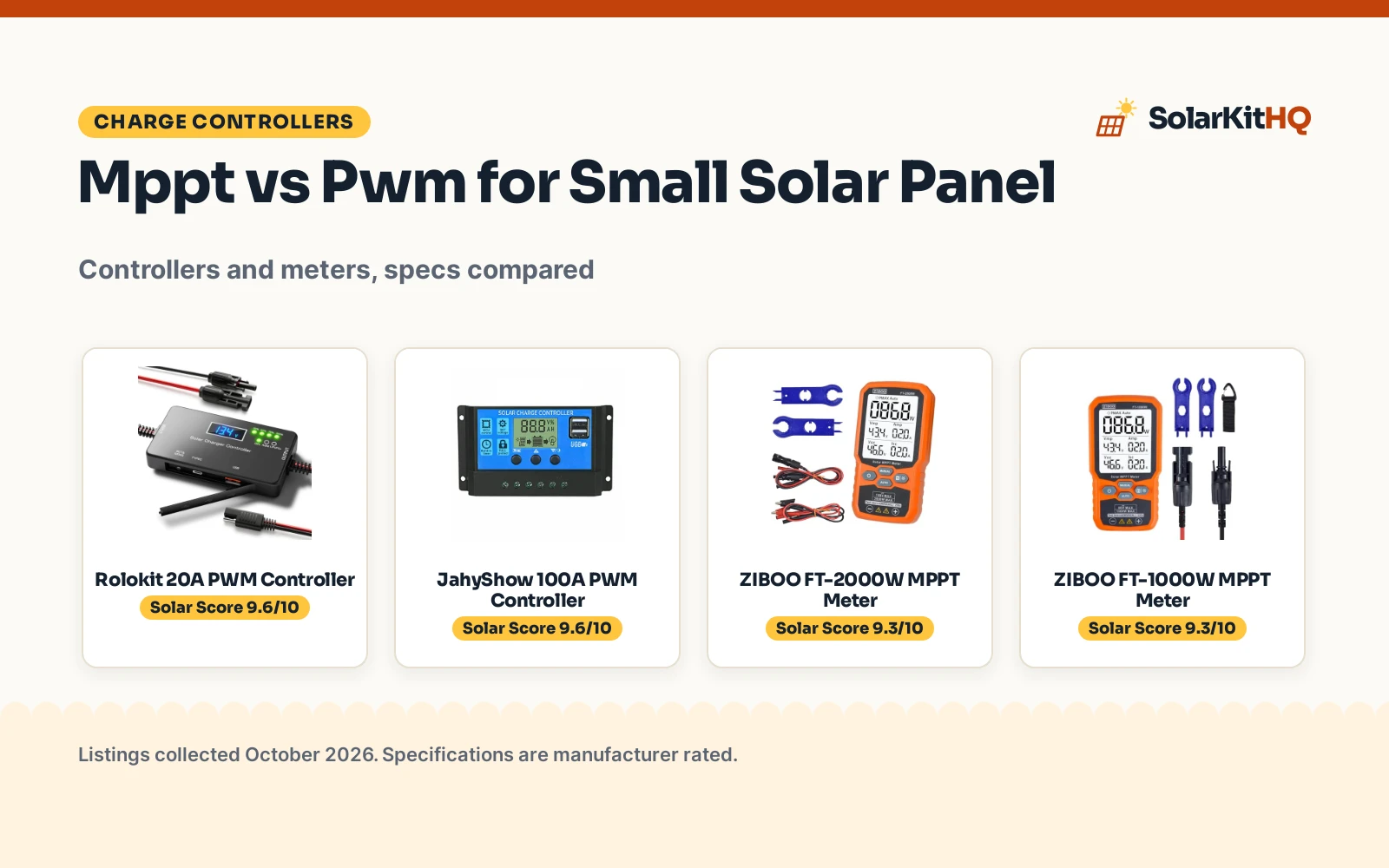
A small panel that never quite fills its battery leaves the owner guessing between controller types, and mppt vs pwm for small solar panel choice turns on what the listings actually describe. We compared what each listing states: controller amps, system voltage, protections and display features. The short verdict: the PWM listings here are real charge controllers, while the MPPT-side listings are panel meters, so pick by function, not by label.
SolarKitHQ earns a commission when you buy through links on this page, at no extra cost to you. As an Amazon Associate I earn from qualifying purchases. Affiliate disclosure.
Mppt vs Pwm for Small Solar Panel: side by side
| Controller | Solar Score | Role | Key figure | Warranty | Amazon |
|---|---|---|---|---|---|
| Rolokit 20A PWM Controller | 9.6/10 | PWM controller | 20A, panels up to 300W | Not stated | View on Amazon |
| JahyShow 100A PWM Controller | 9.6/10 | PWM controller | 100A, 12V/24V | Not stated | View on Amazon |
| ZIBOO FT-2000W MPPT Meter | 9.3/10 | Panel meter | Pmax up to 2000W, Voc 12-150V | Not stated | View on Amazon |
| ZIBOO FT-1000W MPPT Meter | 9.3/10 | Panel meter | Pmax up to 1000W, Voc 12-80V | Not stated | View on Amazon |
Specifications are manufacturer rated as listed, collected 29 October 2026.
The label problem: meters are not controllers
The two MPPT-side listings describe panel meters, not charge controllers. The ZIBOO FT-1000W and FT-2000W listings state maximum power measurement, open-circuit voltage and short-circuit current measurement, with data hold and a backlit LCD, and they state no battery charging function at all. A meter checks what a panel produces; it does not charge a battery, manage charging stages or protect a battery from overcharge. The two PWM-side listings describe charge controllers that manage charging, so the two sides do not compete on the same job. Any comparison that calls the MPPT side better for charging would rest on a function its listings never state.
Amps and system voltage
On the controller side, amps and system voltage separate the two listings clearly. The Rolokit listing states 20A for 12V systems with panels up to 300W, and states it is not for 24V or 36V batteries. The JahyShow listing states 100A for 12V and 24V systems, so it states the higher controller amps and the wider system voltage of the two controllers. The ZIBOO listings state a short-circuit current of 35A, but that is a measurement range for panel current, not a charging current, so it does not compare with controller amps. Likewise, the ZIBOO Voc ranges of 12-80V and 12-150V describe panel voltage measurement, not battery system voltage.
Protections and display
Protections differ in kind between controllers and meters. The Rolokit listing states 6 layers of protection: overcharge, over-voltage, short-circuit, reverse polarity, over-temperature protection and nighttime anti-leakage, plus an LCD showing battery voltage and charge levels of 25%, 50%, 75% and 100%, with 22W Type-C and 18W USB charging ports. The JahyShow listing states overcurrent, short circuit, reverse connection and open circuit protection with automatic recovery, plus an LCD display, dual USB ports and an adjustable timer setting. The ZIBOO listings state CAT III 1000V and CAT IV 600V classes with double-insulated probes, IEC/EN 61010 standards and IP54 dust and water resistance, which are meter safety classes for working on live arrays, not charging protections. See our mppt vs pwm charge controller guide for more on controller types.
What the listings leave unclear
Several points deserve care. The JahyShow listing calls its PWM technology advanced maximum power point tracking and claims an efficiency improvement of 10%-30%, wording that borrows MPPT language for a PWM listing, so treat that claim as the maker wording, not as a measured comparison. The Rolokit listing states compatibility with LiFePO4, AGM and Gel batteries, while the JahyShow listing states it suits lead-acid batteries only, including OPEN, AGM and GEL, and does not suit lithium ions, so the two controllers disagree on battery chemistry. No listing here states a warranty term. The ZIBOO listings state no controller function, so the MPPT side of this comparison has no charging specs to weigh at all.
The listings up close
| # | Product | Solar Score | Buy |
|---|---|---|---|
| 1 | 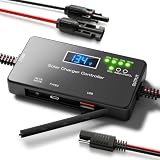 Rolokit 20A PWM Controller | 9.6/10 | Buy on Amazon |
| 2 |  JahyShow 100A PWM Controller | 9.6/10 | Buy on Amazon |
| 3 |  ZIBOO FT-2000W MPPT Meter | 9.3/10 | Buy on Amazon |
| 4 | 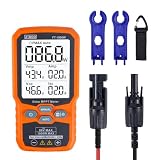 ZIBOO FT-1000W MPPT Meter | 9.3/10 | Buy on Amazon |
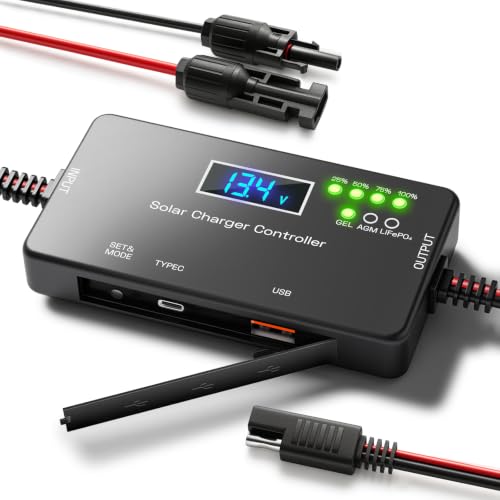
Rolokit 20A PWM Controller
A 12V 20A PWM solar charge controller with an LCD, 22W Type-C and 18W USB ports, for LiFePO4, AGM and Gel batteries.
Pros
- 20A for 12V systems with panels up to 300W stated
- Compatibility with LiFePO4, AGM and Gel batteries stated
- 6 layers of protection stated, including overcharge and short-circuit protection
- LCD showing battery voltage and charge levels of 25%, 50%, 75% and 100% stated
Cons
- Not for 24V or 36V batteries, as the listing states
- No warranty term is stated
- No IP code is stated
- 22W Type-C and 18W USB ports are device charging ports, not controller output figures
Detailed Review
The listing states a 12V 20A PWM solar charge controller for LiFePO4, AGM and Gel batteries, handling panels up to 300W, with an LCD showing battery voltage and charge levels of 25%, 50%, 75% and 100%, plus 22W Type-C and 18W USB ports. It states 6 layers of protection: overcharge, over-voltage, short-circuit, reverse polarity, over-temperature protection and nighttime anti-leakage. It states it is not for 24V or 36V batteries, and states no warranty term.
Who it's for: owners of a 12V small-panel system who want LiFePO4 compatibility and stated charging protections. Who should skip it: owners with 24V systems or lead-acid-only needs, who should weigh the JahyShow listing instead.
Its Solar Score of 9.6/10 comes from performance 30/35, build 21/25, value 21/25, safety 8/10 and warranty 0/5: 80 of 100 points, placed on our 9.2 to 9.8 scale.
Key Specifications
| Amps | 20A |
|---|---|
| System voltage | 12V |
| Panels | Up to 300W |
| Display | LCD with 25%, 50%, 75% and 100% levels |
Figures as published on the retailer listing, collected 29 October 2026. Performance figures are manufacturer rated.
Safety and Warranty
What this listing states. Overcharge, over-voltage, short-circuit, reverse polarity, over-temperature protection and nighttime anti-leakage stated, so safety scores 8 of 10. No warranty term, so warranty scores zero. See How We Pick.
Stay under the input limit. Keep your panels' combined open circuit voltage, with cold weather margin, under the controller's stated maximum PV input, connect the battery first unless the manual says otherwise, and fuse both sides as the manual directs.
This is general buying information, not professional advice. Follow each product manual and local rules, and see our Safety Disclaimer.

JahyShow 100A PWM Controller
A 100A PWM solar charge controller for 12V and 24V systems with an LCD, dual USB ports and an adjustable timer setting.
Pros
- 100A for 12V and 24V systems stated
- Overcurrent, short circuit, reverse connection and open circuit protection stated
- LCD display with mode switching and parameter configuration stated
- Adjustable timer setting and dual USB ports stated
Cons
- Lead-acid batteries only, not suitable for lithium ions, as the listing states
- Listing calls its PWM technology maximum power point tracking, borrowing MPPT wording
- No warranty term is stated
- No IP code is stated
Detailed Review
The listing states a 100A PWM solar charge controller for 12V and 24V systems with an LCD display, dual USB ports, an adjustable timer setting and automatic recovery, plus overcurrent, short circuit, reverse connection and open circuit protection. It states suitability for lead-acid batteries only, including OPEN, AGM and GEL, and states it does not suit lithium ions. It describes its PWM technology with maximum power point tracking wording and claims an efficiency improvement of 10%-30%; treat that wording as the maker claim.
Who it's for: owners of 12V or 24V lead-acid systems who want 100A and timer control. Who should skip it: owners with lithium batteries, who should weigh the Rolokit listing instead.
Its Solar Score of 9.6/10 comes from performance 29/35, build 20/25, value 20/25, safety 7/10 and warranty 0/5: 76 of 100 points, placed on our 9.2 to 9.8 scale.
Key Specifications
| Amps | 100A |
|---|---|
| System voltage | 12V/24V |
| Display | LCD |
| Ports | Dual USB |
Figures as published on the retailer listing, collected 29 October 2026. Performance figures are manufacturer rated.
Safety and Warranty
What this listing states. Overcurrent, short circuit, reverse connection and open circuit protection stated, so safety scores 7 of 10. No warranty term, so warranty scores zero. See How We Pick.
Stay under the input limit. Keep your panels' combined open circuit voltage, with cold weather margin, under the controller's stated maximum PV input, connect the battery first unless the manual says otherwise, and fuse both sides as the manual directs.
This is general buying information, not professional advice. Follow each product manual and local rules, and see our Safety Disclaimer.

ZIBOO FT-2000W MPPT Meter
A solar panel meter measuring maximum power up to 2000W, Voc of 12-150V and Isc of 35A, with data hold and a backlit LCD.
Pros
- Maximum power measurement up to 2000W stated
- Voc range of 12-150V and Isc of 35A stated
- CAT III 1000V and CAT IV 600V classes with IEC/EN 61010 standards stated
- IP54 dust and water resistance stated with data hold and backlit LCD
Cons
- Not a charge controller: no battery charging function is stated
- No warranty term is stated
- Measurement ranges do not compare with controller charging amps
- Same size and weight as the FT-1000W listing, with no stated difference beyond measurement range
Detailed Review
The listing states a solar panel meter measuring maximum power up to 2000W, open-circuit voltage of 12-150V and short-circuit current of 35A with ±0.8% accuracy, tracking Vmp of 150V, with data hold and a backlit LCD. It states CAT III 1000V and CAT IV 600V classes with double-insulated probes, IEC/EN 61010 standards and IP54 dust and water resistance, at 0.65 pounds and 5.51 by 2.99 by 1.26 inches. It states no battery charging function, so it cannot serve as a charge controller.
Who it's for: owners who need to check panel output up to 2000W before choosing or fault-finding a controller. Who should skip it: owners who need battery charging, who should weigh the PWM controller listings instead.
Its Solar Score of 9.3/10 comes from performance 19/35, build 20/25, value 15/25, safety 9/10 and warranty 0/5: 63 of 100 points, placed on our 9.2 to 9.8 scale.
Key Specifications
| Max power | Up to 2000W |
|---|---|
| Voc range | 12-150V |
| Isc | 35A |
| Accuracy | ±0.8% |
Figures as published on the retailer listing, collected 29 October 2026. Performance figures are manufacturer rated.
Safety and Warranty
What this listing states. CAT III 1000V and CAT IV 600V classes, IEC/EN 61010 standards and IP54 dust and water resistance stated, so safety scores 9 of 10. No warranty term, so warranty scores zero. See How We Pick.
Stay under the input limit. Keep your panels' combined open circuit voltage, with cold weather margin, under the controller's stated maximum PV input, connect the battery first unless the manual says otherwise, and fuse both sides as the manual directs.
This is general buying information, not professional advice. Follow each product manual and local rules, and see our Safety Disclaimer.
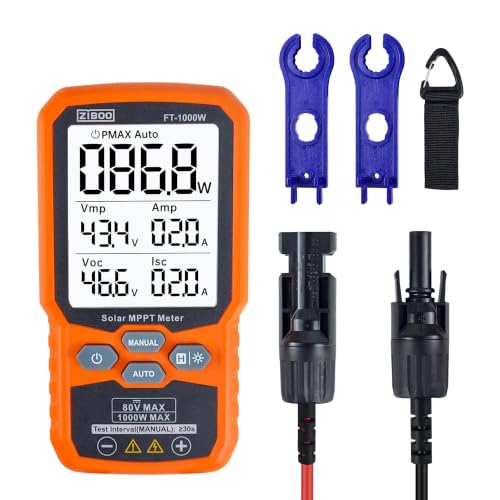
ZIBOO FT-1000W MPPT Meter
A solar panel meter measuring maximum power up to 1000W, Voc of 12-80V and Isc of 35A, with data hold and a backlit LCD.
Pros
- Maximum power measurement up to 1000W stated
- Voc range of 12-80V and Isc of 35A stated
- CAT III 1000V and CAT IV 600V classes with IEC/EN 61010 standards stated
- IP54 dust and water resistance stated with data hold and backlit LCD
Cons
- Not a charge controller: no battery charging function is stated
- No warranty term is stated
- Measurement ranges do not compare with controller charging amps
- Lower maximum power and Voc range than the FT-2000W listing
Detailed Review
The listing states a solar panel meter measuring maximum power up to 1000W, open-circuit voltage of 12-80V and short-circuit current of 35A with ±0.8% accuracy, tracking Vmp of 80V, with data hold and a backlit LCD. It states CAT III 1000V and CAT IV 600V classes with double-insulated probes, IEC/EN 61010 standards and IP54 dust and water resistance, at 0.65 pounds and 5.51 by 2.99 by 1.26 inches. It states no battery charging function, so it cannot serve as a charge controller.
Who it's for: owners who need to check panel output up to 1000W before choosing or fault-finding a controller. Who should skip it: owners who need battery charging or a wider Voc range, who should weigh the other listings instead.
Its Solar Score of 9.3/10 comes from performance 16/35, build 20/25, value 15/25, safety 9/10 and warranty 0/5: 60 of 100 points, placed on our 9.2 to 9.8 scale.
Key Specifications
| Max power | Up to 1000W |
|---|---|
| Voc range | 12-80V |
| Isc | 35A |
| Accuracy | ±0.8% |
Figures as published on the retailer listing, collected 29 October 2026. Performance figures are manufacturer rated.
Safety and Warranty
What this listing states. CAT III 1000V and CAT IV 600V classes, IEC/EN 61010 standards and IP54 dust and water resistance stated, so safety scores 9 of 10. No warranty term, so warranty scores zero. See How We Pick.
Stay under the input limit. Keep your panels' combined open circuit voltage, with cold weather margin, under the controller's stated maximum PV input, connect the battery first unless the manual says otherwise, and fuse both sides as the manual directs.
This is general buying information, not professional advice. Follow each product manual and local rules, and see our Safety Disclaimer.
As an Amazon Associate I earn from qualifying purchases.
How we scored them
The Solar Score weighs performance, build, value, safety and warranty. For a charge controller, safety means stated charging protections; both PWM listings state protections, and the ZIBOO listings state meter safety classes instead. No listing here states a warranty term, so every pick scores zero on warranty. The meters score lower overall because they do not serve the controller job this comparison is about, whatever their measurement ranges. How we pick explains the weights.
| Product | Solar Score | Perf. /35 | Build /25 | Value /25 | Safety /10 | Warranty /5 |
|---|---|---|---|---|---|---|
| Rolokit 20A PWM Controller | 9.6 | 30 | 21 | 21 | 8 | 0 |
| JahyShow 100A PWM Controller | 9.6 | 29 | 20 | 20 | 7 | 0 |
| ZIBOO FT-2000W MPPT Meter | 9.3 | 19 | 20 | 15 | 9 | 0 |
| ZIBOO FT-1000W MPPT Meter | 9.3 | 16 | 20 | 15 | 9 | 0 |
Scores run from 9.2 to 9.8: each product’s point total is placed on that range, so more points always means a higher score.
Mppt vs Pwm for Small Solar Panel: which should you choose?
Choose a PWM controller here if you need charging: the Rolokit suits a 12V system with panels up to 300W and LiFePO4, AGM or Gel batteries, while the JahyShow suits 12V or 24V systems at 100A for lead-acid batteries. Choose a ZIBOO meter if you need to check panel output: the FT-2000W measures up to 2000W with Voc to 150V, and the FT-1000W measures up to 1000W with Voc to 80V. Do not buy a meter expecting it to charge a battery, and do not read the MPPT label on a meter as a controller advantage.
| If you need | Look at |
|---|---|
| A controller for a small 12V panel | Rolokit 20A PWM Controller, panels up to 300W |
| A controller for 12V or 24V systems | JahyShow 100A PWM Controller, 100A |
| A meter to check panel output | ZIBOO FT-2000W MPPT Meter, Pmax up to 2000W |
| Stated charging protections | Rolokit 20A PWM Controller, 6 layers stated |
Sizing Notes
- Match controller amps and system voltage to the panel and battery: Rolokit states 20A for 12V systems with panels up to 300W, and JahyShow states 100A for 12V and 24V systems.
- Match battery chemistry to the controller listing: Rolokit states LiFePO4, AGM and Gel batteries, while JahyShow states lead-acid batteries only and does not suit lithium ions.
- Check what the device does before ordering: meters measure Pmax, Voc and Isc, while controllers charge batteries, so a meter cannot replace a controller.
- Check stated protections against the job: Rolokit states 6 layers of charging protection, JahyShow states overcurrent, short circuit, reverse connection and open circuit protection, and the ZIBOO listings state CAT III 1000V and CAT IV 600V meter classes.
Frequently Asked Questions
Are the MPPT-side listings charge controllers?
No. The ZIBOO listings describe panel meters that measure maximum power, open-circuit voltage and short-circuit current, and they state no battery charging function.
Which controller here supports LiFePO4 batteries?
The Rolokit listing states compatibility with LiFePO4, AGM and Gel batteries. The JahyShow listing states lead-acid batteries only and does not suit lithium ions.
Which controller states the higher amps?
The JahyShow listing states 100A, and the Rolokit listing states 20A, so JahyShow states the higher controller amps of the two controllers.
Do any listings here state a warranty term?
No. None of the listings states a warranty term.
Related guides
See every Controllers and Inverters guide. Also see our mppt vs pwm charge controller guide.
More picks: best solar charge controller for boat, best solar charge controller for agm batteries.