On this page
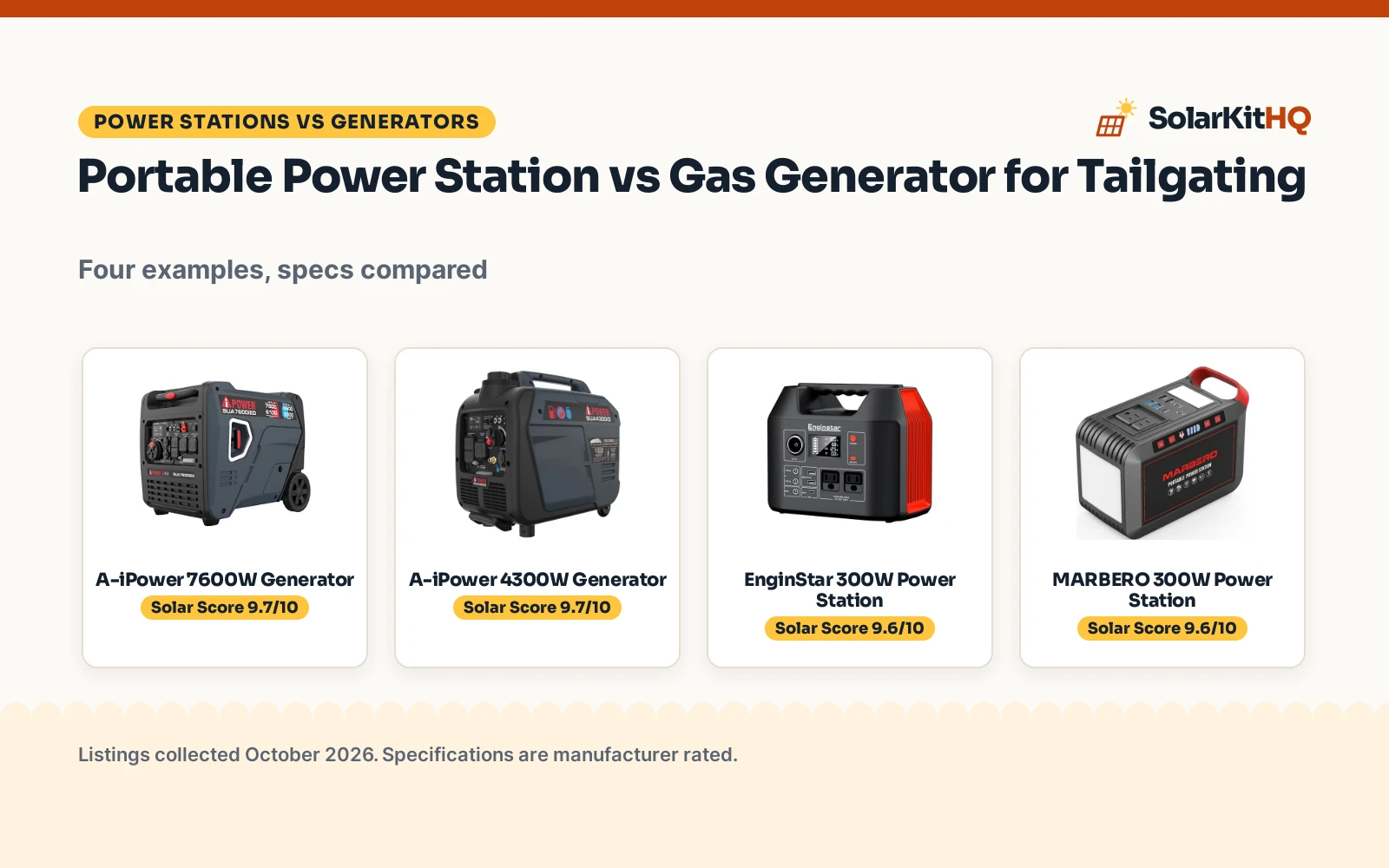
The short answer on portable power station vs gas generator for tailgating: a power station suits a lighter carry-in setup for smaller loads, while a gas generator suits larger loads at a tailgate, at the cost of weight and fuel handling. This article compares two power stations and two gas generators on what each listing states: output, weight, noise, fuel and charging, and warranty terms. The power station examples are lighter and recharge from a wall outlet, a car socket or a solar panel, while the gas generator examples list far higher output watts and dual fuel operation.
SolarKitHQ earns a commission when you buy through links on this page, at no extra cost to you. As an Amazon Associate I earn from qualifying purchases. Affiliate disclosure.
Portable power station vs gas generator: side by side
| Portable power station vs gas generator | A-iPower 7600W Generator | A-iPower 4300W Generator | EnginStar 300W Power Station | MARBERO 300W Power Station | Amazon |
|---|---|---|---|---|---|
| Type | Gas generator | Gas generator | Portable power station | Portable power station | |
| Output | 7,600W starting, 6,100W running on gas | 4,300W starting, 3,450W running on gas | 300W | 300W, 375W peak | |
| Capacity | Not stated as Wh | Not stated as Wh | 296Wh | 237Wh | |
| Weight | 130.0 lb | 54.8 lb | 6.5 lb | 4.6 lb | |
| Noise | 62dB | 63dB | Not stated | Not stated | |
| Warranty | 2 years | 3 years | 12 months | 12 months | |
| Protection | CO sensor, EPA and CARB compliance stated | CO sensor, EPA and CARB compliance stated | ETL, BMS stated | BMS stated |
Specifications are manufacturer rated as listed, collected 1 November 2026.
Output and load size
Output watts decide which loads a unit can run, and the gap between the two sides here is large. Both power station examples list the same AC output figure, while both gas generator examples list starting watts several times higher, with separate running watts on gas and on propane.
Both power station examples list 300W AC output.
Both gas generator examples list dual fuel operation on gas and propane.
The A-iPower 7600W Generator lists 7,600W starting watts on gas.
The A-iPower 7600W Generator lists 6,100W running watts on gas.
The A-iPower 4300W Generator lists 4,300W starting watts on gas.
The A-iPower 4300W Generator lists 3,450W running watts on gas.
The MARBERO 300W Power Station lists 375W peak power.
The EnginStar 300W Power Station lists 8 output ports.
The MARBERO 300W Power Station lists 2 AC outlets, USB ports and a DC output port.
Weight and portability
Weight is the clearest practical gap between the sides, because a tailgate setup has to be carried from a vehicle to a parking spot. Both power station examples list weights in single figures, while both gas generator examples list weights in double and triple figures, with telescoping handles and wheels for moving them.
The MARBERO 300W Power Station lists a weight of 4.6 lbs.
The EnginStar 300W Power Station lists a weight of 6.5 lbs in the bullets.
The A-iPower 4300W Generator lists a weight of 54.8 pounds.
The A-iPower 7600W Generator lists a weight of 130.0 pounds.
The A-iPower 4300W Generator lists a telescoping handle and flat free wheels.
The A-iPower 7600W Generator lists a telescoping handle and flat free wheels.
Noise, fuel and charging
Noise, fuel and charging separate the sides in different ways, and the listings do not state every figure on both sides. A direct noise comparison is not possible from the listings alone, because only one side states decibel figures.
Neither power station listing states a decibel figure.
The A-iPower 4300W Generator lists a sound level as low as 63dB.
The A-iPower 7600W Generator lists a sound level as low as 62dB.
The A-iPower 4300W Generator lists a run time of 7.5 hours at 25% load with a 1.6 gallon fuel tank on gasoline.
The A-iPower 7600W Generator lists a run time of 10 hours at 25% load with a 3.6 gallon fuel tank.
The A-iPower 7600W Generator lists a combined run time of up to 21.2 hours at 25% load with fuel sense switching.
The MARBERO 300W Power Station lists full charging in 6 hours from a wall outlet.
The MARBERO 300W Power Station lists full charging in 8 hours from a car adapter.
The MARBERO 300W Power Station lists solar recharging with a panel not included.
The EnginStar 300W Power Station lists charging to 80% in 2 hours at a maximum charging speed of 65W.
The EnginStar 300W Power Station lists charging from a compatible solar panel, also not included.
What the listings leave unclear
Some figures differ inside a listing, and some figures are stated on one side only. Those gaps matter more than any single headline figure, because they decide which comparisons can be made fairly.
The EnginStar 300W Power Station bullets state a weight of 6.5 pounds.
The EnginStar 300W Power Station spec table states a weight of 7.936641432 pounds.
The A-iPower 7600W Generator spec table states product dimensions of 25.1 x 19.7 x 21.4 inches.
The A-iPower 7600W Generator spec table also states a size of 28 inches by 22 inches by 24 inches.
Neither power station listing states a decibel figure.
Neither gas generator listing states a watt-hour capacity.
Neither gas generator listing states a recharge time, because a gas generator runs on fuel rather than on a rechargeable battery.
Four examples
| # | Product | Solar Score | Buy |
|---|---|---|---|
| 1 |  A-iPower 7600W Generator | 9.7/10 | Buy on Amazon |
| 2 |  A-iPower 4300W Generator | 9.7/10 | Buy on Amazon |
| 3 |  EnginStar 300W Power Station | 9.6/10 | Buy on Amazon |
| 4 |  MARBERO 300W Power Station | 9.6/10 | Buy on Amazon |
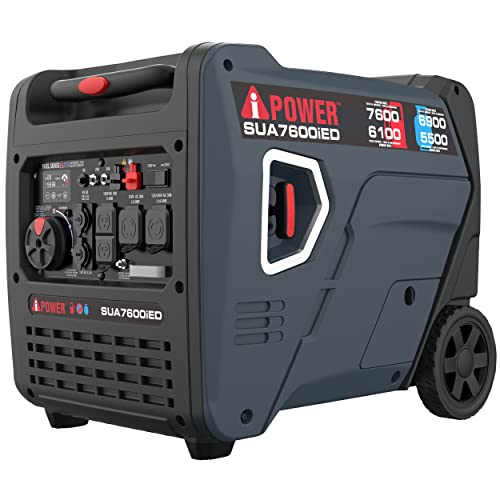
A-iPower 7600W Generator
A dual fuel inverter generator with 7,600W starting watts on gas, fuel sense switching and a CO sensor.
Pros
- 7,600W starting watts with 6,100W running watts on gas stated
- Dual fuel operation with fuel sense switching stated
- Combined run time of up to 21.2 hours at 25% load stated
- Electric start with telescoping handle and flat free wheels stated
Cons
- No watt-hour capacity stated
- No recharge time stated, as this runs on fuel
- Weight of 130.0 pounds stated
- Two different size sets stated in the spec table
Detailed Review
The listing states a dual fuel inverter generator with 7,600W starting watts and 6,100W running watts on gas. The listing states 6,900W starting watts and 5,500W running watts on propane, with a run time of 10 hours at 25% load and a 3.6 gallon fuel tank. Fuel sense switching gives a combined run time of up to 21.2 hours at 25% load. A 2-year manufacturer warranty is stated.
Who it's for: owners who want the largest output in this article for large tailgate loads. Who should skip it: owners who want a light carry-in unit or a stated watt-hour capacity.
Its Solar Score of 9.7/10 comes from performance 33/35, build 22/25, value 22/25, safety 7/10 and warranty 2/5: 86 of 100 points, placed on our 9.2 to 9.8 scale.
Key Specifications
| Output | 7,600W starting, 6,100W running on gas |
|---|---|
| Fuel | Dual fuel, 3.6 gallon tank |
| Run time | 10 hours at 25% load |
| Weight | 130.0 pounds |
Figures as published on the retailer listing, collected 1 November 2026. Performance figures are manufacturer rated.
Safety and Warranty
What this listing states. CO sensor and EPA and CARB compliance stated, so safety scores 7 of 10. 2-year manufacturer warranty stated. It does not say everything a buyer needs, such as who pays return shipping, so warranty scores 2 of 5. See How We Pick.
Power station limits. Stay within the stated continuous output and solar input limits, keep the unit ventilated and dry, charge within the stated temperature range, and never connect it to home wiring except through equipment a licensed electrician installs.
This is general buying information, not professional advice. Follow each product manual and local rules, and see our Safety Disclaimer.

A-iPower 4300W Generator
A dual fuel inverter generator with 4,300W starting watts on gas, fuel sense and a CO sensor.
Pros
- 4,300W starting watts with 3,450W running watts on gas stated
- Dual fuel operation with fuel sense stated
- 3% THD clean power output stated
- Sound level as low as 63dB stated
Cons
- No watt-hour capacity stated
- No recharge time stated, as this runs on fuel
- Weight of 54.8 pounds stated
- No solar charging stated
Detailed Review
The listing states a dual fuel inverter generator with 4,300W starting watts and 3,450W running watts on gas. The listing states 3,900W starting watts and 3,100W running watts on propane, with a run time of 7.5 hours at 25% load and a 1.6 gallon fuel tank on gasoline. A CO sensor indicator light and a data center display are stated. A 3-year limited manufacturer warranty is stated.
Who it's for: owners who want a mid-size dual fuel generator with the longest stated warranty in this article. Who should skip it: owners who want a light carry-in unit or a stated watt-hour capacity.
Its Solar Score of 9.7/10 comes from performance 32/35, build 22/25, value 21/25, safety 7/10 and warranty 2/5: 84 of 100 points, placed on our 9.2 to 9.8 scale.
Key Specifications
| Output | 4,300W starting, 3,450W running on gas |
|---|---|
| Fuel | Dual fuel, 1.6 gallon tank |
| Run time | 7.5 hours at 25% load |
| Noise | 63dB |
Figures as published on the retailer listing, collected 1 November 2026. Performance figures are manufacturer rated.
Safety and Warranty
What this listing states. CO sensor and EPA and CARB compliance stated, so safety scores 7 of 10. 3-year limited manufacturer warranty stated. It does not say everything a buyer needs, such as who pays return shipping, so warranty scores 2 of 5. See How We Pick.
Power station limits. Stay within the stated continuous output and solar input limits, keep the unit ventilated and dry, charge within the stated temperature range, and never connect it to home wiring except through equipment a licensed electrician installs.
This is general buying information, not professional advice. Follow each product manual and local rules, and see our Safety Disclaimer.

EnginStar 300W Power Station
A 300W portable power station with 296Wh capacity, ETL certification and 8 output ports.
Pros
- 300W AC output with 296Wh capacity stated
- ETL certification stated
- 8 output ports stated
- Charging to 80% in 2 hours at 65W maximum stated
Cons
- No decibel figure stated
- No solar panel included stated
- Weight differs between bullets and spec table
- No fuel operation stated, as this is a battery unit
Detailed Review
The listing states a 300W portable power station with 296Wh capacity, 110V pure sine wave AC outlets and 8 output ports. The listing states ETL certification and a battery management system with voltage and temperature control. Charging to 80% in 2 hours at a maximum of 65W is stated. The bullets state a weight of 6.5 pounds, while the spec table states 7.936641432 pounds, so the bullets are the safer guide to the weight. A 12-month limited warranty is stated.
Who it's for: owners who want a light power station with many ports for phones, laptops and small loads. Who should skip it: owners who want large output watts or a stated decibel figure.
Its Solar Score of 9.6/10 comes from performance 29/35, build 21/25, value 21/25, safety 7/10 and warranty 2/5: 80 of 100 points, placed on our 9.2 to 9.8 scale.
Key Specifications
| Output | 300W AC |
|---|---|
| Capacity | 296Wh |
| Ports | 8 output ports |
| Weight | 6.5 pounds |
Figures as published on the retailer listing, collected 1 November 2026. Performance figures are manufacturer rated.
Safety and Warranty
What this listing states. ETL certification and battery management system stated, so safety scores 7 of 10. 12-month limited warranty stated. It does not say everything a buyer needs, such as who pays return shipping, so warranty scores 2 of 5. See How We Pick.
Power station limits. Stay within the stated continuous output and solar input limits, keep the unit ventilated and dry, charge within the stated temperature range, and never connect it to home wiring except through equipment a licensed electrician installs.
This is general buying information, not professional advice. Follow each product manual and local rules, and see our Safety Disclaimer.

MARBERO 300W Power Station
A 300W portable power station with 237Wh capacity, a battery management system and a camping lantern.
Pros
- 300W output with 375W peak power stated
- 237Wh capacity stated
- Battery management system with automatic shutoff stated
- LED camping lantern with varied brightness levels stated
Cons
- No decibel figure stated
- No solar panel included stated
- No ETL certification stated
- No cycle count stated
Detailed Review
The listing states a 300W portable power station with 237Wh capacity, 110V pure sine wave AC outlets and a battery management system. The listing states full charging in 6 hours from a wall outlet and in 8 hours from a car adapter, plus solar recharging with a panel not included. A size of 8.15 x 5.83 x 3.90 inches and a weight of 4.6 lbs are stated. A 12-month warranty is stated.
Who it's for: owners who want the lowest weight unit in this article for a carry-in tailgate setup. Who should skip it: owners who want large output watts or a stated decibel figure.
Its Solar Score of 9.6/10 comes from performance 28/35, build 20/25, value 20/25, safety 6/10 and warranty 2/5: 76 of 100 points, placed on our 9.2 to 9.8 scale.
Key Specifications
| Output | 300W, 375W peak |
|---|---|
| Capacity | 237Wh |
| Size | 8.15 x 5.83 x 3.90 inches |
| Weight | 4.6 pounds |
Figures as published on the retailer listing, collected 1 November 2026. Performance figures are manufacturer rated.
Safety and Warranty
What this listing states. Battery management system with voltage and temperature control stated, so safety scores 6 of 10. 12-month warranty stated. It does not say everything a buyer needs, such as who pays return shipping, so warranty scores 2 of 5. See How We Pick.
Power station limits. Stay within the stated continuous output and solar input limits, keep the unit ventilated and dry, charge within the stated temperature range, and never connect it to home wiring except through equipment a licensed electrician installs.
This is general buying information, not professional advice. Follow each product manual and local rules, and see our Safety Disclaimer.
As an Amazon Associate I earn from qualifying purchases.
Where the points went
The Solar Score weighs performance, build, value, safety and warranty. For a tailgate power source, safety means a battery management system, ETL certification, a CO sensor or EPA and CARB compliance the listing actually states. All 4 picks state a warranty term, from 12 months to 3 years. How we pick explains the weights.
| Product | Solar Score | Perf. /35 | Build /25 | Value /25 | Safety /10 | Warranty /5 |
|---|---|---|---|---|---|---|
| A-iPower 7600W Generator | 9.7 | 33 | 22 | 22 | 7 | 2 |
| A-iPower 4300W Generator | 9.7 | 32 | 22 | 21 | 7 | 2 |
| EnginStar 300W Power Station | 9.6 | 29 | 21 | 21 | 7 | 2 |
| MARBERO 300W Power Station | 9.6 | 28 | 20 | 20 | 6 | 2 |
Scores run from 9.2 to 9.8: each product’s point total is placed on that range, so more points always means a higher score.
Portable power station vs gas generator for tailgating: which should you choose?
Choose a power station if the loads are small, if the setup must be carried in by hand, and if recharging from a wall outlet, a car socket or a solar panel suits the trip. Choose a gas generator if the loads are large, if dual fuel operation suits the trip, and if the weight and fuel handling fit the vehicle and the parking spot.
| If you need | Look at |
|---|---|
| Lowest weight | MARBERO 300W Power Station, 4.6 lb |
| Many output ports | EnginStar 300W Power Station, 8 output ports |
| Largest starting watts | A-iPower 7600W Generator, 7,600W starting on gas |
| Longest stated warranty | A-iPower 4300W Generator, 3 years |
Sizing Notes
- Match the stated output watts to the loads planned, using only figures the listings state.
- Match the stated weight to the carry from the vehicle to the parking spot.
- Match the stated fuel or charging options to the site, and use the cable gauge and fuses the manual gives.
- Leave any connection to a home system to a qualified installer, and follow the manual for fuel handling and ventilation.
FAQ: power away from the grid
Is a power station quieter than a gas generator?
The listings leave this unclear for a direct decibel comparison.
The A-iPower 4300W Generator lists a sound level as low as 63dB.
Which side lists higher output watts?
The gas generator examples list higher output watts.
The A-iPower 7600W Generator lists 7,600W starting watts on gas.
Which pick has the longest stated warranty?
The A-iPower 4300W Generator states a 3-year warranty.
Can a power station be recharged from a solar panel?
The MARBERO 300W Power Station lists solar recharging with a panel not included.
The EnginStar 300W Power Station lists charging from a compatible solar panel, also not included.
Related solar guides
See every Power Stations and Generators guide.
More picks: best portable power station for camping, best solar panel kit for rv, best lithium battery bank.