On this page
Battery charger problems usually show up at the worst moment: a charger that flashes red, a battery that never reaches full charge, or a charger that stays silent when it is plugged in. The cause can sit in the charger, the cable, the clamps or the battery itself, so guessing wastes an afternoon. This guide works through the checks that narrow a charger problem down, and the meters below give the readings each check needs.
SolarKitHQ earns a commission when you buy through links on this page, at no extra cost to you. As an Amazon Associate I earn from qualifying purchases. Affiliate disclosure.
What battery charger problems look like
Most battery charger problems fall into a few shapes. A charger that flashes red signals a fault, though the listings here do not state what each flash pattern means, so the manual for your charger holds that answer. A charger that runs and never finishes may be fighting a weak connection, a worn cable or a battery that no longer holds charge. A charger that stays silent may have no power at the outlet, a blown fuse or a broken lead. The checks below sort these apart with readings, not guesses.
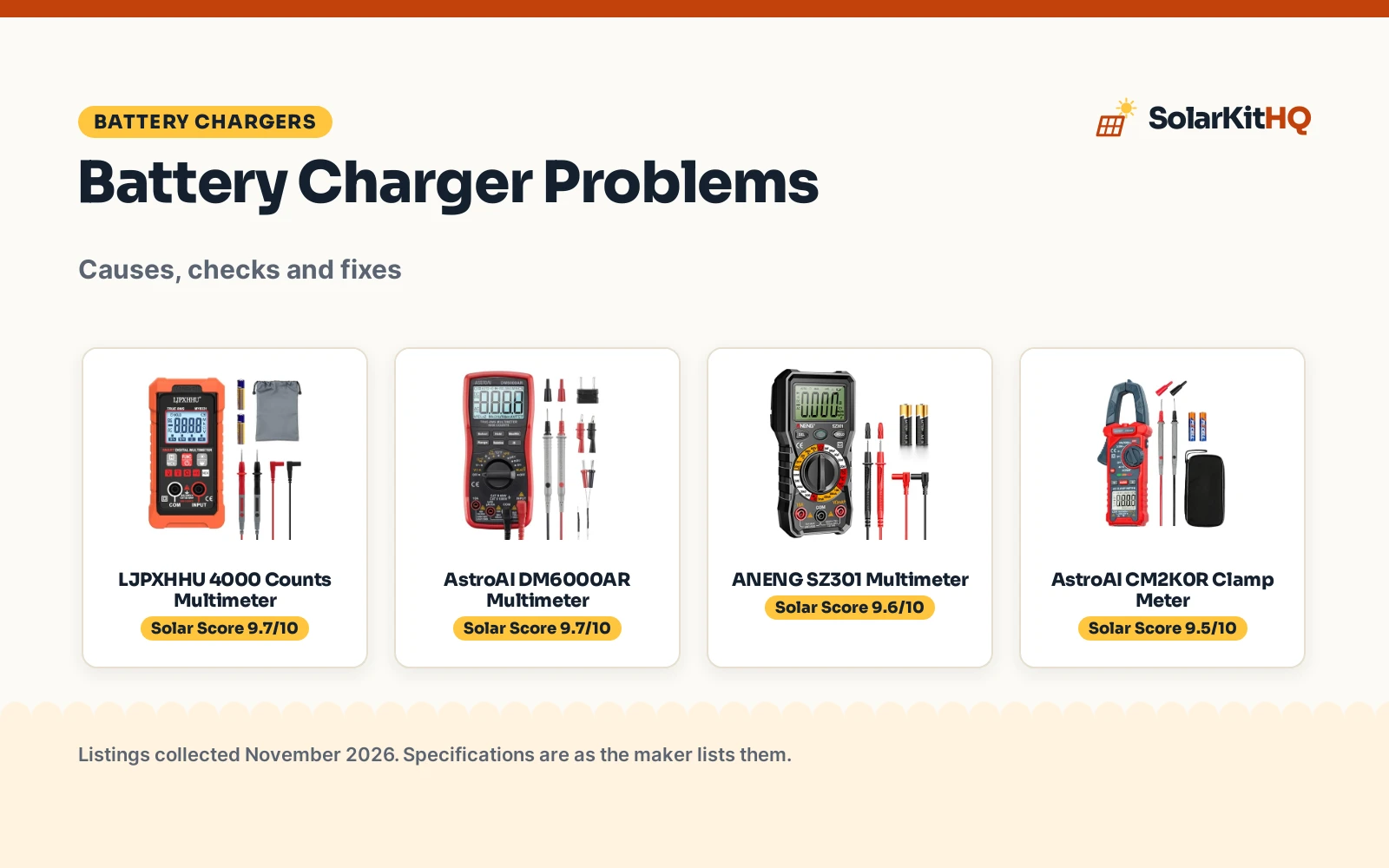
Meters for battery charger problems compared
| Meter | Counts | Voltage range | Current | Amazon |
|---|---|---|---|---|
| LJPXHHU 4000 Counts Multimeter | 4000, True RMS | AC/DC 0.8 to 600V | AC/DC | View on Amazon |
| AstroAI DM6000AR Multimeter | 6000, True RMS | AC/DC | AC/DC | View on Amazon |
| ANENG SZ301 Multimeter | Not stated | DC 200mV to 600V, AC 200mV to 600V | DC and AC 2mA to 10A | View on Amazon |
| AstroAI CM2K0R Clamp Meter | 2000 | AC/DC | AC by clamp, no DC current | View on Amazon |
Counts and ranges separate the meters: the DM6000AR leads at 6000 counts, the LJPXHHU meter (on Amazon) pairs 4000 counts with a 3-year warranty, and the CM2K0R trades counts for a clamp jaw.
Checks that narrow down a charger problem
Check the connection first
Loose clamps and dirty terminals cause more charger problems than dead chargers. Look at the clamp jaws and the terminal posts, and make sure the clamp bites clean metal, not corrosion. If the connection looks poor, clean the contact points and seat the clamp again before blaming the charger. See the battery charger repair guide for common fixes.
Measure the battery voltage
A meter that reads DC voltage covers the check. The LJPXHHU meter reads AC/DC voltage from 0.8 to 600V, the ANENG meter (on Amazon) reads DC voltage from 200mV to 600V, and the AstroAI DM6000AR reads AC/DC voltage with True RMS. A reading far below the voltage the battery is built for points at the battery, while a normal reading points back at the charger.
Check current and continuity
Continuity and current readings show whether the path is open or the charger is delivering. The DM6000AR measures AC/DC current, capacitance, frequency, duty cycle, resistance, diode, continuity and temperature, while the ANENG meter reads current from 2mA to 10A. The CM2K0R clamp reads AC current around one wire, but it cannot measure DC current, so use a probe meter for DC current checks.
Read the safety marks before you buy a meter
The LJPXHHU meter is CE and RoHS certified with leads that carry CAT III/CAT IV safety caps, the CM2K0R passed overvoltage category III 600V and pollution degree 2 standards, and the DM6000AR carries a double ceramic fuse with F600mA/250V and F10A/250V fuse tubes. The ANENG meter states anti-burn double fuses, overload protection and insulated probes.
The gear
Each check above needs a reading, so the 4 meters below cover the voltage, current, continuity and safety checks a charger problem calls for.
| # | Product | Solar Score | Buy |
|---|---|---|---|
| 1 | 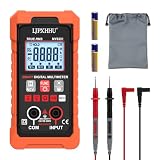 LJPXHHU 4000 Counts Multimeter | 9.7/10 | Buy on Amazon |
| 2 |  AstroAI DM6000AR Multimeter | 9.7/10 | Buy on Amazon |
| 3 | 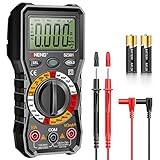 ANENG SZ301 Multimeter | 9.6/10 | Buy on Amazon |
| 4 |  AstroAI CM2K0R Clamp Meter | 9.5/10 | Buy on Amazon |
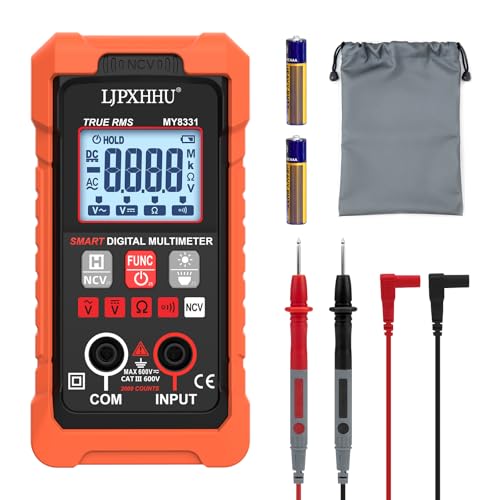
LJPXHHU 4000 Counts Multimeter
A 4000-count auto-range meter that reads AC/DC voltage, resistance, continuity and battery voltage when a charger misbehaves.
Pros
- 4000 counts with True RMS and auto range, so no manual range selection
- Non-contact voltage detection with audible and visual alarms
- CE and RoHS certified, with overload protection and CAT III/CAT IV safety caps
- 3-year warranty, the only warranty term stated in this group
Cons
- Spec table lists size as 12 Volts while the bullets give a 0.8 to 600V range
- No capacitance or frequency measurement is stated
- No clamp jaw is stated, so current is read through the leads
- Auto power-off and low battery warning are listed, but no run time is stated
Detailed Review
The listing states a true RMS 4000-count auto-range meter: AC/DC voltage from 0.8 to 600V, resistance from 4 kΩ to 40 MΩ, continuity and battery measurement, non-contact voltage detection with audible and visual alarms, data hold, a backlit LED display and a flashlight. It states CE and RoHS certification, a removable orange silicone cover, overload protection, leads with CAT III/CAT IV safety caps, a 3-year warranty and 2 AAA batteries. The spec table lists the size as 12 Volts, which does not match the 0.8 to 600V range in the bullets.
Who it's for: car owners and home users who want an auto-range meter with non-contact voltage detection and a 3-year warranty. Who should skip it: owners who need capacitance, frequency or a clamp jaw.
Its Solar Score of 9.7/10 comes from performance 30/35, build 21/25, value 21/25, safety 7/10 and warranty 3/5: 82 of 100 points, placed on our 9.2 to 9.8 scale.
Key Specifications
| Counts | 4000 counts, True RMS |
|---|---|
| Voltage | AC/DC 0.8 to 600V |
| Resistance | 4 kΩ to 40 MΩ |
| Warranty | 3 years |
Taken from the seller's listing on 13 November 2026. Capacity and output figures are rated by the manufacturer.
Safety and Warranty
What this listing states. CE and RoHS certified, with overload protection and CAT III/CAT IV safety caps stated, so safety scores 7 of 10. 3-year warranty stated. It does not say everything a buyer needs, such as who pays return shipping, so warranty scores 3 of 5. See How We Pick.
Match the charger. Use a charger mode that matches your battery's stated chemistry and voltage, connect in the order the manual gives, and keep it ventilated and dry.
This is general buying information, not professional advice. Follow each product manual and local rules, and see our Safety Disclaimer.
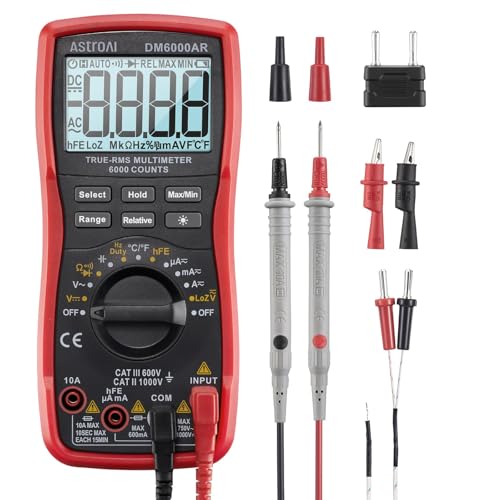
AstroAI DM6000AR Multimeter
A 6000-count True RMS meter that measures AC/DC current, voltage, capacitance, frequency, duty cycle, resistance, diode, continuity and temperature.
Pros
- 6000 counts with True RMS for AC current and voltage
- Measures capacitance, frequency, duty cycle, resistance, diode, continuity and temperature
- Double ceramic fuse with F600mA/250V and F10A/250V fuse tubes
- Data hold, large backlit LCD screen, auto shut-off and kickstand
Cons
- No warranty term is stated
- No non-contact voltage detection is stated
- No carry case is stated
- Temperature measurement is stated, but no temperature range is given
Detailed Review
The listing states a 6000-count True RMS auto-ranging meter that measures AC/DC current, AC/DC voltage, capacitance, frequency, duty cycle, resistance, diode, continuity and temperature. It states a double ceramic fuse with F600mA/250V and F10A/250V fuse tubes. The spec table gives 7.48 by 3.54 by 1.38 inches, while the size field rounds them to 3.54 by 7.48 by 1.38 inches.
Who it's for: automotive and home users who want the widest measurement list. Who should skip it: owners who want a stated warranty or non-contact voltage detection, neither of which the listing gives.
Its Solar Score of 9.7/10 comes from performance 32/35, build 21/25, value 21/25, safety 8/10 and warranty 0/5: 82 of 100 points, placed on our 9.2 to 9.8 scale.
Key Specifications
| Counts | 6000 counts, True RMS |
|---|---|
| Measures | AC/DC current and voltage, capacitance, frequency, duty cycle, resistance, diode, continuity, temperature |
| Fuses | F600mA/250V and F10A/250V ceramic fuse tubes |
| Size | 3.54 x 7.48 x 1.38 inches |
Taken from the seller's listing on 13 November 2026. Capacity and output figures are rated by the manufacturer.
Safety and Warranty
What this listing states. Double ceramic fuse with F600mA/250V and F10A/250V fuse tubes stated, so safety scores 8 of 10. No warranty term, so warranty scores zero. See How We Pick.
Match the charger. Use a charger mode that matches your battery's stated chemistry and voltage, connect in the order the manual gives, and keep it ventilated and dry.
This is general buying information, not professional advice. Follow each product manual and local rules, and see our Safety Disclaimer.

ANENG SZ301 Multimeter
A wide-range meter with a case and leads that reads DC and AC voltage from 200mV to 600V and current from 2mA to 10A.
Pros
- DC and AC voltage from 200mV to 600V, current from 2mA to 10A
- Resistance from 0Ω to 200MΩ and capacitance from 0nF to 2mF
- Silicone protective case, 2 cable leads and 2 pre-installed AA batteries included
- Anti-burn double fuses, overload protection and insulated probes
Cons
- No warranty term is stated
- No count figure is stated
- Bullets tie the voltage range to dehumidifiers, an odd fit for a battery and automotive meter
- No non-contact voltage detection is stated
Detailed Review
The listing states a meter that measures AC/DC voltage, current, resistance, continuity, diode and live wire, with DC and AC voltage from 200mV to 600V, DC and AC current from 2mA to 10A, resistance from 0Ω to 200MΩ and capacitance from 0nF to 2mF. It states anti-burn double fuses, overload protection, insulated probes, a silicone case, 2 cable leads and 2 pre-installed AA batteries of 1.5V. The bullets tie the voltage range to dehumidifiers, which sits oddly beside the automotive and battery uses the listing also names.
Who it's for: hobbyists, students and professionals who want wide ranges with a case and leads. Who should skip it: owners who want a stated count figure, a warranty term or non-contact voltage detection.
Its Solar Score of 9.6/10 comes from performance 28/35, build 20/25, value 21/25, safety 7/10 and warranty 0/5: 76 of 100 points, placed on our 9.2 to 9.8 scale.
Key Specifications
| Voltage | DC 200mV to 600V, AC 200mV to 600V |
|---|---|
| Current | DC and AC 2mA to 10A |
| Resistance | 0Ω to 200MΩ |
| Capacitance | 0nF to 2mF |
Taken from the seller's listing on 13 November 2026. Capacity and output figures are rated by the manufacturer.
Safety and Warranty
What this listing states. Anti-burn double fuses, overload protection and insulated probes stated, so safety scores 7 of 10. No warranty term, so warranty scores zero. See How We Pick.
Match the charger. Use a charger mode that matches your battery's stated chemistry and voltage, connect in the order the manual gives, and keep it ventilated and dry.
This is general buying information, not professional advice. Follow each product manual and local rules, and see our Safety Disclaimer.

AstroAI CM2K0R Clamp Meter
A 2000-count clamp meter that measures AC current by clamping one wire, plus AC/DC voltage, resistance and capacitance.
Pros
- Clamp jaw measures AC current around one wire, with no lead in the circuit
- Non-contact voltage detection with sound and light alarm
- Passed overvoltage category III 600V and pollution degree 2 safety standards
- Data hold, Max/Min, auto shut-off, low battery indicator, continuity buzzer, backlit screen and flashlight
Cons
- Cannot measure DC current
- No warranty term is stated
- 2000 counts, the lowest count figure in this group
- Voltage is read through leads, not by clamping
Detailed Review
The listing states a 2000-count auto-ranging clamp meter that measures AC/DC voltage, AC current, capacitance, resistance, diode continuity and live wire checks, with data hold, Max/Min, auto shut-off and a low battery indicator. It states non-contact voltage detection with a sound and light alarm, and that it passed overvoltage category III 600V and pollution degree 2 standards. It also states the clamp cannot measure DC current and voltage must not be read by clamping. The spec table gives 2.68 by 1.14 by 7.67 inches, and 2 AAA batteries of 1.5V are included.
Who it's for: owners who want to read AC current without breaking the circuit, plus non-contact voltage checks. Who should skip it: owners who need DC current readings.
Its Solar Score of 9.5/10 comes from performance 27/35, build 20/25, value 20/25, safety 7/10 and warranty 0/5: 74 of 100 points, placed on our 9.2 to 9.8 scale.
Key Specifications
| Counts | 2000 counts |
|---|---|
| Current | AC current by clamp; cannot measure DC current |
| Safety | Overvoltage category III 600V, pollution degree 2 |
| Size | 2.68 x 1.14 x 7.67 inches |
Taken from the seller's listing on 13 November 2026. Capacity and output figures are rated by the manufacturer.
Safety and Warranty
What this listing states. Passed overvoltage category III 600V and pollution degree 2 safety standards, so safety scores 7 of 10. No warranty term, so warranty scores zero. See How We Pick.
Match the charger. Use a charger mode that matches your battery's stated chemistry and voltage, connect in the order the manual gives, and keep it ventilated and dry.
This is general buying information, not professional advice. Follow each product manual and local rules, and see our Safety Disclaimer.
As an Amazon Associate I earn from qualifying purchases.
Where the points went
The Solar Score weighs performance, build, value, safety and warranty. For meters, safety means stated certifications, fuses and insulated probes and leads. The LJPXHHU meter states a 3-year warranty, while the other 3 picks state no warranty term. How we pick explains the weights.
How to choose the best meter for battery charger problems
Pick a meter that reads the voltage you need
The LJPXHHU meter reads AC/DC voltage from 0.8 to 600V, the ANENG meter reads DC and AC voltage from 200mV to 600V, and the DM6000AR and the CM2K0R both read AC/DC voltage. See the battery charger types guide for how chargers differ.
Count the measurements you will use
The DM6000AR gives 6000 counts, the LJPXHHU meter gives 4000 counts and the CM2K0R gives 2000 counts, while the ANENG meter states no count figure. The DM6000AR also adds capacitance, frequency, duty cycle and temperature.
Clamp or probes for current
A clamp reads AC current without breaking the circuit: the CM2K0R clamps around one wire, not the whole cord. It cannot measure DC current, so a probe meter like the DM6000AR or the ANENG meter, which read DC current to 10A, covers that check. See the 10 amp vs 12 amp battery charger comparison for charger current and battery size.
Check the warranty and the pack
The LJPXHHU meter states a 3-year warranty and includes leads with CAT III/CAT IV safety caps, instructions and 2 AAA batteries. The ANENG meter includes a silicone protective case, 2 cable leads and 2 pre-installed AA batteries, but states no warranty term. The DM6000AR and the CM2K0R state no warranty term either.
FAQ: power away from the grid
Why is my battery charger flashing red?
A flashing red light is a fault signal, but the listings here do not state what each flash pattern means, so check the manual. Before replacing anything, check the clamp connection and measure the battery voltage: the LJPXHHU meter reads AC/DC voltage from 0.8 to 600V.
Can a clamp meter measure DC current?
Not every clamp can. The AstroAI CM2K0R listing states it cannot measure DC current, and the clamp jaw only measures current, so voltage must not be read by clamping. For DC current, use a probe meter: the ANENG meter reads DC current from 2mA to 10A.
Do I need a True RMS meter for charger work?
True RMS is stated on 2 meters here: the LJPXHHU 4000-count meter and the AstroAI DM6000AR, both stating True RMS applies to AC current and voltage. If your charger work stays on DC battery circuits, a standard meter covers it.
What does CAT III 600V mean on a multimeter?
It is a safety category stated in the listing. The CM2K0R passed overvoltage category III 600V and pollution degree 2 standards, and the LJPXHHU meter includes leads with CAT III/CAT IV safety caps.
Related solar guides
See every Battery Chargers and Maintainers guide and all Batteries and Charging guides.
More picks: best battery charger and maintainer picks, battery charger repair, battery charger types and what to look for in a portable battery charger.