On this page
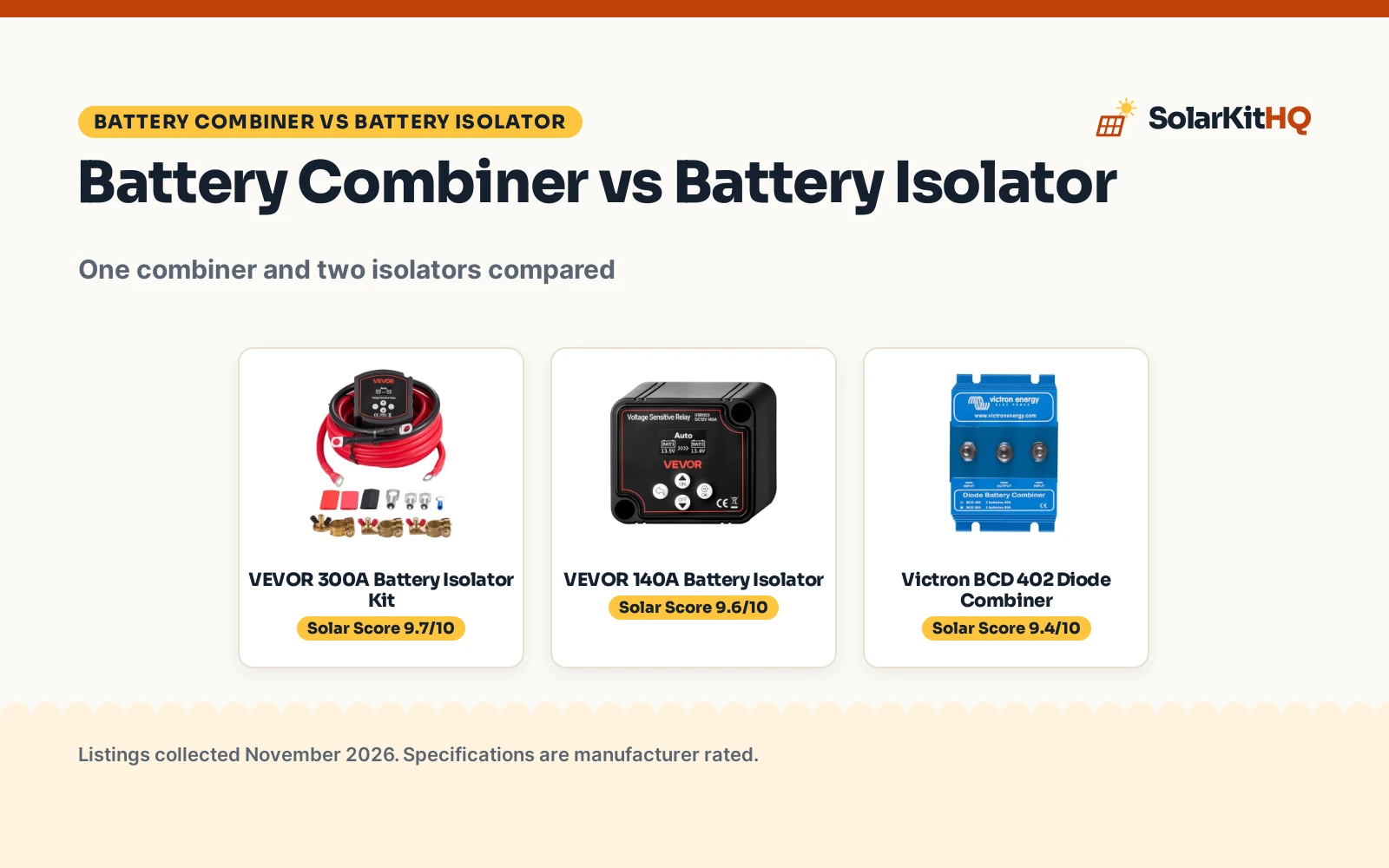
The short answer on battery combiner vs battery isolator: pick the combiner when a diode unit must keep a critical load fed from parallel sources, and pick an isolator when a relay must charge an auxiliary battery and show voltage on a display. We compared a diode combiner against voltage sensitive relay isolators on what each listing states: stated current, display, delay, cables and protection. The isolator listings suit auxiliary battery charging with a screen, while the combiner suits a critical load that must stay fed if a source drops out.
SolarKitHQ earns a commission when you buy through links on this page, at no extra cost to you. As an Amazon Associate I earn from qualifying purchases. Affiliate disclosure.
Battery combiner vs battery isolator: side by side
| Battery combiner vs isolator | Victron BCD 402 Diode Combiner | VEVOR 300A Battery Isolator Kit | VEVOR 140A Battery Isolator | Amazon |
|---|---|---|---|---|
| Side | Battery combiner | Battery isolator | Battery isolator | |
| Rated current | 40 Amp | 300 Amp | 140 Amp | |
| Voltage | Not stated | 12V | 12V | |
| Weight | 0.65 pounds | 7.28 pounds | 0.53 pounds | |
| Display | Not stated | LCD screen, voltmeter, 4.5V-20V | LCD screen, 4.5V-20V | |
| Delay | Not stated | 3-60 seconds | 3-60 seconds | |
| Cable in the box | Not stated | 20 ft 2 AWG red cable, 2 ft ground cable | Not stated | |
| Protection stated | Schottky diodes, low voltage drop | Overvoltage and undervoltage protection | Overvoltage and undervoltage protection |
These specs are rated by the maker and quoted from each listing on 6 November 2026.
Current and cables
The gap in stated current is wide. The Victron combiner is listed at 40 Amp, while the VEVOR isolators are listed at 140 Amp and 300 Amp. Only the 300 Amp kit lists cables in the box: 20 ft of 2 AWG red cable and a 2 ft 2 AWG black ground cable, plus 3 pure copper connectors, 2 heat shrink tubes, 4 cable lugs and 6 zip ties. The 140 Amp listing states no cable, and the Victron listing states no cable either. Size follows the same pattern: the Victron case measures 3.0 by 4.7 by 2.4 inches at 0.65 pounds, the 140 Amp VEVOR measures 3.15 by 2.76 by 2.36 inches at 0.53 pounds, and the 300 Amp kit measures 3.54 by 3.54 by 3.15 inches at 7.28 pounds.
Display, delay and modes
Both VEVOR isolators state a dual voltage display with a range of 4.5V to 20V and an adjustable delay of 3 to 60 seconds, with manual and automatic modes through a voltage sensitive relay. The 300 Amp kit adds a voltmeter and an LCD screen, and the 140 Amp listing states an LCD screen. In manual mode, a charged auxiliary battery can reverse-charge a depleted main battery, per both VEVOR listings, with no jumper cables needed. The Victron combiner states no display, no delay and no modes: it is a diode unit, and the listing describes parallel sources feeding a load rather than a relay switching between batteries.
Protection and mounting
Both VEVOR isolators state overvoltage and undervoltage protection, and both describe the unit as sturdy, durable, shockproof and dustproof. The Victron combiner states Schottky diodes with a low voltage drop, and warns of a hot surface with mounting on a non-flammable surface only. Neither VEVOR listing states a hot surface warning, and the Victron listing states no overvoltage or undervoltage protection. Mounting hardware is stated only for the 300 Amp kit, which lists mounting screws in the box.
What the listings leave unclear
The Victron listing mixes names: the title and model say BCD 402 while the bullets call the unit an Argo combiner. No listing here states a warranty term, so the warranty line of the score stays empty for all three. The Victron listing states no voltage, so its side of a voltage comparison stays blank. The 140 Amp listing states no cable and no package contents, so what arrives in its box is unstated. The 300 Amp kit is the only listing that spells out its package contents in full.
Three examples
| # | Product | Solar Score | Buy |
|---|---|---|---|
| 1 |  VEVOR 300A Battery Isolator Kit | 9.7/10 | Buy on Amazon |
| 2 |  VEVOR 140A Battery Isolator | 9.6/10 | Buy on Amazon |
| 3 |  Victron BCD 402 Diode Combiner | 9.4/10 | Buy on Amazon |
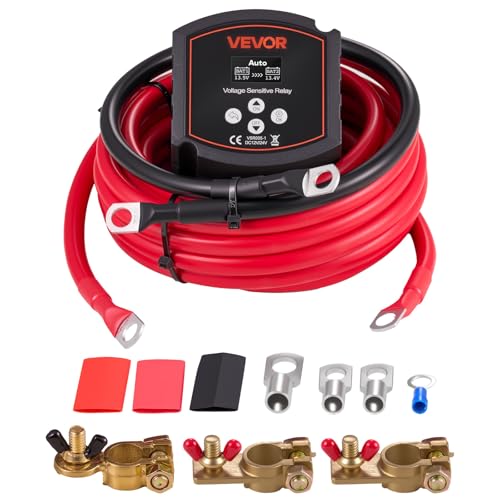
VEVOR 300A Battery Isolator Kit
A 12V 300 Amp dual battery isolator kit with a voltage sensitive relay, voltmeter and LCD screen, plus 20 ft of 2 AWG red cable and a 2 ft ground cable.
Pros
- 300 Amp figure, the highest current stated in this group
- Manual and automatic modes with a voltage sensitive relay stated
- Dual voltage display with a 4.5V-20V range and an LCD screen stated
- Kit includes 20 ft of 2 AWG red cable, a 2 ft ground cable, 3 copper connectors, 4 cable lugs and 6 zip ties
Cons
- 7.28 pounds, the heaviest listing here
- 3.54 by 3.54 by 3.15 inches, the largest case in this group
- No warranty term is stated
- Voltage display covers 4.5V to 20V only
Detailed Review
The listing states a 12V 300 Amp dual battery isolator kit with a voltage sensitive relay, manual and automatic modes, an adjustable delay of 3 to 60 seconds, a dual voltage display with a range of 4.5V to 20V, overvoltage and undervoltage protection, and compatibility with lithium and lead-acid batteries. The kit includes a 300 Amp isolator with mounting screws, 20 ft of 2 AWG red cable, a 2 ft 2 AWG black ground cable, 3 pure copper connectors, 2 heat shrink tubes, 4 cable lugs and 6 zip ties. The isolator case measures 3.54 by 3.54 by 3.15 inches and weighs 7.28 pounds. No warranty term is stated.
Who it's for: UTV, RV, truck, boat and off-grid owners who want the highest stated current here and a complete cable kit in the box. Who should skip it: anyone who wants a lighter unit or a smaller case.
Its Solar Score of 9.7/10 comes from performance 32/35, build 21/25, value 21/25, safety 8/10 and warranty 0/5: 82 of 100 points, placed on our 9.2 to 9.8 scale.
Key Specifications
| Current | 300 Amp, 12V |
|---|---|
| Display | LCD screen, voltmeter, 4.5V-20V |
| Delay | 3-60 seconds |
| Cable | 20 ft 2 AWG red, 2 ft ground |
Figures as published on the retailer listing, collected 6 November 2026. Performance figures are manufacturer rated.
Safety and Warranty
What this listing states. Overvoltage and undervoltage protection stated; sturdy, durable, shockproof and dustproof, so safety scores 8 of 10. No warranty term, so warranty scores zero. See How We Pick.
Match the charger. Use a charger mode that matches your battery's stated chemistry and voltage, connect in the order the manual gives, and keep it ventilated and dry.
This is general buying information, not professional advice. Follow each product manual and local rules, and see our Safety Disclaimer.

VEVOR 140A Battery Isolator
A 12V 140 Amp dual battery isolator with a voltage sensitive relay, manual and automatic modes, an LCD screen and a dual voltage display.
Pros
- 140 Amp figure with manual and automatic modes stated
- Dual voltage display with a 4.5V-20V range and an LCD screen stated
- Adjustable delay of 3-60 seconds stated
- 0.53 pounds, the lowest weight stated here
Cons
- No cable is stated in the listing
- No warranty term is stated
- 140 Amp figure sits below the 300 Amp kit in this group
- Voltage display covers 4.5V to 20V only
Detailed Review
The listing states a 12V 140 Amp dual battery isolator with a voltage sensitive relay, manual and automatic modes, an adjustable delay of 3 to 60 seconds, a dual voltage display with a range of 4.5V to 20V, overvoltage and undervoltage protection, and compatibility with lithium and lead-acid batteries. The case measures 3.15 by 2.76 by 2.36 inches and weighs 0.53 pounds. No warranty term is stated, and no cable is stated in the listing.
Who it's for: car, truck, RV, UTV, ATV and boat owners who want the same display and modes as the 300 Amp kit in a lighter unit. Who should skip it: anyone who needs the 300 Amp figure or a cable kit in the box.
Its Solar Score of 9.6/10 comes from performance 29/35, build 20/25, value 21/25, safety 8/10 and warranty 0/5: 78 of 100 points, placed on our 9.2 to 9.8 scale.
Key Specifications
| Current | 140 Amp, 12V |
|---|---|
| Display | LCD screen, 4.5V-20V |
| Delay | 3-60 seconds |
| Weight | 0.53 pounds |
Figures as published on the retailer listing, collected 6 November 2026. Performance figures are manufacturer rated.
Safety and Warranty
What this listing states. Overvoltage and undervoltage protection stated; sturdy, durable, shockproof and dustproof, so safety scores 8 of 10. No warranty term, so warranty scores zero. See How We Pick.
Match the charger. Use a charger mode that matches your battery's stated chemistry and voltage, connect in the order the manual gives, and keep it ventilated and dry.
This is general buying information, not professional advice. Follow each product manual and local rules, and see our Safety Disclaimer.

Victron BCD 402 Diode Combiner
A 40 Amp diode battery combiner with Schottky diodes, a low voltage drop and a 0.65 pound case.
Pros
- Schottky diodes with a low voltage drop stated
- Failure of one source will not interrupt power to the critical load, per the listing
- 0.65 pounds in a 3.0 by 4.7 by 2.4 inch case
- Combines two or more DC power sources in parallel
Cons
- 40 Amp figure, the lowest current stated here
- Bullets call it an Argo combiner while the title says BCD 402
- Hot surface warning: mount on a non-flammable surface only
- No warranty term is stated
Detailed Review
The listing states a Victron Energy BCD 402 40 Amp diode battery combiner that combines two or more DC power sources in parallel to supply a mission critical load, so failure of one source will not interrupt power to that load. It states Schottky diodes with a low voltage drop, a blue case of 3.0 by 4.7 by 2.4 inches and a weight of 0.65 pounds. The bullets call the unit an Argo combiner while the title and model say BCD 402, and the listing warns of a hot surface and says to mount it on a non-flammable surface only. No voltage and no warranty term are stated.
Who it's for: owners of mission critical DC equipment who want a diode combiner that keeps power flowing if one source fails. Who should skip it: anyone who needs a higher stated current or a voltage display.
Its Solar Score of 9.4/10 comes from performance 26/35, build 19/25, value 18/25, safety 6/10 and warranty 0/5: 69 of 100 points, placed on our 9.2 to 9.8 scale.
Key Specifications
| Current | 40 Amp |
|---|---|
| Diodes | Schottky, low voltage drop |
| Size | 3.0 x 4.7 x 2.4 in |
| Weight | 0.65 pounds |
Figures as published on the retailer listing, collected 6 November 2026. Performance figures are manufacturer rated.
Safety and Warranty
What this listing states. Schottky diodes with low voltage drop; failure of one source will not interrupt power to the critical load; hot surface warning, mount on non-flammable surface only, so safety scores 6 of 10. No warranty term, so warranty scores zero. See How We Pick.
Match the charger. Use a charger mode that matches your battery's stated chemistry and voltage, connect in the order the manual gives, and keep it ventilated and dry.
This is general buying information, not professional advice. Follow each product manual and local rules, and see our Safety Disclaimer.
As an Amazon Associate I earn from qualifying purchases.
Where the points went
The Solar Score weighs performance, build, value, safety and warranty. For combiners and isolators, safety means protection the listing names, such as overvoltage and undervoltage protection, or diode and mounting warnings. Both VEVOR isolators state overvoltage and undervoltage protection, and the Victron states diode and mounting details. None of the three state a warranty term. How we pick explains the weights.
| Product | Solar Score | Perf. /35 | Build /25 | Value /25 | Safety /10 | Warranty /5 |
|---|---|---|---|---|---|---|
| VEVOR 300A Battery Isolator Kit | 9.7 | 32 | 21 | 21 | 8 | 0 |
| VEVOR 140A Battery Isolator | 9.6 | 29 | 20 | 21 | 8 | 0 |
| Victron BCD 402 Diode Combiner | 9.4 | 26 | 19 | 18 | 6 | 0 |
Every total is translated into a figure between 9.2 and 9.8 with a linear formula; ranking by points and ranking by score always agree.
Battery combiner vs battery isolator: which should you choose?
Choose the combiner side, and the Victron example, if a critical load must stay fed from parallel sources and a diode unit with a low voltage drop fits the setup. Choose the isolator side if an auxiliary battery needs charging with a screen showing voltage: the 300 Amp kit suits owners who want the highest stated current and cables in the box, while the 140 Amp unit suits owners who want the same display and modes in the case with the lowest weight stated here. A relay isolator and a diode combiner do different jobs, so match the device to the job, not to the other side.
| If you need | Look at |
|---|---|
| Highest stated current | VEVOR 300A Battery Isolator Kit, 300 Amp |
| Lowest weight stated | VEVOR 140A Battery Isolator, 0.53 pounds |
| A diode combiner for a critical load | Victron BCD 402 Diode Combiner |
| Cables in the box | VEVOR 300A Battery Isolator Kit, 20 ft 2 AWG red cable |
Sizing Notes
- Match the stated current to the charging setup: 40 Amp on the Victron combiner, 140 Amp and 300 Amp on the VEVOR isolators.
- Match the cable to the kit: the 300 Amp kit lists 2 AWG cable in the box, and the other listings state no cable.
- Check the display range: both VEVOR isolators show voltage from 4.5V to 20V.
- Mount the Victron combiner on a non-flammable surface, per its hot surface warning.
- Fuse the positive lead as the manual directs.
FAQ: power away from the grid
What is the difference between a battery combiner and a battery isolator?
A combiner joins DC power sources in parallel to feed a load, while an isolator charges an auxiliary battery through a relay and keeps the main battery apart. In this group, the Victron combiner feeds a critical load from parallel sources, and the VEVOR isolators charge an auxiliary battery with a voltage sensitive relay.
Can these isolators charge a lithium auxiliary battery?
Yes, per the listings. Both VEVOR isolators state compatibility with lithium and lead-acid batteries, and the 300 Amp kit title names lithium batteries.
Which isolator here has the higher stated current?
The 300 Amp kit at 300 Amp, against 140 Amp on the other VEVOR isolator. The kit also lists 20 ft of 2 AWG red cable and a 2 ft ground cable in the box.
Do the VEVOR isolators show battery voltage?
Yes. Both state a dual voltage display with a range of 4.5V to 20V, and the 300 Amp kit adds a voltmeter and an LCD screen.
Does the Victron combiner need a special mounting surface?
Yes. The listing warns of a hot surface and says to mount the combiner on a non-flammable surface only.
Related solar guides
See every Battery Monitors and Accessories guide and all Batteries and Charging guides. Also see our best dual battery isolator, battery isolator vs solenoid, battery selector switch vs battery isolator, single vs dual battery isolator, best battery isolator and best battery cut off switch.