On this page
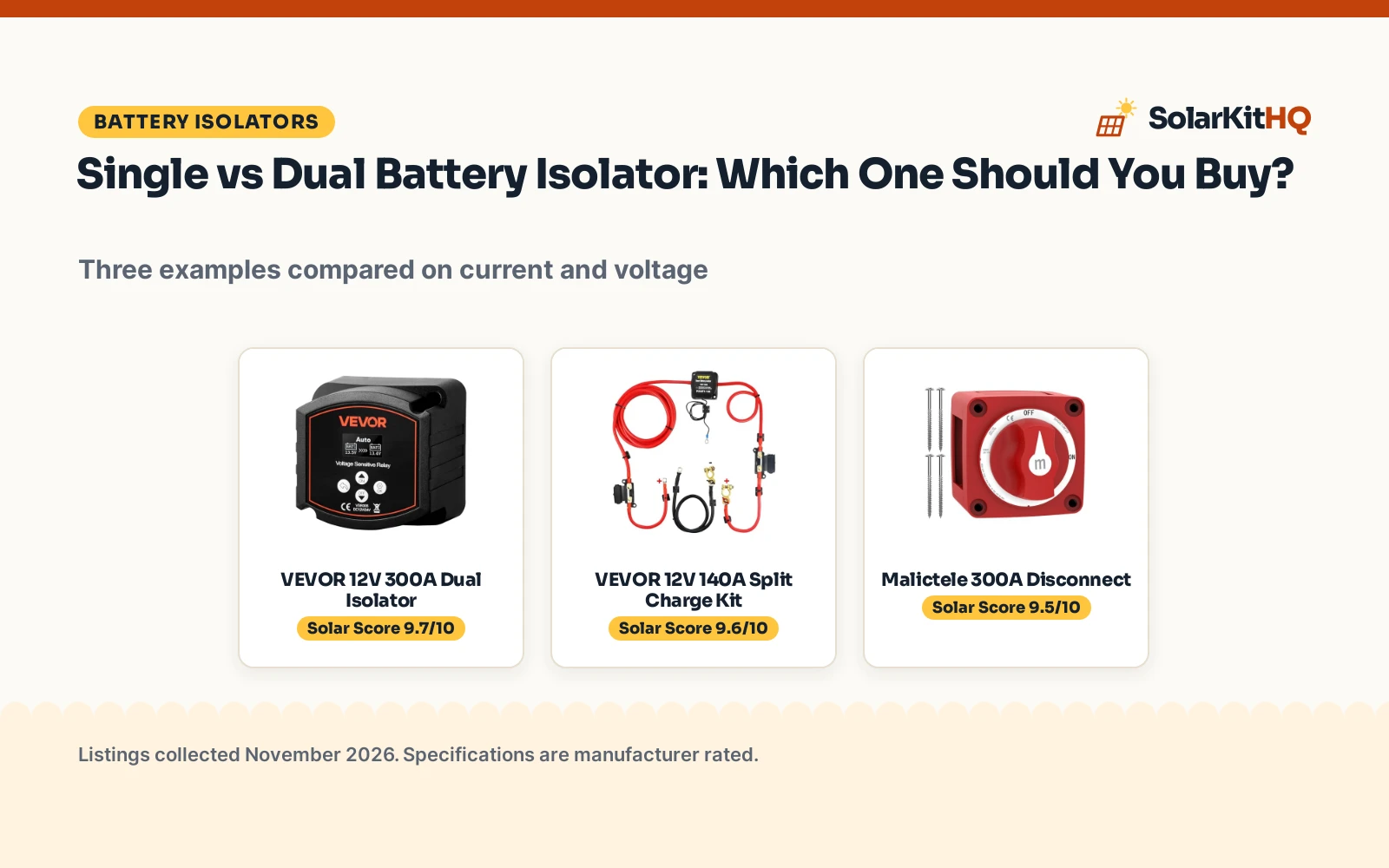
A campsite at dusk with a dead phone and a starter battery too flat to turn the engine is where single vs dual battery isolator stops being theory. The short answer: pick the dual side when a second battery must charge from the alternator and stay apart from the starter battery, and pick the single side when one battery only needs a firm cutoff. This comparison uses three listings as examples: two dual isolators and one single-circuit disconnect switch.
SolarKitHQ earns a commission when you buy through links on this page, at no extra cost to you. As an Amazon Associate I earn from qualifying purchases. Affiliate disclosure.
Single vs dual: side by side
| Single vs Dual Battery Isolator | VEVOR 12V 300A Dual Isolator | VEVOR 12V 140A Split Charge Kit | Malictele 300A Disconnect | Amazon |
|---|---|---|---|---|
| Side | Dual battery isolator | Dual battery isolator | Single circuit switch | |
| Current | 300A | 140A | 300A | |
| Voltage | 12V, display 4.5V to 20V | 12V | 12V to 48V | |
| Switching | Manual and automatic modes | Cuts in at 13.3V, out at 12.8V | ON/OFF knob | |
| Protection stated | Overvoltage and undervoltage protection | IP65, shockproof and dustproof | Ignition-protected design | |
| Display | LCD screen | Not stated | Not stated | |
| Cable | Not stated | 6m cable included | Not stated |
We copied each rating from the seller’s listing as the brand states it; data date 6 November 2026.
Current and voltage
The two dual examples and the single example split on current in a way that surprises no one who reads the listings. The VEVOR 300A example states 300A. The VEVOR 140A example states 140A. The Malictele example states 300A continuous. Voltage splits the same way. The VEVOR 300A example states 12V with a display range of 4.5V to 20V. The VEVOR 140A example states 12V. The Malictele example states 12V to 48V, the widest voltage span in this group.
What each side actually does
A dual isolator charges a second battery and keeps it apart from the starter battery. The VEVOR 140A example states that it can charge two batteries at once and isolate them from each other when the vehicle is turned off, cutting in at 13.3 volts and cutting out at 12.8 volts. The VEVOR 300A example states manual and automatic modes, with a one-click switch to manual mode that lets a charged auxiliary battery reverse-charge a depleted main battery. The single side works differently. The Malictele example is a single-circuit ON/OFF switch that connects one battery to a single load group, with a knob and a make-before-break contact design.
Protection and housing
Protection is where the listings give the fullest picture. The VEVOR 300A example states overvoltage and undervoltage protection, and describes its housing as sturdy, shockproof and dustproof. The VEVOR 140A example states IP65 protection, with a plastic housing described as shockproof and dustproof. The Malictele example states an ignition-protected design for gasoline-powered boats, an ABS plastic housing and tinned copper studs.
What the listings leave unclear
Three gaps matter. The Malictele bullets mention switching between battery banks without interrupting the power supply, while the title and the first bullet describe a single-circuit switch for one battery and one load group, so the bank-switching line does not fit the single-circuit description. None of the three examples states a warranty term. The VEVOR 140A example is the only one that states an IP code. The VEVOR 300A example is the only one that states a display, so a buyer who wants both has no single listing here that states both.
Three examples
| # | Product | Solar Score | Buy |
|---|---|---|---|
| 1 |  VEVOR 12V 300A Dual Isolator | 9.7/10 | Buy on Amazon |
| 2 |  VEVOR 12V 140A Split Charge Kit | 9.6/10 | Buy on Amazon |
| 3 |  Malictele 300A Disconnect | 9.5/10 | Buy on Amazon |

VEVOR 12V 300A Dual Isolator
A 12V 300A dual battery isolator with manual and automatic modes, an LCD screen showing both battery voltages, and overvoltage and undervoltage protection.
Pros
- 300A current with manual and automatic modes stated
- LCD screen shows both battery voltages, with a stated display range of 4.5V to 20V
- Adjustable delay of 3 to 60 seconds stated to avoid frequent switching
- Compatible with lithium and lead-acid batteries, per the listing
Cons
- No warranty term is stated
- No cable is included in the listing
- No IP code is stated
- Reverse charging needs a switch to manual mode
Detailed Review
The listing states a 12V 300A dual battery isolator with manual and automatic modes, an LCD screen showing both battery voltages in real time across a stated 4.5V to 20V display range, an adjustable delay of 3 to 60 seconds, compatibility with lithium and lead-acid batteries, and overvoltage and undervoltage protection. The housing is described as sturdy, shockproof and dustproof, and the stated size is 3.54 by 3.54 by 3.15 inches at 0.93 pounds.
Who it's for: RV, truck, boat and off-grid owners who want a dual-battery isolator with a display and manual control. Who should skip it: anyone who needs a stated warranty term or a stated IP code, since the listing gives neither.
Its Solar Score of 9.7/10 comes from performance 32/35, build 21/25, value 21/25, safety 8/10 and warranty 0/5: 82 of 100 points, placed on our 9.2 to 9.8 scale.
Key Specifications
| Current | 300A |
|---|---|
| Voltage | 12V, display 4.5V to 20V |
| Delay | 3 to 60 seconds |
| Size | 3.54 x 3.54 x 3.15 in |
Figures as published on the retailer listing, collected 6 November 2026. Performance figures are manufacturer rated.
Safety and Warranty
What this listing states. Overvoltage and undervoltage protection stated, shockproof and dustproof housing, so safety scores 8 of 10. No warranty term, so warranty scores zero. See How We Pick.
Match the charger. Use a charger mode that matches your battery's stated chemistry and voltage, connect in the order the manual gives, and keep it ventilated and dry.
This is general buying information, not professional advice. Follow each product manual and local rules, and see our Safety Disclaimer.

VEVOR 12V 140A Split Charge Kit
A 12V 140A dual battery isolator kit with a voltage sense relay, a 6m cable, and IP65 protection.
Pros
- Cuts in at 13.3 volts and cuts out at 12.8 volts, per the listing
- Charges two batteries at once and isolates them when the vehicle is off
- 6m cable and accessories included, per the listing
- IP65 protection stated for dusty and wet conditions
Cons
- No warranty term is stated
- No manual mode is stated
- No voltage display is stated
- 140A current is below the 300A figures of the other two examples
Detailed Review
The listing states a 12V 140A split charge relay kit with a voltage sense relay, a 6m cable, cut-in at 13.3 volts and cut-out at 12.8 volts, and IP65 protection. The housing is plastic, described as shockproof and dustproof, and the stated size is 2.66 by 2.11 by 2.66 inches. The kit states complete accessories and detailed instructions.
Who it's for: camper van, RV, caravan and boat owners who want voltage-based switching with a cable in the kit. Who should skip it: anyone who wants a display, a manual mode, or a higher stated current than 140A.
Its Solar Score of 9.6/10 comes from performance 29/35, build 21/25, value 21/25, safety 8/10 and warranty 0/5: 79 of 100 points, placed on our 9.2 to 9.8 scale.
Key Specifications
| Current | 140A |
|---|---|
| Cut-in / cut-out | 13.3V / 12.8V |
| Cable | 6m |
| Size | 2.66 x 2.11 x 2.66 in |
Figures as published on the retailer listing, collected 6 November 2026. Performance figures are manufacturer rated.
Safety and Warranty
What this listing states. IP65 protection stated, shockproof and dustproof housing, so safety scores 8 of 10. No warranty term, so warranty scores zero. See How We Pick.
Match the charger. Use a charger mode that matches your battery's stated chemistry and voltage, connect in the order the manual gives, and keep it ventilated and dry.
This is general buying information, not professional advice. Follow each product manual and local rules, and see our Safety Disclaimer.

Malictele 300A Disconnect
A 300A single-circuit battery disconnect switch for 12V to 48V systems, with an ignition-protected design and tinned copper studs.
Pros
- 300A continuous figure across a 12V to 48V span
- Ignition-protected design stated for gasoline-powered boats
- ABS plastic housing with tinned copper studs
- Surface, front panel, or rear panel mounting stated
Cons
- Single circuit only: one battery to one load group, not two batteries
- No automatic charging or voltage sensing is stated
- No warranty term is stated
- No IP code is stated
Detailed Review
The listing states a 300A single-circuit battery disconnect switch for 12V to 48V systems, with an ON/OFF knob, an ABS plastic housing, tinned copper studs, an ignition-protected design and 4 screws. The bullets mention switching between battery banks without interrupting the power supply, while the title and the first bullet describe a single-circuit switch for one battery and one load group, so read it as a single-circuit cutoff, not a dual-battery manager.
Who it's for: boat, RV, truck and ATV owners who want a knob that cuts one battery off. Who should skip it: anyone who needs two batteries charged and kept apart, since this switch connects one battery to one load group.
Its Solar Score of 9.5/10 comes from performance 26/35, build 20/25, value 19/25, safety 7/10 and warranty 0/5: 72 of 100 points, placed on our 9.2 to 9.8 scale.
Key Specifications
| Current | 300A continuous |
|---|---|
| Voltage | 12V to 48V |
| Housing | ABS plastic, tinned copper studs |
| Mounting | Surface, front panel, or rear panel |
Figures as published on the retailer listing, collected 6 November 2026. Performance figures are manufacturer rated.
Safety and Warranty
What this listing states. Ignition-protected design stated, ABS plastic housing, tinned copper studs, so safety scores 7 of 10. No warranty term, so warranty scores zero. See How We Pick.
Match the charger. Use a charger mode that matches your battery's stated chemistry and voltage, connect in the order the manual gives, and keep it ventilated and dry.
This is general buying information, not professional advice. Follow each product manual and local rules, and see our Safety Disclaimer.
As an Amazon Associate I earn from qualifying purchases.
Where the points went
The Solar Score weighs performance, build, value, safety and warranty. For battery isolators, safety means stated protection such as overvoltage and undervoltage protection, an IP code, or an ignition-protected design. All three examples state a safety feature. None of the three states a warranty term. How we pick explains the weights.
| Product | Solar Score | Perf. /35 | Build /25 | Value /25 | Safety /10 | Warranty /5 |
|---|---|---|---|---|---|---|
| VEVOR 12V 300A Dual Isolator | 9.7 | 32 | 21 | 21 | 8 | 0 |
| VEVOR 12V 140A Split Charge Kit | 9.6 | 29 | 21 | 21 | 8 | 0 |
| Malictele 300A Disconnect | 9.5 | 26 | 20 | 19 | 7 | 0 |
We place weighted points on a scale whose ends are 9.2 and 9.8. Because the mapping is straight, a unit with more points never shows less.
How to choose the best single vs dual battery isolator
Start from the job, not the label. A second battery that must charge while driving and sit apart when parked needs the dual side. A single battery that must be cut off cleanly needs the single side. The three examples below show how the stated figures sort that choice.
Pick dual when a second battery must charge and stay separate
Dual isolators exist for one job: charge the auxiliary battery from the same charging source, then keep it apart from the starter battery when the vehicle is off. The VEVOR 140A example states that job plainly, with cut-in at 13.3 volts and cut-out at 12.8 volts. The VEVOR 300A example adds manual and automatic modes and a display that shows both battery voltages. For background on the wider choice, see the battery isolator vs solenoid guide.
Pick single when one battery needs a simple cutoff
A single-circuit switch suits a boat or RV where one battery feeds one load group and the owner wants a knob that cuts it off. The Malictele example states exactly that shape: one battery, one load group, a 300A continuous figure and a 12V to 48V span. It states no automatic charging and no voltage sensing, so it does not manage a second battery. Compare it with the best dual battery isolator picks when the job grows to two batteries.
Match current and voltage to the system
Current and voltage decide fit before any other figure. The VEVOR 300A example states 300A. The VEVOR 140A example states 140A. The Malictele example states 300A continuous across 12V to 48V. Check the stated voltage span against the system voltage, and check the stated current against the charging source, then confirm the mounting space from the stated dimensions.
| If you need | Look at |
|---|---|
| Charge a second battery and keep it apart | VEVOR 12V 300A Dual Isolator, 300A |
| See both battery voltages at a glance | VEVOR 12V 300A Dual Isolator, LCD screen |
| Voltage switching with a cable in the kit | VEVOR 12V 140A Split Charge Kit, 6m cable |
| Cut one battery off with a knob | Malictele 300A Disconnect, 12V to 48V |
Sizing Notes
- Match the isolator voltage to the system voltage: the VEVOR examples state 12V, and the Malictele example states 12V to 48V.
- Match the stated current to the charging source: 300A on the VEVOR 300A example and the Malictele example, 140A on the VEVOR 140A example.
- Check the stated size before mounting: the VEVOR 140A example lists 2.66 by 2.11 by 2.66 inches, and the VEVOR 300A example lists 3.54 by 3.54 by 3.15 inches.
- Fuse the positive lead as the manual directs, and leave changes to the vehicle wiring to a qualified technician.
FAQ: power away from the grid
What does a dual battery isolator do?
A dual battery isolator charges a second battery and keeps it apart from the starter battery. The VEVOR 140A example states that it charges two batteries at once and isolates them from each other when the vehicle is turned off.
How is a single battery isolator different?
A single-circuit switch connects one battery to one load group and cuts it off with a knob. The Malictele example states that shape, with a 300A continuous figure and a 12V to 48V span.
Which example shows both battery voltages?
The VEVOR 300A example. Its LCD screen shows both battery voltages, with a stated display range of 4.5V to 20V.
Do any of these examples state a warranty?
No. None of the three examples states a warranty term.
What current figures do the examples state?
The VEVOR 300A example states 300A. The VEVOR 140A example states 140A. The Malictele example states 300A continuous.
Related solar guides
See every Batteries and Charging guide and all Battery Monitors and Accessories guides.
More picks: best battery combiner box, best battery cut off switch, best battery selector switch, rv battery vs marine battery.