On this page
The benefits of attic fan use come from moving hot air out of the attic before it builds up under the roof, which keeps the space above the living rooms cooler through the hot part of the day. A fan pulls cooler air in through vents while it pushes hot, stale air out, and a solar panel can run it without a cord to the house. The steps below explain what the fan moves, how the thermostat and power choices work, and which figures to match to the attic.
SolarKitHQ earns a commission when you buy through links on this page, at no extra cost to you. As an Amazon Associate I earn from qualifying purchases. Affiliate disclosure.
Benefits of attic fan: the quick answer
An attic fan vents the attic: it draws air in through intake vents and exhausts hot air out, which lowers the temperature under the roof and clears stale, humid air. Solar models run from a panel on the roof, and many listings add an AC adapter or battery so the fan keeps running after sunset or on cloudy days. A thermostat starts the fan when the attic reaches a set temperature and stops it when the air cools, so the fan runs only when the attic needs it.
Step 1: What the fan moves
Airflow is the first figure to read, stated in CFM. The reference listings span a wide range: the Hon&Guan 25W example moves up to 320 CFM, the HONGUAN 34W example moves up to 1200 CFM, the RYLENE example moves up to 1600 CFM, the PEAKROCK example moves 2000 CFM, and the VEVOR 50W (on Amazon) example moves up to 3000 CFM. Coverage follows the same spread: the Hon&Guan 25W example covers up to 1300 sq ft, the HONGUAN 34W and BINGLUX examples cover up to 1800 sq ft, the Amtrak example covers up to 2,250 sq ft, the RYLENE example covers up to 2500 sq ft, and the PEAKROCK example covers up to 2,800 sq ft. Match the CFM and coverage figures to the attic, and read them as the maker states them.
| Fan example | Panel watts | Airflow | Coverage |
|---|---|---|---|
| Hon&Guan 25W | 25W | Up to 320 CFM | Up to 1300 sq ft |
| HONGUAN 34W | 34W | Up to 1200 CFM | Up to 1800 sq ft |
| RYLENE 35W | 35W | Up to 1600 CFM | Up to 2500 sq ft |
| PEAKROCK 30W | 30W | 2000 CFM | Up to 2,800 sq ft |
| VEVOR 50W | 50W | Up to 3000 CFM | Not stated |
| Quietcool 50W | 50W | Up to 1119 CFM | Not stated |
| Amtrak 100W | 100W | Up to 2000 CFM | Up to 2,250 sq ft |
Step 2: How the thermostat decides when it runs
A thermostat turns the fan on when the attic reaches the set temperature and off when it cools. The Hon&Guan 25W and HONGUAN 34W examples state an adjustable range of 68 to 113 degrees Fahrenheit. The RYLENE example turns on when the indoor temperature exceeds 26 degrees Celsius and turns off when it falls below 24 degrees Celsius. The BINGLUX example auto-starts at 77 degrees Fahrenheit, and the Quietcool 25W example states an adjustable thermostat from 50 to 120 degrees Fahrenheit. Set the thermostat to the temperature the listing states, and let the probe do the switching.
Step 3: Solar power, AC backup, and night running
Solar panels run the fan by day, and an AC adapter or battery keeps it going after dark. The VEVOR 50W example switches from solar to electrical power at sunset, and the RYLENE example switches from solar to AC power the same way. The Hon&Guan 25W (on Amazon) example adds an AC adapter for 24/7 running, and the Quietcool 50W (on Amazon) example supplements solar energy with AC power for daytime and nighttime use. The Ereto example carries a 12V 4000mAh battery in its control box, and the Quietcool 25W example includes an AC/DC inverter for 24/7 runtime. A remote control turns some fans off from a distance: the VEVOR example lists up to 32 feet, the BINGLUX example lists a 65-foot range, and the RYLENE example lists up to 30 metres.
Step 4: Panel size, speeds, and noise
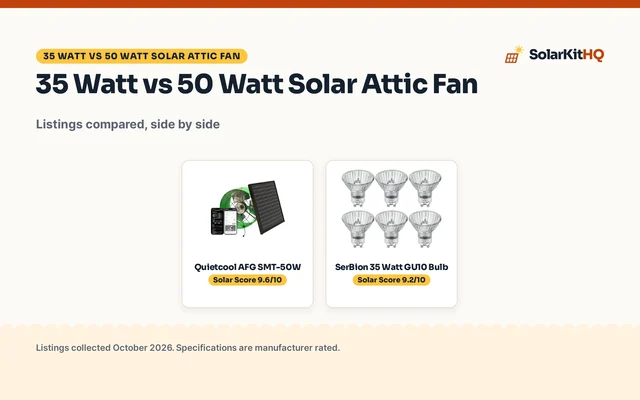
Panel watts track with airflow in these listings: the Ereto example uses a 15W panel, the Hon&Guan 25W and BINGLUX examples use 25W panels, the PEAKROCK example uses a 30W panel, the HONGUAN example uses a 34W panel, the RYLENE example uses a 35-watt panel, and the VEVOR and Quietcool examples use 50-watt panels, while the Amtrak example uses a 100-watt panel. Speeds vary too: the Hon&Guan 25W example offers 4 speeds, the BINGLUX example offers 6 speeds, and the Ereto remote (on Amazon) offers 1 to 6 fan speed settings. Noise is stated as a figure on some listings: the PEAKROCK example lists 45 dB, and the BINGLUX example states below 45dB. Match panel watts, speeds, and the noise figure to the attic and the rooms below it. See the 35 watt vs 50 watt solar attic fan comparison for the two most common panel sizes.
What to match before you buy
- Coverage: match the maker’s stated square feet to the attic, from 1300 sq ft on the smallest example to 2,800 sq ft on the largest.
- Airflow: match CFM to the attic size, from 320 CFM to 3000 CFM in these listings.
- Thermostat: check the stated temperature range, such as 68 to 113 degrees Fahrenheit, and the auto-start temperature.
- Power: check whether the fan runs on solar alone or adds an AC adapter or battery for night running.
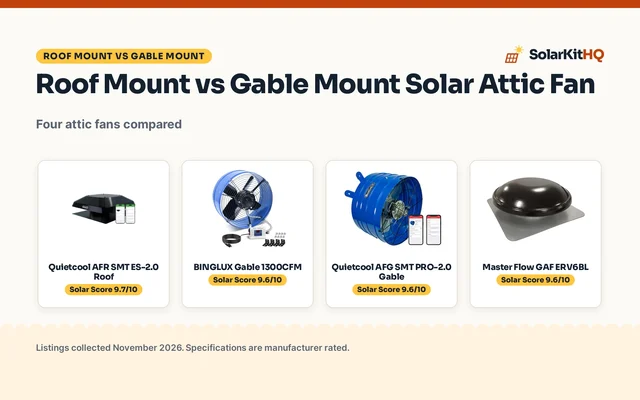
- Roof fit: check the stated roof types, such as metal, masonry, asphalt shingle, and wood roofs on the RYLENE example. See the roof mount vs gable mount solar attic fan comparison for the two mounting styles.
FAQ: power away from the grid
Does an attic fan run at night?
Some do. The Hon&Guan 25W example adds an AC adapter for 24/7 running, and the VEVOR 50W example switches to electrical power at sunset. The PEAKROCK example activates at sunrise and shuts off at dusk, so a solar-only fan runs while the sun shines.
How much air does an attic fan move?
It depends on the model. The listings cited here range from up to 320 CFM on the Hon&Guan 25W example to up to 3000 CFM on the VEVOR 50W example. Match the CFM figure to the attic size the maker states.
What temperature turns an attic fan on?
The thermostat setting decides. The Hon&Guan 25W and HONGUAN 34W examples state an adjustable range of 68 to 113 degrees Fahrenheit, the RYLENE example turns on above 26 degrees Celsius, and the BINGLUX example auto-starts at 77 degrees Fahrenheit.
Do attic fans need a remote control?
No. A remote is a convenience on some listings: the VEVOR example lists up to 32 feet, the BINGLUX example lists a 65-foot range, and the RYLENE example lists up to 30 metres. Check the listing for a remote before you buy.
Related solar guides
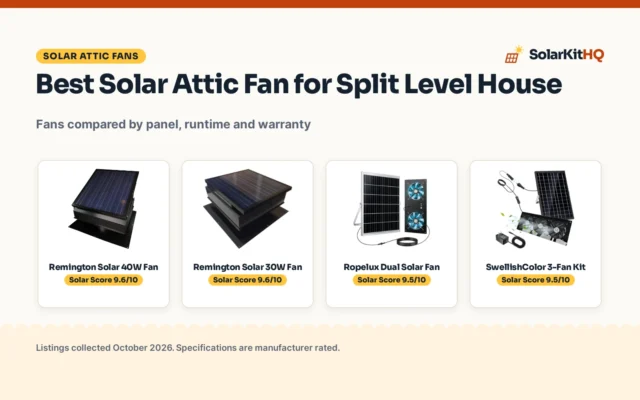
See the best solar attic fan for split level house, the best solar attic fan for colonial house, the solar fan vs evaporative cooler and the are solar powered attic fans worth it.