On this page
When the attic turns into an oven on a summer afternoon, solar attic fan cost is the question to settle before choosing a fan. A solar attic fan vents hot air out through the roof on sunlight, and what it costs depends on the size of the panel, the airflow it moves, and the controls it carries. A small basic fan sits at one end, and a large fan with a remote, a thermostat, an AC adapter and app control sits at the other. Installation adds to the total, and the sections below show what moves the figure and how to match a fan to the attic.
SolarKitHQ earns a commission when you buy through links on this page, at no extra cost to you. As an Amazon Associate I earn from qualifying purchases. Affiliate disclosure.
Solar attic fan cost: the quick answer
Solar attic fan cost follows panel watts, airflow and controls. The listings run from a 15W panel to a 100W panel, and from 320 CFM to 3000 CFM of airflow. Coverage runs from up to 1300 sq ft to up to 2,800 sq ft. A fan with a remote, an adjustable thermostat, an AC adapter for day and night use, and app control sits above a basic solar-only fan.
Step 1: Match the airflow to the attic
Airflow is the first figure to match, and it is stated in CFM with a coverage figure in square feet. A small attic takes a small fan: the Hon&Guan 25W fan (on Amazon) states 320 CFM for up to 1300 sq ft. A mid-size attic takes more: the Hon&Guan 34W (on Amazon) and the BINGLUX 25W (on Amazon) each state 1200 CFM for up to 1800 sq ft, and the RYLENE states 1600 CFM for up to 2500 sq ft. A large attic takes the most: the PEAKROCK 30W (on Amazon) states 2000 CFM for up to 2,800 sq ft, the Amtrak 100W states up to 2000 CFM for up to 2,250 sq ft, and the VEVOR 50W (on Amazon) states 3000 CFM. The Quietcool 50W states up to 1119 CFM on high and 686 CFM on low.
| Fan | Airflow stated | Coverage stated |
|---|---|---|
| VEVOR 50W | 3000 CFM | Not stated |
| Amtrak 100W | Up to 2000 CFM | Up to 2,250 sq ft |
| PEAKROCK 30W | 2000 CFM | Up to 2,800 sq ft |
| RYLENE | 1600 CFM | Up to 2500 sq ft |
| Hon&Guan 34W | 1200 CFM | Up to 1800 sq ft |
| BINGLUX 25W | 1200 CFM | Up to 1800 sq ft |
| Hon&Guan 25W | 320 CFM | Up to 1300 sq ft |
These are the figures the listings state. Measure the attic floor before choosing, and match the coverage figure to it rather than the panel watts alone. See benefits of attic fan for what the moving air does.
Step 2: Check the panel watts
Panel watts run from 15W to 100W in the listings. The Ereto fan carries a 15W panel with a 12V 4000mAh battery for day and night use. The Hon&Guan 25W and the BINGLUX 25W carry 25W panels, the PEAKROCK carries a 30W panel, and the Hon&Guan 34W carries a 34W panel. The VEVOR and the Quietcool carry 50W panels, and the Amtrak carries a 100W panel. A fan that states high CFM usually carries a larger panel: the VEVOR states 3000 CFM from a 50W panel. Check the panel angle too: the Hon&Guan 25W panel measures 17 inches by 13 inches and adjusts to catch the sun, and the PEAKROCK mount adjusts to face the sun.
Step 3: Count the controls and extras
Controls and extras move the figure as much as watts do. A thermostat sets when the fan runs: the Hon&Guan 34W sets its temperature from 68°F to 113°F, the BINGLUX auto-starts at 77°F, and the RYLENE turns on above 26°C and off below 24°C. A remote adds reach: the VEVOR remote works from up to 32 feet, the RYLENE remote from up to 30 metres, the BINGLUX remote from a 65ft range, and the Ereto remote from over 165 feet. An AC adapter keeps the fan running after sunset: the Hon&Guan 25W, the Hon&Guan 34W, the RYLENE, the Quietcool and the BINGLUX listings all state an AC adapter or AC backup. The Quietcool 50W adds app control with a thermostat and a humidistat, plus a built-in fire safety shut off, and the VEVOR adds smoke detection that shuts the fan off. The BINGLUX states a 5-year support term, and the PEAKROCK states 45 dB.
Step 4: Allow for installation
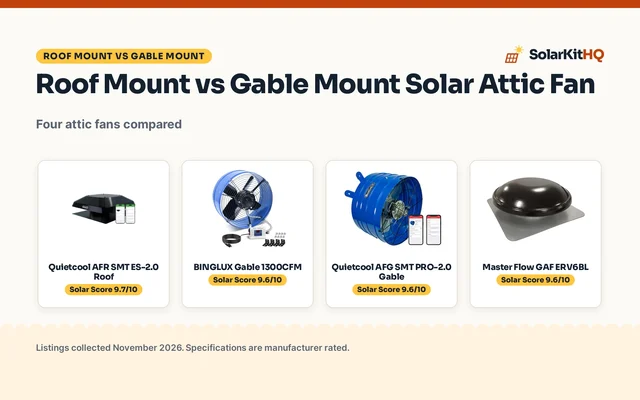
Roof type and mount shape what the install takes. The listings state fit for metal, masonry, asphalt shingle, wood and tile roofs, so check the roof against the listing. Roof mount and gable mount differ: the Amtrak kit is built for gable vents, with an on/off switch and 15 ft of extra wire, See roof mount vs gable mount solar attic fan to tell the two apart. Cord length matters when the outlet is far from the fan: the Quietcool 25W includes a 20 foot power cord, and the BINGLUX includes a 9.8ft cord. The Quietcool 50W states interchangeable flashings for multiple roof types, sold separately. It weighs 43.0 pounds at 31.0 by 14.0 by 30.0 inches. The Ereto listing states the kit needs no professional electrician and includes the install hardware.
What to check before you buy
- Match the coverage figure to the attic: 320 CFM covers up to 1300 sq ft, and 2000 CFM covers up to 2,250 or 2,800 sq ft.
- Check whether an AC adapter is included for use after sunset, or whether the fan runs on solar alone.
- Check the remote range and the cord length: remotes run from 32 feet to over 165 feet in the listings, and cords run from a 9.8ft cord to a 20 foot cord.
- Check the support term: the BINGLUX states 5-year support, and the RYLENE states after-sales service.
- Check the noise figure: the PEAKROCK states 45 dB, and the BINGLUX states below 45dB.
FAQ: power away from the grid
How much airflow does a solar attic fan need?
Match the CFM and the coverage to the attic. The listings state 320 CFM for up to 1300 sq ft, 1200 CFM for up to 1800 sq ft, 1600 CFM for up to 2500 sq ft, and 2000 CFM for up to 2,250 or 2,800 sq ft.
Do solar attic fans work at night?
The ones with an AC adapter do. The Hon&Guan 25W, the Hon&Guan 34W, the RYLENE, the Quietcool and the BINGLUX listings state an AC adapter or AC backup for use after sunset. A solar-only fan runs on sunlight, so check the listing for an adapter before counting on night use.
What size panel does a solar attic fan need?
Panels in the listings run from 15W to 100W. The Ereto carries a 15W panel, the Hon&Guan 25W and the BINGLUX 25W carry 25W panels, the PEAKROCK carries a 30W panel, and the Amtrak carries a 100W panel.
How loud is a solar attic fan?
Two listings state a noise figure: the PEAKROCK states 45 dB, and the BINGLUX states below 45dB. The rest state no noise figure, so check the listing when quiet running matters.
How long does a solar attic fan last?
The listings state support terms rather than a life figure. The BINGLUX states 5-year support, and the RYLENE states after-sales service. The PEAKROCK states an IP65 code with a brushless motor.
Does a solar attic fan need a thermostat?
Not every fan has one, and the ones that do state the range. The Hon&Guan 34W sets its temperature from 68°F to 113°F, the BINGLUX auto-starts at 77°F, and the RYLENE turns on above 26°C and off below 24°C. A fan without a thermostat runs whenever the sun shines.
Related solar guides
See every Solar Fans and Pumps guide and all Solar Lights, Cameras and Fans guides. For whether a fan is worth it, see are solar powered attic fans worth it, and for the cooling side, see solar fan vs evaporative cooler.