On this page
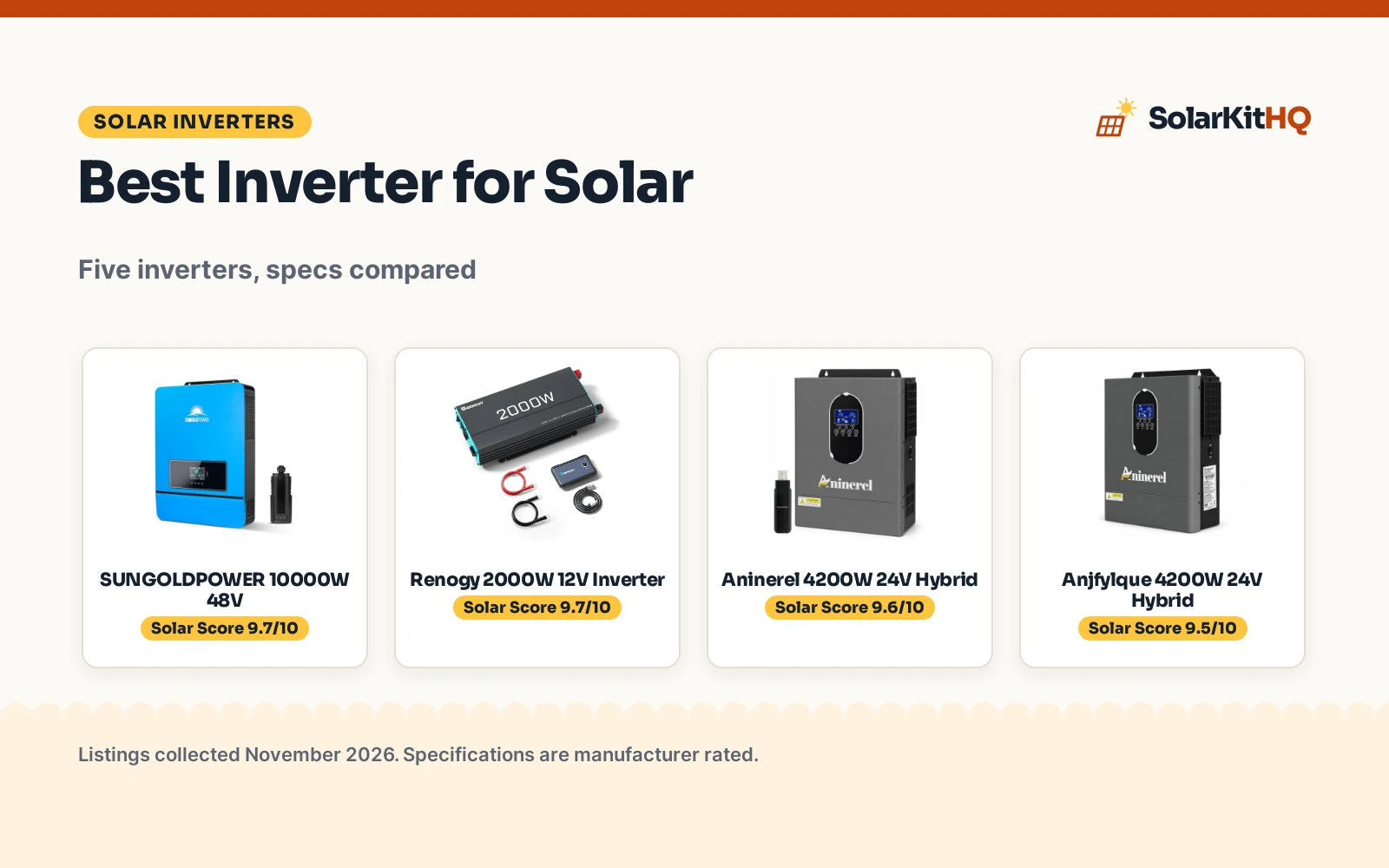
A cabin that loses power at dusk needs an inverter that turns stored battery power into household current, and the best inverter for solar is the one that matches your battery voltage, your panel array and the loads you run. This guide compares the inverters on continuous watts, battery voltage, MPPT charging and warranty terms, using only what each listing states. The SUNGOLDPOWER unit gives the fullest stated case, with split-phase output and built-in MPPT controllers, while the smaller Loddery unit suits a small battery bank and a handful of outlets.
SolarKitHQ earns a commission when you buy through links on this page, at no extra cost to you. As an Amazon Associate I earn from qualifying purchases. Affiliate disclosure.
Quick picks
 Best Overall SUNGOLDPOWER 10000W 48V: 10000W split phase with 2 MPPTs and 200A charging Check price on Amazon
 Best 24V Hybrid Aninerel 4200W 24V Hybrid: 4200W with 120A MPPT, IP21 protection and battery-free operation Check price on Amazon
 Longest Warranty Anjfylque 4200W 24V Hybrid: 5-year warranty with 120A MPPT and 6200W PV input Check price on Amazon
 Best Small Inverter Loddery 850W 12V Inverter: 850W with 3 AC outlets, 2 USB ports and an LCD display Check price on Amazon
The kits we chose
| # | Product | Solar Score | Buy |
|---|---|---|---|
| 1 | SUNGOLDPOWER 10000W 48V | 9.7/10 | Buy on Amazon |
| 2 |  Renogy 2000W Pure Sine | 9.7/10 | Buy on Amazon |
| 3 | Aninerel 4200W 24V Hybrid | 9.6/10 | Buy on Amazon |
| 4 | Anjfylque 4200W 24V Hybrid | 9.5/10 | Buy on Amazon |
| 5 | Loddery 850W 12V Inverter | 9.4/10 | Buy on Amazon |

SUNGOLDPOWER 10000W 48V
A 10000W 48V split-phase pure sine wave inverter with 2 built-in MPPT controllers, 200A max battery charging and a UL1741 listing.
Pros
- 10000W rated output with 20,000W peak power and 6HP motor capacity
- 2 MPPT controllers built in, with 500VDC max open-circuit voltage
- Split-phase 120V/240V output, settable, or single-phase 120V output
- WiFi module included, with BMS communication and battery-free support
Cons
- Large size at 26.0 by 17.9 by 5.1 inches and 53.5 pounds
- 48V battery bank required, so 12V and 24V owners need a different inverter
- Only a 2 year manufacturer warranty is stated
- WiFi monitoring needs the mobile phone app
Detailed Review
The listing states a 10000W 48V pure sine wave inverter with 2 built-in MPPT controllers, max 200A battery charging, and split-phase 120V/240V output that is settable, or single-phase 120V output. Rated output power is 10000W with 20,000W peak power and 6HP loaded motor capacity, and the max open-circuit voltage is 500VDC. The listing names PV input over-voltage and over-current protection, AC input over-voltage protection, battery over-voltage protection and over-load protection, plus a UL1741 listing. Four charging modes and four output modes are listed, with a time-slot charging and discharging function, and the unit supports 48V AGM, sealed, gel, flooded and lithium batteries with a user mode, plus battery-free operation. A WiFi module is included. The stated weight is 53.5 pounds and the stated size is 26.0 by 17.9 by 5.1 inches, with a 2 year manufacturer warranty.
Who it's for: owners building a 48V system who want split-phase output and two MPPT controllers in one box. Who should skip it: owners with a 12V or 24V battery bank, who need a lower-voltage inverter.
Its Solar Score of 9.7/10 comes from performance 33/35, build 22/25, value 21/25, safety 8/10 and warranty 3/5: 87 of 100 points, placed on our 9.2 to 9.8 scale.
Key Specifications
| Continuous watts | 10000W |
|---|---|
| Peak watts | 20,000W |
| Battery voltage | 48V |
| MPPT | 2 built in, 200A max charging |
Taken from the seller's listing on 15 November 2026. Capacity and output figures are rated by the manufacturer.
Safety and Warranty
What this listing states. UL1741 listed; PV input over-voltage and over-current, AC input over-voltage, battery over-voltage and over-load protection stated, so safety scores 8 of 10. 2 year manufacturer warranty stated. It does not say everything a buyer needs, such as who pays return shipping, so warranty scores 3 of 5. See How We Pick.
Inverter limits. Stay within the stated continuous watts (surge watts last only a moment), use the cable size and fuse the manual gives, ventilate it, and never connect an inverter to home wiring yourself; that is work for a licensed electrician.
This is general buying information, not professional advice. Follow each product manual and local rules, and see our Safety Disclaimer.

Renogy 2000W Pure Sine
A 2000W continuous, 4000W peak pure sine wave inverter with UL and CSA listings, 3 AC outlets and a 1 year warranty.
Pros
- 2000W continuous and 4000W peak pure sine wave output
- UL and CSA listed
- Two 1/0 AWG 3ft cables and a 16.4ft wired remote included
- 3 AC outlets plus an AC terminal block and a 5V/2.1A USB port
Cons
- 2000W continuous suits mid-size tools, not the heaviest loads
- Only a 1 year warranty is stated
- 11.7 pounds before cables and battery
- 2000W continuous is below the 3000W and 5000W picks here
Detailed Review
The listing states a 2000W continuous, 4000W peak pure sine wave inverter converting 12V DC to 110V or 120V AC at over 90 percent efficiency and 60 hertz. It lists a built-in 5V/2.1A USB port, 3 AC outlets, an AC terminal block, two 1/0 AWG 3ft cables and a 16.4ft wired remote, at 17.8 by 8.6 by 4 inches and 11.7 pounds. It states UL and CSA listings and a 1 year manufacturer warranty, and notes the input should be a deep cycle battery.
Who it's for: site crews running sensitive electronics and mid-size tools from a 12V battery bank. Who should skip it: anyone needing more than 2000W continuous.
Its Solar Score of 9.7/10 comes from performance 32/35, build 21/25, value 21/25, safety 7/10 and warranty 2/5: 83 of 100 points, placed on our 9.2 to 9.8 scale.
Key Specifications
| Continuous / peak | 2000 W / 4000 W |
|---|---|
| Waveform | Pure sine wave |
| Outlets | 3 AC, terminal block, USB |
| Certification | UL, CSA |
Figures as published on the retailer listing, collected 20 October 2026. Performance figures are manufacturer rated.
Safety and Warranty
What this listing states. UL and CSA listed, so safety scores 7 of 10. 1 year manufacturer warranty stated. It does not say everything a buyer needs, such as who pays return shipping, so warranty scores 2 of 5. See How We Pick.
Inverter limits. Stay within the stated continuous watts (surge watts last only a moment), use the cable size and fuse the manual gives, ventilate it, and never connect an inverter to home wiring yourself; that is work for a licensed electrician.
This is general buying information, not professional advice. Follow each product manual and local rules, and see our Safety Disclaimer.

Aninerel 4200W 24V Hybrid
A 4200W 24V hybrid inverter with a built-in 120A MPPT controller, 6200W PV input, IP21 protection and battery-free operation.
Pros
- 4200W continuous power with 8.4kW surge power and pure sine wave output
- 120A MPPT controller supporting up to 6200W of photovoltaic arrays
- Battery-free operation with a PV input voltage of 130VDC or higher
- IP21 protection with a removable dust cover for dusty environments
Cons
- 24V battery bank required, so 12V and 48V owners need a different inverter
- Only a 2 Year Manufacturer warranty is stated
- Battery-free operation needs a PV input voltage of 130VDC or higher
- 4200W continuous output, so larger loads need a bigger inverter
Detailed Review
The listing states a 4200W solar hybrid inverter with 24V DC to 110V AC pure sine wave output, a built-in 120A MPPT controller and a max PV input voltage of 500V. It supports 4.2kW continuous power and 8.4kW surge power, up to 6200W of photovoltaic arrays, and an MPPT voltage range of 60-450V. Battery-free operation is listed with a PV input voltage of 130VDC or higher, and LiFePO4 battery communication runs through RS485 with EQ balancing. The unit has IP21 protection, a removable dust cover and a temperature range of -10 to 50 degrees Celsius. The title names a WiFi module while the bullets call the WiFi remote monitoring module optional; check before ordering. The stated weight is 15.0 pounds and the stated size is 12.2 by 4.72 by 14.17 inches, with a 2 Year Manufacturer warranty.
Who it's for: owners with a 24V battery bank who want MPPT charging, battery-free operation and IP21 protection. Who should skip it: owners with a 12V or 48V battery bank, or anyone who needs more than 4200W continuous.
Its Solar Score of 9.6/10 comes from performance 29/35, build 21/25, value 20/25, safety 5/10 and warranty 3/5: 78 of 100 points, placed on our 9.2 to 9.8 scale.
Key Specifications
| Continuous watts | 4200W |
|---|---|
| Surge watts | 8.4kW |
| MPPT | 120A, 6200W PV max |
| Battery voltage | 24V |
Taken from the seller's listing on 15 November 2026. Capacity and output figures are rated by the manufacturer.
Safety and Warranty
What this listing states. IP21 protection and removable dust cover stated, so safety scores 5 of 10. 2 Year Manufacturer warranty stated. It does not say everything a buyer needs, such as who pays return shipping, so warranty scores 3 of 5. See How We Pick.
Inverter limits. Stay within the stated continuous watts (surge watts last only a moment), use the cable size and fuse the manual gives, ventilate it, and never connect an inverter to home wiring yourself; that is work for a licensed electrician.
This is general buying information, not professional advice. Follow each product manual and local rules, and see our Safety Disclaimer.

Anjfylque 4200W 24V Hybrid
A 4200W 24V hybrid inverter with a built-in 120A MPPT controller, 6200W PV input and a 5-year warranty.
Pros
- 4200W continuous power with 120V AC pure sine wave output
- 120A MPPT controller with 6200W solar input and 500V max PV voltage
- 120A total charging current from solar and utility combined
- Four modes: Utility First, Solar First, SBU Priority and SUB Priority
Cons
- 24V battery bank required, so 12V and 48V owners need a different inverter
- Lithium systems without communication need user-defined charging settings
- Installation should be completed by qualified personnel, with proper breakers, fuses and cable sizes
- 4200W continuous output, so larger loads need a bigger inverter
Detailed Review
The listing states a 4200W 24V hybrid inverter with 120V AC pure sine wave output, a built-in 120A MPPT controller, 6200W solar input and 500V max PV open-circuit voltage. The MPPT voltage range is 60V-500V with 27A max PV input current, and the inverter supports up to 120A PV charging current and up to 120A total charging current from solar and utility combined. It suits 24V battery banks, common lead-acid types and user-defined charging settings for lithium systems without communication. Four modes are listed: Utility First, Solar First, SBU Priority and SUB Priority. An LCD display shows system status, and RS485, RS232 and dry contact ports are included. The listing states a 5 Year warranty.
Who it's for: owners with a 24V battery bank who want a long warranty term and four modes. Who should skip it: owners with a 12V or 48V battery bank, or anyone who needs more than 4200W continuous.
Its Solar Score of 9.5/10 comes from performance 29/35, build 20/25, value 20/25, safety 0/10 and warranty 3/5: 72 of 100 points, placed on our 9.2 to 9.8 scale.
Key Specifications
| Continuous watts | 4200W |
|---|---|
| MPPT | 120A, 6200W PV max |
| Battery voltage | 24V |
| Warranty | 5 Year |
Taken from the seller's listing on 15 November 2026. Capacity and output figures are rated by the manufacturer.
Safety and Warranty
What this listing states. No UL or ETL listing and no protection detail is stated, so safety scores zero. 5 Year warranty stated. It does not say everything a buyer needs, such as who pays return shipping, so warranty scores 3 of 5. See How We Pick.
Inverter limits. Stay within the stated continuous watts (surge watts last only a moment), use the cable size and fuse the manual gives, ventilate it, and never connect an inverter to home wiring yourself; that is work for a licensed electrician.
This is general buying information, not professional advice. Follow each product manual and local rules, and see our Safety Disclaimer.

Loddery 850W 12V Inverter
An 850W 12V DC to 110V-120V AC inverter with 3 AC outlets, 2 USB charging ports and an LCD display.
Pros
- 3 AC outlets and 2 USB charging ports for laptops and larger devices
- Over-voltage, over-load, low voltage, over-current, over-temperature and short circuit protection stated
- Solid aluminum housing protects against drops and bumps
- High-performance cooling fan keeps the inverter running at a low temperature
Cons
- Only 850W, so it suits small loads only
- No MPPT controller or solar charging is stated
- No warranty term is stated
- 12V battery required, so 24V and 48V owners need a different inverter
Detailed Review
The listing states an 850 watt solar power inverter, 12V DC to 110V-120V AC, with 3 AC outlets, 2 USB charging ports and an intelligent LCD display that shows battery status and load capacity. The solid aluminum housing protects against drops and bumps, and a high-performance cooling fan keeps the inverter running at a low temperature. Protection is listed for over-voltage, over-load, low voltage, over-current, over-temperature and short circuit. The listing names product safety certification and 24-hour customer service, and advises use in a well-ventilated, dry area. The listing states an 80% energy efficiency class.
Who it's for: owners with a 12V battery who want a small inverter with outlets and USB ports for a few devices. Who should skip it: owners who need MPPT charging, a 24V or 48V bank, or more than 850W.
Its Solar Score of 9.4/10 comes from performance 23/35, build 19/25, value 19/25, safety 7/10 and warranty 0/5: 68 of 100 points, placed on our 9.2 to 9.8 scale.
Key Specifications
| Continuous watts | 850W |
|---|---|
| Output | 12V DC to 110V-120V AC |
| Outlets | 3 AC outlets, 2 USB ports |
| Protection | Over-voltage, over-load, short circuit and more |
Taken from the seller's listing on 15 November 2026. Capacity and output figures are rated by the manufacturer.
Safety and Warranty
What this listing states. Over-voltage, over-load, low voltage, over-current, over-temperature and short circuit protection stated, so safety scores 7 of 10. No warranty term, so warranty scores zero. See How We Pick.
Inverter limits. Stay within the stated continuous watts (surge watts last only a moment), use the cable size and fuse the manual gives, ventilate it, and never connect an inverter to home wiring yourself; that is work for a licensed electrician.
This is general buying information, not professional advice. Follow each product manual and local rules, and see our Safety Disclaimer.
As an Amazon Associate I earn from qualifying purchases.
Numbers side by side
| Inverter | Solar Score | Continuous watts | Battery voltage | MPPT | Warranty | Amazon |
|---|---|---|---|---|---|---|
| SUNGOLDPOWER 10000W 48V | 9.7/10 | 10000W | 48V | 2 MPPTs, 200A max charging | 2 years | View on Amazon |
| Aninerel 4200W 24V Hybrid | 9.6/10 | 4200W | 24V | 120A, 6200W PV max | 2 years | View on Amazon |
| Anjfylque 4200W 24V Hybrid | 9.5/10 | 4200W | 24V | 120A, 6200W PV max | 5 years | View on Amazon |
| Loddery 850W 12V Inverter | 9.4/10 | 850W | 12V | Not stated | Not stated | View on Amazon |
| Renogy 2000W 12V Inverter | 9.7/10 | 2000W | 12V | Not stated | Not stated |
All numbers here are manufacturer claims from the listings, not our measurements (15 November 2026).
Where the points went
The Solar Score weighs performance, build, value, safety and warranty. For an inverter, safety means UL or IP marks and the protection list the listing actually states; an inverter that states none scores zero on that line, whatever its watts. Three of the five inverters state a warranty term, and only the SUNGOLDPOWER unit carries a UL1741 listing. How we pick explains the weights.
| Product | Solar Score | Perf. /35 | Build /25 | Value /25 | Safety /10 | Warranty /5 |
|---|---|---|---|---|---|---|
| SUNGOLDPOWER 10000W 48V | 9.7 | 33 | 22 | 21 | 8 | 3 |
| Aninerel 4200W 24V Hybrid | 9.6 | 29 | 21 | 20 | 5 | 3 |
| Anjfylque 4200W 24V Hybrid | 9.5 | 29 | 20 | 20 | 0 | 3 |
| Loddery 850W 12V Inverter | 9.4 | 23 | 19 | 19 | 7 | 0 |
Scores start at 9.2 for the lowest totals and top out at 9.8. In between, a kit’s position follows its weighted points one to one in order.
How to choose the best inverter for solar
Start with battery voltage
Battery voltage is the first filter, because an inverter only works with the bank it is built for. The SUNGOLDPOWER is a 48V unit, the Aninerel and Anjfylque are 24V units, and the Loddery and Renogy are 12V units. A 48V bank suits a larger system with more panels, while a 12V bank suits a small cabin, RV or truck setup with a single battery. Check the voltage on your battery bank before comparing watts, since a mismatch means a different inverter entirely. The SUNGOLDPOWER also lists battery-free operation, and the Aninerel lists battery-free operation with a PV input voltage of 130VDC or higher, so both can run from panels alone when the sun is up.
Match continuous watts to your loads
Continuous watts set what the inverter can run without stopping, and peak watts cover the brief surge when a motor starts. The SUNGOLDPOWER is rated at 10000W with 20,000W peak power and 6HP loaded motor capacity. The two 4200W hybrids cover mid-size loads, the Renogy covers 2000W, and the Loddery covers 850W for small devices. Add up the loads you plan to run at once, and leave headroom above that total. The SUNGOLDPOWER also lists 6HP loaded motor capacity for motor loads. The table below puts the stated watts side by side.
| Inverter | Continuous watts | Peak watts | Battery voltage |
|---|---|---|---|
| SUNGOLDPOWER 10000W 48V | 10000W | 20,000W | 48V |
| Aninerel 4200W 24V Hybrid | 4200W | 8.4kW surge | 24V |
| Anjfylque 4200W 24V Hybrid | 4200W | Not stated | 24V |
| Loddery 850W 12V Inverter | 850W | Not stated | 12V |
| Renogy 2000W 12V Inverter | 2000W | Not stated | 12V |
MPPT charging and PV input
Three of the five inverters include MPPT charging, and the other two state none. The SUNGOLDPOWER has 2 MPPT controllers built in, with max 200A battery charging and a max open-circuit voltage of 500VDC. The Aninerel and Anjfylque each have a built-in 120A MPPT controller, up to 6200W of solar input and a 500V max PV voltage, with MPPT voltage ranges of 60-450V and 60V-500V. The Loddery and Renogy state no MPPT charging, so they need a separate charge controller for a solar array. For the wider range of options, see the best inverter guide.
Read the warranty lines closely
Warranty terms vary more than the watts do. The Anjfylque states a 5 Year warranty, while the SUNGOLDPOWER and the Aninerel each state a 2 year manufacturer warranty. The Loddery and Renogy state no warranty term, so a buyer who wants a written term should pick from the three that name one. For RV setups, the best inverter charger for RV guide covers combined inverter and charger units.
Sizing Notes
- Match battery voltage first: 48V for the SUNGOLDPOWER, 24V for the Aninerel and Anjfylque, 12V for the Loddery and Renogy.
- Match continuous watts to the loads you run at once: 10000W, 4200W, 2000W or 850W as each listing states.
- Check MPPT and PV limits: the SUNGOLDPOWER has 2 MPPTs with a 500VDC max open-circuit voltage, and the two 4200W hybrids have 120A MPPT with 6200W PV input and a 500V max.
- Any connection to home wiring is a job for a licensed electrician.
FAQ: power away from the grid
Which inverter here has the highest continuous watts?
The SUNGOLDPOWER, at 10000W rated output with 20,000W peak power. The two 4200W hybrids come next, then the Renogy at 2000W and the Loddery at 850W.
Which inverters work without a battery?
The SUNGOLDPOWER supports battery-free operation, and the Aninerel operates without a battery with a PV input voltage of 130VDC or higher. The other three listings state no battery-free operation.
Which inverters include an MPPT controller?
The SUNGOLDPOWER includes 2 MPPT controllers, and the Aninerel and Anjfylque each include a built-in 120A MPPT controller. The Loddery and Renogy state no MPPT charging.
Which inverter states the longest warranty?
The Anjfylque states a 5 Year warranty. The SUNGOLDPOWER and the Aninerel each state a 2 year manufacturer warranty, and the Loddery and Renogy state no warranty term.
Related solar guides
See every Power Inverters guide and all Controllers and Inverters guides.
More picks: best inverter generator for home backup, best inverter for portable AC, best inverter for refrigerator.