On this page
On a hot afternoon with the sun beating down and the air conditioner humming, the idea of running it on sunshine feels like the obvious answer, and the question is whether the panels on the roof can keep up with the compressor. Can solar power run air conditioner? Yes, with a large enough system: enough panels to feed the load, a large battery bank to carry it through the night, and an inverter with enough output to start the compressor. The steps below show how to size each part from the air conditioner label, so the system runs the cooling load instead of tripping on it.
SolarKitHQ earns a commission when you buy through links on this page, at no extra cost to you. As an Amazon Associate I earn from qualifying purchases. Affiliate disclosure.
Can solar power run air conditioner: the quick answer
Yes, solar power can run an air conditioner, but only as a system: panels, a battery bank and an inverter sized together around the air conditioner’s load. An air conditioner is a heavy load with a compressor that pulls a short surge at startup, so a small portable setup will not keep it running for long. A large battery bank and an inverter with enough output can run a small window unit or a mini-split, while a large central unit asks for far more power than a small off-grid setup can give. The rest of this guide shows how to read the label and size each part.
Read the air conditioner label
Every air conditioner states its running watts on a label, a nameplate or in the manual, and that figure sets the size of everything else. Read the running watts and the startup draw for the unit, and read the label on the outdoor unit as well as the indoor unit when the indoor and outdoor units are separate. A plug-in watt meter measures real use over time for a window unit, which is the best number when the label is hard to read. See the best watt meters for meters that measure real use.
Size the inverter output
The inverter turns battery power into household AC, so its output must cover the air conditioner’s running watts, and its surge limit must cover the short surge when the compressor starts. When the surge limit is too low, the inverter trips each time the compressor kicks in, even when the running watts look small on the label. A soft-start device lowers the startup draw the inverter must cover, which helps a small system start a compressor that would trip it otherwise. For loads with electronic controls, a pure sine wave inverter is the usual match, since it gives the same kind of power as a household outlet.
Size the battery bank
The battery bank sets how long the air conditioner runs. An air conditioner is a heavy load, so it drains a battery bank fast, and a small bank runs down long before the night is over. A large bank can run a small window unit or a mini-split through the night, while the compressor cycles on and off as the room cools. A deep-cycle battery is the usual match for an inverter setup, since it is built to give power over a long stretch rather than in one short burst. See the best deep cycle batteries for inverters for battery options.
Size the panels
The panels must put back what the air conditioner used, so the panel array sets whether the battery is full again by the next evening. On a sunny day the panels carry the load while the sun is up and charge the bank at the same time, while on a cloudy stretch the bank runs down and the air conditioner runs for a shorter while. Shade, panel angle and the hours of sun through the day all move the figure, so use the sun the roof actually gets rather than a figure from a brochure. When the panels cannot keep up, the answer is more panels or a shorter run time, not a bigger inverter alone.
What kind of air conditioner runs best on solar
- A small window unit: a small window unit is the simplest match for a solar setup, since it plugs into an outlet and its label gives the watts to size from.
- A mini-split: a mini-split with an inverter compressor starts gently and varies its speed with the load, which suits a battery bank and an inverter.
- A portable unit: a portable unit works where a window unit cannot fit, though its hose and its drain add work in a small room.
- A large central unit: a large central unit asks for far more power than a small off-grid setup can give, so it needs a large system of its own.
Ways to use less power
- Run the air conditioner while the sun is up, so the panels carry the load directly and the battery stays full for the night.
- Close blinds and curtains on sunny windows, and keep doors shut so the cooled air stays in the room.
- Set the thermostat a little higher and use a small fan to move the air, since a fan asks far less of the battery than the compressor.
- Shade the outdoor unit and keep its coils clear, so the unit sheds heat and the compressor cycles less often.
- Cool one room instead of the whole house, and close off rooms that do not need cooling.
FAQ: power away from the grid
Can a portable power station run an air conditioner?
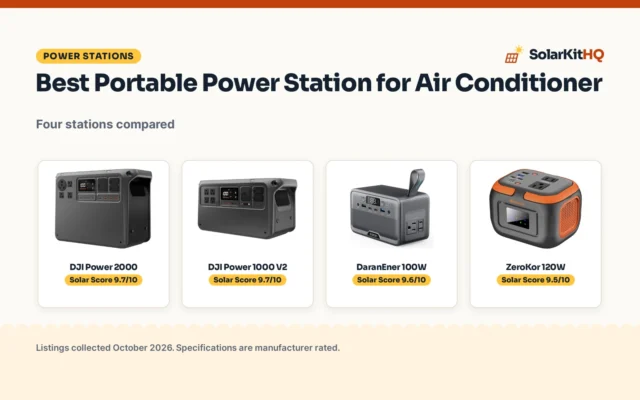
A large one can, for a short while. It depends on the station’s output and capacity against the air conditioner’s label watts and startup draw. See the best portable power stations for home backup for large stations.
Can solar panels run an air conditioner directly?
No. Panels alone do not run an air conditioner: the panels charge a battery bank, and the inverter turns battery power into household AC for the unit.
How long can solar power run an air conditioner?
It depends on the battery bank and the load: a large bank can run a small unit through the night, while a small bank runs down fast. The compressor cycling on and off stretches the run time, since the unit draws full power only while the compressor runs.
Do I need a battery to run an air conditioner on solar?
Yes for running it after sunset. During the day the panels can carry the load while the sun is up, but the battery covers clouds and the night.
What size solar system do I need for an air conditioner?
Size it from the label: the running watts and startup draw set the inverter, the run time sets the battery, and the daily use sets the panels. When the label watts are unknown, a watt meter on a plug-in unit gives the real use.
Related solar guides
See every Power Stations and Generators guide, the best portable power stations for home backup, the solar generator vs portable inverter generator comparison and the best solar inverters with chargers.