On this page
A cabin at dusk with no plumbing and a van parked for the night need the same thing: a toilet that works without water or a sewer line. The cost of a composting toilet depends on the type you choose, the size, whether it needs power, and what comes in the box. This guide walks through each cost driver so you can see where the money goes before you buy.
SolarKitHQ earns a commission when you buy through links on this page, at no extra cost to you. As an Amazon Associate I earn from qualifying purchases. Affiliate disclosure.
What drives the cost of a composting toilet
The short answer is that the type sets the range. A manual urine-diverting model with no fan and no power sits at the lower end, while a larger powered model with a fan, an agitator and a bigger capacity sits at the upper end. Size adds to the difference: a compact unit for a van costs less to build and ship than a full-size unit for a cabin. Power adds its own cost, since a fan, a motor and the wiring to run them are parts you pay for. Installation and extras add more, from vent hoses and mounting hardware to the cover material you use after each visit. The steps below work through each driver with the figures the reference models state, so you can weigh them against the space and the use you have in mind.
Step 1: Pick the type first
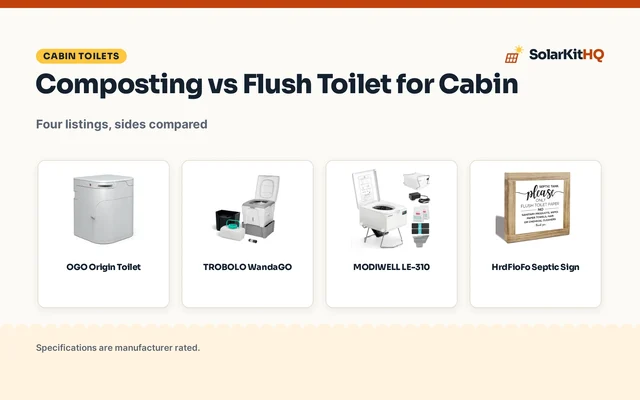
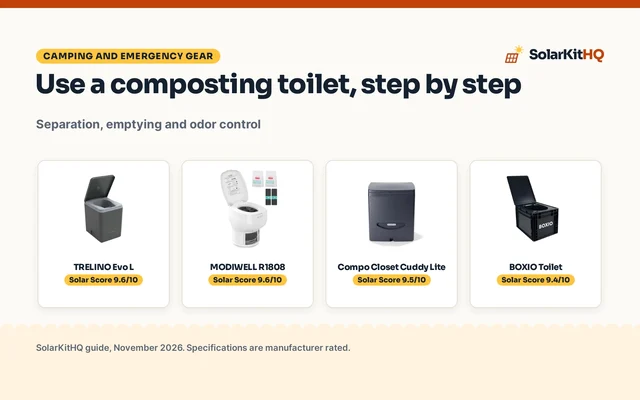
Most composting toilets in the reference listings separate liquids from solids. The TRELINO diverts urine to a 1.3 gal container and solids to a 2.1 gal container, the OGO sends liquids to a 2.4-gal bottle, and the Nature’s Head holds urine in an 8.3 liter bottle. The Cuddy Lite uses the same liquid-diverting design and runs its LED full indicator on a 9V battery, while the Separett Villa measures 26.5 x 18.0 x 21.3 inches and the Separett Weekend Prime measures 19.6 x 15.7 x 18.5 inches with a weight of 21.2 pounds. A portable flush toilet is a different design: the YITAHOME model carries a 3.17 gallon fresh water tank and a 5.28 gallon waste-water tank, so it needs water and a place to empty the tank. Check the type before you compare anything else, since a urine-diverting model and a flush portable model solve different problems and carry different costs.
Step 2: Match the size to the space
Footprint decides whether the toilet fits the room you have. The OGO is built for tight builds with a 15 x 16 in footprint, and the TRELINO measures 13 x 15.4 x 14.2 inches. The Separett Weekend Prime measures 19.6 x 15.7 x 18.5 inches, the Thinktank measures 23.2 x 18.0 x 19.0 inches, and the Separett Villa measures 26.5 x 18.0 x 21.3 inches. Weight matters when the unit moves: the OGO weighs 28.0 pounds, the Thinktank weighs 30.0 pounds, the Separett Villa weighs 34.0 pounds, and the Separett Weekend Prime weighs 21.2 pounds. The TRELINO supports up to 330 lbs and the YITAHOME supports 275 lbs, so check the load rating against the people who will use it. Measure the floor space and the door swing before you order, since a unit that does not fit costs more in time and return shipping than a unit you measured for.
Step 3: Count the power and moving parts
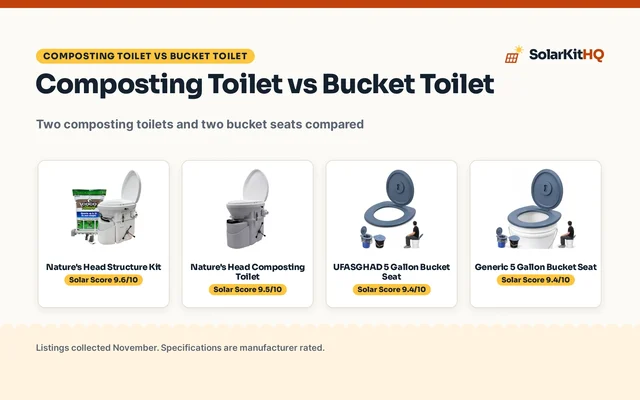
Power is a clear cost driver. The Nature’s Head runs a fan on a 12 V connection, or a 230 V power supply, and uses 1.7Ah per day to keep the fan running. The OGO uses a 12V motor to mix solids with a push-button agitator, so there is no crank to turn by hand. The Cuddy Lite needs no external power and runs its LED full indicator on a 9V battery. The Separett Weekend Prime is fully manual with no fan and no power, which keeps the design simple and the parts count low. A fan and a motor add parts that can wear, and they need a power source in the cabin or van, so weigh the convenience of powered mixing and venting against the simplicity of a manual unit.
Step 4: Check capacity and emptying
Capacity sets how often you empty the unit, and larger capacities cost more to build. The TRELINO urine container holds 1.3 gallons and the solids container holds 2.1 gallons, which the maker rates at 9 to 11 uses for liquids and 6 to 10 uses for solids. The OGO liquids bottle holds 2.4 gal and the solids bin holds 25 to 30 uses. The Nature’s Head urine bottle holds 8.3 liters. The Separett Villa is built for extended use between emptying cycles, with no fixed figure stated for the interval. Match the capacity to the number of people using the toilet and the length of the stay, since a small unit emptied often costs less up front but asks for more of your time.
Step 5: Add installation and extras
The unit itself is only part of the total. The Nature’s Head includes a 1.8 m cable, a 1.5 m exhaust hose, 2 mounting brackets and lock nuts, and mounts to the floor with 4 screws. The Separett Villa needs no plumbing and no water connection, and the Separett Weekend Prime needs no fan, no power and no ventilation. The Cuddy Lite needs no plumbing, no chemicals and no electricity, and its solids bin takes a bag for disposal. The TRELINO carries a 2 Year Manufacturer warranty, which is the only warranty term stated among the reference models. Check what comes in the box before you order, since a hose, a cable, brackets or cover material bought separately add to the total.
Ways to keep the cost down
- Measure the space first and pick the smallest footprint that fits, since size is a direct cost driver.
- Choose a manual model when you have no power to spare, since a fan and a motor add parts and wiring.
- Match the capacity to the stay: a 2.4-gal bottle and a bin rated at 25 to 30 uses suits longer stays, while a smaller unit suits short trips.
- Check what comes in the box, such as the 1.5 m exhaust hose and the mounting brackets, before buying extras.
- Look for a stated warranty term, such as the 2 Year Manufacturer warranty on the TRELINO, when comparing models at the upper end.
FAQ: power away from the grid
Do composting toilets need electricity?
Some do and some do not. The Nature’s Head runs a fan on a 12 V connection and uses 1.7Ah per day, the OGO uses a 12V motor for its agitator, and the Cuddy Lite runs its LED indicator on a 9V battery. The Separett Weekend Prime is fully manual with no fan and no power.
How often do you empty a composting toilet?
It depends on capacity and use. The TRELINO holds 9 to 11 uses of liquid and 6 to 10 uses of solids, and the OGO solids bin holds 25 to 30 uses. Check the stated capacity of the model you choose against how many people use it and how long the stay lasts.
What size composting toilet fits in a van?
Measure the space first. The OGO has a 15 x 16 in footprint, and the TRELINO measures 13 x 15.4 x 14.2 inches. Compare those figures with the floor space in the van before you order.
Do composting toilets need water or plumbing?
No. The Separett Villa and the Separett Weekend Prime are waterless, the Cuddy Lite needs no plumbing and no electricity, and the Nature’s Head works without water. A vent hose may still be needed: the Nature’s Head includes a 1.5 m exhaust hose.
Related solar guides
See the best portable toilets for tiny houses, the bucket toilet vs cassette toilet comparison and the best emergency toilet absorbent powder. See every camping and emergency gear guide and all power stations guides.