On this page
An outage at dinner time leaves a fridge warming, phones fading, and a house going dark while food sits on the stove. That is the moment when the dual fuel vs gas portable generator choice stops being abstract. A gas portable generator burns gasoline. A dual fuel portable generator burns gasoline or propane, so the fuel choice stays open when a tank runs low or a store shelf sits empty. Every generator featured here is a dual fuel model, so the gas side of this comparison comes from the gasoline figures stated for those same machines. Choose dual fuel when fuel flexibility matters for home backup, camping, or tailgating, and choose gas only when a gas model states the output, outlets, and run time you need.
SolarKitHQ earns a commission when you buy through links on this page, at no extra cost to you. As an Amazon Associate I earn from qualifying purchases. Affiliate disclosure.
The quick answer
On the stated figures, propane output sits below gasoline output for every model with stated running watts here. The PowerSmart model is rated at 3800 starting watts and 3300 running watts on gasoline, and 3500 starting watts and 3100 running watts on propane. The Westinghouse iGen2800DFc is rated at 2,800W peak and 2,200W running on gasoline, and 2,520W peak and 1,980W running on propane. The A-iPower model is rated at 2,300 starting watts and 1,800 running watts on gas, and 2,000 starting watts and 1,600 running watts on propane. A gas-only generator gives you the gasoline column and nothing else. A dual fuel generator gives you both columns in the same machine, and the trade is clear from the maker figures: flexibility on fuel, lower stated watts on propane.
Run time is fuel-specific too. PowerSmart states 8 hours at 25% load on gasoline, or up to 24 hours with a standard 20-lb propane tank. Westinghouse states up to 12 hours at 25% load. A-iPower run time is Not stated.
How to choose a dual fuel vs gas portable generator
Start with running watts on the fuel you plan to burn. Peak and starting watts describe short bursts. Running watts describe the load carried hour after hour. The gear below is ranked on stated running watts, run time, noise, outlets, weight, and warranty, with the Westinghouse 12500 Peak Watt model last.
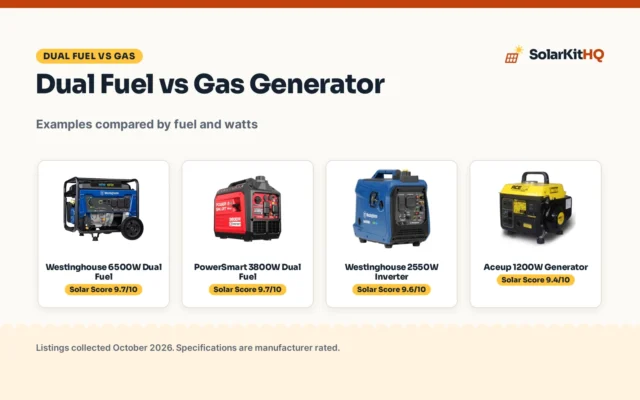
PowerSmart 3800 Watt Dual Fuel Inverter Generator
The maker lists 3800 starting watts and 3300 running watts on gasoline, and 3500 starting watts and 3100 running watts on propane. Run time is stated as 8 hours at 25% load on a 1.3-gallon gas tank, or up to 24 hours with a standard 20-lb propane tank. Noise is stated as 59 dBA at Eco Mode. Outlets include a 120V 30A twist-lock outlet, a 120V 20A 5-20R duplex household outlet, a 12V 8A DC port, and dual 5V 2.1A USB ports. Weight is stated as 50.7 pounds. The maker states carbon-monoxide sensor protection, low-oil shutdown, and a 2-year limited warranty.
Westinghouse iGen2800DFc Dual Fuel Inverter Generator
The maker lists gasoline at 2,800W peak and 2,200W running, and propane at 2,520W peak and 1,980W running. Run time is stated as up to 12 hours at 25% load. Noise is stated as quiet as 52 dBA, and total harmonic distortion is stated as less than 3% THD. Outlets include a 120V TT-30R 30A outlet and a 120V 5-20R 20A standard duplex outlet. Weight is stated as 45.0 pounds. The maker states a CO sensor, parallel capability with cables sold separately, Eco Mode, and a 3 Year Limited Warranty.
A-iPower 2300W Dual Fuel Inverter Generator
The maker lists 2,300 starting watts and 1,800 running watts on gas, and 2,000 starting watts and 1,600 running watts on propane. Sound level is stated as low as 61dB, and clean power output is stated as 3% THD. The control panel includes a CO sensor indicator light, 2x USB 5VDC, 1x 8.3A 12VDC, 1x L5-30R 30A 120V, and 1x Duplex 5-20R 20A 120V. Weight is stated as 40.3 pounds, with a telescoping handle and flat free wheels. The maker states an 80cc OHV engine, parallel readiness, and a 3 Year Limited Manufacturers Warranty. Run time is Not stated.
Westinghouse 12500 Peak Watt Dual Fuel Home Backup Portable Generator
The maker states 12500 Peak Watt and dual fuel home backup use in the product name. Running watts on gasoline, running watts on propane, run time, noise level, outlets, weight, dimensions, and warranty are Not stated. Treat the peak figure as a headline until the maker states the running figures you need for a load plan.
| Generator | Gas running watts | Propane running watts | Noise | Weight |
|---|---|---|---|---|
| PowerSmart 3800 Watt Dual Fuel Inverter Generator | 3300 | 3100 | 59 dBA | 50.7 pounds |
| Westinghouse iGen2800DFc Dual Fuel Inverter Generator | 2,200W | 1,980W | 52 dBA | 45.0 pounds |
| A-iPower 2300W Dual Fuel Inverter Generator | 1,800 | 1,600 | 61dB | 40.3 pounds |
| Westinghouse 12500 Peak Watt Dual Fuel Home Backup Portable Generator | Not stated | Not stated | Not stated | Not stated |
Figures in this table are the manufacturer’s ratings as listed. Compare running watts on the same fuel, and keep peak watts separate from running watts.
What changes with fuel choice
Fuel choice changes stated watts and can change stated run time. PowerSmart states 3300 running watts on gasoline against 3100 on propane. Westinghouse states 2,200W running on gasoline against 1,980W on propane for the iGen2800DFc. A-iPower states 1,800 running watts on gas against 1,600 on propane. Size your load plan on the column for the fuel you will burn.
Outlets and safety features stay with the machine across fuels. Westinghouse states less than 3% THD and A-iPower states 3% THD for sensitive electronics such as phones, TVs, computers, and laptops. PowerSmart THD is Not stated. PowerSmart, Westinghouse, and A-iPower each state CO sensor protection. Warranty is 2-year limited for PowerSmart and 3 Year Limited for Westinghouse and A-iPower.
Matching the generator to the load
- Running watts on your fuel: add the running watts of loads you plan to run together, then compare that total with stated running watts on your fuel.
- Peak or starting watts: keep peak figures separate from running watts, from 2,300 starting with 1,800 running on gas for A-iPower to 3800 starting with 3300 running on gasoline for PowerSmart.
- Run time at a stated load: compare run time only at the stated load: 8 hours at 25% load, up to 12 hours at 25% load, and up to 24 hours with a 20-lb propane tank.
- Outlets and weight: match outlets to your cords, including TT-30R 30A, L5-30R 30A 120V, and 5-20R 20A duplex where stated, and check weight from 40.3 pounds to 50.7 pounds.
Run fuel generators outdoors only, far from doors and windows, because of carbon monoxide.
FAQ: power away from the grid
Does a dual fuel generator make the same watts on propane as on gasoline?
No. PowerSmart states 3300 running watts on gasoline and 3100 on propane. Westinghouse states 2,200W running on gasoline and 1,980W on propane for the iGen2800DFc. A-iPower states 1,800 running watts on gas and 1,600 on propane.
How long will a dual fuel generator run on propane?
The PowerSmart maker states up to 24 hours with a standard 20-lb propane tank. The Westinghouse maker states up to 12 hours at 25% load for the iGen2800DFc. Run time for the A-iPower model is Not stated, and run time for the Westinghouse 12500 Peak Watt model is Not stated.
Which outlets do these dual fuel generators have?
The Westinghouse iGen2800DFc has a 120V TT-30R 30A outlet and a 120V 5-20R 20A standard duplex outlet. The PowerSmart model has a 120V 30A twist-lock outlet, a 120V 20A 5-20R duplex household outlet, a 12V 8A DC port, and dual 5V 2.1A USB ports. The A-iPower model has 2x USB 5VDC, 1x 8.3A 12VDC, 1x L5-30R 30A 120V, and 1x Duplex 5-20R 20A 120V.
How loud are these dual fuel inverter generators?
The Westinghouse maker states noise as quiet as 52 dBA for the iGen2800DFc. The PowerSmart maker states 59 dBA at Eco Mode. The A-iPower maker states sound level as low as 61dB. Noise for the Westinghouse 12500 Peak Watt model is Not stated.
Related solar guides
See every Inverter and Dual Fuel Generators guide and all Generators guides, including Gas Generators.