On this page
How does solar work? Sunlight falls on a panel, the panel turns it into direct current, and that current runs through a controller into a battery, where it waits until a load needs it. An inverter turns the stored direct current into the alternating current that household loads use, and the whole chain works wherever the sun reaches the panel. The steps below follow that chain from the panel to the load, and the kits after them show what each part looks like in practice.
SolarKitHQ earns a commission when you buy through links on this page, at no extra cost to you. As an Amazon Associate I earn from qualifying purchases. Affiliate disclosure.
How does solar work: the quick answer
A solar panel turns sunlight into direct current. A charge controller takes that current and charges a battery in stages, protecting it from overcharging. The battery stores the charge, and an inverter turns it back into alternating current for loads. The Renogy kit below states an average of 1000Wh per day based on 5 hours of direct sunlight, which shows the shape of the answer: panel watts times sun hours gives the daily charge, and the battery holds it until night. See how a solar panel system fits together.
Step 1: The panel turns sunlight into direct current
Sunlight strikes the cells and the panel puts out direct current. The DOKIO kit (on Amazon) lists two 100W panels for 200W in all, and the Renogy kits list the same 200W from two 100W panels. Half-cell layout and bypass diodes keep the charging steady when part of a panel sits in shade, as the DOKIO listing states. A panel in open sun gives its stated watts; a panel in shade gives less, so the mount matters as much as the panel. See whether solar panels need direct sun.
Step 2: The controller charges the battery
Direct current from the panel does not go straight to the battery. A charge controller sits between them, taking the panel current and feeding the battery in stages so it charges fully without overcharging. The Renogy kits list a 30A PWM Wanderer controller with 4-stage charging, bulk, boost, float and equalization, for Sealed, Gel, Flooded and Lithium batteries. The DOKIO kit ships without a controller, so a PWM or MPPT controller must be added for 12V battery charging. The controller also carries the protections: reverse polarity, battery overcharging, overload and short circuit protection, as the Renogy listing states. See MPPT vs PWM for the difference between the two controller types.
Step 3: The battery stores the charge
The battery is the store. It takes the charge while the sun shines and gives it back after dark, so the loads run when the panel gives nothing. The Renogy kits state an average of 1000Wh per day based on 5 hours of direct sunlight, and the same kits expand up to 400W by adding more of the same panels. A larger battery holds more of the day’s charge, and a larger array fills it faster, so size the battery and the array together. See how long a solar panel battery lasts.
Step 4: The inverter turns it into alternating current
Most loads run on alternating current, while the battery holds direct current. An inverter turns the battery current into alternating current, and the loads run from the inverter output. The Renogy listing notes battery and inverter options for a more complete power solution, and the DOKIO listing notes that controllers or batteries can sit shaded while the panel sits in the sun. Keep the inverter near the battery and the panel in the sun, and the chain stays short and simple.
The kits that show the chain
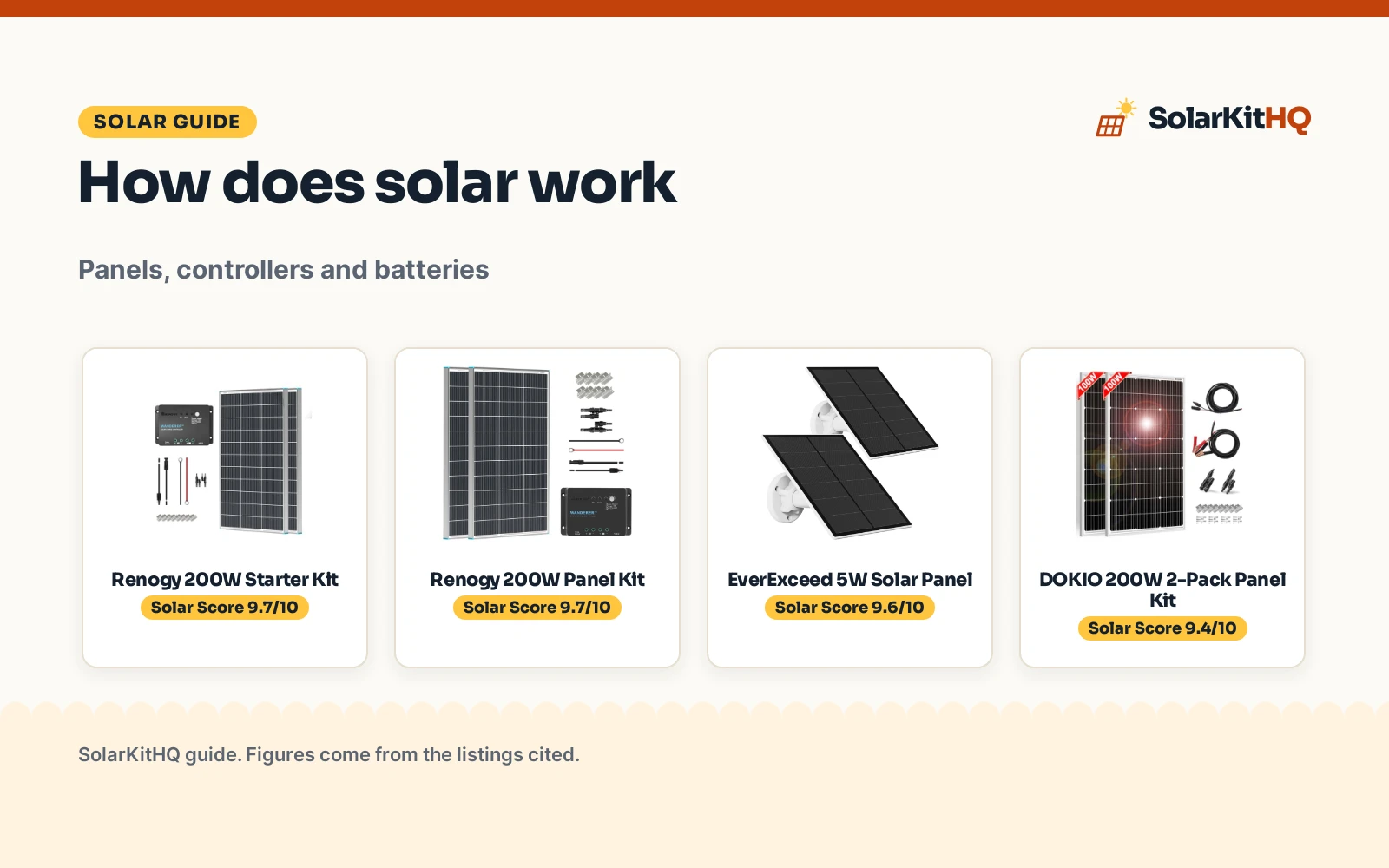
The kits below handle the steps above: panels for the sunlight, controllers for the battery, and cables and brackets for the mount. Each kit shows a different part of the chain, from a bare panel kit to a complete starter kit.
| # | Product | Solar Score | Buy |
|---|---|---|---|
| 1 |  Renogy 200W Starter Kit | 9.7/10 | Buy on Amazon |
| 2 |  Renogy 200W Solar Panel Kit | 9.7/10 | Buy on Amazon |
| 3 |  EverExceed 5W Panel 2-Pack | 9.6/10 | Buy on Amazon |
| 4 |  DOKIO 200W 2-Pack Panel Kit | 9.4/10 | Buy on Amazon |

Renogy 200W Starter Kit
A 200W starter kit with two 100W panels and a 30A PWM charge controller for 12V battery charging.
Pros
- 1000Wh per day on 5 hours of direct sunlight stated
- 25% cell efficiency stated
- 30A PWM controller with 4-stage charging for Sealed, Gel, Flooded and Lithium batteries
- Reverse polarity, overcharging, overload and short circuit protection stated
Cons
- PWM controller, not MPPT
- Kit expands to 400W only by adding more of the same panels
- No snow or wind load figure is stated
- No cable length is stated
Detailed Review
The listing states a 200W kit with two 100W panels, a 30A PWM Wanderer controller, cables, Z-brackets and pre-drilled holes, an average of 1000Wh per day based on 5 hours of direct sunlight, 25% cell efficiency, and expansion up to 400W by adding more of the same panels. The controller suits Sealed, Gel, Flooded and Lithium batteries with 4-stage charging, and lists reverse polarity, battery overcharging, overload and short circuit protection. A 1-year warranty is stated.
Who it's for: RV, boat and camper owners who want a complete 200W starter kit with a controller in the box. Who should skip it: owners who want an MPPT controller from the start.
Its Solar Score of 9.7/10 comes from performance 30/35, build 21/25, value 21/25, safety 8/10 and warranty 3/5: 83 of 100 points, placed on our 9.2 to 9.8 scale.
Key Specifications
| Panels | 2 x 100W, 12V |
|---|---|
| Controller | Wanderer 30A PWM |
| Output | 1000Wh per day on 5 hours of sun |
| Efficiency | 25% cell efficiency |
Taken from the seller's listing on 13 November 2026. Capacity and output figures are rated by the manufacturer.
Safety and Warranty
What this listing states. Reverse polarity, battery overcharging, overload and short circuit protection stated, so safety scores 8 of 10. 1-year warranty stated. It does not say everything a buyer needs, such as who pays return shipping, so warranty scores 3 of 5. See How We Pick.
Panels make voltage in daylight. Keep connectors covered until you connect them, check the panel's stated open circuit voltage and current against your controller or power station input limits, and use cables rated for the current. Roof and permanent mounts belong to a qualified installer.
This is general buying information, not professional advice. Follow each product manual and local rules, and see our Safety Disclaimer.

Renogy 200W Solar Panel Kit
A 200W kit with 30A controller, suited to van roofs with room for two panels; skip it if you want a single panel.
Pros
- 200W with about 1000Wh per day stated
- Expandable to 400W with more panels
- 30A PWM controller with 4-stage charging
- 5-year material and workmanship warranty
Cons
- Two 100W panels to mount, not one
- Rigid frames need flat mounting space
- Barrel connector, check fit with your battery
Detailed Review
Renogy lists a 200W 12V monocrystalline starter kit with two 100W panels and a Wanderer 30A PWM charge controller. The listing states about 1000Wh per day in 5 hours of direct sun, 22% cell efficiency, and expansion to 400W with more of the same panels. The controller supports sealed, gel, flooded and lithium batteries with 4-stage charging and full system protections. The listing states a 5-year material and workmanship warranty.
Who it's for: van and RV roofs with room for two panels. Who should skip it: anyone who wants a single-panel kit.
Its Solar Score of 9.7/10 comes from performance 32/35, build 21/25, value 20/25, safety 7/10 and warranty 4/5: 84 of 100 points, placed on our 9.2 to 9.8 scale.
Key Specifications
| Power | 200W, ~1000Wh/day |
|---|---|
| Controller | 30A PWM, 4-stage |
| Warranty | 5 years |
| Expansion | Up to 400W |
Figures as published on the retailer listing, collected 19 October 2026. Performance figures are manufacturer rated.
Safety and Warranty
What this listing states. Reverse polarity, overcharge, overload and short-circuit protections are stated, so safety scores 7 of 10. 5-year material and workmanship warranty stated. It does not say everything a buyer needs, such as who pays return shipping, so warranty scores 4 of 5. See How We Pick.
Panels make voltage in daylight. Keep connectors covered until you connect them, check the panel's stated open circuit voltage and current against your controller or power station input limits, and use cables rated for the current. Roof and permanent mounts belong to a qualified installer.
This is general buying information, not professional advice. Follow each product manual and local rules, and see our Safety Disclaimer.

EverExceed 5W Panel 2-Pack
A 5W two-pack of monocrystalline panels with 20% stated efficiency and IP65 weather resistance.
Pros
- 20% maximum efficiency value stated, the only percentage in this group
- Two 5W panels for two cameras or a spare
- IP65 weather resistance and -4°F to 122°F operating range stated
- 360 degree adjustable bracket with a 9.8 ft cable
Cons
- No warranty term is stated
- Not compatible with Arlo, Blink, Ring or Google Nest cameras
- The listing asks buyers to add their own protection at the camera charging port
Detailed Review
The listing states two 5W monocrystalline silicon panels with a 20% maximum efficiency value, 5V output, IP65 weather resistance, a -4°F to 122°F operating range, a 360 degree adjustable bracket and 9.8 ft cables. It gives dimensions of 6.85 by 6.46 by 0.58 inches and a weight of 8.32 ounces per the spec table. It is compatible with DC 5V rechargeable battery cameras with Micro USB or USB-C ports, and excludes Arlo, Blink, Ring and Google Nest cameras. The spec table unit count of 1 conflicts with the title, bullets and packing list, which all say two panels, so trust the title for the two-pack.
Who it's for: owners fitting two 5V battery cameras who want the highest stated efficiency in this group. Who should skip it: anyone with a Ring, Arlo, Blink or Google Nest camera, which the listing excludes.
Its Solar Score of 9.6/10 comes from performance 30/35, build 21/25, value 21/25, safety 7/10 and warranty 0/5: 79 of 100 points, placed on our 9.2 to 9.8 scale.
Key Specifications
| Output | 2 x 5W, 5V, 20% efficiency stated |
|---|---|
| Weather rating | IP65, -4°F to 122°F |
| Cable | 9.8 ft |
| Panel size | 6.85 x 6.46 x 0.58 in |
Figures as published on the retailer listing, collected 20 October 2026. Performance figures are manufacturer rated.
Safety and Warranty
What this listing states. IP65 weather resistance and -4°F to 122°F operating range stated, so safety scores 7 of 10. No warranty term, so warranty scores zero. See How We Pick.
Cameras and privacy. Point cameras at your own property, check local rules on recording audio and neighbors' areas, and treat battery life and night vision range as the maker's figures.
This is general buying information, not professional advice. Follow each product manual and local rules, and see our Safety Disclaimer.

DOKIO 200W 2-Pack Panel Kit
A 200W kit with two 100W panels, mounting brackets and a 5 m cable, with the charge controller sold separately.
Pros
- Two 100W panels with Z-brackets and a 5 m MC4 cable
- Half-cell layout and bypass diodes for steady charging in less-than-ideal light
- Pre-drilled holes and Z-brackets for RV, boat, cabin or roof mounting
- 3 m alligator clip cable and 5 m adaptor lead for longer reach
Cons
- No warranty term is stated
- Charge controller sold separately
- No cell efficiency figure is stated
- Snow and wind tolerance is stated without figures
Detailed Review
The listing states two 100W panels, Z-brackets, alligator clips and a 5 m MC4 cable, with a 3 m alligator clip cable and a 5 m adaptor lead, half-cell layout and bypass diodes, pre-drilled holes, and a glass and aluminum frame. It states that the kit suits RVs, boats, cabins and roofs, and that the panels withstand heavy snow and high winds without giving figures. A PWM or MPPT controller is needed for 12V battery charging and is sold separately.
Who it's for: owners who already have a controller and want two 100W panels with brackets and long cables. Who should skip it: owners who want a controller in the box.
Its Solar Score of 9.4/10 comes from performance 28/35, build 21/25, value 20/25, safety 0/10 and warranty 0/5: 69 of 100 points, placed on our 9.2 to 9.8 scale.
Key Specifications
| Panels | 2 x 100W |
|---|---|
| Cable | 5 m MC4 cable |
| Battery | 12V charging with added controller |
| Size | 38.2 x 22.2 x 0.98 in |
Taken from the seller's listing on 13 November 2026. Capacity and output figures are rated by the manufacturer.
Safety and Warranty
What this listing states. No UL, TÜV or IEC listing and no weather rating is stated, so safety scores zero. No warranty term, so warranty scores zero. See How We Pick.
Panels make voltage in daylight. Keep connectors covered until you connect them, check the panel's stated open circuit voltage and current against your controller or power station input limits, and use cables rated for the current. Roof and permanent mounts belong to a qualified installer.
This is general buying information, not professional advice. Follow each product manual and local rules, and see our Safety Disclaimer.
As an Amazon Associate I earn from qualifying purchases.
Ways to keep the system working
- Mount the panel where it sees open sun, and keep the controller and battery shaded.
- Check the polarity before connecting anything, as the DOKIO listing advises.
- Match the controller to the battery type: Sealed, Gel, Flooded or Lithium.
- Add panels of the same kind when expanding, up to the 400W the Renogy listing states.
FAQ: power away from the grid
How does solar work at night?
It does not generate at night; the battery carries the loads. The Renogy kits state an average of 1000Wh per day based on 5 hours of direct sunlight, and the battery holds that charge until night.
Do solar panels work on cloudy days?
They give less. The DOKIO listing states that half-cell layout and bypass diodes keep charging steady in less-than-ideal light. A panel in shade gives less than the same panel in open sun.
What does a charge controller do?
It sits between the panel and the battery, charging in stages and protecting against overcharging. The Renogy kits list a 30A PWM controller with 4-stage charging and reverse polarity, overcharging, overload and short circuit protection.
Can more panels be added later?
Yes, with the same panels. The Renogy kits expand up to 400W by adding more of the same panels. Check the controller before adding panels.
Related solar guides
See the solar panel wiring guide, benefits of solar panels for outages and off-grid days, how to repair solar panels at home and best solar panels for a camper trailer.