On this page
How long do security cameras last? It depends on how the camera is powered and how often it wakes up. A battery camera lasts a few months on a charge, a wired camera lasts for years on plug-in power, and a solar camera keeps going as long as the panel gets sun. This guide explains what sets each lifespan, how to stretch it, and when a camera is done.
SolarKitHQ earns a commission when you buy through links on this page, at no extra cost to you. As an Amazon Associate I earn from qualifying purchases. Affiliate disclosure.
The quick answer: how long do security cameras last
Battery cameras last 1 to 6 months on a charge, and the longest listings in this guide reach 240 to 300 days. Wired cameras run 24/7 on plug-in power, so their limit is the hardware, not the charge. Solar cameras sit in the middle: the panel tops up the battery, and the Tapo C425 (on Amazon) listing states the optional solar panel eliminates the need for recharging.
Step 1: Battery life on a charge
Battery life is set by how often the camera wakes up. The HITELLARCAM states 1 to 6 months of battery life, with 60 days when motion detection triggers 100 times per day. The VISION WELL cameras state 1 to 5 months per charge. The Tapo C400 states up to 180 days on its 5200mAh battery, and the Tapo C401 3-pack states the same 180 days. The aosu system (on Amazon) states 240 days of battery life on 1 charge, based on 40 events per day with 10s of recording each. The Tapo C425 states up to 300 days on its 10000mAh battery.
What shortens a charge is easy to see: more motion triggers, longer clips and more live viewing drain the battery faster. The HITELLARCAM listing warns that battery performance may vary with motion detection frequency, recording mode and temperature, and the aosu listing notes that actual battery life varies with detection frequency, video length and live viewing time.
| Camera | Battery per charge | Notes |
|---|---|---|
| HITELLARCAM | 1 to 6 months | 60 days at 100 triggers per day |
| Tapo C400 | Up to 180 days | 5200mAh battery |
| aosu 2-cam kit | 240 days | 40 events per day, 10s each |
| Tapo C425 | Up to 300 days | 10000mAh battery |
Step 2: Solar cameras last longer
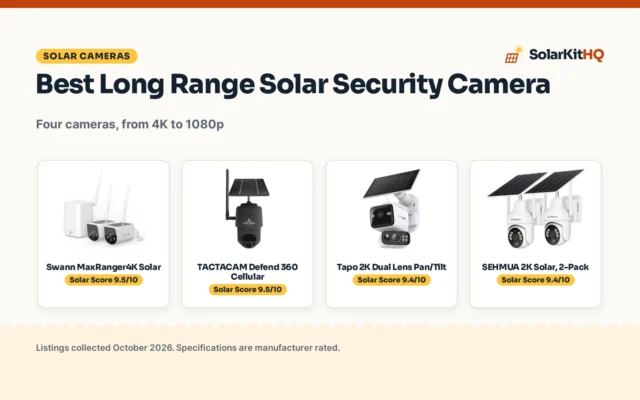
A solar panel keeps the battery topped up, so the camera rarely needs to come down for charging. The Tapo C425 listing states the optional Tapo A200 Solar Panel eliminates the need for recharging, and the aosu camera accepts a solar panel too, with 3.5 times the battery capacity of other aosu models, so it keeps working on days that lack sunlight. Solar cameras still need light: a panel in deep shade charges slowly, and winter days give less sun. Even so, a solar camera outlasts the same camera on battery alone, because the charge cycle never ends.
Step 3: Wired cameras and hardware lifespan
Wired cameras do not run out of charge at all. They plug in and record 24/7, so the lifespan question becomes about the hardware: the lens, the sensor and the storage. Storage sets how much footage you keep, not how long the camera lives. The aosu system has 32GB of built-in memory, giving 240 to 360 days of video recording, and up to 4 cameras can connect to the aosuBase. The Tapo cameras take a microSD card up to 512GB, the HITELLARCAM and realhide take SD cards up to 256GB, and the VISION WELL cameras take a microSD card up to 128GB.
Weather hardiness matters too. The cameras here state IP65 or IP66, with the Tapo C425 and realhide at IP66 and the Tapo C400 (on Amazon) and VISION WELL at IP65 as well. The VISION WELL listing states the camera can work in any weather, and the realhide listing states it handles heavy rain, snow, heat, humidity and dust year-round.
Ways to make cameras last longer
- Cut false alerts: AI and PIR detection filter out leaves and shadows, so the camera wakes up only for real movement. The HITELLARCAM uses AI motion detection to minimize false alerts.
- Add a solar panel: the Tapo C425 and aosu cameras both accept one, and the panel removes the charging chore.
- Keep clips short: the aosu 240-day figure is based on 10s of recording per event, so shorter clips stretch the charge.
- Use local storage: recording to an SD card or the aosuBase avoids the cloud round trip, and the aosu system stores all data locally with no subscription required.
- Mount for the weather: IP65 and IP66 cameras handle rain and dust, but a mount under an eave keeps the lens cleaner for longer.
FAQ: power away from the grid
How long do battery security cameras last?
Most battery cameras last 1 to 6 months on a charge. The HITELLARCAM and realhide state up to 6 months, the Tapo C400 states up to 180 days, the aosu states 240 days, and the Tapo C425 states up to 300 days.
Do solar security cameras last longer?
Yes. A solar panel recharges the battery during the day, and the Tapo C425 listing states the optional solar panel eliminates the need for recharging. The aosu camera also accepts a solar panel.
How long does a security camera record for?
That depends on storage. The aosu system has 32GB of built-in memory, giving 240 to 360 days of video recording, and the Tapo cameras take a microSD card up to 512GB.
How often should security cameras be replaced?
Replace a camera when the battery no longer holds a charge, the night vision fades, or the camera drops off WiFi for good. A wired camera with a clean lens and working storage can run for years.
Do security cameras work in winter?
Yes. The cameras here state IP65 or IP66, and the VISION WELL listing states the camera can work in any weather. Cold weather shortens battery life, so a solar panel or a wired camera is the safer pick for a cold spot.
Related solar guides
See every Solar Security Cameras guide, plus the best solar security cameras for a parking lot and the best solar security cameras for a tiny house.