On this page
A campsite at dusk with a dead phone shows the problem this guide answers: how to step up DC voltage when a battery bank gives fewer volts than the device needs. A small boost converter module sits between the bank and the device and raises the voltage to the level the device wants. The steps below show how to pick the module, set its output and check it with a meter before the load goes on.
SolarKitHQ earns a commission when you buy through links on this page, at no extra cost to you. As an Amazon Associate I earn from qualifying purchases. Affiliate disclosure.
How to step up DC voltage in short
Read the voltage the source gives and the voltage the load needs, then pick a boost module whose input range covers the source and whose output range covers the load. Set the output with the module adjustment screw while a meter watches the output, and only then connect the load. The DORHEA module (on Amazon) in the gear section covers 2-24V in and 5-28V out, while the XIITIA module (on Amazon) covers 8.5-50V in and 10-60V out, so the range you need decides the module.
Match the module to the voltage you need
Start with the voltages that matter: the voltage the source gives and the voltage the load needs. A module only works when the source voltage sits inside its input range and the load voltage sits inside its output range. The DORHEA and AITRIP modules take 2-24V in and give 5-28V out, which covers a 5V, 9V, 12V, 18V or 24V load from a low-voltage source. The XIITIA module takes 8.5-50V in and gives 10-60V out, which suits a higher-voltage load such as a 24V device fed from a 12V bank. The EKYLIN converter (on Amazon) is fixed at 12V in and 24V out, so it suits only that pair.
Current matters as much as voltage. The DORHEA and AITRIP modules list a 2A maximum output current, while the XIITIA module lists a 15A maximum input current and a 12A maximum output current. The EKYLIN converter lists 5A and 120W. Pick a module whose maximum current covers the load with room to spare, and remember that a boost module draws more current from the source than it gives to the load.
Set the output before you connect the load
Adjustable modules have a small blue adjustment screw that sets the output voltage. The DORHEA listing describes the first-use routine: with the module unpowered and no load connected, turn the screw counterclockwise to the end, then clockwise more than 30 turns, then connect power and use a meter to watch the output while you turn the screw to the voltage you need. Set the output with no load connected, since the load should only see the voltage it needs.
The AITRIP module (on Amazon) takes its input through a Type-C USB connection, which suits a USB power adapter as the source. The XIITIA module uses screw terminals for input and output, so the wires fasten under screws and come off again without soldering. The EKYLIN converter has no adjustment screw in its title, so its output stays at the 24V its title states.
Check the output with a meter
Connect power to the module with no load attached and put a meter across the output terminals. Turn the adjustment screw until the meter reads the voltage the load needs, then leave the screw alone. The DORHEA listing says to use a meter to monitor the output voltage to reach the voltage you want, and the same routine works for the AITRIP module. A meter reading beats a guess, since a screw turned too far can send the load more volts than it wants.
Connect the load and mind the heat
Once the meter reads the voltage you need, connect the load to the output terminals. The XIITIA module carries 2 heat sinks to move heat away from the board, and its listing says to decrease power and current when the gap between input and output voltage is big. The DORHEA and AITRIP modules state under-voltage lockout, current limiting and thermal overload protection, which guard the module when the output is overloaded. Give the module air around it and keep it away from flammable material while it runs.
How to step up DC voltage: the gear
The modules below cover the ranges and currents in the steps above: the DORHEA and AITRIP modules handle low-voltage sources, the XIITIA module handles higher power, and the EKYLIN converter covers a fixed 12V to 24V step.
| # | Product | Solar Score | Buy |
|---|---|---|---|
| 1 |  DORHEA MT3608 2A Boost Module | 9.6/10 | Buy on Amazon |
| 2 |  XIITIA 400W 15A Boost Converter | 9.6/10 | Buy on Amazon |
| 3 |  AITRIP Type-C MT3608 Module | 9.6/10 | Buy on Amazon |
| 4 |  EKYLIN 24V 5A Step-Up Converter | 9.6/10 | Buy on Amazon |
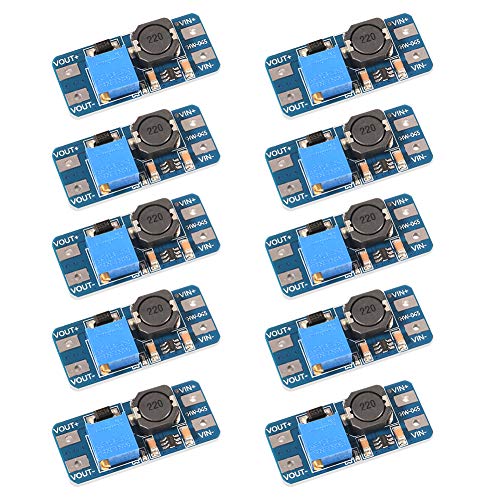
DORHEA MT3608 2A Boost Module
A 2A MT3608 boost module with a 2-24V input and a 5-28V output, sold as a pack of 10 for low-voltage sources.
Pros
- 2-24V input and 5-28V output cover 5V, 9V, 12V, 18V and 24V loads
- Under-voltage lockout, current limiting and thermal overload protection stated
- Up to 93% conversion efficiency stated
- Pack of 10 gives spares for extra projects
Cons
- No warranty term is stated
- Adjustment routine needs a meter and more than 30 turns of the screw
- 2A maximum output current suits only light loads
- No dimensions are stated for the module
Detailed Review
The listing states a mini DC-DC step up module with a 2-24V input, a 5-28V output and a 2A maximum current, built around the MT3608 chip with conversion efficiency up to 93%. It lists under-voltage lockout, current limiting and thermal overload protection, and says the module suits storage batteries, power transformers, DIY adjustable regulated power supplies and industrial equipment. The pack holds 10 modules, and the spec table lists a weight of 0.11 pounds. The listing describes a first-use routine: turn the blue adjustment screw counterclockwise to the end, then clockwise more than 30 turns, then connect power and use a meter to watch the output voltage.
Who it's for: anyone stepping up a low-voltage source to 5V, 9V, 12V, 18V or 24V who wants spares on hand. Who should skip it: anyone who needs more than 2A of output current.
Its Solar Score of 9.6/10 comes from performance 29/35, build 21/25, value 22/25, safety 8/10 and warranty 0/5: 80 of 100 points, placed on our 9.2 to 9.8 scale.
Key Specifications
| Input | 2-24V DC |
|---|---|
| Output | 5-28V DC |
| Max current | 2A |
| Efficiency | Up to 93% |
Figures as published on the retailer listing, collected 12 November 2026. Performance figures are manufacturer rated.
Safety and Warranty
What this listing states. Under-voltage lockout, current limiting and thermal overload protection stated, so safety scores 8 of 10. No warranty term, so warranty scores zero. See How We Pick.
Match the charger. Use a charger mode that matches your battery's stated chemistry and voltage, connect in the order the manual gives, and keep it ventilated and dry.
This is general buying information, not professional advice. Follow each product manual and local rules, and see our Safety Disclaimer.

XIITIA 400W 15A Boost Converter
A 400W boost module with an 8.5-50V input, a 10-60V output and 2 heat sinks for higher-power loads.
Pros
- 400W maximum power with a 15A maximum input current
- 12A maximum output current, the highest in this group
- Up to 96% maximum conversion efficiency stated
- Screw terminals make the wires easy to connect and disconnect
Cons
- No warranty term is stated
- No under-voltage lockout or overload protection is stated
- Listing says to decrease power and current when the gap between input and output voltage is big
- No USB input option is stated; wires fasten to screw terminals
Detailed Review
The listing states a 400W boost module with an 8.5-50V input, a 10-60V output, a 15A maximum input current and a 12A maximum output current, with conversion efficiency up to 96%. It carries 2 heat sinks to enhance heat dissipation, uses screw terminals for input and output, and says it can drive high power LED lights or serve as a voltage regulator for solar panels. The pack holds 2 modules.
Who it's for: anyone stepping up a higher-voltage source for a load that needs up to 60V and 12A. Who should skip it: anyone working from a source below 8.5V.
Its Solar Score of 9.6/10 comes from performance 32/35, build 22/25, value 21/25, safety 5/10 and warranty 0/5: 80 of 100 points, placed on our 9.2 to 9.8 scale.
Key Specifications
| Input | 8.5-50V DC |
|---|---|
| Output | 10-60V DC |
| Max power | 400W |
| Efficiency | Up to 96% |
Figures as published on the retailer listing, collected 12 November 2026. Performance figures are manufacturer rated.
Safety and Warranty
What this listing states. Two heat sinks stated to enhance heat dissipation, so safety scores 5 of 10. No warranty term, so warranty scores zero. See How We Pick.
Match the charger. Use a charger mode that matches your battery's stated chemistry and voltage, connect in the order the manual gives, and keep it ventilated and dry.
This is general buying information, not professional advice. Follow each product manual and local rules, and see our Safety Disclaimer.

AITRIP Type-C MT3608 Module
A 2A MT3608 boost module with a Type-C USB input and a 5-28V output, sold as a pack of 5.
Pros
- Type-C USB input suits a USB power adapter as the source
- Under-voltage lockout, current limiting and thermal overload protection stated
- Efficiency over 93% stated
- Dimensions of 30 x 17 x 6 mm stated
Cons
- No usable warranty term is stated
- 2A maximum output current suits only light loads
- No weight is stated for the module
Detailed Review
The listing states a Type-C MT3608 boost module with a 2A maximum output current, a 5-28V output and efficiency over 93%, with under-voltage lockout, current limiting and thermal overload protection. The title lists a 2-24V input, but a bullet lists the input as 2-15V, so the input range is unclear at the low end. The module measures 30 x 17 x 6 mm, and the pack holds 5 modules.
Who it's for: anyone who wants a Type-C input and a 5-28V output from a USB power adapter. Who should skip it: anyone who needs the input range pinned down in the listing before buying.
Its Solar Score of 9.6/10 comes from performance 28/35, build 20/25, value 20/25, safety 8/10 and warranty 0/5: 76 of 100 points, placed on our 9.2 to 9.8 scale.
Key Specifications
| Input | 2-24V DC |
|---|---|
| Output | 5-28V DC |
| Max current | 2A |
| Efficiency | Over 93% |
Figures as published on the retailer listing, collected 12 November 2026. Performance figures are manufacturer rated.
Safety and Warranty
What this listing states. Under-voltage lockout, current limiting and thermal overload protection stated, so safety scores 8 of 10. No warranty term, so warranty scores zero. See How We Pick.
Match the charger. Use a charger mode that matches your battery's stated chemistry and voltage, connect in the order the manual gives, and keep it ventilated and dry.
This is general buying information, not professional advice. Follow each product manual and local rules, and see our Safety Disclaimer.

EKYLIN 24V 5A Step-Up Converter
Steps 12V up to 24V at 5A and 120W, with a 3 Year Warranty stated and five protections listed.
Pros
- 3 Year Warranty stated, the longest term in this group
- Five protections listed: over-voltage, under-voltage, overload, over-heat and short circuit
- Wide 9V to 20V input range stated
- Slim shape stated, with a line about 12CM long
Cons
- 5A output is the lowest current in this group
- 120W output is the lowest power in this group, shared with the DIGITEN module
- No efficiency figure is stated
- No IP code is stated for the housing
Detailed Review
The listing states a 12V to 24V step-up converter with a 9V to 20V input range, a 5A output at 120W, five protections, and a 3 Year Warranty. The line is about 12CM long, and the housing is described for use in vehicles, security systems, hospital equipment and telecommunications. No efficiency figure and no IP code are stated, so the housing claim has no code to check against.
Who it's for: owners who want a small 120W step-up converter with the longest warranty term here. Who should skip it: anyone who needs more than 5A at 24V.
Its Solar Score of 9.6/10 comes from performance 28/35, build 20/25, value 20/25, safety 7/10 and warranty 4/5: 79 of 100 points, placed on our 9.2 to 9.8 scale.
Key Specifications
| Output | 24V, 5A, 120W |
|---|---|
| Input range | 9V to 20V DC |
| Size | DC 12V to 24V 5A |
| Protection | Over-voltage, under-voltage, overload, over-heat, short circuit |
Figures as published on the retailer listing, collected 10 November 2026. Performance figures are manufacturer rated.
Safety and Warranty
What this listing states. Over-voltage, under-voltage, overload, over-heat and short circuit protection stated, so safety scores 7 of 10. 3 Year Warranty stated. It does not say everything a buyer needs, such as who pays return shipping, so warranty scores 4 of 5. See How We Pick.
Match the charger. Use a charger mode that matches your battery's stated chemistry and voltage, connect in the order the manual gives, and keep it ventilated and dry.
This is general buying information, not professional advice. Follow each product manual and local rules, and see our Safety Disclaimer.
As an Amazon Associate I earn from qualifying purchases.
FAQ: power away from the grid
Can a boost converter raise 5V to 12V?
Yes, when the module range covers both voltages. The DORHEA and AITRIP modules take 2-24V in and give 5-28V out, so 5V in and 12V out sit inside those ranges. Set the output with the adjustment screw and check it with a meter before you connect the load.
What does the adjustment screw do?
Turning the screw changes the output voltage. The DORHEA listing describes turning the blue screw counterclockwise to the end, then clockwise more than 30 turns, then connecting power and watching a meter while you turn the screw to the voltage you need.
How much current can a small boost module give?
The DORHEA and AITRIP modules list a 2A maximum output current, while the EKYLIN converter lists 5A and the XIITIA module lists a 12A maximum output current with a 15A maximum input current. Pick the module whose maximum current covers the load.
Can a boost converter work as a solar panel voltage regulator?
The XIITIA listing says it can serve as a voltage regulator for solar panels. Check that the panel voltage sits inside the 8.5-50V input range and the load voltage sits inside the 10-60V output range.
Related solar guides
See the best DC to DC converter step up 12V picks, the best DC to DC converters and every inverters and controllers guide.