On this page
A battery bank and a device that needs a lower voltage do not meet in the middle on their own, and the part that bridges them is a DC step-down converter. How to step down DC voltage comes down to matching a buck converter to the job: the input range has to cover the source, the output has to match the load, and the current has to cover what the load draws. The listings in this guide cover converters from a pack of fixed boards to a unit with a meter, and the steps below show how to read the ranges and set the output.
SolarKitHQ earns a commission when you buy through links on this page, at no extra cost to you. As an Amazon Associate I earn from qualifying purchases. Affiliate disclosure.
As an Amazon Associate, SolarKitHQ earns from qualifying purchases. When you buy through links on this page, SolarKitHQ may earn a commission.
The quick answer
Use a DC buck converter. It takes a higher DC voltage in and gives a lower DC voltage out, and you set the output with a potentiometer or a screwdriver while you watch the display. The DROK converter (on Amazon) in this guide takes an input of DC 6V-32V and gives an output of DC 1.5V-32V at up to 5A, the Seloky module (on Amazon) takes 4.0V-40V in and gives 1.25V-37V out, and the DROK CNC (on Amazon) unit takes 6-70V in and gives 0-60V out at up to 20A. The Teyleten boards give a fixed 5V output, so they suit a load that already runs on 5V.
How to step down DC voltage: match the converter to the job
3 figures decide the match, and every listing in this guide states them.
- Input range. The converter has to accept the source voltage. The DROK converter accepts DC 6V-32V, the Seloky module accepts 4.0V-40V, the Teyleten boards accept 5.5V-30V, and the DROK CNC unit accepts 6-70V.
- Output range. The output has to match the load. The DROK converter gives DC 1.5V-32V, the Seloky module gives 1.25V-37V, the DROK CNC unit gives 0-60V with fixed outputs of 5V, 9V, 12V, 24V, 36V, 48V and 60V, and the Teyleten boards give a fixed 5V.
- Current and power. The converter has to carry the load current. The DROK converter gives up to 5A and 75W, with use within 4.5A and 50W recommended, the DROK CNC unit gives up to 20A and 1200W, and the Teyleten boards give 3A with a 4A maximum peak.
The Seloky module states an LED voltmeter display with a measurement error of ±0.1V, and the DROK converter states an LCD screen showing voltage and current at the same time. The Teyleten boards state an output accuracy of ±0.1V and a conversion efficiency of 96% maximum.
The converters that step the voltage down
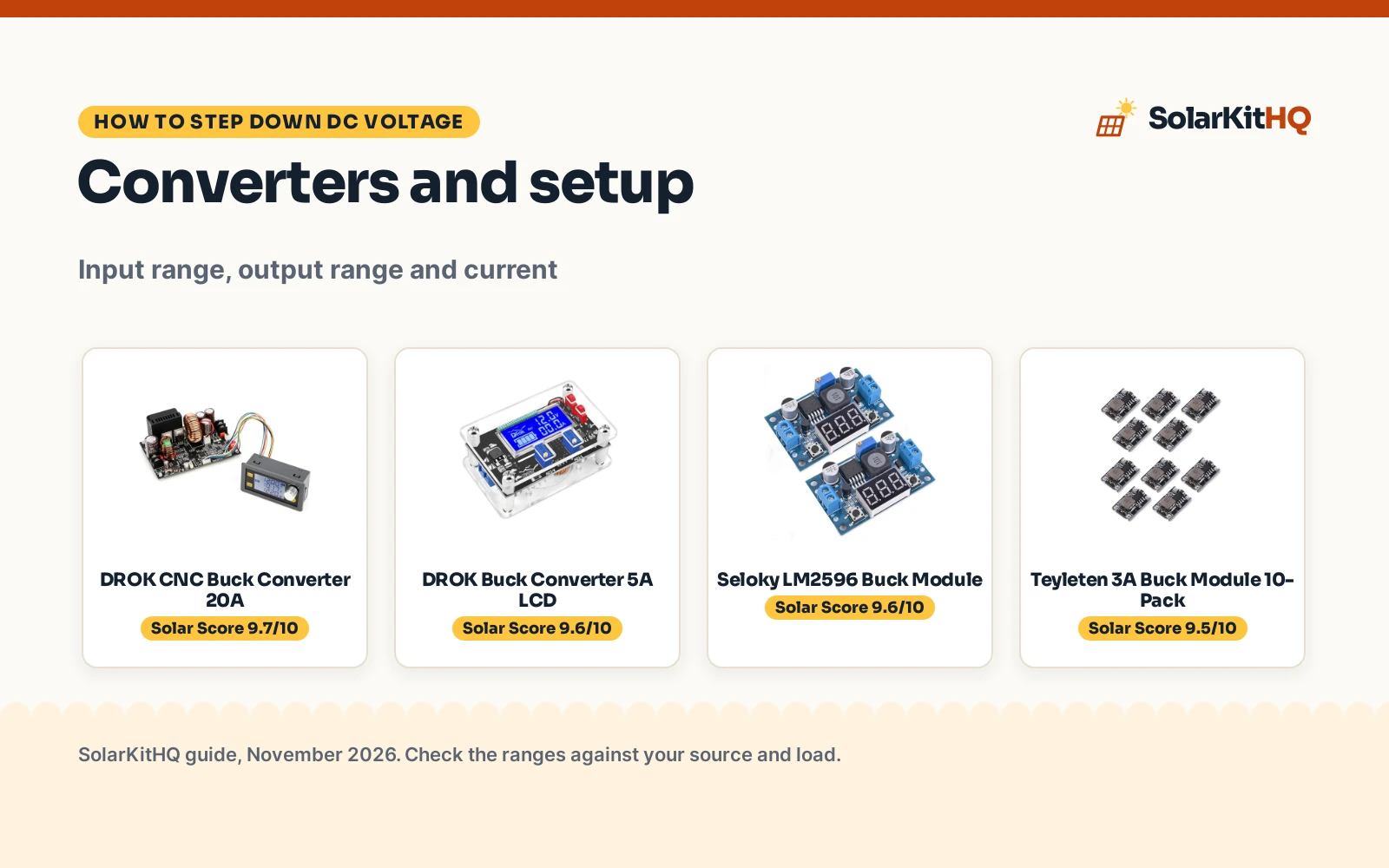
Each converter below covers one part of the job: the DROK CNC unit for the largest current and power, the DROK converter with a display for an adjustable output, the Seloky modules for a small adjustable output with a voltmeter, and the Teyleten boards for a fixed 5V output across several builds.
| # | Product | Solar Score | Buy |
|---|---|---|---|
| 1 |  DROK CNC Buck Converter 20A | 9.7/10 | Buy on Amazon |
| 2 |  DROK Buck Converter 5A LCD | 9.6/10 | Buy on Amazon |
| 3 |  Seloky LM2596 Buck Module | 9.6/10 | Buy on Amazon |
| 4 |  Teyleten 3A Buck Module 10-Pack | 9.5/10 | Buy on Amazon |

DROK CNC Buck Converter 20A
A 20A, 1200W buck converter with a 6-70V input, a 0-60V output, fixed output voltages and a temperature-controlled cooling fan.
Pros
- Input 6-70V and output 0-60V at up to 20A and 1200W
- Fixed output voltages of 5V, 9V, 12V, 24V, 36V, 48V and 60V
- Temperature-controlled cooling fan with a large heat sink
- LCD color screen shows the module status
Cons
- Output is set to fixed voltages, not a continuous range
- No input reverse connection protection is stated
- No meter accuracy figure is stated
- No input connector type is stated
Detailed Review
The listing states an input of 6-70V, an output of 0-60V, an output current of 0-20A and an output power of 0-1200W, with fixed output voltages of 5V, 9V, 12V, 24V, 36V, 48V and 60V. It states a temperature-controlled cooling fan with a large heat sink, an LCD color screen and low ripple output. Protection covers external temperature, input over and under voltage, output over voltage, over current and over power, over temperature, timeout, over capacity and over energy. The listing states a 1-year warranty.
Who it's for: an owner who needs up to 20A and 1200W from a 6-70V source with a set output voltage. Who should skip it: anyone who needs a continuously adjustable output voltage, or a stated input connector type.
Its Solar Score of 9.7/10 comes from performance 33/35, build 22/25, value 21/25, safety 8/10 and warranty 0/5: 84 of 100 points, placed on our 9.2 to 9.8 scale.
Key Specifications
| Input | 6-70V |
|---|---|
| Output | 0-60V, 0-20A, 0-1200W |
| Fixed outputs | 5V, 9V, 12V, 24V, 36V, 48V, 60V |
| Cooling | Temperature-controlled fan |
Figures as published on the retailer listing, collected 12 November 2026. Performance figures are manufacturer rated.
Safety and Warranty
What this listing states. External temperature, input over and under voltage, output over voltage, over current and over power, over temperature, timeout, over capacity and over energy protection stated, so safety scores 8 of 10. No warranty term, so warranty scores zero. See How We Pick.
Follow the manual. Connect and use the product as the maker describes, stay within every stated rating, and read the manual before first use.
This is general buying information, not professional advice. Follow each product manual and local rules, and see our Safety Disclaimer.

DROK Buck Converter 5A LCD
An adjustable buck converter with a 6V-32V input, a 1.5-32V output, a 5A maximum current and an LCD screen showing voltage and current.
Pros
- Input 6V-32V and output 1.5V-32V at up to 5A and 75W
- LCD screen shows voltage and current at the same time
- Constant current and constant voltage modes with calibration
- USB interface and a protective case
Cons
- No warranty term is stated
- Maximum current is 5A, with use within 4.5A recommended
- Maximum power is 75W, with use within 50W recommended
- The case is packaged unassembled and needs manual installation
Detailed Review
The listing states an input of DC 6V-32V, an output of DC 1.5V-32V, a maximum output current of 5A with use within 4.5A recommended, and a maximum output power of 75W with use within 50W recommended. It states a large clear digital LCD display showing voltage and current at the same time, constant current and voltage modes, voltage and current calibration, a USB interface and a protective case. Protection covers over-current, short-circuit, over-temperature and input reverse connection. The output voltage is set around 20V by default, and the case is packaged unassembled.
Who it's for: an owner who wants an adjustable buck converter with a display for a 6V-32V source. Who should skip it: anyone who needs more than 5A, or a case that arrives assembled.
Its Solar Score of 9.6/10 comes from performance 30/35, build 21/25, value 21/25, safety 7/10 and warranty 0/5: 79 of 100 points, placed on our 9.2 to 9.8 scale.
Key Specifications
| Input | DC 6V-32V |
|---|---|
| Output | DC 1.5V-32V, 5A, 75W |
| Display | LCD voltage and current |
| Case | Protective case |
Figures as published on the retailer listing, collected 12 November 2026. Performance figures are manufacturer rated.
Safety and Warranty
What this listing states. Over-current, short-circuit and over-temperature protection and input reverse connection protection stated, so safety scores 7 of 10. No warranty term, so warranty scores zero. See How We Pick.
Follow the manual. Connect and use the product as the maker describes, stay within every stated rating, and read the manual before first use.
This is general buying information, not professional advice. Follow each product manual and local rules, and see our Safety Disclaimer.

Seloky LM2596 Buck Module
A pack of 2 LM2596 buck converter modules with a 4.0-40V input, a 1.25-37V output and an LED voltmeter display.
Pros
- Input 4.0V-40V and output 1.25V-37V
- LED voltmeter display with a measurement error of ±0.1V
- Terminal blocks for quick connections, with no soldering needed
- Pack of 2 modules
Cons
- No warranty term is stated
- For power over 15W, the listing says to improve heat dissipation
- The voltmeter does not operate if the input is below 4V
Detailed Review
The listing states an input of 4.0V to 40V, an output of 1.25V to 37V and an LED voltmeter display with a measurement error of ±0.1V. It states an internal oscillation frequency of 150KHz, solid capacitors, terminal blocks for quick connections and adjustment with a mini screwdriver. The input side is protected by two diodes, with overheat and short-circuit protection. The title states a pack of 2 while the spec table lists 1 item, so the title is the figure to trust.
Who it's for: an owner who wants a small adjustable buck module with a voltmeter display for a 4.0-40V source. Who should skip it: anyone who needs more than the stated 15W without added heat dissipation, or a stated warranty term.
Its Solar Score of 9.6/10 comes from performance 29/35, build 20/25, value 21/25, safety 7/10 and warranty 0/5: 77 of 100 points, placed on our 9.2 to 9.8 scale.
Key Specifications
| Input | 4.0V-40V |
|---|---|
| Output | 1.25V-37V |
| Display | LED voltmeter, ±0.1V |
| Pack | 2 modules |
Figures as published on the retailer listing, collected 12 November 2026. Performance figures are manufacturer rated.
Safety and Warranty
What this listing states. Input protected by two diodes, overheat and short-circuit protection stated, so safety scores 7 of 10. No warranty term, so warranty scores zero. See How We Pick.
Follow the manual. Connect and use the product as the maker describes, stay within every stated rating, and read the manual before first use.
This is general buying information, not professional advice. Follow each product manual and local rules, and see our Safety Disclaimer.

Teyleten 3A Buck Module 10-Pack
A 10-pack of mini buck converter boards with a 5.5V-30V input, a fixed 5V output and a 3A maximum current.
Pros
- Fixed 5V output at up to 3A, with a 4A maximum peak
- Conversion efficiency of 96% maximum
- Output accuracy of ±0.1V and output ripple under 30mA
- 10 boards in the pack
Cons
- No warranty term is stated
- Output is fixed at 5V, with no adjustment stated
- No short-circuit or reverse connection protection is stated
- Current is within 2A without heat dissipation
Detailed Review
The listing states an input of 5.5V to 30V, with input greater than output and use within 28V recommended, and a fixed output of 5V. Output current is 3A with a 4A maximum peak, and 2A without heat dissipation. It states a conversion efficiency of 96% maximum, output ripple under 30mA, output accuracy of ±0.1V and a no-load current of 1mA. The operating temperature is -20°C to +85°C and the operating humidity is 20% to 90%.
Who it's for: an owner who needs a fixed 5V output at up to 3A across several small builds. Who should skip it: anyone who needs an adjustable output voltage, or a stated warranty term.
Its Solar Score of 9.5/10 comes from performance 28/35, build 20/25, value 22/25, safety 0/10 and warranty 0/5: 70 of 100 points, placed on our 9.2 to 9.8 scale.
Key Specifications
| Input | 5.5V-30V |
|---|---|
| Output | 5V fixed, 3A |
| Efficiency | 96% maximum |
| Pack | 10 boards |
Figures as published on the retailer listing, collected 12 November 2026. Performance figures are manufacturer rated.
Safety and Warranty
What this listing states. No safety listing, protection or rating is stated, so safety scores zero. No warranty term, so warranty scores zero. See How We Pick.
Follow the manual. Connect and use the product as the maker describes, stay within every stated rating, and read the manual before first use.
This is general buying information, not professional advice. Follow each product manual and local rules, and see our Safety Disclaimer.
As an Amazon Associate I earn from qualifying purchases.
How to set the output voltage
Set the output before you connect the load, and check it on the display.
- Read the ranges. Check the input range against the source and the output range against the load. The DROK converter accepts DC 6V-32V, and the Seloky module accepts 4.0V-40V.
- Turn the adjustment. The DROK converter sets its output with a potentiometer, and the Seloky module adjusts with a mini screwdriver. The DROK converter ships with its output set around 20V by default, so turn the potentiometer anticlockwise for 10 laps or more until the voltage changes if the input is lower than that.
- Watch the display. The DROK converter shows voltage and current on its LCD screen, and the Seloky module shows voltage on its LED voltmeter. The Seloky voltmeter switches off when you hold the switch for over 1 second and less than 4 seconds, then turns on with a brief press.
- Check the protections. The DROK converter states over-current, short-circuit, over-temperature and input reverse connection protection, and the Seloky module states input protection by two diodes with overheat and short-circuit protection.
For power over 15W, the Seloky listing says to improve heat dissipation. The Teyleten boards give 2A without heat dissipation, and the DROK CNC unit has a temperature-controlled cooling fan with a large heat sink.
FAQ: power away from the grid
What is a DC buck converter?
A buck converter takes a higher DC voltage in and gives a lower DC voltage out. The DROK converter in this guide takes DC 6V-32V in and gives DC 1.5V-32V out, and the Seloky module takes 4.0V-40V in and gives 1.25V-37V out.
Can a buck converter raise the voltage?
No. A buck converter only steps voltage down, so the output stays below the input. The Teyleten boards state that the input must be greater than the output, and the DROK converter gives an output of DC 1.5V-32V from an input of DC 6V-32V.
How do I set the output voltage on a buck converter?
Turn the adjustment while you watch the display. The DROK converter sets its output with a potentiometer and shows voltage and current on its LCD screen, and the Seloky module adjusts with a mini screwdriver and shows voltage on its LED voltmeter.
What current can these buck converters carry?
The DROK CNC unit carries up to 20A and 1200W, the DROK converter carries up to 5A and 75W with use within 4.5A and 50W recommended, and the Teyleten boards carry 3A with a 4A maximum peak. Match the current to what the load draws.
Related solar guides
See every controllers and inverters guide, the best 12V batteries for generators and the best deep cycle batteries for generators.