On this page
At a campsite at dusk, a fridge and a phone charger share a battery, and the question is whether the voltage needs to go up or down: step up vs step down DC converter is the choice between raising a low battery voltage and dropping a high one to the level your loads want. The short verdict: pick a step-down converter when your battery bank sits above the voltage your loads want, and a step-up converter when it sits below it. This comparison covers step-up and step-down converters on input and output voltage, current, power, protection and warranty terms.
SolarKitHQ earns a commission when you buy through links on this page, at no extra cost to you. As an Amazon Associate I earn from qualifying purchases. Affiliate disclosure.
Step up vs step down DC converter: side by side
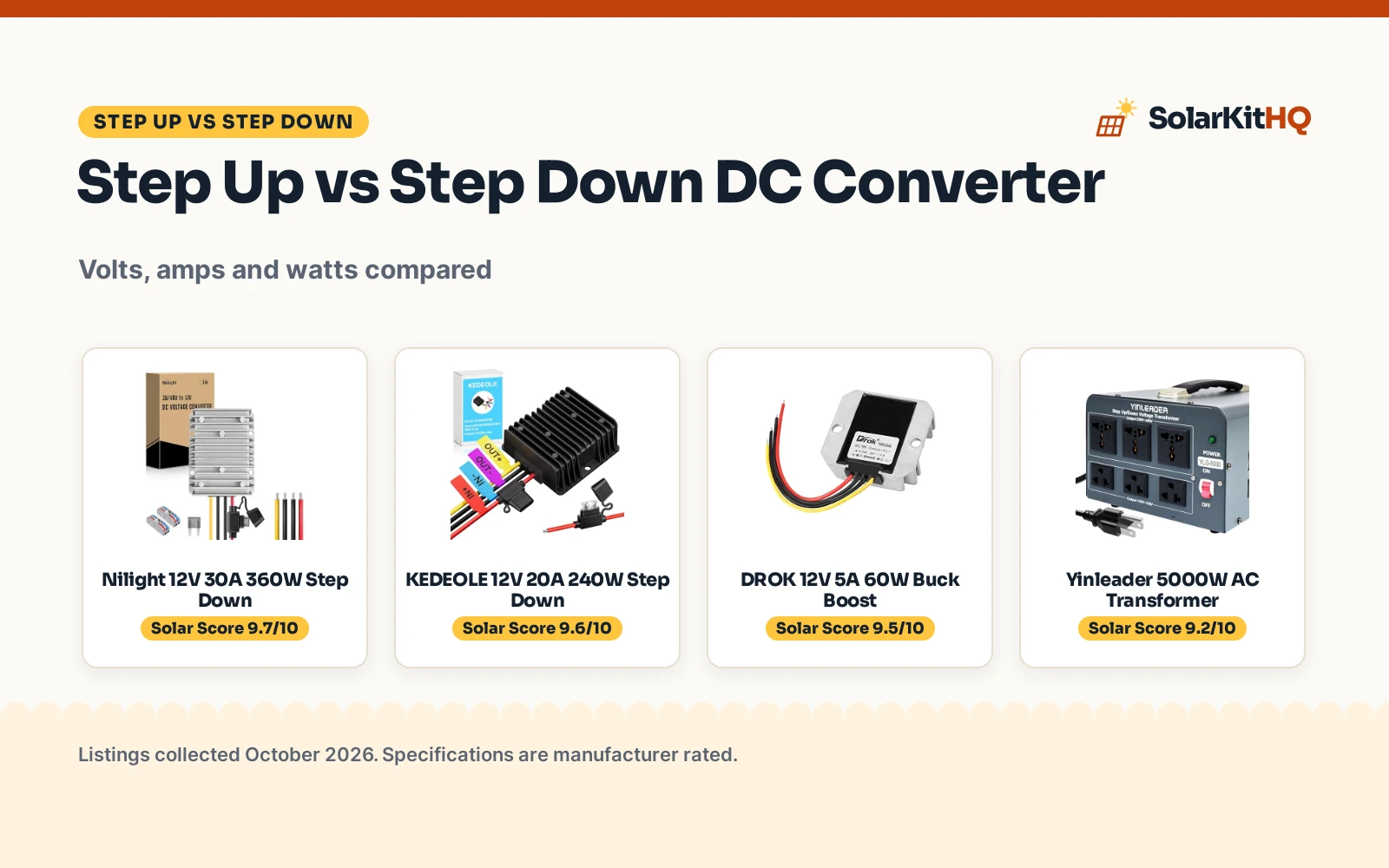
| Step Up vs Step Down DC Converter | Nilight 12V 30A 360W Step Down | KEDEOLE 12V 20A 240W Step Down | DROK 12V 5A 60W Buck Boost | Yinleader 5000W AC Transformer | Amazon |
|---|---|---|---|---|---|
| Side | Step down | Step down | Step up | Step up | |
| Input voltage | DC 18-60V | DC 20-60V | DC 9-36V | AC 110/120V or 220/240V | |
| Output | 12V, 30A, 360W | 12V, 20A, 240W | 12V, 5A, 60W | 110/120V or 220/240V, 5000W | |
| Efficiency stated | Up to 96% | Not stated | Over 90% | Not stated | |
| Protection stated | Over/under voltage, over-current, overload, over-temperature, short circuit | Overload, short-circuit, over-current, over-temperature, fuse | Over-current, over-temperature | Circuit breaker | |
| Warranty | 2 years | Not stated | Not stated | 1 year |
Figures in this table are the manufacturer’s ratings as listed, captured 13 November 2026.
Input and output voltage
Voltage direction is the first split. The Nilight takes DC 18V to 60V in and puts out a fixed 12V, and the KEDEOLE takes DC 20V to 60V in and puts out the same fixed 12V. Both are step-down converters: a battery bank above 12V goes in, and 12V comes out. The DROK takes DC 9V to 36V in and also puts out a fixed 12V, so it raises voltages below 12V and drops voltages above it. The Yinleader is the odd listing here: it converts AC mains voltage between 110/120V and 220/240V, not a DC battery voltage.
Power and current
Current decides how much load a converter can feed at 12V. The Nilight lists 30A and 360W, the KEDEOLE lists 20A and 240W, and the DROK lists 5A and 60W. The Yinleader lists 5000W, but that figure belongs to an AC transformer, and its bullets put the maximum appliance power at 3000 watts, so it does not compare with the DC figures. The DROK listing also states to leave a margin for the power supply, so size the converter above the load it feeds.
Protection and housings
Protection is stated on each listing. The Nilight lists a smart chip with protection against over-voltage, over-current, overload, over-temperature and short circuit. The KEDEOLE lists auto-cutoff for overload, short-circuit, over-current and over-temperature with a safety fuse. The DROK lists over-current and over-temperature protection. The Yinleader lists circuit breaker protection for each voltage. Housings are aluminum on the three DC converters: the Nilight shell is die-cast aluminum with silicone sealing, the KEDEOLE housing is aluminum with thermal pads and a zero-fan design, and the DROK shell is aluminum with potting technology.
What the listings leave unclear
The DROK title calls it a step up down converter while a bullet calls it a step down power module; the 9V to 36V input with a fixed 12V output covers both directions, so the buck-boost name is the one to use. The KEDEOLE and Nilight titles name 36V and 48V inputs while their bullets state wider input ranges, 20V to 60V and 18V to 60V. The Yinleader is listed on the step-up side but is an AC transformer, so the DROK is the only true step-up DC converter here. No listing here states a UL, ETL or CSA listing.
The examples
| # | Product | Solar Score | Buy |
|---|---|---|---|
| 1 |  Nilight 12V 30A 360W Step Down | 9.7/10 | Buy on Amazon |
| 2 |  KEDEOLE 12V 20A 240W Step Down | 9.6/10 | Buy on Amazon |
| 3 |  DROK 12V 5A 60W Buck Boost | 9.5/10 | Buy on Amazon |
| 4 |  Yinleader 5000W AC Transformer | 9.2/10 | Buy on Amazon |

Nilight 12V 30A 360W Step Down
A 12V 30A 360W step-down converter with a stated 96% efficiency, a die-cast aluminum shell and a 2-year warranty.
Pros
- 30A output at 12V, the highest current in this group
- Conversion efficiency stated up to 96%
- Smart chip protection against over-voltage, over-current, overload, over-temperature and short circuit stated
- 2-year warranty stated
Cons
- Title names 36V and 48V inputs while the bullets state an 18V to 60V input range
- Output is fixed at 12V
- No fuse is listed
- No dimensions are listed
Detailed Review
The listing states an input range of DC 18V to 60V, an output of 12V at 30A and 360W, a conversion efficiency of up to 96% with synchronous rectification, and a die-cast aluminum shell with silicone sealing. A smart chip gives protection against over-voltage, over-current, overload, over-temperature and short circuit, and the warranty is 2 years. The title names 36V and 48V inputs while the bullets state the wider 18V to 60V range, so compare on the wider range.
Who it's for: owners with a 24V, 36V or 48V battery bank who want a fixed 12V output at up to 30A. Who should skip it: anyone whose load wants a voltage other than 12V.
Its Solar Score of 9.7/10 comes from performance 32/35, build 22/25, value 21/25, safety 9/10 and warranty 3/5: 87 of 100 points, placed on our 9.2 to 9.8 scale.
Key Specifications
| Input | DC 18-60V |
|---|---|
| Output | 12V, 30A, 360W |
| Efficiency | Up to 96% |
| Warranty | 2 Year Warranty |
Taken from the seller's listing on 13 November 2026. Capacity and output figures are rated by the manufacturer.
Safety and Warranty
What this listing states. Smart chip protection against over-voltage, over-current, overload, over-temperature and short circuit stated, so safety scores 9 of 10. 2 Year Warranty stated. It does not say everything a buyer needs, such as who pays return shipping, so warranty scores 3 of 5. See How We Pick.
Match the charger. Use a charger mode that matches your battery's stated chemistry and voltage, connect in the order the manual gives, and keep it ventilated and dry.
This is general buying information, not professional advice. Follow each product manual and local rules, and see our Safety Disclaimer.
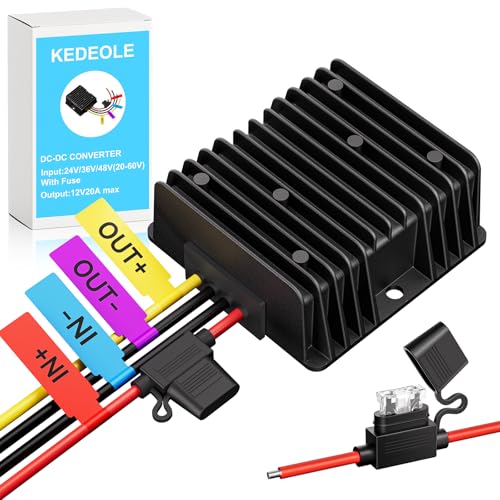
KEDEOLE 12V 20A 240W Step Down
A 12V 20A 240W step-down converter with a fuse and an aluminum housing.
Pros
- 20A output at 12V and 240W stated
- Vibration-proof and weather-resistant aluminum housing stated
- Auto-cutoff for overload, short-circuit, over-current and over-temperature with a safety fuse stated
- Zero-fan design with an aluminum housing and thermal pads stated
Cons
- Title names 36V and 48V inputs while the bullets state a 20V to 60V input range
- Output is fixed at 12V
- No efficiency figure is stated
- No fuse size is stated
Detailed Review
The listing states a 20V to 60V input, a 12V output at 20A and 240W, an aluminum housing with thermal pads and a zero-fan design. Auto-cutoff covers overload, short-circuit, over-current and over-temperature, with a safety fuse. The title names 36V and 48V inputs while the bullets state the wider 20V to 60V range, so compare on the wider range.
Who it's for: golf cart and RV owners with a 24V, 36V or 48V bank who want a fixed 12V output at up to 20A. Who should skip it: anyone who wants more than 20A of output current.
Its Solar Score of 9.6/10 comes from performance 30/35, build 21/25, value 20/25, safety 8/10 and warranty 0/5: 79 of 100 points, placed on our 9.2 to 9.8 scale.
Key Specifications
| Input | DC 20-60V |
|---|---|
| Output | 12V, 20A, 240W |
| Size | 2.9 x 1.29 x 2.9 in |
Taken from the seller's listing on 13 November 2026. Capacity and output figures are rated by the manufacturer.
Safety and Warranty
What this listing states. Auto-cutoff for overload, short-circuit, over-current and over-temperature with a safety fuse stated, so safety scores 8 of 10. No warranty term, so warranty scores zero. See How We Pick.
Match the charger. Use a charger mode that matches your battery's stated chemistry and voltage, connect in the order the manual gives, and keep it ventilated and dry.
This is general buying information, not professional advice. Follow each product manual and local rules, and see our Safety Disclaimer.

DROK 12V 5A 60W Buck Boost
A 9V to 36V buck-boost converter with a fixed 12V output at 5A and 60W, over 90% efficiency and an aluminum shell.
Pros
- Input range of 9V to 36V covers voltages below and above 12V
- Conversion efficiency stated over 90% with synchronous rectification
- Over-current and over-temperature protection stated
- Aluminum shell with potting stated
Cons
- No warranty term is stated
- 5A and 60W output, the lowest power here
- The title calls it a step up down converter while a bullet calls it a step down power module
- Non-isolated module, with ground wires tied together
Detailed Review
The listing states an input range of DC 9V to 36V, a fixed output of 12V at 5A and 60W, a conversion efficiency of over 90% with synchronous rectification, and over-current and over-temperature protection. The aluminum shell uses potting technology. The title calls it a step up down converter while a bullet calls it a step down power module; the 9V to 36V input with a fixed 12V output covers both directions. The listing states to leave a margin for the power supply.
Who it's for: owners with a 9V, 12V, 24V or 36V source who want a fixed 12V output at up to 5A. Who should skip it: anyone who wants more than 5A or a stated warranty term.
Its Solar Score of 9.5/10 comes from performance 29/35, build 20/25, value 19/25, safety 7/10 and warranty 0/5: 75 of 100 points, placed on our 9.2 to 9.8 scale.
Key Specifications
| Input | DC 9-36V |
|---|---|
| Output | 12V, 5A, 60W |
| Efficiency | Over 90% |
| Protection | Over-current, over-temperature |
Taken from the seller's listing on 13 November 2026. Capacity and output figures are rated by the manufacturer.
Safety and Warranty
What this listing states. Over-current protection and over-temperature protection stated, so safety scores 7 of 10. No warranty term, so warranty scores zero. See How We Pick.
Match the charger. Use a charger mode that matches your battery's stated chemistry and voltage, connect in the order the manual gives, and keep it ventilated and dry.
This is general buying information, not professional advice. Follow each product manual and local rules, and see our Safety Disclaimer.

Yinleader 5000W AC Transformer
A 5000W AC step-up and step-down transformer with 110/120V and 220/240V sockets, circuit breaker protection and a 1-year warranty.
Pros
- Converts 110/120V to 220/240V and back
- 5000W figure stated
- Circuit breaker protection for each voltage stated
- 3 US sockets and 3 universal sockets stated
Cons
- An AC mains transformer, not a DC converter
- Maximum appliance power is 3000 watts, below the 5000W figure
- 13.6 pounds stated
- Converts voltage only, not frequency
Detailed Review
The listing states a 5000W step up and step down transformer for 110/120V and 220/240V mains power, with 3 US sockets, 3 universal sockets, a US power cord and circuit breaker protection for each voltage. It is an AC transformer, not a DC converter: it cannot step a DC battery voltage up or down. The listing rates the transformer at 5000W and puts the maximum appliance power at 3000 watts, and states to select the correct input voltage and check the power source before use.
Who it's for: owners who want to run a 110/120V appliance on 220/240V mains, or the reverse. Who should skip it: anyone who wants to convert a DC battery voltage.
Its Solar Score of 9.2/10 comes from performance 18/35, build 15/25, value 12/25, safety 7/10 and warranty 2/5: 54 of 100 points, placed on our 9.2 to 9.8 scale.
Key Specifications
| Input | 110/120V or 220/240V AC |
|---|---|
| Output | 110/120V and 220/240V sockets |
| Power | 5000W |
| Warranty | 1 year |
Taken from the seller's listing on 13 November 2026. Capacity and output figures are rated by the manufacturer.
Safety and Warranty
What this listing states. Circuit breaker protection for each voltage stated, so safety scores 7 of 10. 1 year warranty stated. It does not say everything a buyer needs, such as who pays return shipping, so warranty scores 2 of 5. See How We Pick.
Match the charger. Use a charger mode that matches your battery's stated chemistry and voltage, connect in the order the manual gives, and keep it ventilated and dry.
This is general buying information, not professional advice. Follow each product manual and local rules, and see our Safety Disclaimer.
As an Amazon Associate I earn from qualifying purchases.
Where the points went
The Solar Score weighs performance, build, value, safety and warranty. For DC converters, safety means stated protection against over-current, over-temperature, short circuits and overload; the Nilight, KEDEOLE and DROK state such protection, and the Yinleader states circuit breaker protection. The Nilight states a 2-year warranty and the Yinleader a 1-year warranty, while the KEDEOLE and the DROK state no warranty term. How we pick explains the weights.
| Product | Solar Score | Perf. /35 | Build /25 | Value /25 | Safety /10 | Warranty /5 |
|---|---|---|---|---|---|---|
| Nilight 12V 30A 360W Step Down | 9.7 | 32 | 22 | 21 | 9 | 3 |
| KEDEOLE 12V 20A 240W Step Down | 9.6 | 30 | 21 | 20 | 8 | 0 |
| DROK 12V 5A 60W Buck Boost | 9.5 | 29 | 20 | 19 | 7 | 0 |
| Yinleader 5000W AC Transformer | 9.2 | 18 | 15 | 12 | 7 | 2 |
The Solar Score runs on a 9.2 minimum and a 9.8 maximum, and the weighted point total is placed on that line in proportion, so more points can only raise it.
Step up vs step down DC converter: which should you choose?
Choose a step-down converter when your battery bank sits above 12V: the Nilight covers 18V to 60V in and 30A out, and the KEDEOLE covers 20V to 60V in and 20A out. Choose a step-up converter when your source sits below 12V: the DROK takes 9V to 36V in and puts out a fixed 12V. The Yinleader is an AC transformer, not a DC converter, so it suits mains voltage conversion between 110/120V and 220/240V, not a battery bank.
| If you need | Look at |
|---|---|
| Raise a low DC voltage to 12V | DROK 12V 5A 60W Buck Boost, 9V to 36V input |
| Drop a high DC voltage to 12V at 30A | Nilight 12V 30A 360W Step Down, 18V to 60V input |
| Drop a high DC voltage to 12V at 20A | KEDEOLE 12V 20A 240W Step Down, 20V to 60V input |
| Longest stated warranty | Nilight, 2-year warranty |
| Convert mains AC voltage | Yinleader 5000W AC Transformer, 110/120V or 220/240V |
Sizing Notes
- Match the converter input range to your battery bank: the Nilight takes 18V to 60V, the KEDEOLE 20V to 60V and the DROK 9V to 36V.
- Match the output current to the load: the Nilight lists 30A, the KEDEOLE 20A and the DROK 5A, all at 12V.
- Leave a margin for the power supply, as the DROK listing states.
- A licensed electrician should install anything that connects to home wiring.
- Check the warranty term: 2 years on the Nilight and 1 year on the Yinleader.
FAQ: power away from the grid
Can a step-up converter also step down?
The DROK listing is a boost buck converter with a 9V to 36V input and a fixed 12V output, so it raises voltages below 12V and drops voltages above it. The Nilight and KEDEOLE are step-down only: they take 18V to 60V and 20V to 60V in and put out a fixed 12V.
What input voltage do the step-down converters take?
The Nilight takes DC 18V to 60V in, and the KEDEOLE takes DC 20V to 60V in. Both put out a fixed 12V. The titles name 36V and 48V inputs, but the bullets state the wider ranges.
Which converter here has the highest output current?
The Nilight at 30A and 360W, then the KEDEOLE at 20A and 240W, then the DROK at 5A and 60W. The Yinleader lists 5000W, but that figure belongs to an AC transformer, not a DC converter.
Is the Yinleader a DC converter?
No. The Yinleader is an AC step-up and step-down transformer for 110/120V and 220/240V mains power, with 3 US sockets and 3 universal sockets. It cannot convert a DC battery voltage.
What protection do these converters state?
The Nilight states smart chip protection against over-voltage, over-current, overload, over-temperature and short circuit. The KEDEOLE states auto-cutoff with a safety fuse, the DROK states over-current and over-temperature protection, and the Yinleader states circuit breaker protection.
Related solar guides
See every Controllers and Inverters guide and all DC to DC Chargers guides. For stepping voltage up or down, see how to step up DC voltage and how to step down DC voltage.
More picks: best DC to DC converter, best step down buck converter, best 24V to 12V converter and what is a buck converter.