On this page
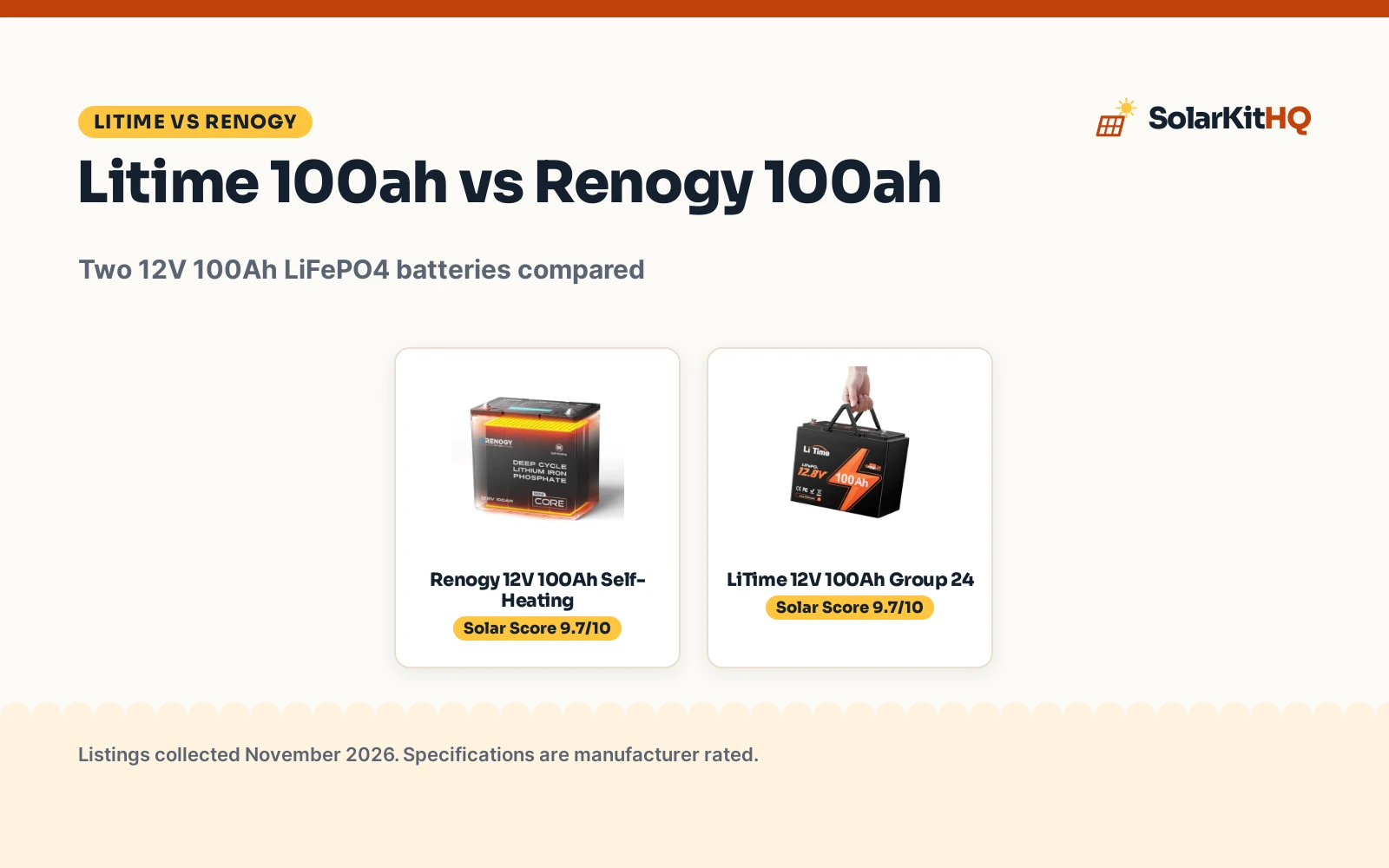
The short answer on litime 100ah vs renogy 100ah: both listings describe a lithium iron phosphate battery for RV, marine and off-grid use, and the choice comes down to cold weather and stated protections, since both state the same capacity. We compared the two listings on weight, size, cycle claims, self-heating, BMS protection and warranty terms. The Renogy states self-heating and a wide temperature range, while the LiTime states expansion to a larger bank and a Group 24 fit.
SolarKitHQ earns a commission when you buy through links on this page, at no extra cost to you. As an Amazon Associate I earn from qualifying purchases. Affiliate disclosure.
Litime 100ah vs Renogy 100ah: side by side
| Battery | Solar Score | Capacity | Weight | Cycle claim | Cold features | Warranty |
|---|---|---|---|---|---|---|
| Renogy 12V 100Ah Self-Heating | 9.7/10 | 12V, 100Ah, 1280Wh | 21.38 lb | 5000+ at 80% DOD | Self-heating, -22°F to 131°F | 5 years |
| LiTime 12V 100Ah Group 24 | 9.7/10 | 12.8V, 100Ah, 1280Wh | 21.0 lb | 4000+ at 100% DOD | Not stated | 5 years |
These specs are rated by the maker and quoted from each listing on 5 November 2026.
Weight and size
The two batteries sit close on weight and size. The LiTime is listed at 21.0 pounds in a Group 24 case of 6.61 by 10.24 by 8.27 inches, and the Renogy at 21.38 pounds in a Group 22NF case of 5.43 by 9.02 by 8.0 inches. The Renogy listing calls its case 45% smaller than similar batteries, while the LiTime listing calls its Group 24 size a drop-in fit for RVs replacing AGM. Both state 1280Wh, so the tray fit matters more than the weight gap.
Protection and cold weather
Protection is where the listings part ways. The Renogy states a 100A BMS with 25+ safety features and IP65 casing, plus dual heating pads at 110W that warm the battery 40% faster and a stated range of -22°F to 131°F. The LiTime states a BMS that guards against overcharge, over-discharge and overcurrent, with Grade-A LiFePO4 cells, and states no IP code and no temperature range. If your battery sits outside heated space in winter, the Renogy states the cold-weather features; the LiTime leaves that part unclear.
What the listings leave unclear
LiTime’s title claims up to 15000 cycles while its bullets state 4000+ cycles at 100% DOD with a 10-year life, so compare on the lower figure. The Renogy title claims 5000+ deep cycles and its bullets state over 5000 cycles at 80% DOD, which lines up. The LiTime states no temperature range and no IP code, and the Renogy states no expansion figure. Neither listing states UL certification.
Two examples

Renogy 12V 100Ah Self-Heating
A 12V 100Ah LiFePO4 battery with self-heating, a 100A BMS, IP65 casing and a 5-year warranty.
Pros
- Self-heating with dual 110W heating pads warms the battery 40% faster, per the listing
- Operates from -22°F to 131°F, per the listing
- 100A BMS with 25+ safety features stated
- IP65 casing stated
Cons
- 21.38 pounds, heavier than the LiTime at 21.0 pounds
- No expansion figure is stated
- Group 22NF case may not fit a Group 24 tray
- No app monitoring is stated
Detailed Review
The listing states a 12V 100Ah self-heating LiFePO4 battery with 1280Wh, a 100A BMS with 25+ safety features, IP65 casing, dual heating pads at 110W that warm the battery 40% faster, and a stated range of -22°F to 131°F (-30°C to 55°C). Grade-A LiFePO4 cells deliver over 5000 cycles at 80% DOD, and the case is Group 22NF at 5.43 by 9.02 by 8.0 inches and 21.38 pounds. The warranty description is 5 Year Manufacturer.
Who it's for: RV, marine and off-grid owners who camp in cold weather and want the battery to warm itself before charging. Who should skip it: anyone with a Group 24 tray who wants a drop-in fit without checking dimensions.
Its Solar Score of 9.7/10 comes from performance 32/35, build 22/25, value 21/25, safety 9/10 and warranty 3/5: 87 of 100 points, placed on our 9.2 to 9.8 scale.
Key Specifications
| Capacity | 12V, 100Ah, 1280Wh |
|---|---|
| Size | Group 22NF, 5.43 x 9.02 x 8.0 in |
| Weight | 21.38 lb |
| BMS | 100A, 25+ safety features |
Figures as published on the retailer listing, collected 5 November 2026. Performance figures are manufacturer rated.
Safety and Warranty
What this listing states. 100A BMS, 25+ safety features and IP65 casing stated, so safety scores 9 of 10. 5 Year Manufacturer warranty stated. It does not say everything a buyer needs, such as who pays return shipping, so warranty scores 3 of 5. See How We Pick.
Battery safety. Charge with a charger and settings that match the stated chemistry, fuse the positive lead as the manual directs, cover terminals, keep within the stated temperature range, and never charge a damaged battery.
This is general buying information, not professional advice. Follow each product manual and local rules, and see our Safety Disclaimer.

LiTime 12V 100Ah Group 24
A Group 24 LiFePO4 battery with 1280Wh, a BMS, expansion to 20.48kWh and a 5-year warranty.
Pros
- Expands from 1.28kWh to 20.48kWh with 16 batteries in 4P4S, per the listing
- Group 24 size drops into RVs to replace AGM with no extra wiring, per the listing
- BMS guards against overcharge, over-discharge and overcurrent, per the listing
- 5-year warranty stated
Cons
- No cold temperature limit is stated
- No IP code is stated
- No BMS amp figure is stated
Detailed Review
The listing states a 12V 100Ah LiFePO4 battery in Group 24 size at 21.0 pounds and 6.61 by 10.24 by 8.27 inches, with 1280Wh, Grade-A LiFePO4 cells and a BMS that guards against overcharge, over-discharge and overcurrent. It expands from 1.28kWh to 20.48kWh with 16 batteries in 4P4S, and the warranty description is 5 years. The title claims up to 15000 cycles while the bullets state 4000+ cycles at 100% DOD with a 10-year life, so use the lower figure when you compare. The listing notes it is not compatible with MerCruiser and Mercury motors without a current regulator.
Who it's for: RV owners with a Group 24 tray who want a lighter drop-in replacement for AGM and room to grow the bank later. Who should skip it: owners who camp below freezing and want stated cold protection.
Its Solar Score of 9.7/10 comes from performance 30/35, build 21/25, value 21/25, safety 8/10 and warranty 3/5: 83 of 100 points, placed on our 9.2 to 9.8 scale.
Key Specifications
| Capacity | 12.8V, 100Ah, 1280Wh |
|---|---|
| Size | Group 24, 6.61 x 10.24 x 8.27 in |
| Weight | 21.0 lb |
| Expansion | To 20.48kWh, 16 batteries, 4P4S |
Figures as published on the retailer listing, collected 5 November 2026. Performance figures are manufacturer rated.
Safety and Warranty
What this listing states. BMS guards against overcharge, over-discharge and overcurrent stated, so safety scores 8 of 10. 5 years warranty stated. It does not say everything a buyer needs, such as who pays return shipping, so warranty scores 3 of 5. See How We Pick.
Battery safety. Charge with a charger and settings that match the stated chemistry, fuse the positive lead as the manual directs, cover terminals, keep within the stated temperature range, and never charge a damaged battery.
This is general buying information, not professional advice. Follow each product manual and local rules, and see our Safety Disclaimer.
As an Amazon Associate I earn from qualifying purchases.
Where the points went
The Solar Score weighs performance, build, value, safety and warranty. For RV house batteries, safety means a battery management system, cold protection or another protection the listing names; both batteries here state a BMS, and only the Renogy states an IP code. Both state a 5-year warranty. How we pick explains the weights.
| Product | Solar Score | Perf. /35 | Build /25 | Value /25 | Safety /10 | Warranty /5 |
|---|---|---|---|---|---|---|
| Renogy 12V 100Ah Self-Heating | 9.7 | 32 | 22 | 21 | 9 | 3 |
| LiTime 12V 100Ah Group 24 | 9.7 | 30 | 21 | 21 | 8 | 3 |
Every total is translated into a figure between 9.2 and 9.8 with a linear formula; ranking by points and ranking by score always agree.
Litime 100ah vs Renogy 100ah: which should you choose?
Choose the Renogy if you camp in cold weather and want stated self-heating, a 100A BMS and IP65 casing in a compact Group 22NF case. Choose the LiTime if you have a Group 24 tray and want a drop-in AGM replacement with room to grow the bank to 20.48kWh later. Both state 1280Wh and a 5-year warranty, so the choice is about fit and cold weather, not capacity.
| If you need | Look at |
|---|---|
| Stated self-heating | Renogy 12V 100Ah Self-Heating, dual 110W pads |
| Group 24 drop-in fit | LiTime 12V 100Ah Group 24 |
| Room to grow the bank | LiTime, expansion to 20.48kWh |
| Widest stated temperature range | Renogy, -22°F to 131°F |
Sizing Notes
- Match the battery’s stated voltage and chemistry to every charging source: converter, solar controller and any DC to DC charger.
- Check the tray: the LiTime is Group 24, the Renogy is Group 22NF.
- Keep total draw under the 100A BMS limit the Renogy listing states.
- Size the bank to the loads you plan: the LiTime listing states expansion to 20.48kWh with 16 batteries in 4P4S.
- Fuse the positive lead as the manual directs, and leave any work on the RV’s mains wiring to a qualified technician.
FAQ: power away from the grid
Which battery here states self-heating for cold weather?
The Renogy. Its listing states dual heating pads at 110W that warm the battery 40% faster, with a stated range of -22°F to 131°F. The LiTime listing states no self-heating and no temperature range.
How much does each battery weigh?
The LiTime is listed at 21.0 pounds and the Renogy at 21.38 pounds.
How many cycles does each listing claim?
The LiTime title claims up to 15000 cycles while its bullets state 4000+ cycles at 100% DOD, so use the lower figure. The Renogy states over 5000 cycles at 80% DOD.
Can the LiTime battery expand into a larger bank?
Yes, per the listing: it expands from 1.28kWh to 20.48kWh with 16 batteries in 4P4S. The Renogy listing states no expansion figure.
What warranty does each listing state?
Both state 5 years: the LiTime warranty description is 5 years, and the Renogy warranty description is 5 Year Manufacturer.
Related solar guides
See every LiFePO4 Batteries guide and all Batteries and Charging guides.
More picks: best lithium battery for solar, best 12v battery for solar panel, best 12 volt deep cycle battery for rv, lifepo4 vs agm battery for rv.