On this page
The power goes out at dinner time, the fridge hums on battery power, and the life of lithium battery becomes the question that decides how long the house stays lit. The short answer is that a lithium battery is built to serve for years of regular use before its capacity fades, and this guide explains what sets that span, how to read the cycle figures the listings state, and which batteries put those figures into practice.
SolarKitHQ earns a commission when you buy through links on this page, at no extra cost to you. As an Amazon Associate I earn from qualifying purchases. Affiliate disclosure.
The quick answer
A lithium iron phosphate battery in this guide is listed with a life of more than 10 years and up to 15000 deep cycles, and the maker checks capacity against 80% of the rated figure as the battery ages. The GRNOE 2-pack (on Amazon) is the listing that states the year figure and the cycle figure. The VATRER listing states no total cycle count and instead describes a capacity check once every 25 cycles, ending the check when capacity falls below 80% of the rated capacity. Cycle count, temperature limits and charging habits decide where inside that span a battery lands, and the sections below walk through each one.
What decides the life of lithium battery
Cycle count leads the list. A deep cycle is one full charge and discharge, and the GRNOE listing states up to 15000 deep cycles with a life of more than 10 years. Temperature comes next: the VATRER listing states high temperature cutoff at 167 °F (75°C) and an operating range down to -20°C and up to 60°C, while the GRNOE listing cuts charging below 32 and allows discharge down to -4. Protection matters too: a BMS that guards against overcharge, over-discharge, overcurrent, short circuit and extreme temperatures keeps a battery inside its safe limits, and the VATRER 150A BMS disconnects at discharge currents over 220A. Charging habits close the list: the GRNOE listing says to use a 14.6V charger, notes that a 12V charger will not fully charge the battery, and asks for a charge at least once every two or three months when the battery sits unused. See LiFePO4 vs lead acid battery for RV for the lead acid comparison.
How to read cycle life before you buy
Start with the cycle figure and the capacity line that goes with it. The GRNOE listing states up to 15000 deep cycles with a life of more than 10 years, which is the clearest longevity statement in this group. The VATRER listing takes a different route: it states no total cycle count, and instead describes a capacity check once every 25 cycles against 80% of the rated capacity. A listing that states neither a cycle count nor a warranty term leaves the buyer with the title alone, which is why the title-only picks sit at the end of this guide. When the figures are missing, compare the size and BMS that the title does state: 12V 100Ah with a 100A BMS is the common size here, while 12V 10Ah with a 10A BMS is a much smaller battery for lighter loads. Size matters too: see lithium battery size for dimensions and capacity before you measure the space.
Batteries for a long life of lithium battery
The batteries below cover the measurements that set battery life: cycle count, temperature limits, BMS protection and app monitoring of charge and cycles.
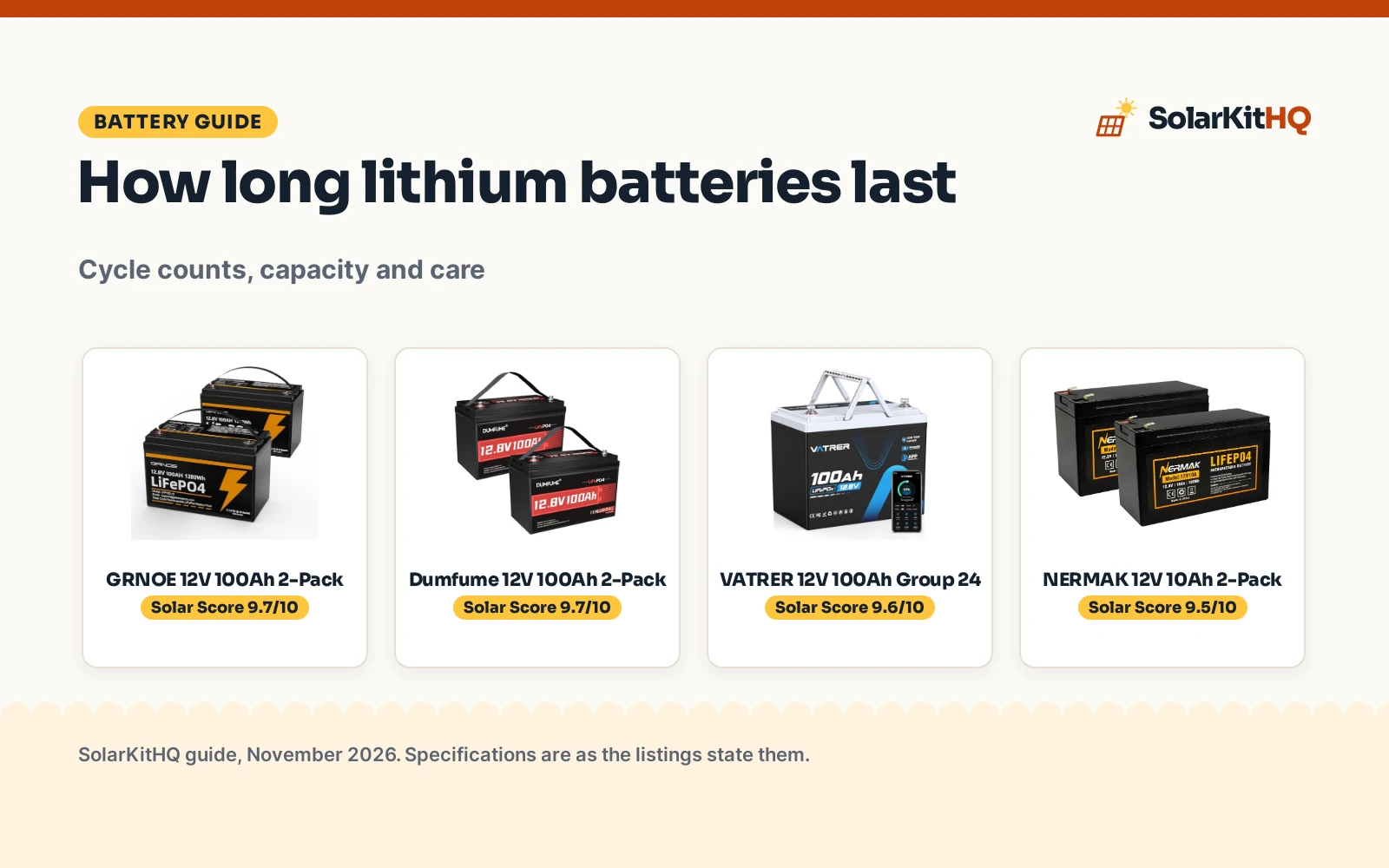
| # | Product | Solar Score | Buy |
|---|---|---|---|
| 1 |  GRNOE 12V 100Ah 2-Pack | 9.7/10 | Buy on Amazon |
| 2 |  Dumfume 100Ah 2-Pack | 9.7/10 | Buy on Amazon |
| 3 |  VATRER 12V 100Ah Group 24 | 9.6/10 | Buy on Amazon |
| 4 |  NERMAK 12V 10Ah 2-Pack | 9.5/10 | Buy on Amazon |

GRNOE 12V 100Ah 2-Pack
Two 12V 100Ah LiFePO4 batteries with a 100A BMS and a stated 15000 deep cycle count, covering the cycle life figure this guide is about.
Pros
- 15000 deep cycles stated, the longest cycle figure in this group
- UL and UN38.3 certification stated
- Low temperature charging cutoff stated, with discharge down to -4
- 3 Year warranty stated
Cons
- Two batteries ship in separate boxes and may arrive on different days
- A 12V charger will not fully charge this battery; a 14.6V charger is needed
- Needs a charge at least once every two or three months in storage
- Batteries in series must match within 0.2V before connecting
Detailed Review
The listing states a 2-pack of 12V 100Ah Group 31 LiFePO4 batteries with a 100A BMS, up to 15000 deep cycles and a battery life more than 10 years longer than traditional batteries. It lists 22.48 pounds, 12.9 x 6.7 x 8.6 inches, 33% of lead-acid weight, 57 Wh/Lbs energy density, UL and UN38.3 certification, IP65 protection and a max discharge current of 300A for 3 seconds. Low temperature protection cuts charging below 32, discharge runs down to -4, and the spec table states a 3 Year warranty.
Who it's for: RV, marine, cabin and off-grid owners who want a stated cycle count and a 2-pack for a house bank. Who should skip it: buyers who need one battery only or a charger other than 14.6V.
Its Solar Score of 9.7/10 comes from performance 32/35, build 22/25, value 21/25, safety 9/10 and warranty 2/5: 86 of 100 points, placed on our 9.2 to 9.8 scale.
Key Specifications
| Capacity | 12V 100Ah, 2-pack |
|---|---|
| Cycle life | Up to 15000 deep cycles |
| BMS | 100A BMS with low temperature cutoff |
| Size and weight | 12.9 x 6.7 x 8.6 in, 22.48 pounds |
Figures as published on the retailer listing, collected 12 November 2026. Performance figures are manufacturer rated.
Safety and Warranty
What this listing states. UL and UN38.3 certification, IP65 protection and 100A BMS with low temperature protection stated, so safety scores 9 of 10. 3 Year warranty stated. It does not say everything a buyer needs, such as who pays return shipping, so warranty scores 2 of 5. See How We Pick.
Battery safety. Charge with a charger and settings that match the stated chemistry, fuse the positive lead as the manual directs, cover terminals, keep within the stated temperature range, and never charge a damaged battery.
This is general buying information, not professional advice. Follow each product manual and local rules, and see our Safety Disclaimer.

Dumfume 100Ah 2-Pack
A 12V 100Ah battery sold as a 2-pack, with a 100A BMS, ABS casing and 1280Wh per battery stated.
Pros
- Sold as a 2-pack, with 1280Wh per battery and 1.28kWh stated
- 4S4P expansion stated, to a 51.2V 400Ah system
- 100A BMS stated with overcharge, over-discharge, short circuit, overheat and overcurrent protection
- ABS casing stated, with dustproof and weather resistance noted
Cons
- No IP code is stated in the listing
- No low-temperature charging cutoff is stated, and battery performance requires temperatures of 5 degrees C or higher
- No Bluetooth monitoring is stated in the listing
- Cycle figures vary by depth of discharge: 4000 cycles at 100% DOD, 6000 cycles at 80% DOD and 15000 cycles at 60% DOD
Detailed Review
The listing states a 12V 100Ah battery sold as a 2-pack, with 1280Wh per battery, a 100A BMS, Grade A cells, an ABS casing and dimensions of 13 by 6.69 by 8.62 inches, with each battery weighing 21.6 lbs. It states 4S4P expansion to a 51.2V 400Ah system, a drop-in replacement claim for lead-acid batteries, and a 5 Year Manufacturer warranty. The title figure of 15000+ cycles matches the bullets figure at 60% DOD, while the bullets give lower figures at deeper discharge, so the cycle figure depends on depth of discharge.
Who it's for: shed owners who want two batteries at once for a larger bank from the start. Who should skip it: owners who need a stated IP code or a stated low-temperature charging cutoff.
Its Solar Score of 9.7/10 comes from performance 30/35, build 21/25, value 21/25, safety 7/10 and warranty 3/5: 82 of 100 points, placed on our 9.2 to 9.8 scale.
Key Specifications
| Capacity | 12V 100Ah, 1280Wh per battery |
|---|---|
| BMS | 100A BMS |
| Size | 13 by 6.69 by 8.62 inches |
| Pack | 2-pack |
Figures as published on the retailer listing, collected 3 November 2026. Performance figures are manufacturer rated.
Safety and Warranty
What this listing states. 100A BMS with overcharge, over-discharge, short circuit, overheat and overcurrent protection, so safety scores 7 of 10. 5 Year Manufacturer. It does not say everything a buyer needs, such as who pays return shipping, so warranty scores 3 of 5. See How We Pick.
Battery safety. Charge with a charger and settings that match the stated chemistry, fuse the positive lead as the manual directs, cover terminals, keep within the stated temperature range, and never charge a damaged battery.
This is general buying information, not professional advice. Follow each product manual and local rules, and see our Safety Disclaimer.

VATRER 12V 100Ah Group 24
A 12V 100Ah Group 24 LiFePO4 battery with a 150A BMS and app monitoring of voltage, current, power, SOC and cycle count, which tracks the life of the battery over time.
Pros
- APP monitoring shows voltage, current, power, SOC and cycle count
- 150A BMS with high and low temperature cutoff stated
- Expands from 1.28kWh to 20.48kWh with up to 16 batteries in 4P4S
- Full charge in 2 hours with an MPPT solar panel of 600W or more
Cons
- No total cycle count is stated
- No warranty term is stated; the listing points to the official website
- Cannot be used as a starter battery or a golf cart battery
- The 2 hour charge needs an MPPT solar panel of 600W or more
Detailed Review
The listing states a 12V 100Ah Group 24 LiFePO4 battery with a 150A BMS, app monitoring and a 1.92kW max load. It lists high temperature cutoff at 167 °F (75°C), an operating range down to -20°C and up to 60°C, a disconnect at discharge currents over 220A, and protection against overcharge, over-discharge, overcurrent, short circuit and extreme temperatures. Capacity is checked once every 25 cycles against 80% of the rated capacity, charging runs through solar, a generator or a 14.6V 20A charger, and capacity expands from 1.28kWh to 20.48kWh with up to 16 batteries in 4P4S.
Who it's for: RV, boat and off-grid owners who want app monitoring of charge and cycles and room to expand the bank later. Who should skip it: buyers who need a stated total cycle count or a warranty term in the listing.
Its Solar Score of 9.6/10 comes from performance 30/35, build 21/25, value 21/25, safety 8/10 and warranty 0/5: 80 of 100 points, placed on our 9.2 to 9.8 scale.
Key Specifications
| Capacity | 12V 100Ah Group 24 |
|---|---|
| BMS | 150A BMS, disconnect over 220A |
| Max load | 1.92kW, up to 30.72kW expanded |
| Size and weight | 10.24 x 6.61 x 8.35 in, 23.48 pounds |
Figures as published on the retailer listing, collected 12 November 2026. Performance figures are manufacturer rated.
Safety and Warranty
What this listing states. 150A BMS with overcharge, over-discharge, overcurrent, short circuit and temperature protection stated, so safety scores 8 of 10. No warranty term, so warranty scores zero. See How We Pick.
Battery safety. Charge with a charger and settings that match the stated chemistry, fuse the positive lead as the manual directs, cover terminals, keep within the stated temperature range, and never charge a damaged battery.
This is general buying information, not professional advice. Follow each product manual and local rules, and see our Safety Disclaimer.

NERMAK 12V 10Ah 2-Pack
A two-pack of 12V 10Ah LiFePO4 deep cycle batteries with a built-in 10A BMS, a 2000+ cycle claim and a 12 month warranty.
Pros
- Built-in 10A BMS stated, covering overcharge, over-discharge, over-current and short circuit
- 2000+ cycle claim, against 200 to 300 cycles stated for traditional lead acid
- Connects in series (up to 4) or parallel for larger banks
- 2.64 lb stated, far less than either power station
Cons
- 10Ah per battery, and no inverter, outlets or charger is included
- Continuous discharge limited to 10A stated
- The maker warns a standard SLA charger may not fully charge it
Detailed Review
The listing states a two-pack of 12V 10Ah LiFePO4 batteries at 12.8V with a built-in 10A BMS (overcharge, over-discharge, over-current and short circuit protection), 2000+ cycles against 200 to 300 stated for traditional lead acid, 10A continuous discharge, 30A peak for under 5 seconds, 5A charging and a 14.6V charging voltage, with up to 4 in series or parallel expansion. The maker warns to use a LiFePO4 charger because an automatic SLA charger may not fully charge it. The spec table lists the height as 3.91 inches in one row and 3.7 inches in another, so measure your tray before ordering. The warranty is 12 months.
Who it's for: builders wiring a small 12V bank for scooters, lighting, fish finders or backup power who want stated BMS protection on a small battery. Who should skip it: anyone who wants AC outlets or an inverter included, which this listing does not have.
Its Solar Score of 9.5/10 comes from performance 26/35, build 20/25, value 19/25, safety 6/10 and warranty 1/5: 72 of 100 points, placed on our 9.2 to 9.8 scale.
Key Specifications
| Capacity | 12.8V, 10Ah |
|---|---|
| Discharge | 10A continuous, 30A peak |
| Charge | 5A, 14.6V charging voltage |
| Weight | 2.64 lb |
Figures as published on the retailer listing, collected 22 October 2026. Performance figures are manufacturer rated.
Safety and Warranty
What this listing states. Built-in 10A BMS with overcharge, over-discharge, over-current and short circuit protection stated, so safety scores 6 of 10. 12 months warranty stated. It does not say everything a buyer needs, such as who pays return shipping, so warranty scores 1 of 5. See How We Pick.
Power station limits. Stay within the stated continuous output and solar input limits, keep the unit ventilated and dry, charge within the stated temperature range, and never connect it to home wiring except through equipment a licensed electrician installs.
This is general buying information, not professional advice. Follow each product manual and local rules, and see our Safety Disclaimer.
As an Amazon Associate I earn from qualifying purchases.
FAQ: power away from the grid
How long does a lithium battery last?
A LiFePO4 battery in this guide is listed with a life of more than 10 years and up to 15000 deep cycles. Cycle count, temperature limits and charging habits decide where inside that span a given battery lands.
How long does a LiFePO4 battery last?
The GRNOE listing states more than 10 years and up to 15000 deep cycles. The VATRER listing states no total cycle count and instead checks capacity once every 25 cycles against 80% of the rated capacity.
What temperature range can a lithium battery handle?
The VATRER listing states an operating range down to -20°C and up to 60°C, with high temperature cutoff at 167 °F (75°C). The GRNOE listing allows discharge down to -4 and cuts charging below 32.
How should I charge a lithium battery for a long life?
Use the charger the listing names: the GRNOE listing calls for a 14.6V charger and notes that a 12V charger will not fully charge the battery. The VATRER listing names solar, a generator or a 14.6V 20A charger, and the GRNOE listing asks for a charge at least once every two or three months when the battery sits unused. See how to recharge a lithium battery for the full charging picture.
Related solar guides
See every LiFePO4 batteries guide and all batteries guides.
More picks: LiFePO4 battery life, best 100Ah lithium battery for a shed and best 12V lithium battery for camping.