On this page
The lights go out in the middle of a storm, the phone is dead, and the drawer holds a flashlight with dead cells: that is the moment when a manual hand crank generator earns its place in the kit. A manual hand crank generator turns muscle into DC power for small loads, with no fuel, no outlet and no battery to keep charged. This guide covers what a crank can run, how to use one in an outage, and where its limits sit, so the reader can pick the right kind and use it well.
SolarKitHQ earns a commission when you buy through links on this page, at no extra cost to you. As an Amazon Associate I earn from qualifying purchases. Affiliate disclosure.
Manual hand crank generator
The quick answer is simple: turn the handle, and the generator inside makes DC power as long as the handle turns. The faster the handle turns, the more power comes out, and the load only runs while someone cranks. That makes a hand crank generator a tool for small, short jobs in an outage: a light, a small radio, a phone charge on a unit with a USB output. It is not a stand-in for a battery bank or a fuel generator, and it cannot run the heavy loads of a house.
How a hand crank generator works
A hand crank generator is a small DC generator with a handle on the shaft. Turning the handle spins the generator, and the spinning makes DC power that flows out through the wires or the outputs on the case. The maker of the hand2mind handheld (on Amazon) unit puts it plainly: the faster the handle is turned, the brighter the bulb glows. The Nightbreeze teaching (on Amazon) unit lists an output of about 1-12V DC with no load, depending on cranking speed, and the hand2mind unit lists use with almost any experiment requiring up to 12 volts DC. Clips on the hand2mind unit allow connection to electrical circuits, and the Nightbreeze kit includes one hand crank generator, three bright LED bulbs and connection wires, so a classroom demo runs with nothing else to buy. The whole Nightbreeze unit measures 3.3 by 2.3 by 3.0 inches.
What a crank can run
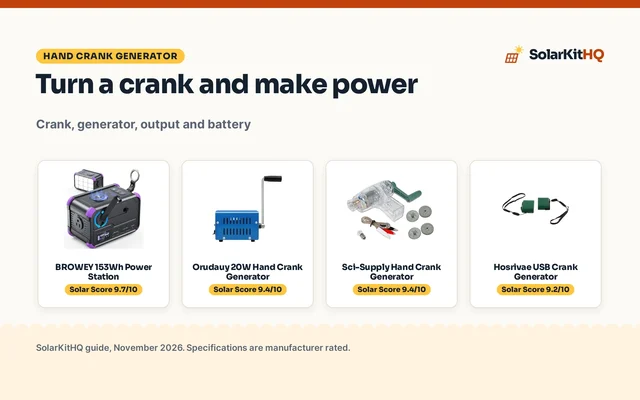
Match the load to the outputs the unit lists. The Nightbreeze kit lights its three LED bulbs straight from the crank, and the hand2mind unit runs small bulbs and low-power circuit experiments. A unit built for emergency charging goes further: the ylpddmm hand crank generator (on Amazon) lists USB 5V, 12V and 110V/220V AC outputs, and states that it can directly charge mobile phones and tablets. It carries a 65W/H lithium battery with its own protection circuit, and lists a 20W all-steel gear DC generator inside, with a foldable aluminum alloy handle. For light, the SAFIGLE kit (on Amazon) pairs its crank with an experiment guide, and its clear housing lets the user watch the gears work while cranking.
What a crank cannot run
A crank makes small power, and the heavy loads stay out of reach. The Nightbreeze maker states plainly that its unit is a physics teaching tool and is not designed to charge phones, batteries, or power professional equipment, so a teaching crank belongs in the classroom, not in the outage kit. Fridges, heaters, kettles and power tools all need far more power than a handle can give, and anything with a household AC plug needs an inverter or a mains supply, which a bare crank does not have. The ylpddmm unit is the exception in the reference listings, because it pairs the crank with a battery and AC outputs, and even that unit is listed for emergency phone charging and small loads, not for running a house.
How to use one in an outage
Set the unit on a steady surface where the handle can turn freely, then connect the load to the output that matches it: a phone charger to the USB 5V output, a 12V light to the 12V output, and clips to a circuit for a classroom demo. Crank at a steady pace and watch the load: a bulb that glows bright means the pace is right, and a bulb that flickers means the pace is uneven. Keep the load small and keep cranking while the load runs, since the power stops the moment the handle stops. When the phone or the light is done, stop cranking and put the unit back where it lives, so it is ready for the next outage.
Ways to get more from a crank
- Crank steadily: a smooth, even pace gives the load steady power, while short bursts make the bulb flicker and the charge stutter.
- Keep the load small: one LED bulb or one phone charge at a time beats a load the crank cannot hold, so add a larger load only after the small load runs steady.
- Use the right output: USB 5V for phones and tablets, 12V for 12V lights and small DC loads, and the AC outputs only on a unit that lists them, such as the ylpddmm 150W model.
- Keep it ready: a crank needs no fuel and no charge to sit on a shelf, so store it where the outage kit lives and check the handle and wires when the seasons change.
- Teach with two: the Nightbreeze maker notes that cranking one unit can spin the handle of a second unit wired to it, which shows how a DC generator and a motor are the same device in reverse.
FAQ: power away from the grid
Can a hand crank generator charge a phone?
It depends on the model. The ylpddmm unit lists USB 5V output and states that it can directly charge mobile phones and tablets, while the Nightbreeze teaching unit is not designed to charge phones. Check the outputs on the label before counting on a phone charge.
How much power does a hand crank generator make?
The output follows the cranking speed. The Nightbreeze unit lists about 1-12V DC with no load, the hand2mind unit lists use up to 12 volts DC, and the ylpddmm unit lists 150W with a 20W DC generator inside. A crank suits small DC loads, not heavy household loads.
Can you run a fridge or a heater from a hand crank generator?
No. A crank makes small DC power for lights, small radios and phone charging on units with the right outputs. The Nightbreeze maker states its unit is not designed to power professional equipment, and a fridge or a heater needs far more power than a handle can give.
Do hand crank generators need batteries?
No. The Nightbreeze maker states that no batteries are required, and the handle alone generates the power for its LED bulbs. The ylpddmm unit carries a 65W/H lithium battery for storage, but the crank itself needs no battery to work.
Are hand crank generators good for emergencies?
Yes, for small loads. The ylpddmm maker lists emergency power outages, outdoor adventures and long-distance travel as the use cases for its unit, and a crank needs no fuel and no outlet. Keep the loads small, and keep a larger power source ready for anything heavier.
Related solar guides
See the camping and emergency gear guides, how a hand crank generator works, the best hand crank chargers for emergencies and emergency lights for a power outage.