On this page
After a summer storm, the gutters run full while the garden beds stay dry, and a rainwater collection calculator tells you how much of that roof water you can keep and how much storage it takes to hold it. The calculator takes a few inputs: the roof area that feeds the tank, the rainfall over the period you plan for, and the size of the tank. The steps below work through each input in order, then match the answer to a tank size.
SolarKitHQ earns a commission when you buy through links on this page, at no extra cost to you. As an Amazon Associate I earn from qualifying purchases. Affiliate disclosure.
The quick answer
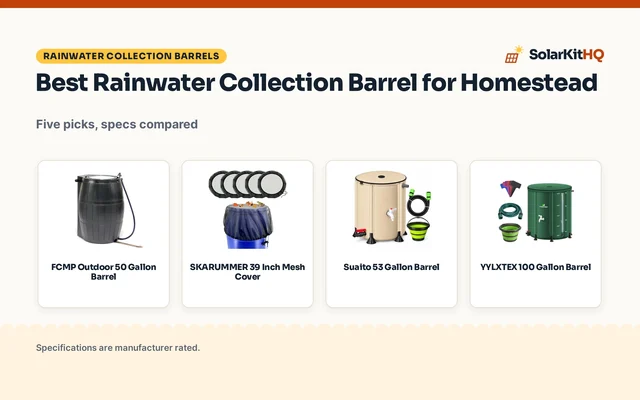
A rainwater collection calculator multiplies the roof area by the rainfall to get the volume the roof can catch, then compares that volume with the tank size. When the roof can catch more than the tank holds, the tank fills and the rest runs off; when the tank holds more than the roof can catch, the tank stays part full. As a concrete example, the YYLXTEX collapsible barrel (on Amazon) is listed at 100 gallons, or 380 litres, so a roof that catches that much water in the period you plan for fills it.
Measure the roof area that feeds the tank
Only the roof area that drains to the tank counts, so start at the downspout and trace the roof surface that feeds it. A roof with several downspouts splits the area between them, so measure the sections that drain to the tank you plan to use. Gutters, valleys and the slope of the roof all shape which part of the roof feeds which downspout, and a diverter decides how much of that flow reaches the tank. See the best rainwater diverter kits for the part that sends downspout water to a barrel.
A flat roof and a steep roof with the same footprint feed different areas to the same downspout, because the slope changes how much roof surface drains to each side. Walk the roofline in your head from ridge to gutter and note where the water runs, since a valley can send water from a wide stretch of roof to the same downspout. If the roof feeds several tanks, work out the area for each tank on its own, so no tank is sized on water that runs somewhere else.
Find the rainfall for the period you plan for
Rainfall figures come from local weather records, given as depth over a month or a season. Pick the period that matches how you use the water: a garden that needs water through a dry season needs a longer period than a barrel that turns over after a storm. Dry spells matter as much as wet ones, because the tank has to hold enough from the wet days to cover the dry days. Use the rainfall for your own area rather than a figure from another place, since rainfall varies widely between areas.
Seasonal rain changes the answer across the year. A wet season can fill a tank in a few storms, while a dry season can leave the same tank waiting weeks between top-ups. Plan around the driest stretch you expect the tank to cover, and treat the rainiest stretch as the time the tank fills, not as the size it needs to be.
What the rainwater collection calculator does with those figures
With the roof area and the rainfall depth in hand, the calculator multiplies them to give the volume the roof can catch over the period. That volume is the ceiling for the tank: a tank larger than the volume the roof can catch stays part full, while a tank smaller than that volume fills early and lets the rest run off. Compare the volume with the tank size before you buy, and remember that the roof area and the rainfall move the answer together, so a change in either changes the volume.
The calculator answers a sizing question, not a weather question. It cannot make rain fall, and it cannot tell you how much rain will fall in a season that has not happened yet. What it can do is show whether the tank you have in mind fits the roof and the rainfall you already know, so you buy storage that matches the water your roof can catch.
Match the tank to the volume
Pick a tank size that fits the volume the roof can catch and the space you have for it. The YYLXTEX barrel is listed at 100 gallons, or 380 litres, with 2mm support poles, a 0.6mm 3-layer PVC body and a 5mm mesh screen, and the maker says it assembles in under 5 minutes. A collapsible barrel suits a spot that needs storage only in the wet season, since it folds away when the rain stops. For a fixed tank, see the best water storage tanks with a hose connection for options that stay in place.
| Figure the maker lists | Value |
|---|---|
| Capacity | 100 gallons, or 380 litres |
| Support poles | 2mm |
| Body | 0.6mm 3-layer PVC |
| Mesh screen | 5mm |
| Setup | Under 5 minutes |
These are the figures the maker lists for the barrel. Compare them with the volume your roof can catch and the space you have before you choose a tank.
Ways to use the stored water well
- Water the garden from the tap: the barrel includes a quick-connect tap and sprinkler, so the stored water reaches the beds without carrying cans.
- Keep the mesh screen clear: the 5mm mesh screen blocks debris at the source, and a clear screen keeps the flow into the tank steady.
- Plan for the tank filling early: when the roof catches more than the tank holds, the extra water needs somewhere to go, so leave room for it to run off away from the house.
- Size for the dry days, not the wet ones: the tank earns its keep in the dry spell after the rain, so match the size to the gap between storms.
- Check the level before a storm: a tank that is already full when the rain starts catches nothing new, so use the stored water down before the next rain arrives.
FAQ: power away from the grid
How do I work out how much rainwater my roof can catch?
Measure the roof area that drains to the tank, find the rainfall for the period you plan for, and multiply them to get the volume. A rainwater collection calculator does that multiplication for you and compares the result with the tank size.
What size rain barrel do I need?
Match the barrel to the volume your roof can catch over the period you plan for. The YYLXTEX barrel is listed at 100 gallons, or 380 litres, which suits a roof that catches that much water in the period; a roof that catches more needs a larger barrel or another tank.
Does a rainwater collection calculator need the roof area?
Yes. The roof area and the rainfall are the inputs, and the calculator multiplies them to give the volume the roof can catch. Without the roof area, the calculator has no way to tell how much rain lands where the tank can collect it.
Can I use collected rainwater in the garden?
Yes. The barrel in this guide is made for lawn and garden watering, and it includes a quick-connect tap and sprinkler for that use. Use the stored water on the beds and the lawn, and keep it for outdoor use.
Related solar guides
See the solar-outdoor guides, the best rainwater collection systems for a backyard and the best rain barrels for a shed.