On this page
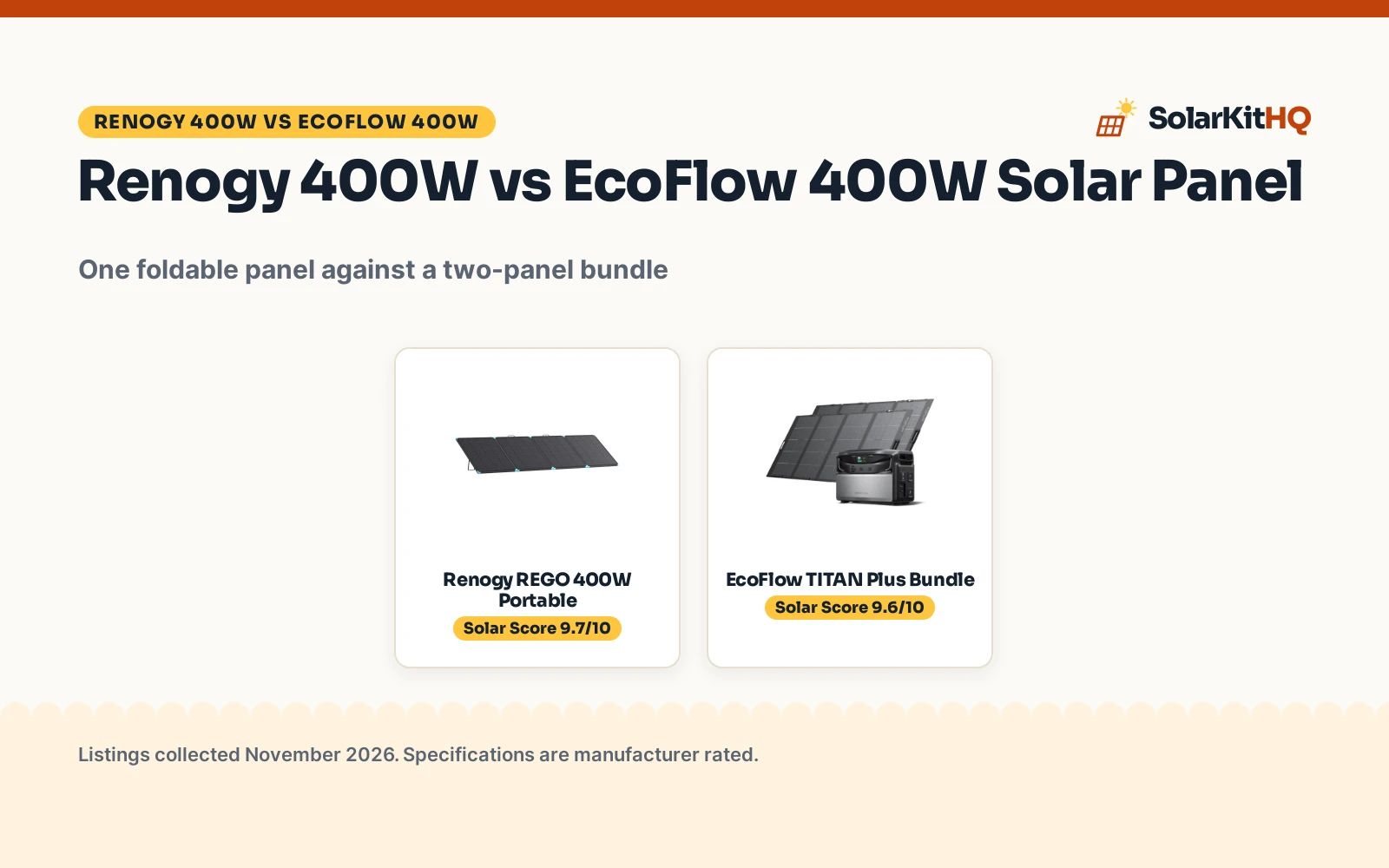
The power goes out at dinner time, the fridge hums its last, and the phones on the counter are all running low. That is the moment a renogy 400w vs ecoflow 400w solar panel comparison earns its keep: both sides promise 400 watts from the sun, but one side is a single foldable panel and the other is a whole power station bundled with two panels. This comparison covers the two listings on what each maker states: watts, weight, efficiency, weather ratings and warranty terms. Short verdict: pick the Renogy REGO for a panel to carry to a power station already owned; pick the EcoFlow TITAN Plus bundle for a home backup station with its panels included.
SolarKitHQ earns a commission when you buy through links on this page, at no extra cost to you. As an Amazon Associate I earn from qualifying purchases. Affiliate disclosure.
Renogy 400W vs EcoFlow 400W: side by side
| 400W solar panel | Solar Score | Panel watts | Efficiency | Weather rating | Warranty |
|---|---|---|---|---|---|
| Renogy REGO 400W Portable | 9.7/10 | 400W | 23% | IP67 | 3 years |
| EcoFlow TITAN Plus Bundle | 9.6/10 | 2 x 400W panels | 22.4% | IP68 | 5 years |
We copied each rating from the seller’s listing as the brand states it; data date 18 November 2026.
Size and weight
The gap in size and weight is the first thing to settle, because the two listings are not the same kind of purchase. The Renogy REGO is a single foldable panel listed at 30.2 pounds that folds to 33.7 by 27.95 inches and is 3.2 inches thick, with a carry case stated. The EcoFlow listing gives 102.5 pounds and 13.2 by 24.5 by 16.0 inches for the bundle as listed, with two items in the box, and gives no separate weight or folded size for one 400W panel alone. So the Renogy figure describes a panel to carry, while the EcoFlow figure describes a station plus two panels to place and leave.
Efficiency and weather protection
Both sides state an efficiency figure and a weather rating, so these two lines can be compared directly. The Renogy states 23% efficiency from A+ monocrystalline cells, with fiberglass material, an ETFE coating, an aluminum backsheet and an IP67 rating, plus parallel wiring stated to hold output under partial shade. The EcoFlow panel states a 22.4% conversion rate through the MPPT algorithm, layers of flexible EVA and fibreglass, and an IP68 rating. On the stated figures, the Renogy panel claims the higher efficiency and the EcoFlow panel claims the higher weather rating, and neither gap is large enough to settle the choice on its own.
What each side includes
The Renogy is a panel only. It has MC4 output cables only, the 4-in-1 adapter cable is sold separately, and a solar charge controller is not included for 12V/24V battery systems. The maker lists compatibility with the Jackery Explorer 1000 v2, EcoFlow DELTA 3 and DELTA 3 Max, Anker SOLIX S2000, C1000 Gen 2 and C2000 Gen 2, and BLUETTI AC180 and Elite 100 V2. The EcoFlow is a bundle: a 5017Wh power station with two 400W panels, 7.2kW continuous output expandable to 10kW with solar PV input, 120V/240V AC output, expansion to 30kWh with up to five 5kWh expansion batteries, dual 4kW solar inputs and 7.6kW AC input. Where the EcoFlow connects to home wiring through the Smart Home Panel 10, a licensed electrician should install it.
What the listings leave unclear
The uneven part of this comparison is the EcoFlow side: with no separate panel weight or folded size stated, the panel alone cannot be weighed against the Renogy panel. The Renogy side states 12V/24V battery compatibility but gives no open-circuit voltage or short-circuit current figure, so matching it to a controller rests on the station list the maker gives. The EcoFlow panel note adds that only the main body of the panel carries the IP68 rating, and the junction box and connection points should not be immersed in water. Read both listings as they are: a portable panel on one side and a home backup bundle on the other, not two panels of the same kind.
Two examples

Renogy REGO 400W Portable
A foldable 400W portable panel at 30.2 pounds with a stated 23% efficiency, IP67 rating and a 3-year warranty.
Pros
- Folds to 33.7 by 27.95 inches and weighs 30.2 pounds, with a carry case stated
- Stated 23% efficiency with A+ monocrystalline cells
- IP67 rating with ETFE coating and an aluminum backsheet stated
- Parallel wiring stated to hold output under partial shade
Cons
- MC4 output cables only; the 4-in-1 adapter cable is sold separately
- Needs a separate solar charge controller for 12V/24V battery systems, which is not included
- No open-circuit voltage or short-circuit current figure is stated
- 3-year warranty is shorter than the EcoFlow 5-year term
Detailed Review
The maker lists a 400W foldable suitcase panel at 30.2 pounds that folds to 33.7 by 27.95 inches and measures 3.2 inches thick, with fiberglass material, an ETFE coating, A+ monocrystalline cells at 23% efficiency, an aluminum backsheet and an IP67 rating. It states compatibility with the Jackery Explorer 1000 v2, EcoFlow DELTA 3 and DELTA 3 Max, Anker SOLIX S2000, C1000 Gen 2 and C2000 Gen 2, and BLUETTI AC180 and Elite 100 V2, plus 12V/24V battery systems with a compatible solar charge controller, which is not included. The panel has MC4 output cables only, the 4-in-1 adapter cable is sold separately, and the warranty is a 3-year material and workmanship warranty.
Who it's for: RV, van and camping owners who want a standalone 400W panel to carry to a power station already owned. Who should skip it: anyone who wants the adapter cable in the box or a panel that plugs straight into a 12V/24V battery bank without a controller.
Its Solar Score of 9.7/10 comes from performance 30/35, build 21/25, value 20/25, safety 8/10 and warranty 2/5: 81 of 100 points, placed on our 9.2 to 9.8 scale.
Key Specifications
| Watts | 400W |
|---|---|
| Weight | 30.2 lb |
| Folded size | 33.7 x 27.95 in |
| Efficiency | 23% |
Taken from the seller's listing on 18 November 2026. Capacity and output figures are rated by the manufacturer.
Safety and Warranty
What this listing states. IP67 rating, ETFE coating, hail-resistant coating and aluminum backsheet stated, so safety scores 8 of 10. 3-year material and workmanship warranty stated. It does not say everything a buyer needs, such as who pays return shipping, so warranty scores 2 of 5. See How We Pick.
Panels make voltage in daylight. Keep connectors covered until you connect them, check the panel's stated open circuit voltage and current against your controller or power station input limits, and use cables rated for the current. Roof and permanent mounts belong to a qualified installer.
This is general buying information, not professional advice. Follow each product manual and local rules, and see our Safety Disclaimer.

EcoFlow TITAN Plus Bundle
A 5017Wh power station bundled with two 400W solar panels, with a stated 22.4% panel conversion rate, IP68 panel rating and a 5-year warranty.
Pros
- Two 400W panels with a stated 22.4% conversion rate and MPPT
- 5017Wh station with 7.2kW continuous output, expandable to 10kW with solar PV input
- IP68 panel rating with flexible EVA and fibreglass layers stated
- 5-year warranty stated, plus UL 9540 certification and 24/7 battery management monitoring
Cons
- A whole station plus two panels is far more to carry and store than a single foldable panel
- No separate folded size or weight is stated for one 400W panel alone
- Only the main body of the panel carries the IP68 rating; the junction box and connection points should not be immersed in water
- Built for whole-home backup, so it is more system than a buyer who only needs one panel may want
Detailed Review
The maker lists the TITAN Plus as a 5017Wh power station bundled with two 400W solar panels, with 7.2kW continuous output expandable to 10kW with solar PV input, 120V/240V AC output, LFP battery cells and expansion to 30kWh with up to five 5kWh expansion batteries. The panels use the MPPT algorithm with a stated 22.4% conversion rate, layers of flexible EVA and fibreglass, and an IP68 rating, while the station states UL 9540 certification and 24/7 battery management system monitoring. The listing gives 102.5 pounds and 13.2 by 24.5 by 16.0 inches for the bundle as listed, and a 5-year warranty. Where it connects to home wiring through the Smart Home Panel 10, a licensed electrician should install it.
Who it's for: homeowners who want a whole-home backup station with two 400W panels in one bundle. Who should skip it: anyone who only needs a single portable panel to carry to a campsite.
Its Solar Score of 9.6/10 comes from performance 28/35, build 20/25, value 18/25, safety 9/10 and warranty 3/5: 78 of 100 points, placed on our 9.2 to 9.8 scale.
Key Specifications
| Station capacity | 5017Wh |
|---|---|
| Output | 7.2kW, expandable to 10kW |
| Panel efficiency | 22.4% |
| Panel rating | IP68 |
Taken from the seller's listing on 18 November 2026. Capacity and output figures are rated by the manufacturer.
Safety and Warranty
What this listing states. UL 9540 certified, IP68 panel rating, LFP battery cells and 24/7 battery management system monitoring stated, so safety scores 9 of 10. 5 Year warranty stated. It does not say everything a buyer needs, such as who pays return shipping, so warranty scores 3 of 5. See How We Pick.
Panels make voltage in daylight. Keep connectors covered until you connect them, check the panel's stated open circuit voltage and current against your controller or power station input limits, and use cables rated for the current. Roof and permanent mounts belong to a qualified installer.
This is general buying information, not professional advice. Follow each product manual and local rules, and see our Safety Disclaimer.
As an Amazon Associate I earn from qualifying purchases.
How the picks were scored
The Solar Score weighs performance, build, value, safety and warranty. For portable panels, safety means the weather rating, the materials the maker names and any certification the listing states; the Renogy states IP67 and the EcoFlow panel states IP68 with UL 9540 certification for the station. Both state a warranty term, 3 years for the Renogy and 5 years for the EcoFlow. How we pick explains the weights.
| Product | Solar Score | Perf. /35 | Build /25 | Value /25 | Safety /10 | Warranty /5 |
|---|---|---|---|---|---|---|
| Renogy REGO 400W Portable | 9.7 | 30 | 21 | 20 | 8 | 2 |
| EcoFlow TITAN Plus Bundle | 9.6 | 28 | 20 | 18 | 9 | 3 |
We place weighted points on a scale whose ends are 9.2 and 9.8. Because the mapping is straight, a unit with more points never shows less.
Renogy 400W vs EcoFlow 400W Solar Panel: Which Should You Choose?
Choose the Renogy REGO 400W Portable if a single panel is the need: it folds to 33.7 by 27.95 inches, weighs 30.2 pounds, states 23% efficiency and an IP67 rating, and plugs into the named stations with MC4 cables. Choose the EcoFlow TITAN Plus Bundle if the need is home backup with panels included: a 5017Wh station, 7.2kW output, two 400W panels at a stated 22.4% conversion rate, an IP68 panel rating and a 5-year warranty. The Renogy suits a camper or RV owner with a station already in hand; the EcoFlow suits a homeowner who wants the station and the panels in one purchase.
| If the need is | Look at |
|---|---|
| One panel to carry | Renogy REGO 400W Portable, 30.2 lb |
| Station plus two panels | EcoFlow TITAN Plus Bundle, 5017Wh |
| Higher stated efficiency | Renogy, 23% |
| Higher stated weather rating | EcoFlow panel, IP68 |
| Longest stated warranty | EcoFlow, 5 years |
Sizing Notes
- Match the 400W panel output to the power station or controller input the maker lists; the Renogy names the stations it suits and 12V/24V battery systems with a controller.
- Check the folded size, 33.7 by 27.95 inches, against the space in the RV or car before ordering the Renogy.
- Match the station capacity of 5017Wh and the 7.2kW output against the loads planned, and note it expands to 30kWh with five 5kWh batteries.
- Use the cable and fuse sizes the manual gives, and leave any connection to home wiring to a licensed electrician.
FAQ: power away from the grid
Which side is lighter, the Renogy panel or the EcoFlow bundle?
The Renogy panel is listed at 30.2 pounds on its own. The EcoFlow listing gives 102.5 pounds for the bundle as listed, with no separate weight for one panel, so the two figures describe different things.
What efficiency does each panel state?
The Renogy states 23% efficiency, and the EcoFlow panel states a 22.4% conversion rate.
Can the Renogy 400W panel charge an EcoFlow power station?
The maker lists compatibility with the EcoFlow DELTA 3 and DELTA 3 Max, with MC4 output cables only and the 4-in-1 adapter cable sold separately.
Is the EcoFlow TITAN Plus a panel on its own?
No. It is a 5017Wh power station bundled with two 400W solar panels, with 7.2kW output and 120V/240V AC output.
Which warranty is longer?
The EcoFlow states 5 years, and the Renogy states a 3-year material and workmanship warranty.
Related solar guides
See every Portable Solar Panels guide and all Solar Panels and Kits guides. For a panel to pair with an RV setup, see the best solar panel kit for RV, and for a station to pair with a panel, the best portable power station for camping. Also see the solar panel vs generator for cabin, flexible vs glass solar panel and best solar panels for EcoFlow Delta Pro guides.
More picks: best solar panel ground mount, ECO-WORTHY 100W vs Renogy 100W solar panel.