On this page
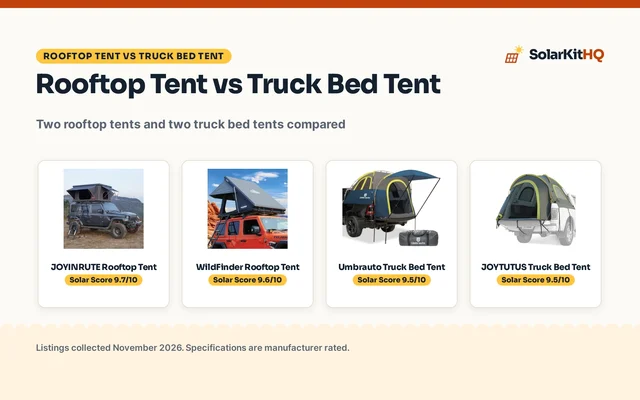
Rooftop tent vs ground tent is a choice between sleeping on the roof and sleeping on the ground. A rooftop tent wins when the camp spot is uneven or wet, because the bed sits on the roof, off the ground, and the tent sets up in minutes; a ground tent wins when the vehicle stays home or the camp sits far from where the car can park. This guide covers rooftop tents only, since no ground tent appears among the listings here, and it compares the rooftop models on the figures each maker states.
SolarKitHQ earns a commission when you buy through links on this page, at no extra cost to you. As an Amazon Associate I earn from qualifying purchases. Affiliate disclosure.
Rooftop tent vs ground tent: the quick answer
Pick a rooftop tent for vehicle-based trips where the car parks beside the camp: the bed stays off wet or uneven ground, setup runs to 30 seconds on the San Hima hard shell and minutes on the WGOS inflatable, and the tent packs away on the roof. Pick a ground tent for walk-in camps, for trips without a car, or when the roof cannot carry the load. Between the rooftop models here, the San Hima hard shell leads on features and setup speed, the WGOS inflatable leads on weight at 42.0 pounds, and the WildFinder and HEYFUN hard shells state no specs to compare.
Setup and pack-down
Setup is where rooftop tents earn their keep. The San Hima hard shell opens in 30 seconds: unlock the lid, lift, and let the gas struts do the job, then clip on the telescopic ladder, rated at 330.69 lbs. The rainfly sets itself automatically, with no rods and no extra steps. The WGOS inflatable uses an air-beam structure with no complicated poles, and inflates in minutes with the included air pump. A ground tent needs poles, pegs and a flat patch of ground, and takes longer to put up and take down, so the rooftop wins on arrival and on departure alike.
Pack-down matters as much as setup. The San Hima lid closes over a 4.57 in thick shell that fits in most garages or undercover parking, so the tent lives on the roof between trips. The WGOS kit packs into a carry bag with the air pump, air mattress, ladder, rainfly, support brackets, guy lines, shoe bag, repair kit and instruction manual. Check the vehicle roof load rating before choosing a rooftop tent, since the roof must carry the tent plus the sleepers and gear.
Weight and roof load
Weight decides which vehicles can carry the tent. The WGOS inflatable weighs 42.0 pounds, lighter than the San Hima hard shell at 133.40 lbs, and its kit includes the air pump, air mattress and ladder. The San Hima hard shell is rated at 133.40 lbs, which the maker describes as 32% lighter than the Hotham. Roof load ratings vary by vehicle, so match the tent weight to the rating in the vehicle manual before buying.
Weather protection
The San Hima and WGOS tents use the same fabric pair, 420D Oxford and 280G poly-cotton, with UV50+ protection. The San Hima adds a 5,000 mm rating for water protection, a 1.57 in raised base to keep water out, AquaShield PTFE tech woven into the fabric, and mesh plus ceiling windows for airflow. The WGOS relies on its rainfly, reinforced zippers, sturdy air columns and protective awnings to keep the interior dry in changing weather, with a panoramic skylight for light and views. No IP rating is stated in the listings here, so the figures above are the maker stated protection.
Sleeping space and comfort
The San Hima suits a couple, while the WGOS, WildFinder and HEYFUN listings state 2-3 person. The San Hima interior measures 81.50 x 46.06 in, with a plush 2.36 in self-inflating mattress, full-ceiling LEDs that shift from bright white to natural daylight or amber, interior storage and a shoe bag. The WGOS sleeps 2-3 person on an included inflatable air mattress, with large windows, mesh doors and a panoramic skylight for airflow, natural light and open-sky views. The WildFinder and HEYFUN hard shells are listed for 2-3 person, with no interior figures stated.
The gear
The rooftop tents below are ranked by the figures each maker states.
| Tent | Setup | Weight | Sleeping space | Warranty |
|---|---|---|---|---|
| San Hima Hotham Lite Gen 2 | 30 seconds | 133.40 lbs | 81.50 x 46.06 in | 2-year |
| WGOS inflatable rooftop tent | Minutes with air pump | 42.0 pounds | 2-3 person | 1 Year Manufacturer |
| WildFinder hard shell rooftop tent | Not stated | Not stated | 2-3 person | Not stated |
| HEYFUN Adventurer Pro hard shell | Not stated | Not stated | 2-3 person | Not stated |
San Hima Hotham Lite Gen 2
The San Hima Hotham Lite Gen 2 is the hard shell pick with the most stated features. It opens in 30 seconds on gas struts, with a rainfly that sets itself automatically and a telescopic ladder rated at 330.69 lbs. The shell is 4.57 in thick, the interior measures 81.50 x 46.06 in with a 2.36 in self-inflating mattress, and the full-ceiling LEDs shift from bright white to natural daylight or amber. A digital panel offers USB-C, USB-A and a CIG socket, plus an air conditioner duct hole for an AC hose. The maker gives 2 weights, 133.40 and 146.6 pounds, 2 interior lengths, 82 and 81.50 inches, and 2 warranty terms, 2 years and 1 year; check before ordering.
Who it suits: a couple who wants a hard shell tent with fast setup, lighting and charging on the roof. Who should skip it: anyone whose roof cannot carry 133.40 lbs, or who wants a written figure they can rely on without checking.
WGOS inflatable rooftop tent
The WGOS inflatable rooftop tent is the lighter pick at 42.0 pounds, and it sleeps 2-3 person. Its air-beam structure inflates in minutes with the included air pump, with no complicated poles, and the kit packs an inflatable air mattress, telescoping anti-slip ladder, rainfly, carry bag, support brackets, guy lines, shoe bag, repair kit and instruction manual. The fabric is 420D Oxford and 280G poly-cotton with UV50+ protection, and large windows, mesh doors and a panoramic skylight bring in airflow, natural light and open-sky views. The maker states a 1 Year Manufacturer warranty.
Who it suits: a camper who wants a light tent and a complete kit in one bag. Who should skip it: anyone who wants a hard shell, or a setup measured in seconds rather than minutes.
WildFinder hard shell rooftop tent
The WildFinder hard shell rooftop tent is listed in aluminum with an LED strip, for 2-3 person. No setup, weight, interior or warranty figures are stated, so it ranks behind the San Hima and WGOS tents. Who it suits: a buyer who wants an aluminum hard shell and will confirm the missing figures with the seller. Who should skip it: anyone who needs stated specs before buying.
HEYFUN Adventurer Pro hard shell rooftop tent
The HEYFUN Adventurer Pro hard shell rooftop tent is listed for 2-3 person, with no further figures stated. It ranks last here because the listing gives no setup, weight, interior or warranty figures to compare. Who it suits: a buyer who wants a hard shell for 2-3 person and will confirm the missing figures with the seller. Who should skip it: anyone who needs stated specs before buying.
FAQ: power away from the grid
Can a rooftop tent fit any car?
No. The tent must suit the vehicle roof, so check the vehicle roof load rating and the tent weight before buying. The WGOS weighs 42.0 pounds and the San Hima is rated at 133.40 lbs, so the choice turns on what the roof can carry.
How fast does a rooftop tent set up?
The San Hima hard shell opens in 30 seconds on gas struts, with the rainfly setting itself automatically. The WGOS inflatable takes minutes with the included air pump. The WildFinder and HEYFUN listings state no setup figure.
How many people sleep in a rooftop tent?
The WGOS, WildFinder and HEYFUN listings state 2-3 person, and the San Hima suits a couple on a 2.36 in self-inflating mattress in an 81.50 x 46.06 in interior.
Are rooftop tents good in rain?
The San Hima is rated at 5,000 mm for water protection, with a 1.57 in raised base, and its rainfly sets itself automatically. The WGOS comes with a rainfly, reinforced zippers and protective awnings, and each listing states UV50+ protection.
What comes with a rooftop tent?
It varies by listing. The WGOS kit includes the tent, air pump, inflatable air mattress, telescoping anti-slip ladder, rainfly, carry bag, support brackets, guy lines, shoe bag, repair kit and instruction manual. The San Hima includes a telescopic ladder and a shoe bag, with a digital panel for USB-C, USB-A and a CIG socket.
Related solar guides
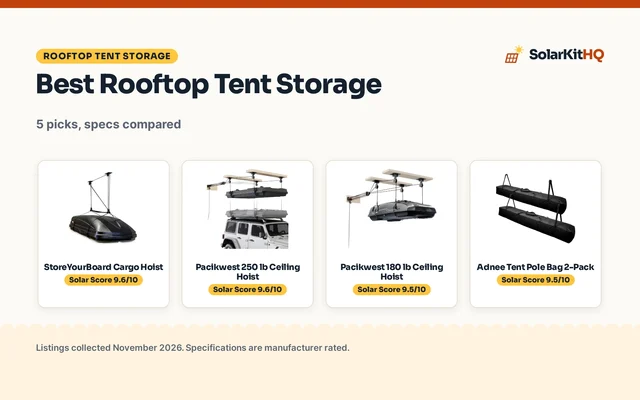
See the camping and emergency gear guides and the overlanding and car camping guides. Also see the best ultralight rooftop tents and the best rooftop tent storage.