On this page
When the tap in your RV coughs air instead of water, rv water pump repair means finding whether the pump lost power, lost prime or lost pressure. Most faults sit in the power supply, the water line or the pump itself, and the checks below work through them in order, from the switch to the pump. The gear at the end keeps the 12V battery charged off grid, since a pump with a flat battery never builds pressure.
SolarKitHQ earns a commission when you buy through links on this page, at no extra cost to you. As an Amazon Associate I earn from qualifying purchases. Affiliate disclosure.
The quick answer
Check the power: the pump switch, the fuse panel and the battery charge, since a pump that never runs has no power reaching it. Then check that the tank holds water and the strainer is clear, and look for air leaks and loose fittings in the lines. If the pump runs and the lines hold water but pressure never builds, the pump itself is worn and replacement is the fix.
Step 1: Check the power
Start at the switch and work toward the pump. Turn the pump switch on and listen: silence points to power, while a hum with no water points to the water line or the pump. Check the fuse panel for a blown fuse and the battery charge, and look at the wiring where it reaches the pump for a loose connection. A pump that gets steady 12V power and still never runs has a fault in the pump itself.
Step 2: Check the water supply and the strainer
Make sure the fresh water tank holds water, then find the strainer on the inlet side of the pump and check it for debris. A clogged strainer starves the pump, so rinse it with clean water and put it back. Look along the inlet line for a kink or a collapsed hose, and check that every fitting is tight. A loose fitting on the inlet side lets the pump draw air instead of water.
Step 3: Look for air and leaks in the lines
Open a tap and let the pump run until the flow turns steady, which clears air trapped in the lines. Walk the lines and look for drips at fittings, joints and the pump head, and feel for wet spots under the RV where a line may have split. Air in the line makes the pump cycle on and off, while a leak on the outlet side keeps pressure from building. Tighten a loose fitting and replace a split line, then run the tap again.
Step 4: Decide whether the pump itself is worn
When power reaches the pump, the tank holds water and the lines are tight, yet pressure never builds, the fault sits in the pump. A worn diaphragm or worn valves let water slip back instead of pushing it to the tap, and the pump runs on without ever reaching shutoff. Replacement is the fix at that point: match the new pump to the manual for your RV, and have a licensed electrician do any wiring work the swap needs.
Ways to keep the pump fed off grid
- Keep the 12V battery charged. A wind turbine listed for RV use can add charge on windy days when the sun is down.
- Check the battery and the pump wiring when the pump slows. Low voltage shows up as a slow pump before it shows up anywhere else.
- Carry a spare strainer and a spare fuse. A clogged strainer and a blown fuse are the faults that strand a trip.
RV water pump repair gear for off-grid power
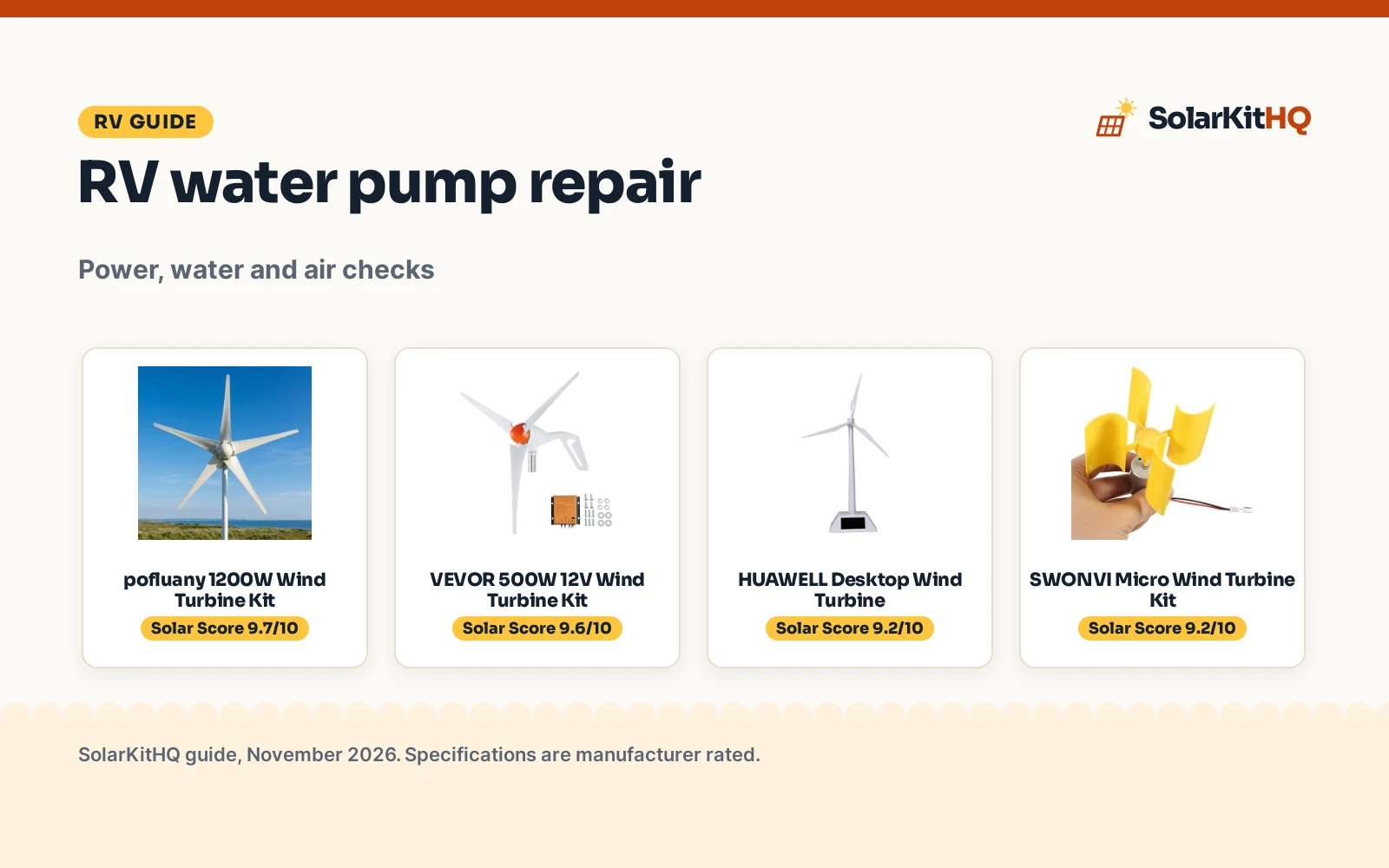
The checks above need steady 12V power, so the kits below keep an RV battery charged away from shore power, while the small models show how wind power works instead of charging a battery bank.
| # | Product | Solar Score | Buy |
|---|---|---|---|
| 1 |  pofluany 1200W Wind Turbine Kit | 9.7/10 | Buy on Amazon |
| 2 |  VEVOR 500W 12V Wind Turbine Kit | 9.6/10 | Buy on Amazon |
| 3 |  HUAWELL Desktop Wind Turbine | 9.2/10 | Buy on Amazon |
| 4 |  SWONVI Micro Wind Turbine Kit | 9.2/10 | Buy on Amazon |

pofluany 1200W Wind Turbine Kit
A 1200W 5-blade wind turbine kit for 12V or 24V systems, with a charging controller and a 2-year warranty.
Pros
- Rated 1200W with an 800 RPM rated speed and a 1.2 m rotor
- Starts at 2.5 m/s wind speed with automatic yaw adjustment
- 2 Year Warranty stated, with an installation tool set included
- Listed for RV, cabin, farm, marine and home use with a 12V battery configuration
Cons
- Tower, mast, wiring and battery are not listed as included
- Measures 44.9 inches on each side, so it needs clear space to mount
- Listed tower requirements call for a diameter over 80 mm and a height of 4.5-10 m
- Professional installation planning is needed for the site, electrical setup, grounding and local codes
Detailed Review
The maker lists a 5-blade turbine rated 1200W with an 800 RPM rated speed, a 1.2 m rotor, a 2.5 m/s start speed and DC 27-54V, for 12V or 24V systems. It includes a charging controller and an installation tool set, lists a 12V battery configuration of 200-400Ah, and states a 2 Year Warranty. The build is listed as weather-resistant, with automatic yaw adjustment and integrated voltage regulation, and no storm-wind rating is given.
Who it's for: RV, cabin, farm and home owners who want a 1200W turbine to charge a 12V battery bank off grid. Who should skip it: anyone without room for a tower of 4.5-10 m or a 200-400Ah battery bank.
Its Solar Score of 9.7/10 comes from performance 32/35, build 21/25, value 21/25, safety 7/10 and warranty 2/5: 83 of 100 points, placed on our 9.2 to 9.8 scale.
Key Specifications
| Rated power | 1200W, 12V/24V |
|---|---|
| Rotor | 5-blade, 1.2 m, 800 RPM |
| Start speed | 2.5 m/s |
| Warranty | 2 Year Warranty |
Taken from the seller's listing on 18 November 2026. Capacity and output figures are rated by the manufacturer.
Safety and Warranty
What this listing states. Weather-resistant build, automatic yaw adjustment and integrated voltage regulation stated, so safety scores 7 of 10. 2 Year Warranty. It does not say everything a buyer needs, such as who pays return shipping, so warranty scores 2 of 5. See How We Pick.
Follow the manual. Connect and use the product as the maker describes, stay within every stated rating, and read the manual before first use.
This is general buying information, not professional advice. Follow each product manual and local rules, and see our Safety Disclaimer.

VEVOR 500W 12V Wind Turbine Kit
A 500W 12V wind turbine kit with an MPPT controller, 3 blades and a 2.5 m/s start speed, listed for RVs and off-grid systems.
Pros
- MPPT controller included, with a 2.5 m/s start speed and a 12 m/s rated wind speed
- 3-phase AC permanent magnet synchronous generator for stable operation
- High-strength nylon composite blades with a die-cast aluminum body
- Adjustable tail tracks wind direction, with dual bearings for smooth operation
Cons
- Tower pole is not included
- No warranty term is stated
- Spans 47.24 inches across, so it needs clear space to mount
- The 500W size comes without an anemometer
Detailed Review
The maker lists a 500W 12V turbine with 3 large-diameter blades, a 2.5 m/s start speed, a 12 m/s rated wind speed and an MPPT controller, built around a 3-phase AC permanent magnet synchronous generator. The blades are high-strength nylon composite, the body is die-cast aluminum, and an adjustable tail and dual bearings are listed for stable, smooth and quiet operation. The kit is listed for homes, farms, RVs, boats and off-grid systems, and the maker states it works with most energy storage batteries.
Who it's for: RV and off-grid owners who want a 500W 12V turbine with an MPPT controller to keep a battery charged. Who should skip it: anyone who needs the tower pole included in the kit.
Its Solar Score of 9.6/10 comes from performance 30/35, build 21/25, value 20/25, safety 5/10 and warranty 0/5: 76 of 100 points, placed on our 9.2 to 9.8 scale.
Key Specifications
| Rated power | 500W, 12V |
|---|---|
| Wind speeds | 2.5 m/s start, 12 m/s rated |
| Blades | 3, nylon composite |
| Controller | MPPT controller included |
Taken from the seller's listing on 18 November 2026. Capacity and output figures are rated by the manufacturer.
Safety and Warranty
What this listing states. Die-cast aluminum body, nylon composite blades and dual bearings stated for stable outdoor operation, so safety scores 5 of 10. No warranty term, so warranty scores zero. See How We Pick.
Follow the manual. Connect and use the product as the maker describes, stay within every stated rating, and read the manual before first use.
This is general buying information, not professional advice. Follow each product manual and local rules, and see our Safety Disclaimer.

HUAWELL Desktop Wind Turbine
A solar powered desktop wind turbine model in ABS plastics, made as an educational desk item rather than a power source.
Pros
- Solar powered rotating base with no battery required
- Easy to assemble with no glue required
- ABS engineering plastics in a compact 10.6 x 9.3 x 1.8 inch size
- Made as an educational item for learning how solar and wind power work
Cons
- A desktop model, not a turbine that charges an RV battery
- Weighs about 147g, so it is a display piece rather than outdoor gear
- Needs sunlight on the base panel to spin, so it stops without sun
- Small 10.6 x 9.3 x 1.8 inch size suits a desk, not a roof or tower
Detailed Review
The maker lists a desktop wind turbine model in ABS engineering plastics, powered by sunlight on a solar panel in the base, with no battery required and no glue needed for assembly. It measures 10.6 x 9.3 x 1.8 inches and weighs about 147g, and the box holds a solar powered rotating base, a tray and a windmill. The maker describes it as an educational item for learning about solar and wind power.
Who it's for: anyone who wants a desk model that shows how a wind turbine spins on solar power. Who should skip it: anyone who needs to charge an RV battery or power a water pump.
Its Solar Score of 9.2/10 comes from performance 14/35, build 12/25, value 12/25, safety 0/10 and warranty 0/5: 38 of 100 points, placed on our 9.2 to 9.8 scale.
Key Specifications
| Type | Desktop model, solar powered |
|---|---|
| Material | ABS engineering plastics |
| Size | 10.6 x 9.3 x 1.8 in |
| Weight | approx. 147g |
Taken from the seller's listing on 18 November 2026. Capacity and output figures are rated by the manufacturer.
Safety and Warranty
What this listing states. No safety listing, protection or rating is stated, so safety scores zero. No warranty term, so warranty scores zero. See How We Pick.
Follow the manual. Connect and use the product as the maker describes, stay within every stated rating, and read the manual before first use.
This is general buying information, not professional advice. Follow each product manual and local rules, and see our Safety Disclaimer.

SWONVI Micro Wind Turbine Kit
A micro wind turbine DIY kit with a DC 0.1V-5.5V motor, made for science education experiments rather than RV power.
Pros
- Starts generating power with gentle breezes, for clear classroom demos
- Captures wind from any direction with omnidirectional operation
- Compact 2.0 x 1.2 x 0.5 inch size for small science models
- Made for STEM science projects and school experiments
Cons
- A micro DIY kit, not a turbine that charges an RV battery
- DC 0.1V-5.5V output suits a demo meter, not a 12V battery
- Tiny 2.0 x 1.2 x 0.5 inch size gives no usable power for an RV
- No warranty term is stated
Detailed Review
The maker lists a micro wind turbine DC motor kit rated DC 0.1V-5.5V at 100-6000RPM, with vertical motor blades in a 2.0 x 1.2 x 0.5 inch size. It is listed as a compact wind power demonstrator for classrooms, a teaching tool for renewable wind power, and a STEM science project model, with omnidirectional wind operation and low wind speed activation.
Who it's for: teachers and students building a science model that shows wind power in a classroom. Who should skip it: anyone who needs to charge a battery or run an RV water pump.
Its Solar Score of 9.2/10 comes from performance 12/35, build 11/25, value 11/25, safety 0/10 and warranty 0/5: 34 of 100 points, placed on our 9.2 to 9.8 scale.
Key Specifications
| Output | DC 0.1V-5.5V, 100-6000RPM |
|---|---|
| Size | 2.0 x 1.2 x 0.5 in |
| Use | Science education experiment |
| Operation | Omnidirectional, low wind activation |
Taken from the seller's listing on 18 November 2026. Capacity and output figures are rated by the manufacturer.
Safety and Warranty
What this listing states. No safety listing, protection or rating is stated, so safety scores zero. No warranty term, so warranty scores zero. See How We Pick.
Follow the manual. Connect and use the product as the maker describes, stay within every stated rating, and read the manual before first use.
This is general buying information, not professional advice. Follow each product manual and local rules, and see our Safety Disclaimer.
As an Amazon Associate I earn from qualifying purchases.
FAQ: power away from the grid
Why does my RV water pump run but move no water?
The pump is drawing air or the inlet is blocked. Check that the tank holds water, rinse the strainer, and look for a loose fitting or a kink on the inlet side. If the lines are tight and the strainer is clear, the valves may be worn.
Why does my RV water pump cycle on and off?
The pump loses pressure between cycles, which points to air in the line, a leak on the outlet side or worn valves. Walk the lines for drips, tighten loose fittings and let the pump run with a tap open until the flow turns steady.
Can a wind turbine keep my RV battery charged for the water pump?
Yes, when the kit is listed for RV use. The VEVOR kit is rated 500W at 12V with an MPPT controller and listed for RVs, and the pofluany kit (on Amazon) is rated 1200W for 12V or 24V systems with a 12V battery configuration. The desktop and DIY models are for learning, not for charging an RV battery.
What wind turbine size fits an RV?
Match the turbine to the battery it charges. The VEVOR kit is rated 500W at 12V with a start speed of 2.5 m/s, and the pofluany kit is rated 1200W with a start speed of 2.5 m/s and a 1.2 m rotor. Both are listed for RV use, so pick by battery voltage and rotor space.
Related solar guides
See every solar outdoor guide and the best RV water pump, the best water pump for a motorhome and how to set a water pump pressure switch.
More picks: best RV water pump for a fresh water tank, how to charge a 12V battery without a charger, how to clean an RV water tank.