On this page
A second panel for the RV roof, a cable that ends a handspan short of the charge controller, a plug that will not mate with the one already on the roof: each one turns on the same small part, and that part is the solar panel wiring connectors. Most panels in this guide use plug pairs, a male plug and a female plug that click together, with a crimped pin inside each half and a spanner wrench to lock and release them. The steps below show how to match the connector to the cable, read the figures the listings state, and build a kit that fits the job.
SolarKitHQ earns a commission when you buy through links on this page, at no extra cost to you. As an Amazon Associate I earn from qualifying purchases. Affiliate disclosure.
What solar panel wiring connectors do
MC4-type connectors join panel cables into a run that reaches the charge controller, and they come as male and female pairs that click together. Each half holds a crimped pin: the pin is crimped onto the stripped cable end with a crimping tool, then pushed into the housing until it locks. The housings are PPO in most listings here, with tinned copper pins, and the spanner wrenches in the kits tighten and loosen the locking nut. The same pair works for panel-to-panel links and for the run to the controller, as long as the cable size and the figures match.
Step 1: Match the connector to the panel
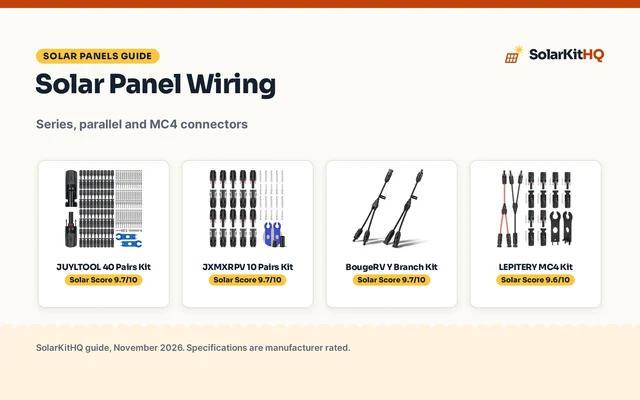
Start with the plug the panel already has: the listings here are MC4-type, and the kits are built around male and female pairs. The JUYLTOOL, PROSOLI and TCEUMIK kits hold 30 pairs, the Noxtren kit (on Amazon) holds 25 pairs, the dakewang kit (on Amazon) holds 24 pairs, the DYVIAHOME kit (on Amazon) holds 13 pairs, and the Daslleysen, LingChievo and Soxzoln kits hold 12 pairs each, while the MUYI kit holds 10 pairs. Count the joints the run needs before you order, since a kit with 12 pairs covers a short run and a kit with 30 pairs covers a longer one with spares. Keep the pairs matched: a male plug mates with a female plug, and the spanner wrenches in the kits lock and release them. See the solar panel connector types guide for the common styles.
Step 2: Match the cable size
The crimper and the pins fit a cable range, and the range is printed on the listing: most kits here take 2.5/4/6 mm² cable, or 14-10 AWG. The MUYI kit takes AWG 13-10, and the TCEUMIK listing gives 14AWG, 12AWG and 10AWG. The PROSOLI stripper (on Amazon) fits AWG 20-10, or 0.8-2.5 mm². Measure the cable or read the print on the jacket, then pick the kit whose range covers it: a pin crimped onto the wrong size cable will not seat or hold. See the 10 AWG vs 14 AWG solar cable guide for the sizes in common use.
Step 3: Crimp the pin and seat it in the housing
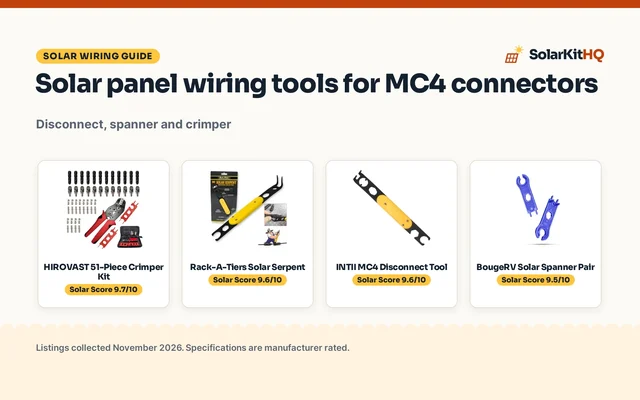
Strip the cable end, crimp the pin onto the bare copper with the ratcheting crimper, and push the pin into the housing until it locks. The kits here use high-carbon steel crimpers with a ratcheting mechanism, and the Soxzoln crimper (on Amazon) has a PP+TPR ergonomic non-slip handle. The pins are tinned copper in most listings, and the housings are PPO with a rubber sealing ring inside. Pull the cable gently after seating to check the pin holds, and use the spanner wrenches to tighten the lock. The TCEUMIK listing says to grip the sides of the built-in lock with the tail of a wrench to separate a pair.
Step 4: Check the figures on the listing
The figures that matter on a connector listing are the voltage, the current, the IP code and the temperature range. The dakewang, MUYI, TCEUMIK, PROSOLI and DYVIAHOME listings give 1000V DC and 30A. Most listings here state IP67, while the Noxtren and PROSOLI listings state IP68. Temperature ranges vary by listing: the dakewang gives -40°F to 105°F, the TCEUMIK gives -40°F to 185°F, the PROSOLI gives -40°F to 227°F, and the MUYI gives -40°F to 257°F. Match each figure to the system the connectors will serve, and treat a missing figure as a gap to check on the listing. For a different plug style, see the MC4 vs Anderson connectors for solar guide.
| Kit | Connectors | 1000V DC / 30A | IP code | Temperature range |
|---|---|---|---|---|
| JUYLTOOL | 30 pairs | Not stated | IP67 | Not stated |
| Daslleysen | 12 pairs | Not stated | IP67 | Not stated |
| dakewang | 24 pairs | 1000V, 30A | IP67 | -40°F to 105°F |
| MUYI | 10 pairs | 1000V, 30A | IP67 | -40°F to 257°F |
| TCEUMIK | 30 pairs | 1000V, 30A | IP67 | -40°F to 185°F |
| PROSOLI | 30 pairs | 1000V, 30A | IP68 | -40°F to 227°F |
| Noxtren | 25 pairs | Not stated | IP68 | Not stated |
Step 5: Build the kit for the job
A kit is more than the connectors: the crimper, the stripper, the spanner wrenches and the case all matter on the day. The JUYLTOOL kit holds 30 pairs of connectors, 1 crimper and 2 spanner wrenches; the Daslleysen kit holds 12 pairs, 1 crimper, 2 wrenches and a zipper case; the Noxtren kit adds a wire stripper and a case with 25 pairs; the PROSOLI kit holds 30 pairs, a crimper, a stripper, 2 spanners and an organizer. The TCEUMIK kit holds 30 pairs and 2 spanner wrenches with no crimper stated, so pair it with a crimper you already own. The DYVIAHOME listing gives 1 pair of wrenches in the title and 2 wrenches in the bullets, so check the count on the listing before you order.
Ways to keep the connections sound
- Match the cable size to the kit range before you crimp: 2.5/4/6 mm², or 14-10 AWG, on most kits here.
- Seat each pin until it locks, then pull the cable gently to check the hold.
- Use the spanner wrenches to tighten the lock, and keep the sealing rings clean and free of grit.
- Check the figures on the listing: 1000V DC and 30A where stated, and the IP code for outdoor use.
For more options, see our solar panels guides.
FAQ: power away from the grid
What is an MC4 connector?
An MC4-type connector is a male and female plug pair for solar panel cables. The plugs click together, and the spanner wrenches in the kits lock and release them. The kits here hold 12 to 30 pairs.
What cable size fits MC4 connectors?
Most kits here take 2.5/4/6 mm² cable, or 14-10 AWG. The MUYI kit takes AWG 13-10, and the PROSOLI stripper fits AWG 20-10. Read the cable size on the listing before you order.
What do 1000V and 30A mean on a connector listing?
They are the figures the listing gives for the connector: 1000V DC and 30A on the dakewang, MUYI, TCEUMIK, PROSOLI and DYVIAHOME listings. Match them to the figures for the panels and the rest of the run.
Are MC4 connectors IP67 or IP68?
Most listings here state IP67. The Noxtren and PROSOLI listings state IP68. Check the IP code on the listing for the connectors you buy, since the code varies by kit.
Do I need a crimper for MC4 connectors?
Yes, to crimp the pins onto the cable ends. Most kits here include a crimper with the connectors and spanner wrenches. The TCEUMIK kit holds 30 pairs and 2 spanner wrenches with no crimper stated, so pair it with a crimper you already own.
Related solar guides
See the solar panel connector types, the MC4 vs Anderson connectors for solar, the solid vs stranded solar cable and the best MC4 cable for charge controller guides.