On this page
The RV sits off-grid for the weekend, the fridge hums on battery power, and by morning the lights are dim. A solar setup for RV use turns that morning around: panels on the roof feed a controller, the controller feeds a battery, and the battery feeds an inverter that runs the RV. The sections below size each part from the listing figures, and the gear at the end covers complete kits.
SolarKitHQ earns a commission when you buy through links on this page, at no extra cost to you. As an Amazon Associate I earn from qualifying purchases. Affiliate disclosure.
How a solar setup for RV works
An RV solar setup has parts that work in a line: panels on the roof, a charge controller, a battery and an inverter. The panels turn sunlight into DC power. The controller feeds the battery at the right voltage. The battery stores the power for night use, and the inverter turns it into household AC for the RV appliances. The ECO-WORTHY kits on this page show the shape of the answer: each lists panels, a battery, a controller and an inverter in the same box, with the figures to match against the RV need.
Step 1: Add up the daily watt-hours
List the RV appliances to run and the watt-hours each needs in a day, then add them together. A fridge, lights, a fan, a TV and a water heater each add their own figure, and the total is the daily need the setup must cover. The ECO-WORTHY listings name the same loads: refrigerators, air conditioners, microwave ovens, TVs, fans, coffee machines, LED lights and water heaters. Read the watt-hours off each appliance label or manual, and write the figure next to it.
Step 2: Size the panels from the sunlight hours
Take the daily watt-hours and divide by the hours of sunlight the roof gets. The ECO-WORTHY listings give the pattern: 4 hours of sunlight per day generates 3.12 kWh on the 2000W kit and 3.2 kWh on the 3000W kit. A roof that gets fewer hours of sunlight needs more panel watts for the same daily total, and a roof that gets more hours needs fewer watts. Use the hours the roof actually gets, with nothing shading the panels, and not the hours of daylight on the longest day.
Step 3: Size the battery and the inverter
The battery stores the day’s energy for night use. The 2000W kit lists a 12.8V 314Ah battery that stores 4.02 kWh, and the 3000W kit lists 2 batteries at 12.8V 280Ah that store 7.168 kWh. Match the storage figure to the night load: a bigger night load needs a bigger battery. The inverter sets what the RV can run at once: the 2000W kit lists a 2000W pure sine wave inverter, and the 3000W kit lists a 3000W UPS inverter charger. Match the inverter watts to the biggest load the RV runs, and check the battery voltage the inverter fits: both kits use 12.8V batteries with a 12V system.
| Kit | Panels | Battery | Inverter | Amazon |
|---|---|---|---|---|
| ECO-WORTHY 2000W kit | 4 x 195W bifacial | 12.8V 314Ah, 4.02 kWh | 2000W pure sine wave | |
| ECO-WORTHY 3000W kit | 4 x 195W bifacial | 2 x 12.8V 280Ah, 7.168 kWh | 3000W UPS inverter charger |
These are the makers’ stated figures. The 3000W kit stores more energy and runs a bigger inverter, while the 2000W kit lists a battery warranty and a BMS with low-temperature protection.
Step 4: Check the controller and the roof space
The controller sits between the panels and the battery. Both kits list a 60A MPPT controller with Bluetooth, and the panels measure 58.86 by 26.18 by 1.18 inches, so measure the roof before buying. Check that the controller current fits the panels: the kits pair a 60A controller with 4 panels at 195W each. See the solar charge controller size guide for how to match a controller to panels.
The kits for this setup
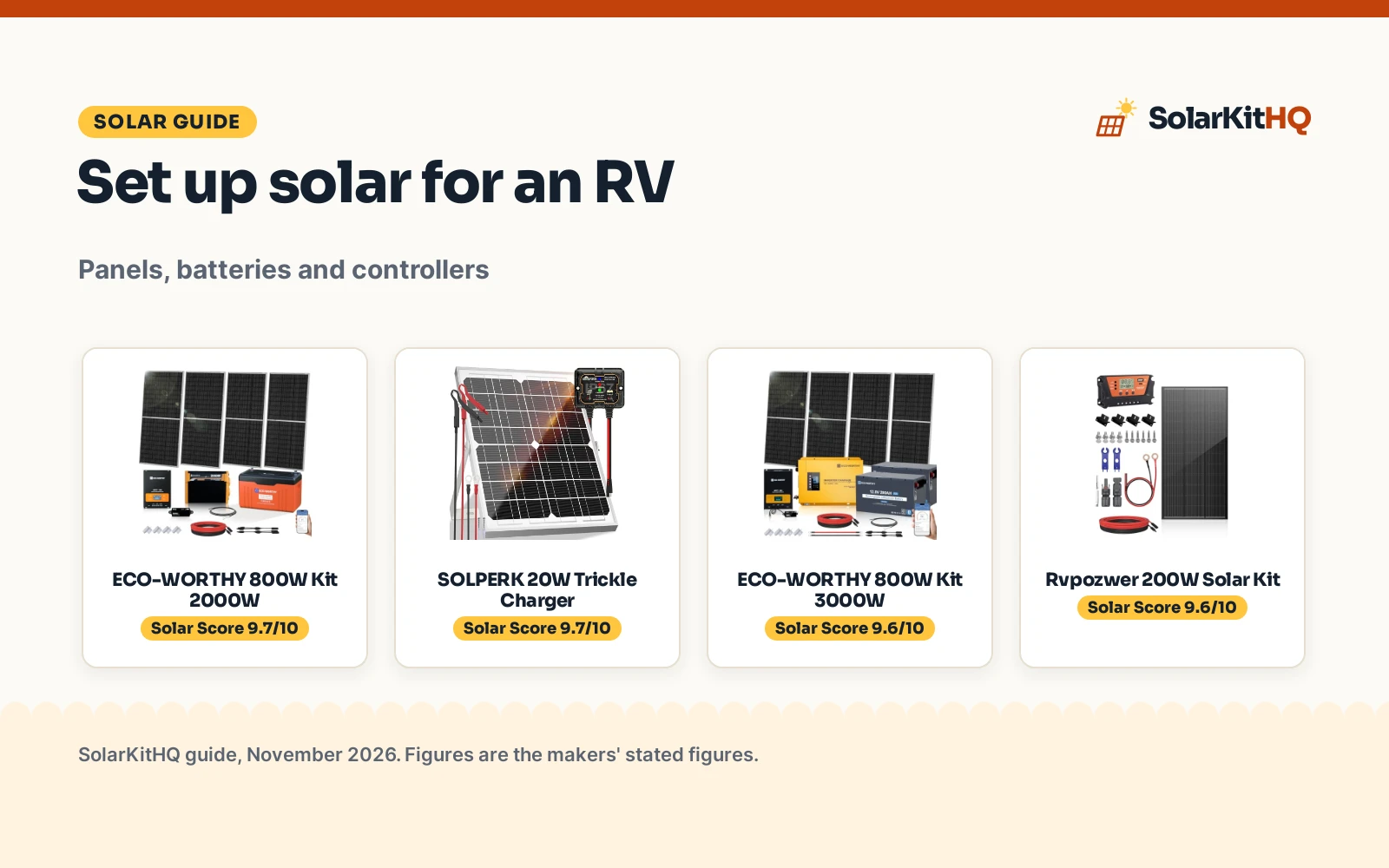
The sizing steps above need a kit with stated panel watts, battery storage, controller current and inverter watts. The kits below cover the setup, from a 20W trickle charger to a complete 800W kit with a 3000W inverter charger.
| # | Product | Solar Score | Buy |
|---|---|---|---|
| 1 |  ECO-WORTHY 800W Kit 2000W | 9.7/10 | Buy on Amazon |
| 2 |  SOLPERK 20W | 9.7/10 | Buy on Amazon |
| 3 |  ECO-WORTHY 800W Kit 3000W | 9.6/10 | Buy on Amazon |
| 4 |  Rvpozwer 200W N-Type Kit | 9.6/10 | Buy on Amazon |

ECO-WORTHY 800W Kit 2000W
A complete 800W RV kit with 4 bifacial panels, a 314Ah battery, a 60A MPPT controller and a 2000W inverter, for the sizing step of the RV setup.
Pros
- 4 bifacial 195W N-Type panels at 25% efficiency
- 12.8V 314Ah lithium battery with a 60A MPPT controller
- 2000W pure sine wave inverter included
- Bluetooth 5.1 monitoring and BMS with low-temperature protection
Cons
- Title says 800W while 4 panels at 195W add to 780W
- Battery warranty is 3 years while other parts are 1 year
- Inverter only, with no charger function stated
- One battery only
Detailed Review
The listing states a complete 800W off-grid kit with 4 bifacial 195W N-Type panels at 25% efficiency, a 12.8V 314Ah lithium battery, a 60A MPPT controller and a 2000W pure sine wave inverter. It lists 3.12 kWh per day with 4 hours of sunlight, a 4.02 kWh battery, Bluetooth 5.1 monitoring, a BMS with low-temperature protection and an IP68 figure. The title says 800W, but 4 panels at 195W add to 780W. The warranty is 3 years for the battery and 1 year for other parts.
Who it's for: RV owners who want a complete kit with panels, battery, controller and inverter in one box. Who should skip it: anyone who needs a bigger inverter or more battery storage in the kit.
Its Solar Score of 9.7/10 comes from performance 30/35, build 22/25, value 20/25, safety 8/10 and warranty 2/5: 82 of 100 points, placed on our 9.2 to 9.8 scale.
Key Specifications
| Panels | 4 x 195W bifacial, N-Type, 25% |
|---|---|
| Battery | 12.8V 314Ah lithium, 4.02 kWh |
| Controller | 60A MPPT |
| Inverter | 2000W pure sine wave |
Figures as published on the retailer listing, collected 12 November 2026. Performance figures are manufacturer rated.
Safety and Warranty
What this listing states. BMS with low-temperature protection, Bluetooth 5.1 and IP68 stated, so safety scores 8 of 10. Battery 3 year and other parts 1 year warranty stated. It does not say everything a buyer needs, such as who pays return shipping, so warranty scores 2 of 5. See How We Pick.
Panels make voltage in daylight. Keep connectors covered until you connect them, check the panel's stated open circuit voltage and current against your controller or power station input limits, and use cables rated for the current. Roof and permanent mounts belong to a qualified installer.
This is general buying information, not professional advice. Follow each product manual and local rules, and see our Safety Disclaimer.

SOLPERK 20W
A 20W solar trickle charger kit with a 10A smart MPPT controller, 360-degree bracket and 1-year service.
Pros
- 20W mono A+ panel at 21% to 30% cell efficiency stated
- 10A smart MPPT controller with three-stage charging
- 360° adjustable bracket with plug-and-play SAE
- 1-year after-sales service with lifetime technical support stated
Cons
- Water protection claimed without an IP code
- 24-hour response is a service claim, not a spec
- No cable length is stated
Detailed Review
The listing states a 20W 12V solar trickle charger kit with a monocrystalline A+ panel, a 10A smart MPPT controller, three-stage charging, a 360° adjustable mounting bracket and SAE connectors. It states 21% to 30% cell efficiency, 2400Pa wind and 5400Pa snow load figures, 1-year after-sales service with lifetime technical support and 24-hour online response. The spec table lists 8A amperage capacity against the 10A controller.
Who it's for: buyers who want the most stated panel detail with a 10A smart MPPT controller. Who should skip it: anyone who wants a stated weather code.
Its Solar Score of 9.7/10 comes from performance 32/35, build 22/25, value 21/25, safety 5/10 and warranty 3/5: 83 of 100 points, placed on our 9.2 to 9.8 scale.
Key Specifications
| Panel | 20W mono A+, 21-30% efficiency |
|---|---|
| Controller | 10A smart MPPT, 3-stage |
| Mount | 360° adjustable bracket |
| Service | 1-year, lifetime tech support |
Figures as published on the retailer listing, collected 21 October 2026. Performance figures are manufacturer rated.
Safety and Warranty
What this listing states. Three-stage charging with overcharging, over-voltage and short circuit protection stated, so safety scores 5 of 10. 1-year after-sales service stated. It does not say everything a buyer needs, such as who pays return shipping, so warranty scores 3 of 5. See How We Pick.
Match the charger. Use a charger mode that matches your battery's stated chemistry and voltage, connect in the order the manual gives, and keep it ventilated and dry.
This is general buying information, not professional advice. Follow each product manual and local rules, and see our Safety Disclaimer.

ECO-WORTHY 800W Kit 3000W
A complete 800W RV kit with 4 bifacial panels, 2 280Ah batteries, a 60A MPPT controller and a 3000W inverter charger, for the sizing step of the RV setup.
Pros
- 2 lithium batteries at 12.8V 280Ah, storing 7.168 kWh
- 3000W UPS inverter charger with fast-switching
- 4 bifacial 195W panels at 25.2% efficiency
- 6-zone anti-shade design with a 60A MPPT controller
Cons
- Title says 800W while 4 panels at 195W add to 780W
- No warranty term is stated
- No IP figure is stated
- No low-temperature protection is stated
Detailed Review
The listing states a complete 800W off-grid kit with 4 bifacial 195W panels at 25.2% efficiency, 2 lithium batteries at 12.8V 280Ah, a 60A MPPT controller and a 3000W UPS inverter charger. It lists 3.2 kWh per day with 4 hours of sunlight and 7.168 kWh of storage, with a 6-zone anti-shade design and Bluetooth. The title says 800W, but 4 panels at 195W add to 780W. No warranty term is stated.
Who it's for: RV owners who want more storage and a bigger inverter charger for fridges, air conditioners and other appliances. Who should skip it: anyone who needs a stated warranty term or a stated IP figure.
Its Solar Score of 9.6/10 comes from performance 33/35, build 21/25, value 21/25, safety 5/10 and warranty 0/5: 80 of 100 points, placed on our 9.2 to 9.8 scale.
Key Specifications
| Panels | 4 x 195W bifacial, 25.2% |
|---|---|
| Batteries | 2 x 12.8V 280Ah, 7.168 kWh |
| Controller | 60A MPPT, Bluetooth |
| Inverter | 3000W UPS inverter charger |
Figures as published on the retailer listing, collected 12 November 2026. Performance figures are manufacturer rated.
Safety and Warranty
What this listing states. Sturdy metal enclosure and UPS fast-switching stated, so safety scores 5 of 10. No warranty term, so warranty scores zero. See How We Pick.
Panels make voltage in daylight. Keep connectors covered until you connect them, check the panel's stated open circuit voltage and current against your controller or power station input limits, and use cables rated for the current. Roof and permanent mounts belong to a qualified installer.
This is general buying information, not professional advice. Follow each product manual and local rules, and see our Safety Disclaimer.

Rvpozwer 200W N-Type Kit
A single 200W N-type panel kit with a 30A charge controller, 10AWG solar cable and tray cable, and black Z brackets.
Pros
- Single 200W N-type panel with a stated 25% conversion rate
- 30A charge controller included
- 10AWG solar cable and tray cable included
- Stated average daily generation of 1000Wh with 5-6 hours of sunshine
Cons
- No voltage figure is stated
- No warranty term is stated
- Connection is limited to 3 panels in parallel or 3 panels in series
- No IP code is stated
Detailed Review
The listing states a single 200W N-type panel at a 25% conversion rate, a 30A charge controller, 10AWG solar cable and tray cable, and black Z brackets. It states an average daily generation of 1000Wh with 5-6 hours of sunshine, and a limit of 3 panels in parallel or 3 panels in series. No voltage figure is stated, so match the panel to a controller input on the other stated figures.
Who it's for: boat and camper owners who want a 200W kit with a controller included. Who should skip it: anyone who needs a stated voltage figure before buying.
Its Solar Score of 9.6/10 comes from performance 32/35, build 21/25, value 20/25, safety 5/10 and warranty 0/5: 78 of 100 points, placed on our 9.2 to 9.8 scale.
Key Specifications
| Watts | 200W |
|---|---|
| Efficiency | 25% |
| Controller | 30A charge controller |
| Cable | 10AWG solar cable |
Figures as published on the retailer listing, collected 2 November 2026. Performance figures are manufacturer rated.
Safety and Warranty
What this listing states. 30A charge controller and 10AWG solar cable stated, so safety scores 5 of 10. No warranty term, so warranty scores zero. See How We Pick.
Panels make voltage in daylight. Keep connectors covered until you connect them, check the panel's stated open circuit voltage and current against your controller or power station input limits, and use cables rated for the current. Roof and permanent mounts belong to a qualified installer.
This is general buying information, not professional advice. Follow each product manual and local rules, and see our Safety Disclaimer.
As an Amazon Associate I earn from qualifying purchases.
Ways to keep the setup working
- Size the battery for the night load first, then the panels for the day load: the 3000W kit stores 7.168 kWh, and the 2000W kit stores 4.02 kWh.
- Keep the panels unshaded: the 3000W kit lists a 6-zone anti-shade design, so shading on a zone leaves the other zones delivering power.
- Match the inverter to the biggest load: the 2000W kit lists a 2000W inverter, and the 3000W kit lists a 3000W inverter charger.
- Check the warranty terms before buying: the 2000W kit lists a 3 year battery warranty and a 1 year warranty for other parts.
FAQ: power away from the grid
How much solar power does an RV need?
It depends on the daily watt-hours the RV uses. Add up the appliances, divide by the hours of sunlight, and match the result to a panel with enough watts. The ECO-WORTHY kits show the scale: 4 panels at 195W each, with 3.12 kWh per day on the 2000W kit and 3.2 kWh per day on the 3000W kit.
What size battery does an RV solar setup need?
Match the storage figure to the night load. The 2000W kit lists a 12.8V 314Ah battery that stores 4.02 kWh, and the 3000W kit lists 2 batteries at 12.8V 280Ah that store 7.168 kWh. A bigger night load needs a bigger battery.
Can an RV solar setup run an air conditioner?
The listings say the kits can power 99% of RV appliances, including refrigerators, air conditioners, microwave ovens, TVs, fans, coffee machines, LED lights and water heaters. Match the inverter watts to the air conditioner first: the 2000W kit lists a 2000W inverter, and the 3000W kit lists a 3000W inverter charger.
Does an RV solar kit include everything needed?
The ECO-WORTHY kits list panels, batteries, a controller, an inverter and cables in the box. The 2000W kit lists 4 panels, a 314Ah battery, a 60A controller and a 2000W inverter, and the 3000W kit lists 4 panels, 2 batteries, a 60A controller and a 3000W inverter charger. Check the listing for the cables and the controller before buying.
Related solar guides
See the solar generator calculator, the best 12V refrigerators for RVs, the solar charge controller size and the DIY solar panel kits.