On this page
Dinner is on the table when the lights go out, and the phone on the counter is nearly dead. An off grid solar setup is a set of panels, a charge controller, a battery and an inverter that keeps the lights and the fridge running without the grid. The steps below list the loads, size the battery and the panels, and match the parts, and the gear section names the books and the kit that cover the job.
SolarKitHQ earns a commission when you buy through links on this page, at no extra cost to you. As an Amazon Associate I earn from qualifying purchases. Affiliate disclosure.
The quick answer
Start with the loads. List every light, fridge, pump and charger the setup must run, and read the watts from each label. Add the watt-hours for a day, size the battery to hold that much with room for cloudy days, and size the panels and the charge controller to refill it. The books below walk through design, install and maintain, and the Renogy kit (on Amazon) supplies the panels and the controller for the hardware side. See the parts of a solar power system for how the pieces fit together.
Step 1: List what needs power
Walk through the cabin, RV, van or boat and write down every load: lights, fridge, water pump, phone chargers, laptop and any fan or tool that plugs in. Read the watts from each label or manual, and note which loads run at the same time and which run only for minutes. A load that runs all day matters more than one that runs for minutes, so sort the list by hours of use as well as watts. Keep the list with the setup, and add to it when a new load joins the system. For an RV, see the solar setup for RV guide for the same steps in a vehicle.
Step 2: Size the battery
Turn the load list into watt-hours by multiplying watts by hours of use for each load, then add the figures for a day. Pick a battery that holds at least that much, with room for cloudy days when the panels make less. Match the battery voltage to the charge controller and the inverter, and check the battery type against what the controller supports. A battery that is too small runs out before the night ends, so leave room in the figure rather than cutting it close. The books below cover battery sizing in detail, and the Renogy kit lists a max battery voltage of 32V, so check the battery you buy against that figure.
Step 3: Size the panels and the controller
Size the panels to replace a day of use, and size the charge controller to take the panels’ watts and voltage. The Renogy kit gives 400W from 4 100W monocrystalline panels and a 40A MPPT charge controller, with a Bluetooth module for monitoring. Place the panels where the sun lands for most of the day, clear of shade from trees, vents and roof racks. Check that the controller covers the panels you connect, and that the panel voltage fits the controller’s input range. A controller that is too small for the panels wastes the power the panels could make. See the solar charge controller size guide before you pick a controller.
Step 4: Check the parts fit together
Match the panel voltage to the controller, the controller to the battery voltage, and the inverter to the loads. The Renogy kit’s max battery voltage is 32V, so a battery above that figure does not fit this controller. Read the manual for each part before connecting anything, and keep the manuals with the setup for later. If the setup ties into home wiring, a licensed electrician should install it. Keep the setup separate from the utility supply. Run the whole system on a clear day before relying on it for a trip or an outage.
The gear for an off grid solar setup
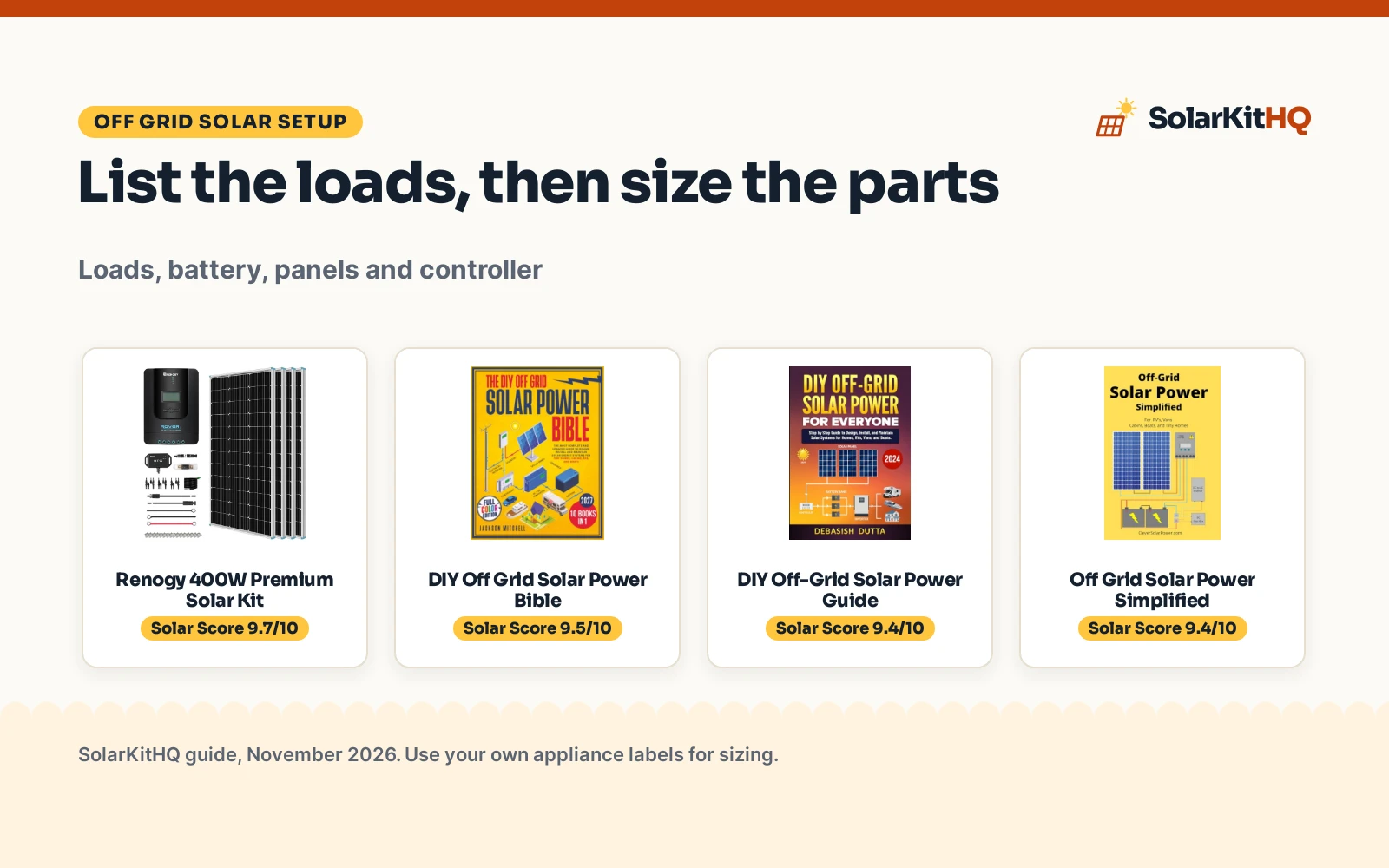
The books below cover the design, install and maintain steps, and the Renogy kit supplies the panels and the 40A controller for the hardware side.
| # | Product | Solar Score | Buy |
|---|---|---|---|
| 1 |  Renogy 400W Premium Kit | 9.7/10 | Buy on Amazon |
| 2 |  DIY Off Grid Solar Power Bible | 9.5/10 | Buy on Amazon |
| 3 |  DIY Off-Grid Solar Power Guide | 9.4/10 | Buy on Amazon |
| 4 |  Off Grid Solar Power Simplified | 9.4/10 | Buy on Amazon |

Renogy 400W Premium Kit
Four 100W panels with a 40A MPPT controller, a Bluetooth module, Z-brackets, cables and an adaptor kit.
Pros
- 400W of panel across four 100W monocrystalline panels
- 40A MPPT controller included
- Bluetooth module, Z-brackets, cables and adaptor kit in the box
- MC4 connectors stated
Cons
- No certification or weather rating is stated
- 56.4 pounds stated for the kit
Detailed Review
The title states four 100W monocrystalline panels, a 40A MPPT charge controller, a Bluetooth module, Z-brackets, cables and an adaptor kit. The spec table gives 41.8 by 20.9 by 1.38 inches per panel, MC4 connectors, 56.4 pounds, a maximum battery voltage of 32V and a 5-year material and workmanship warranty on the panels. The spec table's 100 watt maximum power is the per-panel figure, not the 400W kit total, and the listing states no certification or weather rating.
Who it's for: RV owners with roof space for four panels who want MPPT charging and app monitoring in one box. Who should skip it: buyers who want stated certifications before they buy.
Its Solar Score of 9.7/10 comes from performance 34/35, build 22/25, value 22/25, safety 0/10 and warranty 3/5: 81 of 100 points, placed on our 9.2 to 9.8 scale.
Key Specifications
| Panels | 4 x 100W, 12V |
|---|---|
| Controller | 40A MPPT, Bluetooth module |
| Panel size | 41.8 x 20.9 x 1.38 in |
| Kit weight | 56.4 lb |
Figures as published on the retailer listing, collected 19 October 2026. Performance figures are manufacturer rated.
Safety and Warranty
What this listing states. No UL, TÜV or IEC listing and no weather rating is stated, so safety scores zero. 5-year panel material and workmanship warranty stated. It does not say everything a buyer needs, such as who pays return shipping, so warranty scores 3 of 5. See How We Pick.
Panels make voltage in daylight. Keep connectors covered until you connect them, check the panel's stated open circuit voltage and current against your controller or power station input limits, and use cables rated for the current. Roof and permanent mounts belong to a qualified installer.
This is general buying information, not professional advice. Follow each product manual and local rules, and see our Safety Disclaimer.

DIY Off Grid Solar Power Bible
A 10 in 1 guide that covers design, install and maintain steps for solar systems in tiny homes, cabins, RVs and boats.
Pros
- 10 in 1 guide covering design, install and maintain in one volume
- Covers tiny homes, cabins, RVs and boats
- Measures 8.5 by 0.41 by 11.0 inches
- Covers design, install and maintain, the stages this guide walks through
Cons
- No warranty term is stated
- No page count is stated
- No table of contents is stated
Detailed Review
The listing states a 10 in 1 guide to design, install and maintain solar energy systems for tiny homes, cabins, RVs and boats. The spec table gives 8.5 by 0.41 by 11.0 inches, a weight of 1.26 pounds and a release date of 2024-09-23, and the bullets are empty, so the listing gives no detail beyond the title and the spec table. The title calls it the most complete and updated guide, which is the maker's claim.
Who it's for: readers who want one volume that covers design, install and maintain for a tiny home, cabin, RV or boat. Who should skip it: anyone who wants a stated page count, warranty or table of contents before buying.
Its Solar Score of 9.5/10 comes from performance 27/35, build 19/25, value 19/25, safety not scored (non-powered gear) and warranty 0/5: 65 of 90 points, placed on our 9.2 to 9.8 scale.
Key Specifications
| Format | Guide book |
|---|---|
| Scope | Design, install and maintain |
| Covers | Tiny homes, cabins, RVs and boats |
| Size | 8.5 x 0.41 x 11.0 in |
Figures as published on the retailer listing, collected 12 November 2026. Performance figures are manufacturer rated.
Safety and Warranty
What this listing states. This product does not plug in or run on a battery, so safety is not part of its score. No warranty term, so warranty scores zero. See How We Pick.
Panels make voltage in daylight. Keep connectors covered until you connect them, check the panel's stated open circuit voltage and current against your controller or power station input limits, and use cables rated for the current. Roof and permanent mounts belong to a qualified installer.
This is general buying information, not professional advice. Follow each product manual and local rules, and see our Safety Disclaimer.

DIY Off-Grid Solar Power Guide
A step by step guide to design, install and maintain solar systems for homes, RVs, vans and boats.
Pros
- Step by step guide to design, install and maintain
- Covers homes, RVs, vans and boats
- Measures 7.0 by 0.53 by 10.0 inches
- Lists 1 item in the box
Cons
- No warranty term is stated
- No page count is stated
- No table of contents is stated
Detailed Review
The listing states a step by step guide to design, install and maintain solar systems for homes, RVs, vans and boats. The spec table gives 7.0 by 0.53 by 10.0 inches, a weight of 0.9 pounds and 1 item, and the bullets are empty, so the listing gives no detail beyond the title and the spec table. No release date or warranty term is stated.
Who it's for: readers who want a step by step guide that covers homes as well as RVs, vans and boats. Who should skip it: anyone who wants a stated page count, warranty or table of contents before buying.
Its Solar Score of 9.4/10 comes from performance 24/35, build 18/25, value 18/25, safety not scored (non-powered gear) and warranty 0/5: 60 of 90 points, placed on our 9.2 to 9.8 scale.
Key Specifications
| Format | Guide book |
|---|---|
| Scope | Design, install and maintain |
| Covers | Homes, RVs, vans and boats |
| Size | 7.0 x 0.53 x 10.0 in |
Figures as published on the retailer listing, collected 12 November 2026. Performance figures are manufacturer rated.
Safety and Warranty
What this listing states. This product does not plug in or run on a battery, so safety is not part of its score. No warranty term, so warranty scores zero. See How We Pick.
Panels make voltage in daylight. Keep connectors covered until you connect them, check the panel's stated open circuit voltage and current against your controller or power station input limits, and use cables rated for the current. Roof and permanent mounts belong to a qualified installer.
This is general buying information, not professional advice. Follow each product manual and local rules, and see our Safety Disclaimer.

Off Grid Solar Power Simplified
A simplified guide to off grid solar power for RVs, vans, cabins, boats and tiny homes.
Pros
- Covers RVs, vans, cabins, boats and tiny homes
- Measures 6.0 by 0.95 by 9.0 inches
- Weighs 0.99 pounds
- Simplified approach for readers new to off grid solar
Cons
- No warranty term is stated
- No page count is stated
- No table of contents is stated
Detailed Review
The listing states a simplified guide to off grid solar power for RVs, vans, cabins, boats and tiny homes. The spec table gives 6.0 by 0.95 by 9.0 inches and a weight of 0.99 pounds, and the bullets are empty, so the listing gives no detail beyond the title and the spec table. No release date or warranty term is stated.
Who it's for: readers who want a short, simplified guide for a van, RV, cabin or boat. Who should skip it: anyone who wants design and install steps spelled out in the title.
Its Solar Score of 9.4/10 comes from performance 23/35, build 18/25, value 18/25, safety not scored (non-powered gear) and warranty 0/5: 59 of 90 points, placed on our 9.2 to 9.8 scale.
Key Specifications
| Format | Guide book |
|---|---|
| Covers | RVs, vans, cabins, boats and tiny homes |
| Size | 6.0 x 0.95 x 9.0 in |
| Weight | 0.99 pounds |
Figures as published on the retailer listing, collected 12 November 2026. Performance figures are manufacturer rated.
Safety and Warranty
What this listing states. This product does not plug in or run on a battery, so safety is not part of its score. No warranty term, so warranty scores zero. See How We Pick.
Panels make voltage in daylight. Keep connectors covered until you connect them, check the panel's stated open circuit voltage and current against your controller or power station input limits, and use cables rated for the current. Roof and permanent mounts belong to a qualified installer.
This is general buying information, not professional advice. Follow each product manual and local rules, and see our Safety Disclaimer.
As an Amazon Associate I earn from qualifying purchases.
Ways to make the setup last longer
- Keep the panels clear: shade from trees, vents and roof racks cuts what the panels make, so check the spot through the day.
- Watch the battery: check the charge and the controller display, and turn off loads you do not need when the battery runs low.
- Keep the manuals: follow the manual for each part, and keep the books nearby for the install and maintain steps.
- Plan for clouds: size the battery with room for cloudy days, and keep a spare way to charge the phone.
FAQ: power away from the grid
What parts does an off grid solar setup need?
Panels, a charge controller, a battery and an inverter. The panels make the power, the controller charges the battery, the battery stores it, and the inverter turns it into household AC for the loads.
How much solar do I need for a cabin?
It depends on the loads. List every load and its watts, add the watt-hours for a day, and size the battery and panels from that list. The books below walk through the sizing steps.
Can I use the Renogy kit for a van?
The Renogy kit lists 400W from 4 100W panels and a 40A MPPT controller, with Z-brackets, cables and an adaptor kit. Check the panel sizes against the roof space on your van, and check the 32V max battery voltage against your battery.
Do I need a battery for an off grid solar setup?
Yes, if you want power after the sun goes down. The panels charge the battery during the day, and the battery runs the loads at night. The Renogy kit lists panels and a controller only, so the battery is a separate part.
Related solar guides
See the solar panel parts and components, the DIY solar panel kit, the solar panel output calculator and the solar panel maintenance guides.