On this page
When the lights go out at dinner time in a cabin past the last power pole, the first question is off grid solar system price. The answer is that the price follows the size of the kit: the watts of the panels, the kilowatt-hours of the battery bank and the watts of the inverter set what the system can run, and the makers offer kits from small single-battery sets to whole-home systems. This guide walks through each part, so you can match a kit to the loads you need to cover.
SolarKitHQ earns a commission when you buy through links on this page, at no extra cost to you. As an Amazon Associate I earn from qualifying purchases. Affiliate disclosure.
The quick answer
An off grid solar system price rises with the size of the kit, and size means 3 numbers: the watts of the solar panels, the kilowatt-hours of the battery bank and the watts of the inverter. A small kit pairs 1560W of panels with a 5 kWh battery and a 3500W inverter, while a large kit pairs 10620W of panels with 32.2 kWh of storage and a 10000W inverter. Pick the kit whose stated figures cover your loads.
Step 1: List what the system must run
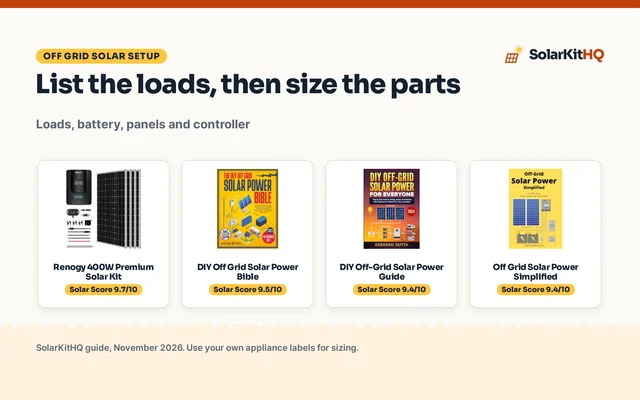
Start with a list of the loads the kit must run, not with the kit. The makers name the same loads: an air conditioner, a TV, a refrigerator, a coffee maker and a microwave, plus lights and small devices. Write down each load you need during an outage, and note which ones run at the same time, since the inverter must cover the loads that run together. See the off grid solar setup guide for the parts of a complete system.
Step 2: Match panel watts to daily energy
Panel watts set how much energy the system can collect in a day, and the makers state that daily figure under 4 hours of full sunlight. ECO-WORTHY lists a kit with 18 panels of 590W, 10620W in all, that generates 39.36 kWh per day, and a kit with 8 panels of 195W, 1560W in all, that generates 6.24 kWh per day. SUNGOLDPOWER lists a kit with 4 panels of 200W, 800W in all, that generates 3.2 kWh per day, and a kit with 6 panels of 370W, 2220W in all, that generates 8.8 kWh per day. More panel watts mean more daily energy, so compare the daily figure, not the panel count alone.
| Kit | Panel watts | Daily energy stated | Battery storage |
|---|---|---|---|
| ECO-WORTHY 10620W kit | 10620W | 39.36 kWh per day | 32.2 kWh |
| ECO-WORTHY 1560W kit | 1560W | 6.24 kWh per day | 5 kWh |
| SUNGOLDPOWER 800W kit | 800W | 3.2 kWh per day | 5.12 kWh |
| SUNGOLDPOWER 2220W kit | 2220W | 8.8 kWh per day | 5.12 kWh |
See solar panels for beginners for how placement shapes output.
Step 3: Match battery storage to the night
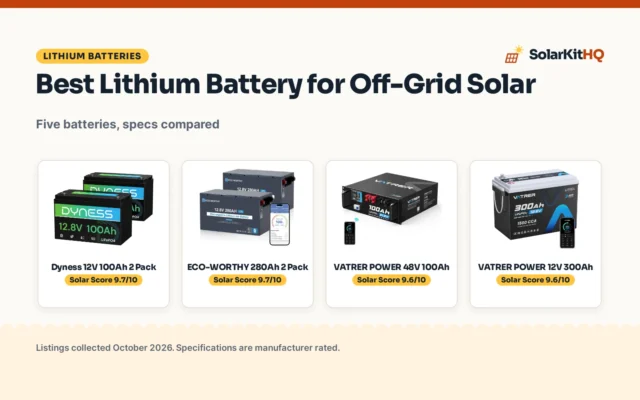
Battery storage, stated in kilowatt-hours, sets how long the system runs after the sun goes down. The makers list a wide range: ECO-WORTHY lists 5 kWh in a 48V 100Ah battery, 16.076 kWh in one 48V 314Ah battery and 32.2 kWh in a kit with 2 of those batteries. SUNGOLDPOWER lists 5.12 kWh in a 51.2V 100Ah battery and in a kit with 2 24V 100Ah batteries. A larger bank covers more overnight use. The bank grows, too: the ECO-WORTHY 48V 314Ah battery supports up to 15 units in parallel, up to 241 kWh, and the SUNGOLDPOWER 6500W inverter supports up to 6 units in parallel for a 39 kW total output.
Storage also ages. SUNGOLDPOWER lists 4000+ deep cycles and more than 10 years for its 24V 100Ah battery, and 7000+ deep cycles with up to 15 years for its 51.2V 100Ah battery. The ECO-WORTHY 48V 100Ah battery lists 6000+ cycles, and the panels carry their own span: up to 25 years for the 200W monocrystalline panels.
Step 4: Match the inverter to the loads
The inverter turns battery power into household AC, and its continuous watts must cover the loads that run at the same time. The makers state a wide range: SUNGOLDPOWER lists 3000W, 5000W, 6500W and 8000W inverters, and ECO-WORTHY lists a 3500W inverter with 7000W peak and a 10000W inverter with 20000W peak. Peak watts cover the short surge when a motor starts, so check the peak figure as well as the continuous figure. A kit that runs on 120V suits 110V to 120V devices, while a 120V/240V split-phase inverter suits 120V and 240V devices together.
Check the inverter input as well. The SUNGOLDPOWER 6500W inverter takes up to 10000W of PV input at up to 550V, and the ECO-WORTHY 10000W inverter (on Amazon) takes up to 200A of battery charging. Most kits here run on 48V, while the smaller SUNGOLDPOWER kits run on 24V.
What drives off grid solar system price
With the parts matched, the price follows 3 things. Panel watts come first: 800W of panels costs less to build than 10620W, and the daily energy rises with it, from 3.2 kWh per day to 39.36 kWh per day. Battery storage comes next: 5 kWh of storage costs less than 32.2 kWh, and the larger bank runs more loads through the night. Inverter size and marks come last: a 3000W inverter costs less than an 8000W inverter, and kits that carry UL 1741, UL 1973 or UL 61730 marks state them with the inverter figures. Warranty terms also differ: the ECO-WORTHY 48V 314Ah battery lists a 10-year manufacturer warranty, while SUNGOLDPOWER inverters list 2-year and 3-year warranties.
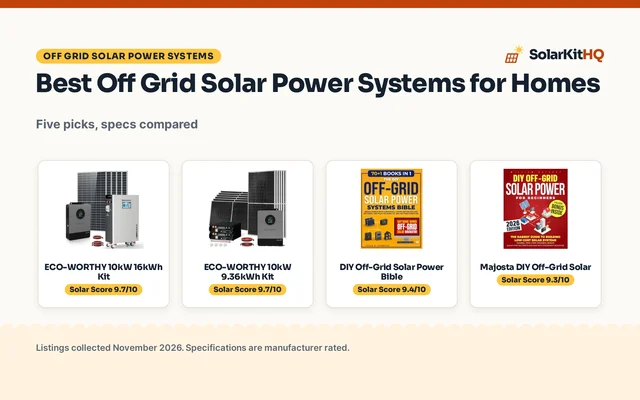
What comes in the box moves the price as well. The SUNGOLDPOWER kits list mounting Z-brackets, 50-foot solar extension cables, a 160A DC breaker and a 25A PV breaker in the box, and the ECO-WORTHY 10000W kit lists cables with the panels and batteries. The ECO-WORTHY 10000W kit also states that a professional installer is recommended. See best off grid solar power systems for homes to compare complete kits side by side.
FAQ: power away from the grid
How many panels does an off grid system need?
It depends on the daily energy you need. The makers show kits with 4 panels of 200W that generate 3.2 kWh per day under 4 hours of full sunlight, and kits with 18 panels of 590W that generate 39.36 kWh per day.
How much battery storage does an off grid system need?
Enough to cover the loads that run after the sun goes down. The makers show storage from 5 kWh in a single 48V 100Ah battery to 32.2 kWh in a kit with 2 48V 314Ah batteries. A bank that supports up to 15 units in parallel, up to 241 kWh, grows with the loads you add later.
Can one inverter run a whole house?
It depends on the loads that run at the same time. ECO-WORTHY lists a 10000W inverter with 20000W peak and 120V/240V split-phase output, and SUNGOLDPOWER lists a 6500W inverter that supports up to 6 units in parallel for a 39 kW total output.
Do off grid solar kits include everything?
The kits list panels, an inverter, batteries, cables and mounting parts in the box. The SUNGOLDPOWER 6500W kit lists 6 panels of 370W, a 51.2V 100Ah battery, 6 sets of Z-brackets, a 50-foot cable set, a 160A DC breaker and a 25A PV breaker. Read the parts list before you order.
Related solar guides
See the best solar panel kits for RVs, the best portable power stations for camping, the best 400Ah lithium batteries for off grid use and the solar panels guides.