On this page
The lights go out while dinner is on the stove, the fridge hums to a stop, and the house goes quiet. That is the moment standby generator sizes start to matter: the right size is the one whose running watts cover everything that runs at the same time, with enough starting watts left over for the largest motor to start. Pick a size from the loads, not from the size of the house, and the steps below show how to add the figures up.
SolarKitHQ earns a commission when you buy through links on this page, at no extra cost to you. As an Amazon Associate I earn from qualifying purchases. Affiliate disclosure.
The quick answer
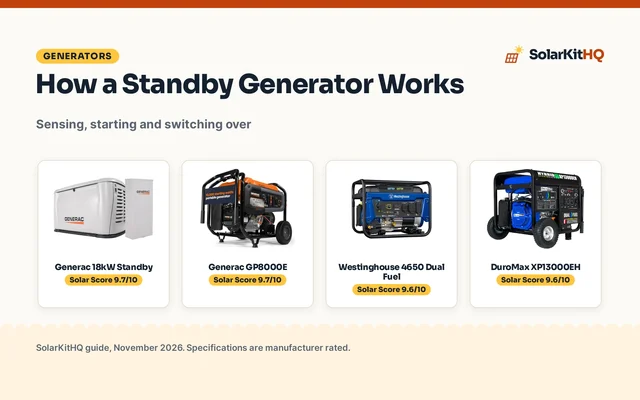
A standby generator size is its running watts, and the figure that matters is the total of the loads that run at the same time plus the starting watts of the largest motor. The units in this guide run from 3,400 running watts on the Oxseryn 4400-watt inverter generator to 22,000 watts on the Champion 22,000-watt dual fuel standby unit, with 8,000 running watts on the Generac GP8000E and 14,500 running watts on the Westinghouse 18,000-watt dual fuel unit in between. The Generac 18 kW and 10 kW models and the Champion 12.5 kW unit sit in the middle of that range. Add the loads, then read the size off the total.
Standby generator sizes at a glance
The table below lines up the sizes the makers list, from a compact inverter unit to a large standby unit.
| Generator size | Running watts | What the maker lists |
|---|---|---|
| Compact inverter | 3,400 watts | Oxseryn 4400-watt unit, 4,400 peak watts |
| Mid-size portable | 8,000 watts | Generac GP8000E, 10,000 starting watts |
| Large portable | 14,500 watts | Westinghouse dual fuel unit, 18,000 peak watts |
| Standby | 12,500 watts on propane | Champion 12.5 kW unit, 11,000 watts on natural gas |
| Standby | 18 kW | Generac 18 kW unit with a 200-amp transfer switch |
| Standby | 10 kW | Generac 10 kW unit |
| Standby | 22,000 watts on propane | Champion 22 kW unit, 19,800 watts on natural gas |
The spread shows why the load list comes before the size: a unit sized for a fridge and a few lights sits far below a unit sized for a full load list, and the gap between 3,400 running watts and 22,000 watts is the gap between those jobs.
List the loads that run together
Walk through the house and write down everything that must run during an outage at the same time. The Generac GP8000E lists central AC, well pumps, refrigerators, sump pumps, lights and essential appliances among the loads its 8,000 running watts can cover, which shows how fast the list grows once heating, cooling and water join the lights. Read the running watts off each appliance label and add them together. See the generator size for a house guide for a worked load list.
Add starting watts for motors
Motors pull more watts to start than to run, so the starting figure decides whether the generator holds the load when a motor kicks in. The Oxseryn lists 4,400 peak watts and 3,400 running watts, the Generac GP8000E lists 10,000 starting watts and 8,000 running watts, and the Westinghouse lists 18,000 peak watts and 14,500 running watts on gasoline. Take the running total from the load list, then add the starting watts of the largest motor that starts while the rest runs. If that combined figure sits above the running watts of the unit, move up a size.
Match the size to the transfer switch
Standby units are sold with a transfer switch rated in amps, and the rating the maker pairs with the unit is part of the size. The Generac 18 kW unit pairs with a 200-amp transfer switch, the Champion 22,000-watt unit pairs with a 200-amp automatic transfer switch, and the Champion 12.5 kW unit pairs with a 100-amp automatic transfer switch with 12 circuits. The Westinghouse 18,000-watt unit is transfer switch ready and pairs with the Westinghouse WATS200 automatic transfer switch, sold separately. A licensed electrician should install a standby generator that connects to home wiring. See what size generator for 200 amp service for how the switch rating fits the sizing question.
Check run time, fuel and noise
Run time decides how long the size you picked keeps the loads going. The Oxseryn lists 14 hours at 25% load on a 2-gallon tank, the Generac GP8000E lists up to 10 hours at 50% load and 15 hours at 25% load on a 7.9-gallon tank, and the Westinghouse lists up to 16 hours at 25% load on a 10.5-gallon tank. Standby units that run on propane or natural gas need no refueling during an outage: Champion lists its 12.5 kW and 22,000-watt units that way. Noise is listed in dBA: the Champion 12.5 kW unit runs at 63 dBA, the Champion 22,000-watt unit at 67 dBA, and the Oxseryn at under 72 dBA from 23 feet away. Fuel generators run outdoors only, far from doors and windows, because of carbon monoxide.
Ways to stretch the size you have
- Start the largest motor loads at different times so their starting watts do not stack on top of each other.
- Keep the load list to the loads that must stay on during an outage, and leave the rest off until power returns.
- Match the tank to the outage length: the Oxseryn lists 14 hours at 25% load on a 2-gallon tank, while the Westinghouse lists up to 16 hours at 25% load on a 10.5-gallon tank.
- See the generator cost guide before planning the purchase and the install.
FAQ: power away from the grid
What size standby generator do I need?
Add the running watts of the loads that run at the same time, then add the starting watts of the largest motor. The units in this guide run from 3,400 running watts to 22,000 watts, so the answer comes from the load list rather than from a fixed size.
What is the difference between running watts and starting watts?
Running watts are what a generator sustains, and starting watts are the short peak it supplies when a motor starts. The Oxseryn lists 4,400 peak watts and 3,400 running watts, and the Generac GP8000E lists 10,000 starting watts and 8,000 running watts.
How long does a standby generator run on a tank of fuel?
It depends on the tank and the load. The Oxseryn lists 14 hours at 25% load on a 2-gallon tank, the Generac GP8000E lists up to 10 hours at 50% load and 15 hours at 25% load on a 7.9-gallon tank, and the Westinghouse lists up to 16 hours at 25% load on a 10.5-gallon tank. Standby units that run on propane or natural gas need no refueling during an outage.
Does a standby generator need a transfer switch?
Standby units are paired with one by the maker: the Generac 18 kW unit pairs with a 200-amp transfer switch, the Champion 12.5 kW unit pairs with a 100-amp automatic transfer switch, and the Westinghouse 18,000-watt unit pairs with the Westinghouse WATS200 automatic transfer switch, sold separately. A licensed electrician should install a standby generator that connects to home wiring.
Related solar guides
See every Generators guide and all Power Stations and Generators guides.