On this page
When the lights go out at dinner time, tri fuel vs gas generator is the choice between fuel flexibility and a lighter, simpler gas unit. This comparison looks at the Pulsar tri-fuel example and the Generac gas generator example, using only what each listing states, and it ends with a short verdict on who should pick which side. Pick the Pulsar example if fuel choice and high output matter for the job at hand, and pick the Generac example if a lighter unit for camping, RV use and home backup fits the plan better.
SolarKitHQ earns a commission when you buy through links on this page, at no extra cost to you. As an Amazon Associate I earn from qualifying purchases. Affiliate disclosure.
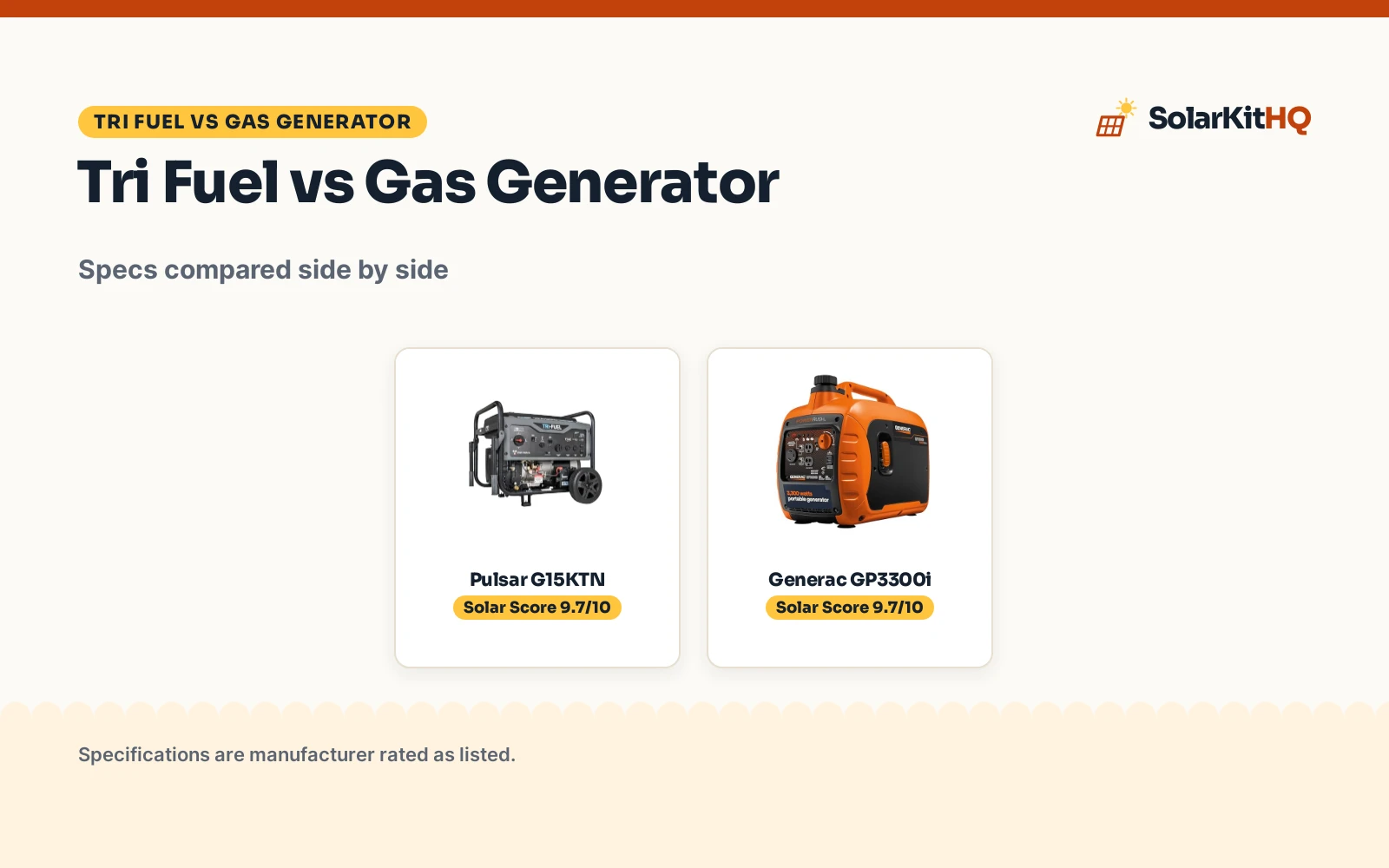
Tri Fuel vs Gas Generator: side by side
| Generator | Solar Score | Starting watts | Running watts | Fuel | Weight |
|---|---|---|---|---|---|
| Pulsar G15KTN | 9.7/10 | 15,000 | 12,000 | Gasoline, propane, natural gas | 242.6 pounds |
| Generac GP3300i | 9.7/10 | 3,300 | 2,500 | Gasoline | 59.5 pounds |
All numbers here are manufacturer claims from the listings, not our measurements (4 November 2026).
Output and fuel
The gap in output is wide. The Pulsar example lists 15,000 starting watts and 12,000 running watts, while the Generac example lists 3,300 starting watts and 2,500 running watts. Fuel choice is the other split: the Pulsar example runs on gasoline, propane, or natural gas, while the Generac example runs on gasoline. Run time follows the same pattern, with the Pulsar example listing up to 9.5 hours of run time on a full tank of gasoline, and the Generac example listing up to 7 hours at 25% load or 4.5 hours at 50% load from a 1.06-gallon fuel tank.
Weight and size
Weight and size point the same way. The Pulsar example weighs 242.6 pounds and measures 33.7 inches by 24.8 inches by 24.6 inches, while the Generac example weighs 59.5 pounds and measures 22.3 inches by 13.4 inches by 18.4 inches. The Generac listing also names a molded carry handle and says one person can transport the unit, while the Pulsar listing describes a design for safe and easy transport without naming a carry handle. For a campsite or an RV bay, the Generac example is the easier unit to move; for a fixed spot at home, the Pulsar example’s weight matters less.
Outlets and controls
Outlets and starting differ as much as output. The Pulsar example lists one 120V 30A outlet, a 120V/240V 30A outlet, a 120V/240V 50A outlet, and two 120V 20A outlets, plus battery-included electric start with a toggle switch and Cold Start Technology. The Generac example lists two 120V 20A household outlets, one 120V 30A twist-lock outlet, and two USB-A ports, plus Economy Mode and a parallel-ready design that needs a sold-separately parallel kit for a second unit. The Pulsar example also lists a digital display, an hour meter, a voltage meter, and a frequency meter, while the Generac example lists no meter of that kind in its bullets.
Safety features
Safety features are where the Generac example stands out. Its listing states COsense monitoring that shuts the unit down if dangerous concentrations are detected near the unit, plus a USDA-qualified spark arrestor for use in national forests, parks, and dry-condition outdoor areas. The Pulsar example lists covered outlets and a design for safe and easy transport, but it names no carbon monoxide shutdown feature. Fuel generators run outdoors only, far from doors and windows, because of carbon monoxide. That outdoor rule applies to each example here, whatever its other features.
What the listings leave unclear
Each listing leaves gaps worth noting. The Pulsar example states a run time only for gasoline, so run time on propane or natural gas is not stated. The Generac example states a run time at 25% load and at 50% load, but it states no run time at full load, and it states no propane or natural gas option. Neither example states a noise figure. The Generac title claims 49 State Compliant, while its bullets do not repeat that claim, and the Pulsar title names a 550cc engine, while its bullets do not repeat that figure.
The examples

Pulsar G15KTN
A tri-fuel portable generator listing 15,000 starting watts and 12,000 running watts, with electric start and covered outlets.
Pros
- Runs on gasoline, propane, or natural gas
- Lists 15,000 starting watts and 12,000 running watts
- Battery-included electric start with Cold Start Technology
- Lists a digital display, an hour meter, a voltage meter, and a frequency meter
Cons
- Weighs 242.6 pounds
- States a run time only for gasoline, with no propane or natural gas run time stated
- States no noise figure
- No parallel capability is stated
Detailed Review
The Pulsar listing states 15,000 starting watts and 12,000 running watts, tri-fuel use on gasoline, propane, or natural gas, and up to 9.5 hours of run time on a full tank of gasoline. It also lists battery-included electric start, Cold Start Technology, a digital display, an hour meter, a voltage meter, and a frequency meter, plus one 120V 30A outlet, a 120V/240V 30A outlet, a 120V/240V 50A outlet, and two 120V 20A outlets. The title and the bullets agree on the watt figures, and no contradiction stands out in the listing.
Who it's for: buyers who want fuel choice and high output for home backup. Who should skip it: buyers who need a lighter unit for camping or RV use, since this example weighs 242.6 pounds.
Its Solar Score of 9.7/10 comes from performance 33/35, build 21/25, value 21/25, safety 7/10 and warranty 4/5: 86 of 100 points, placed on our 9.2 to 9.8 scale.
Key Specifications
| Starting watts | 15,000 |
|---|---|
| Running watts | 12,000 |
| Fuel | Gasoline, propane, natural gas |
| Weight | 242.6 pounds |
Figures as published on the retailer listing, collected 4 November 2026. Performance figures are manufacturer rated.
Safety and Warranty
What this listing states. Covered outlets and a design for safe and easy transport, so safety scores 7 of 10. 3 Year Manufacturer Limited. It does not say everything a buyer needs, such as who pays return shipping, so warranty scores 4 of 5. See How We Pick.
Follow the manual. Connect and use the product as the maker describes, stay within every stated rating, and read the manual before first use.
This is general buying information, not professional advice. Follow each product manual and local rules, and see our Safety Disclaimer.

Generac GP3300i
A gas powered portable inverter generator listing 2,500 running watts and 3,300 starting watts, with COsense shutdown and Economy Mode.
Pros
- Lists 2,500 running watts and 3,300 starting watts for a refrigerator, lights, a TV, and phone charging
- States TruePower Technology with less than 3% total harmonic distortion for sensitive electronics
- States COsense monitoring that shuts the unit down if dangerous concentrations are detected near the unit
- Weighs 59.5 pounds and lists a molded carry handle
Cons
- Runs on gasoline only, with no propane or natural gas option stated
- Lists 4.5 hours at 50% load, against 7 hours at 25% load
- Parallel output needs a sold-separately parallel kit
- States no noise figure
Detailed Review
The Generac listing states 2,500 running watts and 3,300 starting watts, TruePower Technology with less than 3% total harmonic distortion, Economy Mode, COsense monitoring, and a 1.06-gallon fuel tank. It lists two 120V 20A household outlets, one 120V 30A twist-lock outlet, and two USB-A ports, plus a USDA-qualified spark arrestor. The title and the bullets agree on the watt figures, and no contradiction stands out in the listing.
Who it's for: buyers who want a lighter gas generator for camping, RV use, and home backup. Who should skip it: buyers who want tri-fuel use or higher output, since this example lists 2,500 running watts.
Its Solar Score of 9.7/10 comes from performance 28/35, build 21/25, value 21/25, safety 9/10 and warranty 4/5: 83 of 100 points, placed on our 9.2 to 9.8 scale.
Key Specifications
| Starting watts | 3,300 |
|---|---|
| Running watts | 2,500 |
| Fuel | Gasoline |
| Weight | 59.5 pounds |
Figures as published on the retailer listing, collected 4 November 2026. Performance figures are manufacturer rated.
Safety and Warranty
What this listing states. COsense shutdown and USDA-qualified spark arrestor, so safety scores 9 of 10. 3-year residential limited warranty. It does not say everything a buyer needs, such as who pays return shipping, so warranty scores 4 of 5. See How We Pick.
Follow the manual. Connect and use the product as the maker describes, stay within every stated rating, and read the manual before first use.
This is general buying information, not professional advice. Follow each product manual and local rules, and see our Safety Disclaimer.
As an Amazon Associate I earn from qualifying purchases.
Where the points went
The Solar Score weighs performance, build, value, safety and warranty. For portable generators, safety means a carbon monoxide shutdown feature, a spark arrestor, covered outlets, or another protection the listing names; the Generac example states COsense shutdown and a spark arrestor, while the Pulsar example states covered outlets. Each listing states a warranty term. How we pick explains the weights.
| Product | Solar Score | Perf. /35 | Build /25 | Value /25 | Safety /10 | Warranty /5 |
|---|---|---|---|---|---|---|
| Pulsar G15KTN | 9.7 | 33 | 21 | 21 | 7 | 4 |
| Generac GP3300i | 9.7 | 28 | 21 | 21 | 9 | 4 |
Scores start at 9.2 for the lowest totals and top out at 9.8. In between, a kit’s position follows its weighted points one to one in order.
Tri fuel vs gas generator: which should you choose?
Choose the Pulsar example if fuel choice and high output lead the decision, since it runs on gasoline, propane, or natural gas and lists 15,000 starting watts and 12,000 running watts. Choose the Generac example if a lighter unit for camping, RV use and home backup leads the decision, since it weighs 59.5 pounds, lists 2,500 running watts and 3,300 starting watts, and states COsense shutdown. If the load list stays small and the unit must move often, the Generac example fits; if the load list is large and fuel flexibility matters, the Pulsar example fits.
| If you need | Look at |
|---|---|
| Highest starting watts | Pulsar G15KTN, 15,000 starting watts |
| Fuel choice | Pulsar G15KTN, gasoline, propane, natural gas |
| Lowest stated weight | Generac GP3300i, 59.5 pounds |
| Clean power for sensitive electronics | Generac GP3300i, less than 3% total harmonic distortion |
Sizing Notes
- Match starting watts and running watts to the loads you plan: the Pulsar example lists 15,000 starting watts and 12,000 running watts, while the Generac example lists 3,300 starting watts and 2,500 running watts.
- Match fuel choice to what you can store and use: the Pulsar example runs on gasoline, propane, or natural gas, while the Generac example runs on gasoline.
- Check run time against the outage or trip you plan: the Pulsar example lists up to 9.5 hours on a full tank of gasoline, and the Generac example lists up to 7 hours at 25% load.
- Match outlet types to the loads you plan: the Pulsar example lists 120V and 120V/240V outlets, while the Generac example lists 120V outlets and USB-A ports.
- Leave any connection to home wiring to a licensed electrician.
FAQ: power away from the grid
Which example lists higher starting watts?
The Pulsar example lists 15,000 starting watts, while the Generac example lists 3,300 starting watts.
Can the Pulsar example run on propane?
Yes. The Pulsar listing states tri-fuel use on gasoline, propane, or natural gas.
Which example is lighter?
The Generac example weighs 59.5 pounds, while the Pulsar example weighs 242.6 pounds.
Which example states a carbon monoxide shutdown feature?
The Generac example states COsense monitoring that shuts the unit down if dangerous concentrations are detected near the unit.
Related solar guides
See every Power Stations and Generators guide.
More picks: dual fuel vs tri fuel generator, gas generator vs inverter generator, solar generator vs tri fuel generator, tri fuel generator vs inverter generator.