On this page
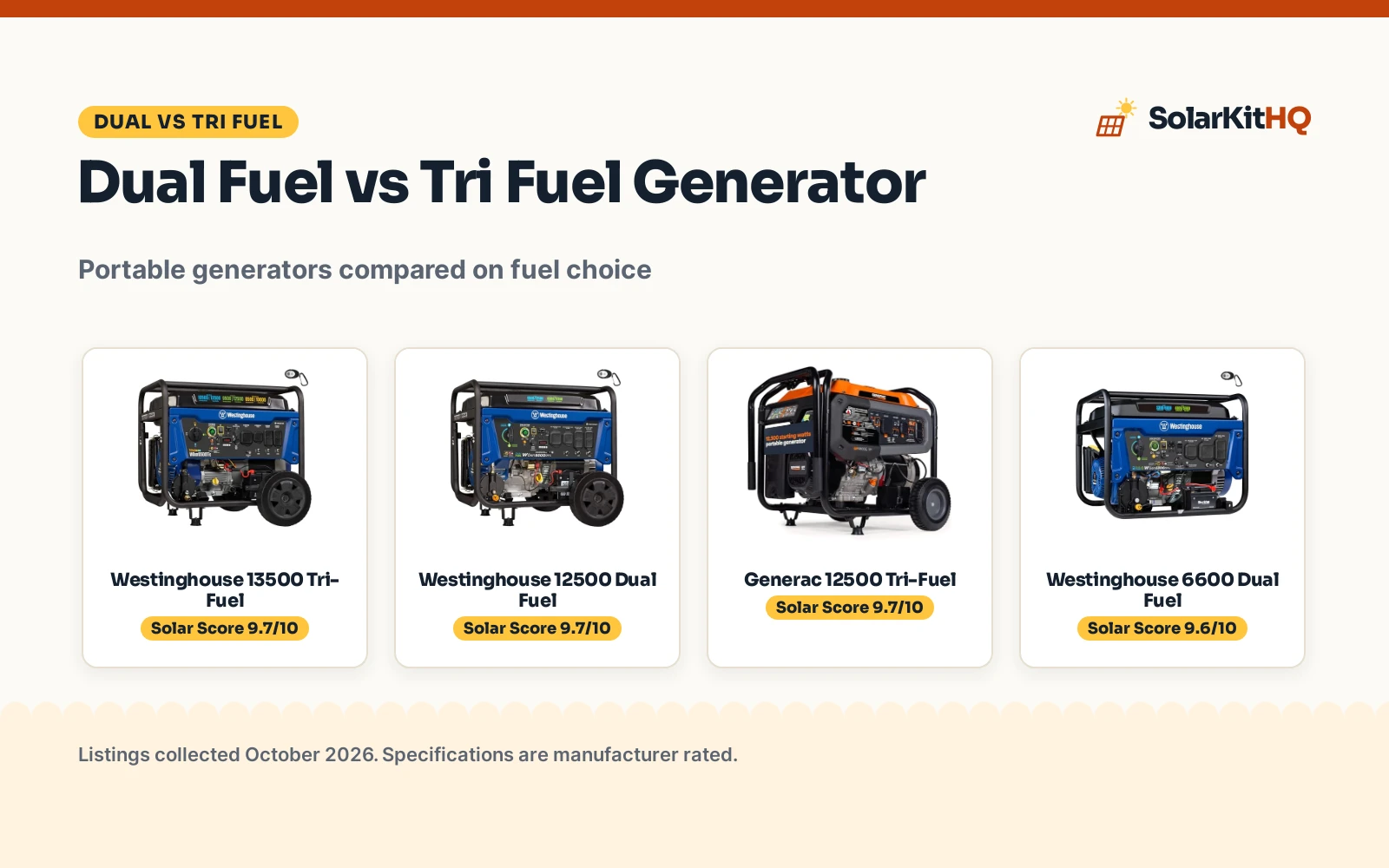
The short answer on dual fuel vs tri fuel generator choice: pick a dual fuel model when gasoline and propane cover the fuel you keep on hand, and pick a tri fuel model when a natural gas line is also available at the site. We compared the fuel options each listing states, the running and peak watts on gasoline, the run times stated, the outlets listed, and the warranty terms stated. The tri fuel examples add natural gas to the dual fuel operation.
SolarKitHQ earns a commission when you buy through links on this page, at no extra cost to you. As an Amazon Associate I earn from qualifying purchases. Affiliate disclosure.
Dual fuel vs tri fuel generator: side by side
| Dual Fuel vs Tri Fuel Generator | Solar Score | Fuel options | Peak watts on gasoline | Run time stated | Weight | Amazon |
|---|---|---|---|---|---|---|
| Westinghouse 13500 Tri-Fuel | 9.7/10 | Gasoline, propane, natural gas | 13500 | Up to 19 hours at 25% load | 230.0 pounds | View on Amazon |
| Westinghouse 12500 Dual Fuel | 9.7/10 | Gasoline, propane | 12500 | Up to 12 hours | 212.1 pounds | View on Amazon |
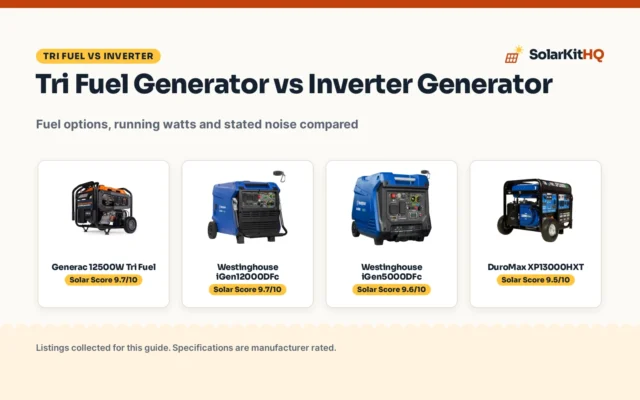
| Generac 12500 Tri-Fuel | 9.7/10 | Gasoline, liquid propane, natural gas | 12500 | Up to 9.5 hours at 50% load | 219 pounds | View on Amazon |
| Westinghouse 6600 Dual Fuel | 9.6/10 | Gasoline, propane | 6600 | Up to 14.5 hours | 135.6 pounds | View on Amazon |
Specifications are manufacturer rated as listed, collected 3 November 2026.
Fuel choice
Fuel choice is the whole gap between the sides. The dual fuel listings state gasoline and propane operation, with watts stated on both fuels. The tri fuel listings state gasoline, propane and natural gas operation, so natural gas joins the choice where a line is available. Neither tri fuel listing states propane or natural gas watt figures, so the comparison rests on gasoline figures plus stated fuel options.
For a site with a natural gas line, the tri fuel examples add a fuel the dual fuel examples lack. For a site without one, the tri fuel advantage stays unused, and the dual fuel examples cover the same gasoline and propane operation with stated watts on both fuels.
Power and run time
On gasoline, the Westinghouse tri fuel example states 10500 running watts and 13500 peak watts, the Westinghouse dual fuel example states 9500 running watts and 12500 peak watts, the Generac tri fuel example states 9500 running watts and 12500 starting watts, and the Westinghouse 6600 dual fuel example states 5300 running watts and 6600 peak watts. On propane, only the dual fuel examples state watts: the Westinghouse 12500 example states 8500 running watts and 11200 peak watts, and the Westinghouse 6600 example states 4800 running watts and 5900 peak watts. Do not call a side better on propane or natural gas watts, since the tri fuel listings leave those figures unclear.
Run times are stated on different bases, so compare them with the basis attached. The Westinghouse tri fuel example states up to 19 hours at 25% load on a 9.5-gallon gasoline tank. The Generac example states up to 9.5 hours at 50% load on gasoline and 14 hours at 25% load. The Westinghouse 12500 dual fuel example states up to 12 hours of run time, and the Westinghouse 6600 dual fuel example states up to 14.5 hours of run time. A run time with no stated load basis cannot be ranked against one with a basis stated.
Size and weight
Weights run from 135.6 pounds for the Westinghouse 6600 dual fuel example to 230.0 pounds for the Westinghouse tri fuel example, with the Westinghouse 12500 dual fuel example at 212.1 pounds and the Generac tri fuel example at 219 pounds. The Westinghouse tri fuel example and the Westinghouse 12500 dual fuel example share 27.2 x 26.1 x 26.5 inches, the Generac example states 27.5 x 27.1 x 27.6 inches, and the Westinghouse 6600 dual fuel example states 23.43 x 20.63 x 19.48 inches. The Generac example adds 9.5-inch never-flat wheels and a folding handle.
What the listings leave unclear
No listing here states a noise level, so noise cannot separate the sides. The Generac listing contradicts itself on warranty: the bullets state a 3-year residential / 2-year commercial limited warranty while the spec table says 8 Year Limited, and the bullets win. The Westinghouse tri fuel listing contradicts itself on peak watts: the title and bullets state 13500 peak watts while the spec table size line says 13000W, and the title figure wins. A licensed electrician should handle any connection to home wiring. Fuel generators run outdoors only, far from doors and windows, because of carbon monoxide.
Four examples
| # | Product | Solar Score | Buy |
|---|---|---|---|
| 1 |  Westinghouse 13500 Tri-Fuel | 9.7/10 | Buy on Amazon |
| 2 |  Westinghouse 12500 Dual Fuel | 9.7/10 | Buy on Amazon |
| 3 |  Generac 12500 Tri-Fuel | 9.7/10 | Buy on Amazon |
| 4 | 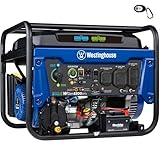 Westinghouse 6600 Dual Fuel | 9.6/10 | Buy on Amazon |

Westinghouse 13500 Tri-Fuel
Tri-fuel portable generator stating gasoline, propane and natural gas operation, 10500 running watts and 13500 peak watts on gasoline, and a 3-year limited residential warranty.
Pros
- Gasoline, propane and natural gas operation stated
- 10500 running watts and 13500 peak watts on gasoline stated
- Runs up to 19 hours at 25% load on a 9.5-gallon gasoline tank stated
- Push-button start with an included remote key fob, plus recoil starting as backup
Cons
- Propane and natural gas watt figures are not stated
- 230.0 pounds stated, the heaviest weight in this group
- Automatic transfer switch sold separately
- No noise level is stated
Detailed Review
The title states 13500 peak watts and the bullets agree, stating 10500 running watts and 13500 peak watts on gasoline, while the spec table size line says 13000W. The title and bullets win over the spec table, so compare on the 13500 peak watt figure. The listing also states a 500cc engine with a pressure lubrication system, a reusable oil screen, a built-in fuel gauge, 50A and 30A outlets, automatic low-oil shutdown and a CO sensor.
Who it's for: buyers with a natural gas line available who want gasoline, propane and natural gas in one portable generator. Who should skip it: buyers who need stated propane or natural gas watt figures, or a lighter unit than 230.0 pounds.
Its Solar Score of 9.7/10 comes from performance 32/35, build 21/25, value 21/25, safety 8/10 and warranty 4/5: 86 of 100 points, placed on our 9.2 to 9.8 scale.
Key Specifications
| Fuel | Gasoline, propane, natural gas |
|---|---|
| Power on gasoline | 10500 running / 13500 peak watts |
| Run time | Up to 19 hours at 25% load |
| Size | 27.2 x 26.1 x 26.5 inches |
Figures as published on the retailer listing, collected 3 November 2026. Performance figures are manufacturer rated.
Safety and Warranty
What this listing states. CO sensor shutdown and automatic low-oil shutdown stated, so safety scores 8 of 10. 3-year limited residential warranty stated. It does not say everything a buyer needs, such as who pays return shipping, so warranty scores 4 of 5. See How We Pick.
Follow the manual. Connect and use the product as the maker describes, stay within every stated rating, and read the manual before first use.
This is general buying information, not professional advice. Follow each product manual and local rules, and see our Safety Disclaimer.

Westinghouse 12500 Dual Fuel
Dual fuel portable generator stating 9500 running watts and 12500 peak watts on gasoline, 8500 running watts and 11200 peak watts on propane, and remote start with an included key fob.
Pros
- Gasoline and propane watt figures both stated
- Remote start with an included key fob, plus electric and recoil start
- GFCI household receptacles plus 30A and 50A outlets stated
- Up to 12 hours of run time stated, with a fuel gauge
Cons
- No natural gas operation stated
- 212.1 pounds stated
- Propane run time is not stated separately
- No noise level is stated
Detailed Review
The listing states 9500 running watts and 12500 peak watts on gasoline and 8500 running watts and 11200 peak watts on propane, from a 457cc engine with a cast iron sleeve. It lists a transfer switch ready 120V L14-30R 30A receptacle, an RV ready 120/240V 14-50R 50A receptacle, GFCI household receptacles with rubber covers, automatic low-oil and carbon monoxide shutdown, and a digital hour meter. The title, bullets and spec table agree on the 12500 peak watt figure.
Who it's for: buyers who want stated watts on both gasoline and propane with remote start. Who should skip it: buyers who want natural gas operation, or a stated propane run time.
Its Solar Score of 9.7/10 comes from performance 30/35, build 21/25, value 21/25, safety 8/10 and warranty 4/5: 84 of 100 points, placed on our 9.2 to 9.8 scale.
Key Specifications
| Fuel | Gasoline, propane |
|---|---|
| Power on gasoline | 9500 running / 12500 peak watts |
| Power on propane | 8500 running / 11200 peak watts |
| Weight | 212.1 pounds |
Figures as published on the retailer listing, collected 3 November 2026. Performance figures are manufacturer rated.
Safety and Warranty
What this listing states. Carbon monoxide shutdown, automatic low-oil shutdown and rubber outlet covers stated, so safety scores 8 of 10. 3-year limited service, labor, and parts coverage stated. It does not say everything a buyer needs, such as who pays return shipping, so warranty scores 4 of 5. See How We Pick.
Follow the manual. Connect and use the product as the maker describes, stay within every stated rating, and read the manual before first use.
This is general buying information, not professional advice. Follow each product manual and local rules, and see our Safety Disclaimer.

Generac 12500 Tri-Fuel
Tri-fuel portable generator stating gasoline, liquid propane, or natural gas operation, 9500 running watts and 12500 starting watts, and push-button electric start.
Pros
- Gasoline, liquid propane, or natural gas operation with a dial turn stated
- 9500 running watts and 12500 starting watts on gas stated
- Automatic voltage regulation stated
- COsense shutdown, 9.5-inch never-flat wheels and a folding handle stated
Cons
- Propane and natural gas watt figures are not stated separately
- 219 pounds stated
- No remote key fob is stated, only push-button electric start
- Warranty terms differ between the bullets and the spec table
Detailed Review
The bullets state a 3-year residential / 2-year commercial limited warranty, while the spec table says 8 Year Limited. The bullets win over the spec table, so compare on the 3-year residential / 2-year commercial terms. The spec table also lists PartNumber G0080632 against Model G0080631, a second mismatch inside the listing. The listing states a 500cc engine, automatic voltage regulation, COsense shutdown, a 7.5-gallon fuel tank, and a digital hour meter.
Who it's for: buyers who want three fuel options with automatic voltage regulation and COsense shutdown. Who should skip it: buyers who need stated propane or natural gas watts, or a remote key fob.
Its Solar Score of 9.7/10 comes from performance 30/35, build 21/25, value 21/25, safety 8/10 and warranty 3/5: 83 of 100 points, placed on our 9.2 to 9.8 scale.
Key Specifications
| Fuel | Gasoline, liquid propane, natural gas |
|---|---|
| Power on gas | 9500 running / 12500 starting watts |
| Run time | Up to 9.5 hours at 50% load on gasoline |
| Size | 27.5 x 27.1 x 27.6 inches |
Figures as published on the retailer listing, collected 3 November 2026. Performance figures are manufacturer rated.
Safety and Warranty
What this listing states. COsense CO detection shutdown and automatic voltage regulation stated, so safety scores 8 of 10. 3-year residential / 2-year commercial limited warranty stated. It does not say everything a buyer needs, such as who pays return shipping, so warranty scores 3 of 5. See How We Pick.
Follow the manual. Connect and use the product as the maker describes, stay within every stated rating, and read the manual before first use.
This is general buying information, not professional advice. Follow each product manual and local rules, and see our Safety Disclaimer.

Westinghouse 6600 Dual Fuel
Dual fuel portable generator stating 6600 peak watts and 5300 running watts on gasoline, 5900 peak watts and 4800 running watts on propane, and push-button electric start with a remote key fob.
Pros
- Gasoline and propane watt figures both stated
- Push-button electric start with a remote key fob stated
- Up to 14.5 hours of run time stated
- 135.6 pounds stated, the lowest weight in this group
Cons
- No natural gas operation stated
- Peak watts below the other Westinghouse dual fuel example here
- 4.7-gallon fuel tank stated, smaller than the tri-fuel examples here
- No noise level is stated
Detailed Review
The listing states 6600 peak watts and 5300 running watts on gasoline and 5900 peak watts and 4800 running watts on propane, from a 274cc engine with a cast iron sleeve. It lists a 4.7-gallon fuel tank with a fuel gauge, a 120/240V volt selector switch, 20A and 30A receptacles, rubber outlet covers, and automatic low-oil and carbon monoxide shutdown. The title, bullets and spec table agree on the 6600 peak watt figure.
Who it's for: buyers who want dual fuel operation at the lowest weight in this group with remote start. Who should skip it: buyers who want natural gas operation, or peak watts above 6600.
Its Solar Score of 9.6/10 comes from performance 28/35, build 20/25, value 21/25, safety 8/10 and warranty 4/5: 81 of 100 points, placed on our 9.2 to 9.8 scale.
Key Specifications
| Fuel | Gasoline, propane |
|---|---|
| Power on gasoline | 5300 running / 6600 peak watts |
| Power on propane | 4800 running / 5900 peak watts |
| Weight | 135.6 pounds |
Figures as published on the retailer listing, collected 3 November 2026. Performance figures are manufacturer rated.
Safety and Warranty
What this listing states. Carbon monoxide shutdown and automatic low-oil shutdown stated, so safety scores 8 of 10. 3-year limited service, labor, and parts coverage stated. It does not say everything a buyer needs, such as who pays return shipping, so warranty scores 4 of 5. See How We Pick.
Follow the manual. Connect and use the product as the maker describes, stay within every stated rating, and read the manual before first use.
This is general buying information, not professional advice. Follow each product manual and local rules, and see our Safety Disclaimer.
As an Amazon Associate I earn from qualifying purchases.
Where the points went
The Solar Score weighs performance, build, value, safety and warranty. For fuel generators, safety means carbon monoxide detection and shutdown plus low-oil shutdown, which every example here states. How we pick explains the weights.
| Product | Solar Score | Perf. /35 | Build /25 | Value /25 | Safety /10 | Warranty /5 |
|---|---|---|---|---|---|---|
| Westinghouse 13500 Tri-Fuel | 9.7 | 32 | 21 | 21 | 8 | 4 |
| Westinghouse 12500 Dual Fuel | 9.7 | 30 | 21 | 21 | 8 | 4 |
| Generac 12500 Tri-Fuel | 9.7 | 30 | 21 | 21 | 8 | 3 |
| Westinghouse 6600 Dual Fuel | 9.6 | 28 | 20 | 21 | 8 | 4 |
Scores run from 9.2 to 9.8: each product’s point total is placed on that range, so more points always means a higher score.
How to choose the best dual fuel vs tri fuel generator
Start from the fuel you can actually supply
If a natural gas line is available, a tri fuel example keeps gasoline and propane as backups while adding natural gas. If none is available, a dual fuel example gives the same gasoline and propane operation. See the tri fuel generator natural gas guide for the natural gas side of the choice.
Match watts to the loads, on the fuel you will run
Compare running watts, not peak watts alone, and compare them on the fuel you plan to run. The dual fuel examples state running watts on both gasoline and propane, while the tri fuel examples state running watts on gasoline only. For home backup planning, see the inverter generator for home backup guide.
Weigh run time claims by their stated basis
A run time at 25% load and a run time at 50% load are different claims, and a run time with no stated load basis cannot be ranked against either. The Westinghouse tri fuel example states a 9.5-gallon gasoline tank behind its 19 hour claim at 25% load, while the Generac example states a 7.5-gallon fuel tank behind its 9.5 hour claim at 50% load. The dual fuel vs gas generator comparison covers the gasoline side of the same question.
| If you need | Look at |
|---|---|
| Natural gas as well as gasoline and propane | The Westinghouse tri fuel example or the Generac tri fuel example |
| Stated watts on both gasoline and propane | The Westinghouse dual fuel examples |
| The lowest-weight unit in this group | The Westinghouse 6600 dual fuel example at 135.6 pounds |
Sizing Notes
- Match the stated running watts to the loads you plan, on the fuel you plan to run, since the tri fuel listings state gasoline watts only.
- Match the stated outlets to the loads: the listings state 20A, 30A and 50A outlets in different combinations.
- Check the stated dimensions and weight against the storage space, since weights here run to 230.0 pounds.
- Match the fuel plan to the site supply: gasoline and propane for dual fuel, plus natural gas for tri fuel.
FAQ: power away from the grid
What fuel choice does a tri fuel generator add over a dual fuel model?
Natural gas. The dual fuel examples state gasoline and propane operation, while the tri fuel examples state gasoline, propane and natural gas operation.
Which generator here states the longest run time?
The Westinghouse tri fuel example, at up to 19 hours at 25% load on a 9.5-gallon gasoline tank. The Generac example states 14 hours at 25% load; the dual fuel examples state up to 12 hours and up to 14.5 hours with no load basis stated.
Do all four listings state carbon monoxide detection and shutdown?
Yes. The Westinghouse examples state automatic low-oil and carbon monoxide shutdown with a CO sensor, and the Generac example states COsense detection that shuts the generator down.
Which listings state a remote key fob?
The Westinghouse tri fuel example, the Westinghouse 12500 dual fuel example and the Westinghouse 6600 dual fuel example all state a remote key fob. The Generac example states push-button electric start with an included 12V battery and no remote fob stated.
What warranty terms do the listings state?
The three Westinghouse listings state 3-year limited coverage, and the Generac bullets state a 3-year residential / 2-year commercial limited warranty. The Generac spec table says 8 Year Limited, but the bullets win over the spec table.
Related solar guides
See every Inverter and Dual Fuel Generators guide and all Power Stations and Generators guides.
More picks: tri fuel generator natural gas, dual fuel vs propane generator, rv generator box.