On this page
The campsite is dark, the phone is nearly dead, and the generator on the porch has an outlet that does not match the RV cord. Types of generator plugs are the NEMA connectors that link a generator to an RV, a camper or a load, and each plug shape carries its own amps and volts. Read the outlet on the generator, match the plug to the load, and use an adapter only when the shapes line up.
SolarKitHQ earns a commission when you buy through links on this page, at no extra cost to you. As an Amazon Associate I earn from qualifying purchases. Affiliate disclosure.
The quick answer
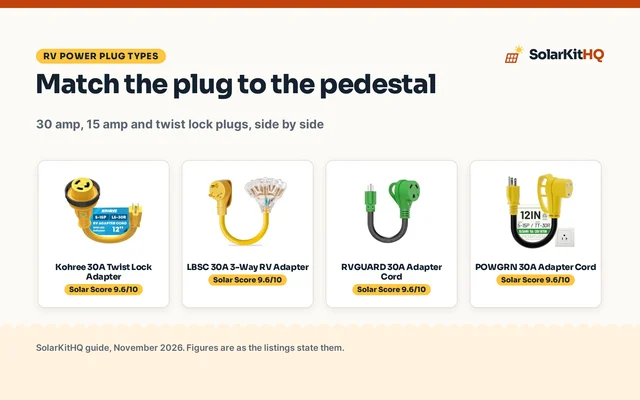
The short version: match the plug shape, the amps and the volts. A TT-30 plug is the RV plug, a L5-30 is a twist-lock plug, and a L14-30 is a twist-lock plug that carries 250V. Household outlets are 5-15R and 5-20R, and an adapter turns one plug shape into another without changing the amps or volts. Check the label on the generator and the label on the load before you buy an adapter.
Step 1: Read the outlet on the generator
Start at the generator. Read the label beside each outlet: it names the NEMA plug, the amps and the volts. A TT-30 outlet is the RV outlet, and it takes a TT-30P plug. A L5-30 outlet takes a twist-lock plug, and a L14-30 outlet takes a 4 prong twist-lock plug. The label is the source to trust: the plug shape and the numbers on the outlet tell you what the generator supplies, and the manual lists the same figures. Note the volts as well as the amps, because a plug that fits does not always carry the volts the load needs. See the power generator types guide for the kinds of generators these outlets sit on.
Step 2: The types of generator plugs
The plugs below cover the shapes the listings state. Match the plug, the amps and the volts to the outlet and the load.
| Plug | Shape | Amps | Volts | Watts | What it feeds |
|---|---|---|---|---|---|
| TT-30 (NEMA TT-30P) | 3 prong | 30 | 110 / 120 | 3600 | RVs, campers and travel trailers |
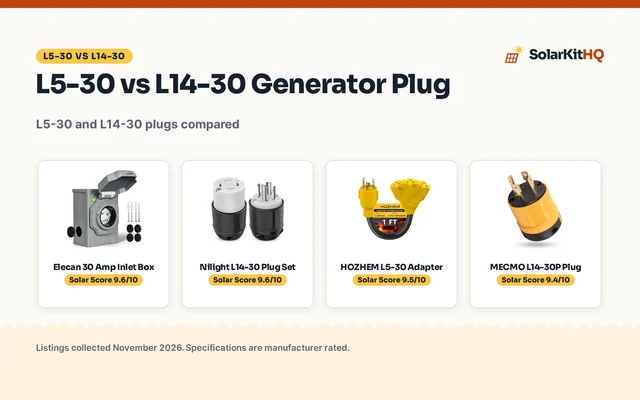
| L5-30 (NEMA L5-30P) | 3 prong twist-lock | 30 | 120 | 3600 | RVs, through an adapter to TT-30R |
| L14-30 (NEMA L14-30R) | 4 prong twist-lock | 30 | 250 | 3750 | RVs, campers and trailers |
| 5-15R / 5-20R | Household | 15 | 110 | Not stated | Phones, laptops, mini-fridges and coffee makers |
Three adapter listings show the same shapes in use. The ELEGRP adapter (on Amazon) turns a TT-30P plug into three 15A household outlets, the WEN GNA030 (on Amazon) turns a L5-30P twist-lock plug into a TT-30R outlet, and the Vockjour adapter (on Amazon) turns a TT-30P plug into a L14-30R outlet. Each one lists 30 amps, and each one lists its own volts and watts.
Step 3: Pick an adapter when the plugs do not match
When the generator outlet and the load plug do not match, an adapter bridges the gap. Pick an adapter whose plug matches the generator outlet and whose outlet matches the load, and check that its amps and volts match both sides. The ELEGRP adapter takes a TT-30P plug and gives three 15A household outlets, with 10AWG copper wire and a 1ft length, so it suits a camper that needs household outlets from an RV outlet. The WEN GNA030 takes a L5-30P twist-lock plug and gives a TT-30R outlet, with a compact design that measures 2.75 by 2.25 by 2.25 inches. The Vockjour adapter takes a TT-30P plug and gives a L14-30R outlet, with a 12 inch length, 10AWG wire and an ETL listing. Never use an adapter to feed a load past the amps the adapter lists: the ELEGRP listing states the total load must not exceed 30 amps.
Step 4: Check the fit before you plug in
Read the plug and the outlet side by side before you plug in. A TT-30P plug goes into a TT-30R outlet, a L5-30P twist-lock plug turns to lock, and a L14-30R outlet takes a 4 prong plug. Grip handles and non-slip grooves help with a tight outlet, and the ELEGRP and Vockjour adapters list grip handles for that reason. A fuel generator runs outdoors only, far from doors and windows, because of carbon monoxide. If the setup ties into home wiring, a licensed electrician should install it, and the setup should stay off the grid. See the how to use a portable generator safely guide for the rest of the safety steps.
Ways to keep the plugs working
- Keep the contacts clean: dirt and moisture on the prongs wear the connection, so wipe the plug and the outlet before you plug in.
- Store the cord loose: a tight coil strains the wire at the plug, so loop the adapter cord in a wide circle.
- Check the jacket: the ELEGRP and Vockjour adapters list a STW jacket and 10AWG copper wire, so check the jacket for cuts before each use.
- Match the amps: check the total load against the 30 amp figure the adapter lists, and turn off a load when the total runs past it.
FAQ: power away from the grid
What is the difference between a TT-30 and a L5-30 plug?
A TT-30 is the RV plug, and a L5-30 is a twist-lock plug. Both list 30 amps, and the WEN GNA030 lists 120 volts and 3600 watts for a L5-30P to TT-30R adapter, so the shapes carry the same amps and volts with a different lock.
What does a L14-30 plug carry?
The Vockjour adapter lists 30 amps, 250 volts and 3750 watts for a TT-30P to L14-30R adapter, with a 4 prong twist-lock plug. It suits an RV, camper or trailer that needs power from one outlet.
Can I plug a household cord into a generator?
Yes, with an adapter that matches the generator outlet. The ELEGRP adapter turns a TT-30P plug into three 15A household outlets, so a mini-fridge, coffee maker or laptop can run from an RV outlet.
How do I know which adapter to buy?
Read the outlet on the generator and the plug on the load, then pick an adapter whose plug and outlet match both. Check the amps and volts on the adapter label, and check that the total load stays under the 30 amp figure the ELEGRP listing states.
Related solar guides
See the size generator for RV, the what type of extension cord for generator and the how much power generator do I need guides, and the camping and emergency gear category.