On this page
What is emergency preparedness? It is a plan and a kit that let a household get through an outage or a disaster without outside help, and it starts with a concrete moment: the lights go out at dinner time, the fridge hums to a stop, and the phone in your pocket is the only light in the room. This guide explains what that means in practice, step by step, using figures from the listings cited so you can size a kit to your household.
SolarKitHQ earns a commission when you buy through links on this page, at no extra cost to you. As an Amazon Associate I earn from qualifying purchases. Affiliate disclosure.
What is emergency preparedness: the quick answer
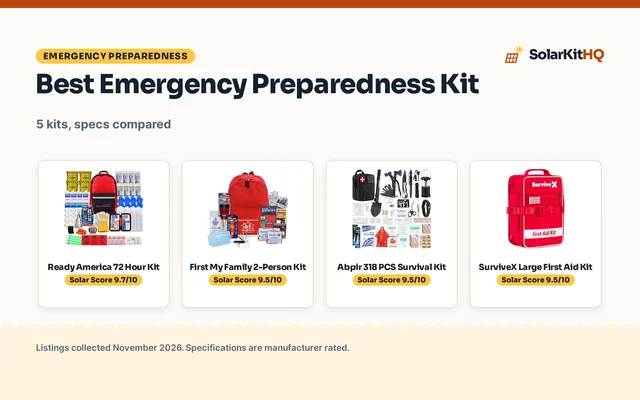
Emergency preparedness means having the supplies and the plan to cover food, water, light, first aid, warmth and communication for a set period, usually measured in hours or days, without relying on shops or services. The listings in this guide are built around a 72-hour window: Ready America sells a 1-person, a 2-person and a 4-person kit that each cover 72 hours, with food, water, first aid and shelter packed in one backpack. A kit is not a stockpile for every scenario; it is a grab-and-go bag that covers the basics until help arrives or services return.
Step 1: Work out who the kit is for
Start with the people. A kit sized for one person will not stretch to a household, and a household kit wastes space for a traveler on their own. Ready America lists a 1-person 72-hour backpack, a 2-person 72-hour backpack and a 4-person 72-hour backpack, so the household size is the first choice to make. The Dlmd survival kit (on Amazon) lists 251 pieces in one bag, and the EVERLIT roadside kit (on Amazon) lists a 108-piece first aid kit inside a car kit, which shows how piece counts climb as the kit covers more people and more situations.
Step 2: Cover food, water and light
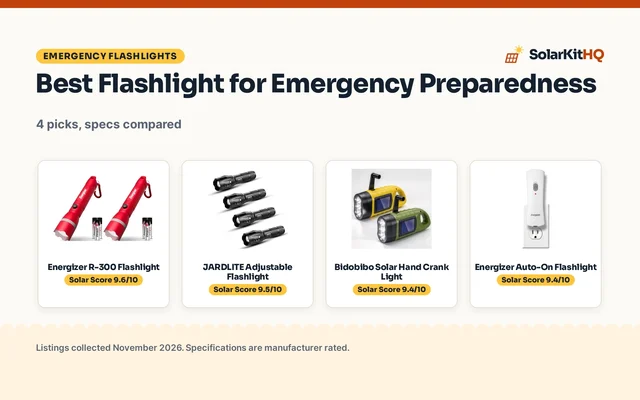
Food and water come first in the bag. The Ready America 2-person kit lists 2 emergency food bars totaling 4800 calories and 12 sealed drinking water pouches, while the 4-person kit lists four 2,400-calorie emergency food bars and four 1-liter water cartons. The 1-person kit lists a 2400 calorie emergency food bar and 6 sealed water pouches. Light follows food and water: the 2-person kit lists 2 long lasting 12 hour lightsticks, the 1-person kit lists a 12 hour lightstick, and the 4-person kit lists emergency lightsticks with a hand-crank power station that combines a flashlight, radio, siren and cell phone charging. See the best flashlights for emergency preparedness for more light options, and the best rechargeable emergency lanterns for room light.
Step 3: Add first aid and tools
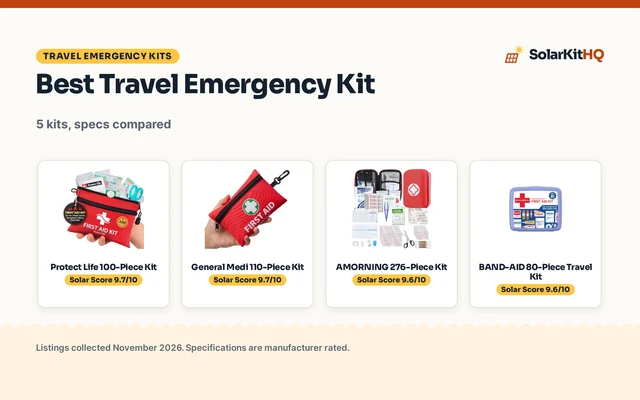
First aid is the next layer. The Vriexsd mini kit (on Amazon) lists 150 pieces in a hard shell case, the EVERLIT car kit lists a 108-piece first aid kit, the Ready America 4-person kit lists a 107-piece first aid kit, and the 1-person and 2-person kits list 18-piece and 33-piece kits. Contents run from bandages and gloves to a tourniquet, tweezers and wound closures, so match the kit to the situations you are most likely to face at home, in the car or on a trail. Tools sit beside first aid: the EVERLIT kit lists a 12 feet jumper cable with 300 amp output, a digital tire inflator that plugs into a 12v outlet, and a tow strap, while the Laffizz lighter (on Amazon) pack lists an IP56 dual-arc lighter that works up to 300 times on a single charge and a butane torch lighter with a jet flame up to 1.8 inches. See the emergency kit vs bug out bag comparison to decide which style of bag fits your plan.
Step 4: Add cooking and warmth
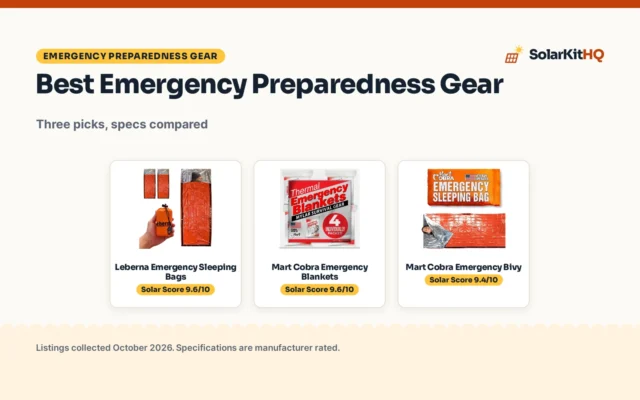
A stove turns stored food into hot meals. The Gas One GS-3400P (on Amazon) lists dual fuel: a single butane cartridge of 8 oz or a propane cylinder of 16.4 oz, with an 8,000 BTU size, automatic piezo-electric ignition and a built-in pressure sensor that ejects the cartridge when irregular pressure is detected. Fuel-burning stoves are for outdoor use, far from doors and windows, because of carbon monoxide. Warmth comes from the bag itself: the Ready America kits list 2 emergency ponchos and 2 survival blankets in the 2-person kit, and the Dlmd kit lists a thermal blanket that retains 90% body heat, an emergency tent and a 17-inch multi-function axe and hammer. Keep the stove, the fuel and the warm layers together, so the kit works together when the power is out.
Ways to make the kit last
- Keep the whole kit in one backpack, by the door or in the car, so it can be grabbed without a search.
- Check the food bars and water pouches on a regular schedule and swap out anything past its date.
- Match the kit to the season: add warm layers before winter and check the lightsticks and batteries before a storm.
- Know the kit before you need it: open each pocket once, learn where the first aid supplies sit, and put the whistle and lightstick where hands find them fast.
FAQ: power away from the grid
How much food and water does a 72-hour kit hold?
It depends on the people it covers. The Ready America 2-person kit lists 2 food bars totaling 4800 calories and 12 water pouches, the 4-person kit lists four 2,400-calorie food bars and four 1-liter water cartons, and the 1-person kit lists a 2400 calorie food bar and 6 water pouches.
What goes in an emergency first aid kit?
The Vriexsd mini kit lists 150 pieces, including bandages, gloves, prep pads, tweezers and a tourniquet, in a case that measures 6.4 x 4.9 x 2.7 inches. The SurviveX large kit adds zip stitch wound closures and labeled pockets for wounds, hygiene, tools and personal items, and it is sized for 3-4 people.
Can a camping stove be part of an emergency kit?
Yes. The Gas One GS-3400P is sold for an emergency preparedness kit, runs on a single 8 oz butane cartridge or a 16.4 oz propane cylinder, and lists an 8,000 BTU size with piezo-electric ignition. Use it outdoors, far from doors and windows.
How big is a 2-person 72-hour kit?
The Ready America 70280 backpack measures 9.5 x 6.0 x 12.0 inches and weighs 7.75 pounds, while the deluxe 70285 measures 10.0 x 8.0 x 15.0 inches and weighs 2.0 pounds. Both pack food, water, first aid, light and shelter for 2 people over 72 hours.
Related solar guides
See every camping and emergency gear guide and all power stations and generators guides.
More picks: emergency kit vs bug out bag, power station types, emergency LED flashlights and emergency radio vs flashlight.