On this page
The short answer on 100 amp vs 300 amp battery shunt sizing: the only real shunt in this pair is the Renogy, which monitors through an app, while the Siemens listing is a circuit breaker, not a shunt at all. That mismatch decides the comparison before any spec does, because a breaker cannot watch a battery bank. This article compares the two listings on what each one states: monitoring, voltage range, sensors, size and warranty terms.
SolarKitHQ earns a commission when you buy through links on this page, at no extra cost to you. As an Amazon Associate I earn from qualifying purchases. Affiliate disclosure.
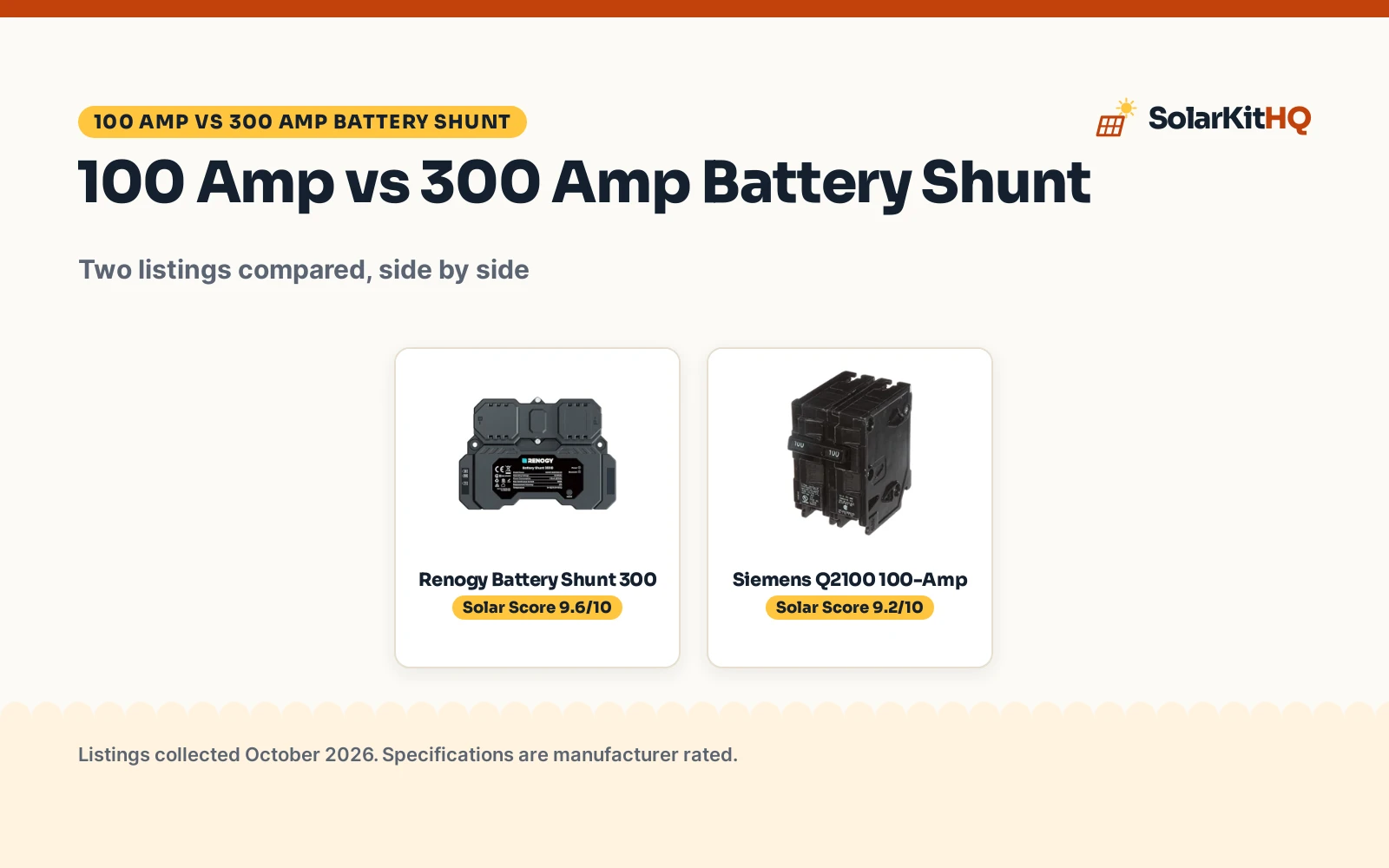
100 Amp vs 300 Amp Battery Shunt: Side by Side
| Battery Shunt | Renogy Battery Shunt 300 | Siemens Q2100 100-Amp | |
|---|---|---|---|
| Type | Battery shunt with app monitoring | Double pole circuit breaker | |
| Amps stated | Up to 500A | 100 Amp | |
| Voltage range | 8V to 120V | 240V | |
| Monitoring | Bluetooth and DC Home app | Not stated | |
| Temperature sensor | Stated | Not stated | |
| Weight | 0.99 pounds | 0.5 pounds | |
| Warranty | 1-year material and workmanship | 1 Year |
Figures in this table are the manufacturer’s ratings as listed, captured 10 November 2026.
What each listing actually is
The Renogy listing is a battery shunt: a sensor that sits in the battery circuit and feeds current and voltage readings to an app. The Siemens listing is a 100-amp double pole type QP circuit breaker for Siemens PL and ES series load centers, with plug-in connections, the insta-wire feature and a 10,000 AIC interrupting figure. A breaker and a shunt do different jobs, so this comparison is really about which listing fits the job of watching a battery bank, and the answer is the Renogy. A circuit breaker connects to home wiring, so a licensed electrician should install it.
Monitoring and alerts
Monitoring is where the Renogy earns its place. The listing states Bluetooth monitoring and control through the DC Home app and Renogy ONE, with historical data and alerts for abnormal conditions, and a battery temperature sensor that the listing calls indispensable for safety, longevity, efficiency and data-driven decisions. It works with starter and main batteries, including lead acid (AGM, GEL), lithium iron phosphate, lithium-ion and nickel-metal hybrid types. One limit is stated plainly: the shunt is not compatible with Renogy ONE M1 currently. The Siemens listing states no monitoring, no app and no sensor, which is expected for a breaker and is exactly why it cannot serve as a shunt.
Voltage range and current figures
The Renogy listing states a range of 8V to 120V and up to 500A, while its title says Battery Shunt 300. Those two figures do not match, so treat the current figure with care and read the title and the bullets together before choosing. The Siemens listing states 100 Amp at 240V with a 10,000 AIC interrupting figure, which describes a breaker, not a shunt range. The two current figures cannot be compared directly, because one belongs to a breaker and the other to a shunt, so neither side wins on amps here.
Size and weight
The two listings are close in size and far apart in weight. The Renogy shunt is listed at 5.31 by 3.82 by 1.22 inches and 0.99 pounds, while the Siemens breaker is listed at 5.0 by 3.5 by 2.5 inches and 0.5 pounds. Both are small enough to sit near a battery bank or inside a load center, and neither size decides the comparison: the deciding factor stays the monitoring the Renogy states and the Siemens listing does not.
What the listings leave unclear
The Renogy title and bullets disagree on the current figure: the title says 300 and the bullets say up to 500A, and the listing gives no way to settle which one describes the shunt. The Siemens listing leaves battery monitoring unclear in a different way: it states no shunt, sensor, app or voltage range for a battery bank, because it is a breaker. Neither listing states a UL listing, an ETL listing or an IP code. Both state a warranty term, so the warranty line is clear on both sides.
Two examples

Renogy Battery Shunt 300
A battery shunt with Bluetooth and app monitoring, a stated range of 8V to 120V and up to 500A, a battery temperature sensor and a 1-year material and workmanship warranty.
Pros
- Bluetooth monitoring and control through the DC Home app and Renogy ONE
- Stated range of 8V to 120V and up to 500A
- Battery temperature sensor stated
- Records historical data and issues alerts for abnormal conditions
Cons
- Not compatible with Renogy ONE M1 currently
- No shunt cable or mounting hardware is listed
- App monitoring needs Bluetooth and the DC Home app
Detailed Review
The listing states a battery shunt with Bluetooth monitoring and control through the DC Home app and Renogy ONE, a range of 8V to 120V and up to 500A, a battery temperature sensor, historical data and alerts for abnormal conditions, and compatibility with lead acid (AGM, GEL), lithium iron phosphate, lithium-ion and nickel-metal hybrid batteries for starter and main batteries. It measures 5.31 by 3.82 by 1.22 inches at 0.99 pounds, and the warranty is a 1-year material and workmanship warranty. The title says Battery Shunt 300 while the bullets say up to 500A, so the current figure is unclear, and the listing states it is not compatible with Renogy ONE M1 currently.
Who it's for: owners who want app-based battery monitoring with a temperature sensor and alerts. Who should skip it: anyone using Renogy ONE M1, which the listing states is not compatible currently.
Its Solar Score of 9.6/10 comes from performance 30/35, build 21/25, value 20/25, safety 7/10 and warranty 2/5: 80 of 100 points, placed on our 9.2 to 9.8 scale.
Key Specifications
| Range | 8V to 120V, up to 500A |
|---|---|
| Monitoring | Bluetooth, DC Home app, Renogy ONE |
| Size | 5.31 x 3.82 x 1.22 in |
| Batteries | Lead acid, lithium iron phosphate, lithium-ion, nickel-metal hybrid |
Figures as published on the retailer listing, collected 10 November 2026. Performance figures are manufacturer rated.
Safety and Warranty
What this listing states. Battery temperature sensor and abnormal-condition alerts stated, so safety scores 7 of 10. 1-year material and workmanship warranty stated. It does not say everything a buyer needs, such as who pays return shipping, so warranty scores 2 of 5. See How We Pick.
Install it right. Fit shunts, bus bars and fuses within their stated current ratings, follow the wiring order in the manual, and disconnect the battery before you work on any connection.
This is general buying information, not professional advice. Follow each product manual and local rules, and see our Safety Disclaimer.

Siemens Q2100 100-Amp
A 100-amp double pole type QP circuit breaker for Siemens PL and ES series load centers, with overload and short-circuit protection and a 1-year warranty.
Pros
- 100 Amp double pole breaker with a 10,000 AIC interrupting figure
- Plug-in connections and the insta-wire feature stated
- Compatible with Siemens PL and ES series load centers
- Overload and short-circuit protection stated
Cons
- It is a circuit breaker, not a battery shunt, so it cannot monitor a battery
- No battery monitoring, app or sensor is stated
- No battery voltage range is stated
- Only fits Siemens PL and ES series load centers
Detailed Review
The listing states a 100-amp double pole type QP circuit breaker at 240V with a 10,000 AIC interrupting figure, plug-in connections, the insta-wire feature and compatibility with Siemens PL and ES series load centers, with overload and short-circuit protection. It measures 5.0 by 3.5 by 2.5 inches at 0.5 pounds in black, and the warranty is 1 Year. It is a breaker, not a shunt: it states no monitoring, no sensor and no app, so it cannot watch a battery bank. A circuit breaker connects to home wiring, so a licensed electrician should install it.
Who it's for: owners who need a 100-amp double pole breaker for a Siemens PL or ES series load center. Who should skip it: anyone shopping for a battery shunt, since this listing monitors nothing.
Its Solar Score of 9.2/10 comes from performance 14/35, build 18/25, value 15/25, safety 5/10 and warranty 2/5: 54 of 100 points, placed on our 9.2 to 9.8 scale.
Key Specifications
| Amps | 100 Amp, double pole |
|---|---|
| Voltage | 240V, 10,000 AIC |
| Size | 5.0 x 3.5 x 2.5 in |
| Weight | 0.5 pounds |
Figures as published on the retailer listing, collected 10 November 2026. Performance figures are manufacturer rated.
Safety and Warranty
What this listing states. Overload and short-circuit protection stated, so safety scores 5 of 10. 1 Year warranty stated. It does not say everything a buyer needs, such as who pays return shipping, so warranty scores 2 of 5. See How We Pick.
Install it right. Fit shunts, bus bars and fuses within their stated current ratings, follow the wiring order in the manual, and disconnect the battery before you work on any connection.
This is general buying information, not professional advice. Follow each product manual and local rules, and see our Safety Disclaimer.
As an Amazon Associate I earn from qualifying purchases.
Where the points went
The Solar Score weighs performance, build, value, safety and warranty. For a battery shunt, safety means a temperature sensor, alerts for abnormal conditions or another protection the listing names; the Renogy states a temperature sensor and alerts, and the Siemens states overload and short-circuit protection. Both state a warranty term of 1 year. How we pick explains the weights.
| Product | Solar Score | Perf. /35 | Build /25 | Value /25 | Safety /10 | Warranty /5 |
|---|---|---|---|---|---|---|
| Renogy Battery Shunt 300 | 9.6 | 30 | 21 | 20 | 7 | 2 |
| Siemens Q2100 100-Amp | 9.2 | 14 | 18 | 15 | 5 | 2 |
The Solar Score runs on a 9.2 minimum and a 9.8 maximum, and the weighted point total is placed on that line in proportion, so more points can only raise it.
100 amp vs 300 amp battery shunt: which should you choose?
Choose the Renogy Battery Shunt 300 if the job is watching a battery bank: it states app monitoring, a temperature sensor, alerts and a range of 8V to 120V. Choose the Siemens Q2100 only if the job is a 100-amp double pole breaker for a Siemens PL or ES series load center, and a licensed electrician should install it. For a closer look at monitors built for solar banks, see the best battery monitor for solar system and the best battery monitor with shunt guides.
| If you need | Look at |
|---|---|
| App monitoring for a battery bank | Renogy Battery Shunt 300 |
| A temperature sensor and alerts | Renogy Battery Shunt 300 |
| A 100-amp breaker for a Siemens load center | Siemens Q2100 100-Amp |
| A 1-year warranty term | Both listings state 1 year |
Sizing Notes
- Match the shunt range to the battery bank: the Renogy listing states 8V to 120V and up to 500A.
- Check battery compatibility: the Renogy listing works with lead acid (AGM, GEL), lithium iron phosphate, lithium-ion and nickel-metal hybrid batteries, and states it is not compatible with Renogy ONE M1 currently.
- Match the breaker to the load center: the Siemens Q2100 fits Siemens PL and ES series load centers, and a licensed electrician should install it.
- Fuse the positive lead as the manual directs.
FAQ: power away from the grid
Is the Siemens Q2100 a battery shunt?
No. The listing states a 100-amp double pole type QP circuit breaker for Siemens PL and ES series load centers, with overload and short-circuit protection. It states no monitoring, sensor or app.
What does the Renogy Battery Shunt 300 monitor?
The listing states Bluetooth monitoring through the DC Home app and Renogy ONE, with historical data and alerts for abnormal conditions, plus a battery temperature sensor. Its stated range is 8V to 120V and up to 500A, although the title says 300.
Which batteries work with the Renogy shunt?
The listing states compatibility with lead acid (AGM, GEL), lithium iron phosphate, lithium-ion and nickel-metal hybrid batteries, for starter and main batteries. It also states the shunt is not compatible with Renogy ONE M1 currently.
How big is each listing?
The Renogy shunt is listed at 5.31 by 3.82 by 1.22 inches and 0.99 pounds. The Siemens breaker is listed at 5.0 by 3.5 by 2.5 inches and 0.5 pounds.
What warranty does each listing state?
Both state 1 year: the Siemens lists a 1-year warranty, and the Renogy lists a 1-year material and workmanship warranty.
Related solar guides
See every Battery Monitors and Accessories guide and all Batteries and Charging guides. For more monitor comparisons, see the best battery monitor for LiFePO4, the analog vs digital battery monitor guide and the bluetooth vs display battery monitor guide.
More picks: best battery monitor for van, best battery monitor for boat and best battery monitor for motorhome.