On this page
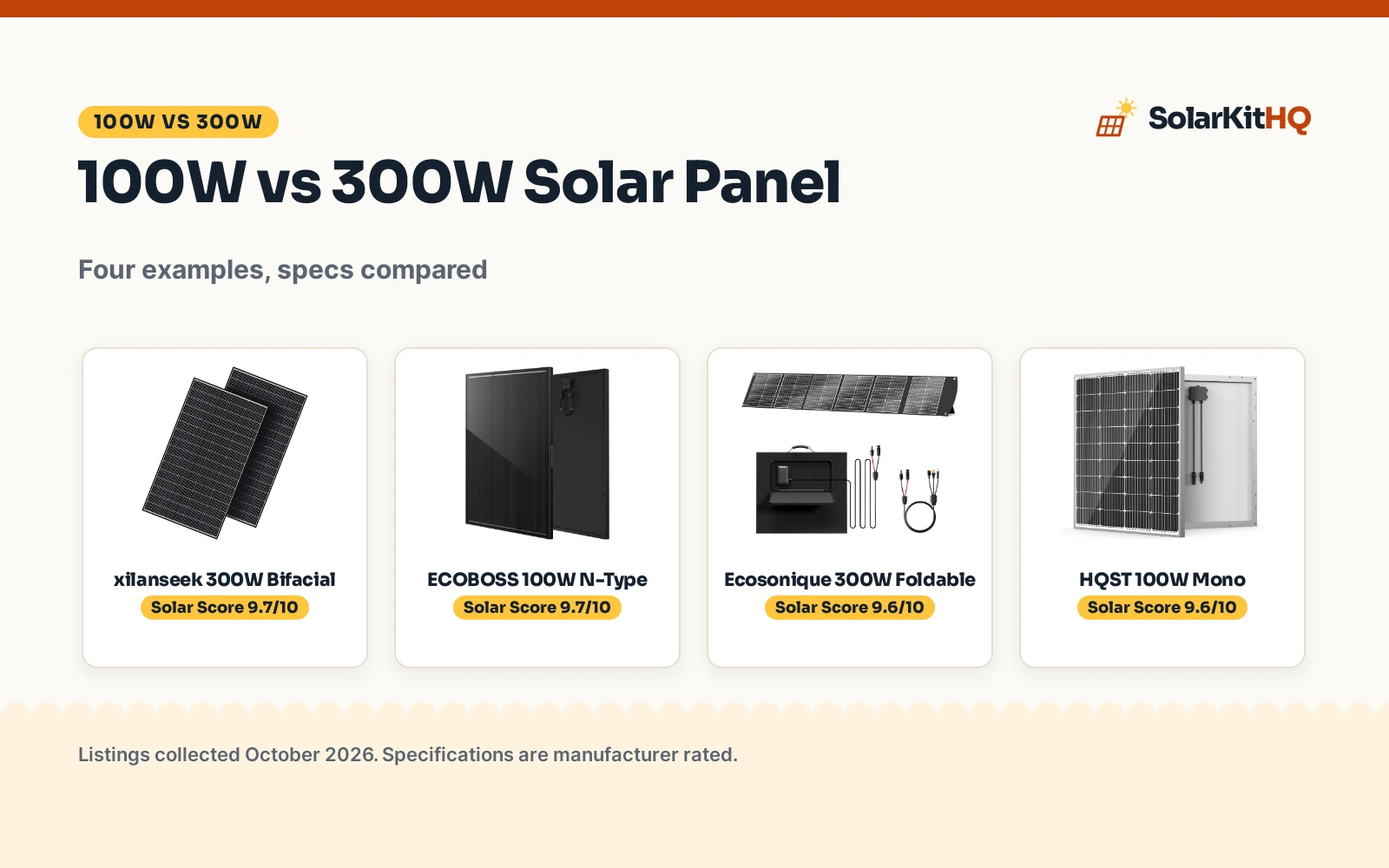
The verdict on 100w vs 300w solar panel is simple: pick 100W when the space or the budget is small and the load is modest, and pick 300W when you want more energy from the same footprint. We compared four listings as concrete examples: two 100W rigid panels and two 300W panels (one portable foldable, one bifacial kit). Every figure below comes from the listings. Efficiency claims are the makers’ stated figures, not measured results.
SolarKitHQ earns a commission when you buy through links on this page, at no extra cost to you. As an Amazon Associate I earn from qualifying purchases. Affiliate disclosure.
100W vs 300W solar panel: side by side
| 100W vs 300W | HQST 100W Mono | ECOBOSS 100W N-Type | Ecosonique 300W Foldable | xilanseek 300W Bifacial | Amazon |
|---|---|---|---|---|---|
| Side | 100w | 100w | 300w solar panel | 300w solar panel | |
| Watts | 100W | 100W | 300W | 300W | |
| Efficiency | 23% stated | 25.8% stated | 23.5% stated | 25% stated | |
| Size | 31.8 x 27.5 x 1.18 in | Not stated | Foldable suitcase | Not stated | |
| Weight | Not stated | Not stated | 15.4 lb | Not stated | |
| Warranty | Not stated | 1 year | Not stated | 30 years |
Specifications are manufacturer rated as listed, collected 21 October 2026.
Watts and efficiency
The wattage gap is the whole point: 100W against 300W stated. On stated efficiency, the ECOBOSS 100W claims 25.8% from N-Type 16BB cells, the xilanseek 300W claims 25% from N-Type 16BB bifacial cells, the Ecosonique 300W claims 23.5% from monocrystalline cells and the HQST 100W claims up to 23% from Grade A+ 166mm cells with 100% EL inspection. The 300W examples are not the same kind of panel: the Ecosonique is a portable foldable suitcase at 15.4 lb stated with a 40V output and MC4/XT60 cabling, while the xilanseek is a rigid bifacial panel that captures reflected light on the back side. If you are comparing panel technologies generally, see monocrystalline vs polycrystalline solar panel.
Build and certifications
The ECOBOSS 100W carries the most stated certification: TÜV certification to IEC 61215, IEC 61730 and UL 61730 for design durability, electrical safety and mechanical safety. The HQST 100W states IP65 with 2400Pa wind loads and 5400Pa snow loads in a compact 31.8 by 27.5 by 1.18 inch body. The xilanseek 300W states an IP65 junction box with IP67 connectors, hail resistance and a 30-year warranty. The Ecosonique 300W states IP65 with Oxford fabric and CPC lamination and operation from 14°F to 158°F. For a bigger wattage step, see our 400W vs 600W solar panel comparison.
What the listings leave unclear
The HQST listing states no warranty term and no weight. The Ecosonique listing states a warranty line with 24/7 lifetime technical support but no concrete warranty term, so it counts as none. The xilanseek title says 600W while the product is a 300W bifacial panel; the 600W appears to be the pair or kit framing, so compare on 300W. The ECOBOSS spec table lists the manufacturer as Hong Kong Xianglin while the brand is ECOBOSS; that is a listing detail, not a contradiction.
Four examples
| # | Product | Solar Score | Buy |
|---|---|---|---|
| 1 |  xilanseek 300W Bifacial | 9.7/10 | Buy on Amazon |
| 2 |  ECOBOSS 100W N-Type | 9.7/10 | Buy on Amazon |
| 3 |  Ecosonique 300W Foldable | 9.6/10 | Buy on Amazon |
| 4 |  HQST 100W Mono | 9.6/10 | Buy on Amazon |

xilanseek 300W Bifacial
A 300W bifacial solar panel with N-Type 16BB cells, 25% stated efficiency and a 30-year warranty, per the listing.
Pros
- 300W bifacial with dual-sided power generation stated
- 25% conversion efficiency from N-Type 16BB cells stated
- IP65 junction box with IP67 connectors stated
- 30-year warranty stated
Cons
- Title says 600W while the panel is 300W, per the listing
- No dimensions or weight stated in the extracted listing
- Hail and wind resistance stated without load figures
- Bifacial gain depends on reflective surfaces, per the listing
Detailed Review
The listing states a 300W bifacial solar panel with advanced N-Type 16BB cells and up to 25% conversion efficiency, with dual-sided power generation that captures more sunlight in low-light, cloudy or reflected environments. It states an IP65 junction box with IP67 connectors, hail resistance, wind and corrosion resistance, anti-corrosion copper wires and a 30-year warranty. The title says 600W while the panel itself is 300W; compare on 300W.
Who it's for: off-grid owners who want bifacial output with a long stated warranty. Who should skip it: anyone confused by the 600W title on a 300W panel.
Its Solar Score of 9.7/10 comes from performance 33/35, build 20/25, value 21/25, safety 7/10 and warranty 5/5: 86 of 100 points, placed on our 9.2 to 9.8 scale.
Key Specifications
| Watts | 300W bifacial |
|---|---|
| Cells | N-Type 16BB |
| Efficiency | 25% stated |
| Ingress | IP65 / IP67 stated |
Figures as published on the retailer listing, collected 21 October 2026. Performance figures are manufacturer rated.
Safety and Warranty
What this listing states. IP65 junction box with IP67 connectors, hail and wind resistance stated, so safety scores 7 of 10. 30-year warranty stated, so warranty scores 5 of 5. See How We Pick.
Panels make voltage in daylight. Keep connectors covered until you connect them, check the panel's stated open circuit voltage and current against your controller or power station input limits, and use cables rated for the current. Roof and permanent mounts belong to a qualified installer.
This is general buying information, not professional advice. Follow each product manual and local rules, and see our Safety Disclaimer.

ECOBOSS 100W N-Type
A 100W N-Type solar panel with TÜV, IEC and UL certification and 25.8% stated efficiency, per the listing.
Pros
- TÜV certified to IEC 61215, IEC 61730 and UL 61730 stated
- 25.8% efficiency from N-Type 16BB cells stated
- Low temperature coefficient for heat and low light stated
- 1-year manufacturer warranty stated
Cons
- No dimensions or weight stated in the extracted listing
- 1-year warranty is far shorter than the xilanseek 30-year term
- 100W suits small loads only, per the listing
- Manufacturer listed as Hong Kong Xianglin, not ECOBOSS
Detailed Review
The listing states a 100W TÜV-certified solar panel with N-Type 16BB monocrystalline cells delivering up to 25.8% conversion efficiency, independently certified to IEC 61215, IEC 61730 and UL 61730 for design durability, electrical safety and mechanical safety. It states a low temperature coefficient for heat and low-light performance and a 1-year manufacturer warranty. It is aimed at 12V off-grid systems, trailers, campers, boats, farms, cabins and rooftops. No contradiction stands out in the listing.
Who it's for: RV, marine and rooftop owners who want certified 100W with a stated warranty. Who should skip it: anyone needing more than 100W per panel.
Its Solar Score of 9.7/10 comes from performance 30/35, build 20/25, value 20/25, safety 9/10 and warranty 3/5: 82 of 100 points, placed on our 9.2 to 9.8 scale.
Key Specifications
| Watts | 100W |
|---|---|
| Cells | N-Type 16BB |
| Efficiency | 25.8% stated |
| Certification | TÜV, IEC 61215, IEC 61730 and UL 61730 |
Figures as published on the retailer listing, collected 21 October 2026. Performance figures are manufacturer rated.
Safety and Warranty
What this listing states. TÜV certified to IEC 61215, IEC 61730 and UL 61730 stated, so safety scores 9 of 10. 1-year manufacturer warranty stated. It does not say everything a buyer needs, such as who pays return shipping, so warranty scores 3 of 5. See How We Pick.
Panels make voltage in daylight. Keep connectors covered until you connect them, check the panel's stated open circuit voltage and current against your controller or power station input limits, and use cables rated for the current. Roof and permanent mounts belong to a qualified installer.
This is general buying information, not professional advice. Follow each product manual and local rules, and see our Safety Disclaimer.
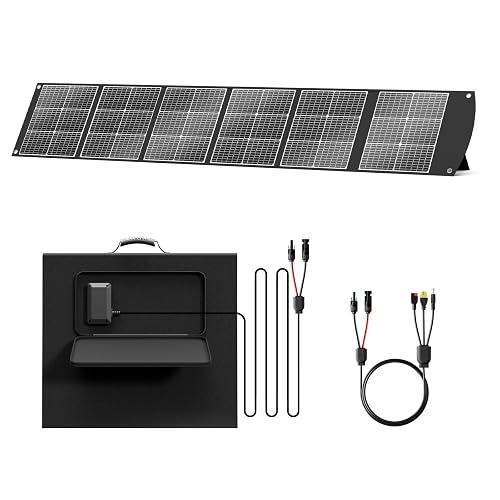
Ecosonique 300W Foldable
A 300W portable foldable solar panel at 15.4 lb with 23.5% stated efficiency, per the listing.
Pros
- 300W portable foldable suitcase design stated
- 15.4 lb stated, 18% lighter per the listing
- 23.5% conversion efficiency stated
- 14°F to 158°F operating range stated
Cons
- No concrete warranty term stated, only lifetime technical support
- 40V output suits power stations, not direct 12V charging
- Foldable fabric build is less rigid than glass panels
- No dimensions stated in the extracted listing
Detailed Review
The listing states a 300W portable foldable solar panel suitcase with monocrystalline cells at 23.5% conversion efficiency, 40V output with MC4 cable and XT60 DC connector, a 3m cable, 15.4 lb with an 18% lighter structure, stable operation from 14°F to 158°F and an IP65 surface with Oxford fabric and CPC lamination. It states a warranty line with 24/7 lifetime technical support but no concrete warranty term, so the warranty scores zero. No contradiction stands out in the listing.
Who it's for: power station owners who want a portable 300W panel for campsites. Who should skip it: anyone wanting a stated warranty term or a rigid roof panel.
Its Solar Score of 9.6/10 comes from performance 32/35, build 21/25, value 21/25, safety 5/10 and warranty 0/5: 79 of 100 points, placed on our 9.2 to 9.8 scale.
Key Specifications
| Watts | 300W portable |
|---|---|
| Output | 40V, MC4 / XT60 |
| Efficiency | 23.5% stated |
| Weight | 15.4 lb stated |
Figures as published on the retailer listing, collected 21 October 2026. Performance figures are manufacturer rated.
Safety and Warranty
What this listing states. IP65 stated, so safety scores 5 of 10. No warranty term, so warranty scores zero. See How We Pick.
Panels make voltage in daylight. Keep connectors covered until you connect them, check the panel's stated open circuit voltage and current against your controller or power station input limits, and use cables rated for the current. Roof and permanent mounts belong to a qualified installer.
This is general buying information, not professional advice. Follow each product manual and local rules, and see our Safety Disclaimer.

HQST 100W Mono
A compact 100W 12V monocrystalline panel with 23% stated efficiency and 2400Pa/5400Pa load figures, per the listing.
Pros
- Compact 31.8 by 27.5 by 1.18 inch square design stated
- Up to 23% conversion with Grade A+ 166mm cells stated
- 100% EL inspection with zero cracks stated
- 2400Pa wind and 5400Pa snow load figures stated
Cons
- No warranty term stated
- No weight stated in the extracted listing
- 23% is the lowest stated efficiency here
- 9BB cells against 16BB on the other 100W panel
Detailed Review
The listing states a 100W 12V monocrystalline solar panel in a compact square design of 31.8 by 27.5 by 1.18 inches, 11% smaller than traditional panels, with 166mm Grade A+ cells, 9BB architecture, 100% EL inspection with zero cracks and up to 23% conversion rate. It states IP65 with 2400Pa wind loads and 5400Pa snow loads. No warranty term or weight is stated, and no contradiction stands out in the listing.
Who it's for: owners with limited roof space who want a compact 100W panel. Who should skip it: anyone wanting a stated warranty term.
Its Solar Score of 9.6/10 comes from performance 28/35, build 21/25, value 20/25, safety 7/10 and warranty 0/5: 76 of 100 points, placed on our 9.2 to 9.8 scale.
Key Specifications
| Watts | 100W 12V |
|---|---|
| Cells | 9BB mono, Grade A+ |
| Efficiency | 23% stated |
| Size | 31.8 x 27.5 x 1.18 in |
Figures as published on the retailer listing, collected 21 October 2026. Performance figures are manufacturer rated.
Safety and Warranty
What this listing states. IP65 with 2400Pa wind and 5400Pa snow load figures stated, so safety scores 7 of 10. No warranty term, so warranty scores zero. See How We Pick.
Panels make voltage in daylight. Keep connectors covered until you connect them, check the panel's stated open circuit voltage and current against your controller or power station input limits, and use cables rated for the current. Roof and permanent mounts belong to a qualified installer.
This is general buying information, not professional advice. Follow each product manual and local rules, and see our Safety Disclaimer.
As an Amazon Associate I earn from qualifying purchases.
Where the points went
The Solar Score weighs performance, build, value, safety and warranty. For solar panels, safety means the certifications and ingress codes the listing actually states: TÜV, IEC and UL listings, IP codes and stated load figures. The ECOBOSS and xilanseek state warranty terms of 1 year and 30 years; the other two state none.
| Product | Solar Score | Perf. /35 | Build /25 | Value /25 | Safety /10 | Warranty /5 |
|---|---|---|---|---|---|---|
| xilanseek 300W Bifacial | 9.7 | 33 | 20 | 21 | 7 | 5 |
| ECOBOSS 100W N-Type | 9.7 | 30 | 20 | 20 | 9 | 3 |
| Ecosonique 300W Foldable | 9.6 | 32 | 21 | 21 | 5 | 0 |
| HQST 100W Mono | 9.6 | 28 | 21 | 20 | 7 | 0 |
Scores run from 9.2 to 9.8: each product’s point total is placed on that range, so more points always means a higher score.
100W vs 300W solar panel: which should you choose?
Choose 100W if the roof, the trailer or the budget is small: the ECOBOSS example states 25.8% efficiency with TÜV, IEC and UL certification and a 1-year warranty, and the HQST example states a compact 31.8 by 27.5 by 1.18 inch body with 2400Pa wind and 5400Pa snow load figures. Choose 300W if you want more energy per panel: the xilanseek bifacial example states 25% efficiency with a 30-year warranty, and the Ecosonique portable example states 23.5% efficiency at 15.4 lb for power station charging. For portable panels with controllers, see our best portable solar panel with charge controller roundup.
| If you need | Look at |
|---|---|
| Certified 100W with warranty | ECOBOSS 100W N-Type |
| Compact 100W for tight roofs | HQST 100W Mono |
| Portable 300W for power stations | Ecosonique 300W Foldable |
| 300W bifacial with 30-year warranty | xilanseek 300W Bifacial |
Sizing Notes
- Three 100W panels roughly match one 300W panel in stated watts; check your roof or rack space.
- The Ecosonique portable states 15.4 lb; the HQST states 31.8 by 27.5 by 1.18 inches.
- The xilanseek is bifacial: it captures reflected light on the back side, per the listing.
- Only the ECOBOSS and xilanseek state warranty terms: 1 year and 30 years.
FAQ: power away from the grid
How many 100W panels equal a 300W panel?
Three, in stated watts. Check the listed dimensions of each 100W panel against your available space before assuming the swap.
Is a bifacial panel worth it?
The xilanseek listing states its dual-sided design captures more sunlight in low-light, cloudy or reflected conditions. It is the only bifacial example here.
Which example has the best certification?
The ECOBOSS 100W: TÜV certification to IEC 61215, IEC 61730 and UL 61730, per the listing.
Which examples state a warranty?
The ECOBOSS states 1 year and the xilanseek states 30 years. The HQST and Ecosonique state no concrete term.
Related solar guides
See every Portable Solar Panels guide and all Solar Panels and Kits guides. Also see our monocrystalline vs polycrystalline solar panel comparison. Also see our 400W vs 600W solar panel comparison. Also see our best portable solar panel with charge controller roundup.
More picks: series vs parallel solar panels, pole mount vs ground mount solar panel and adjustable vs fixed solar panel mount.