On this page
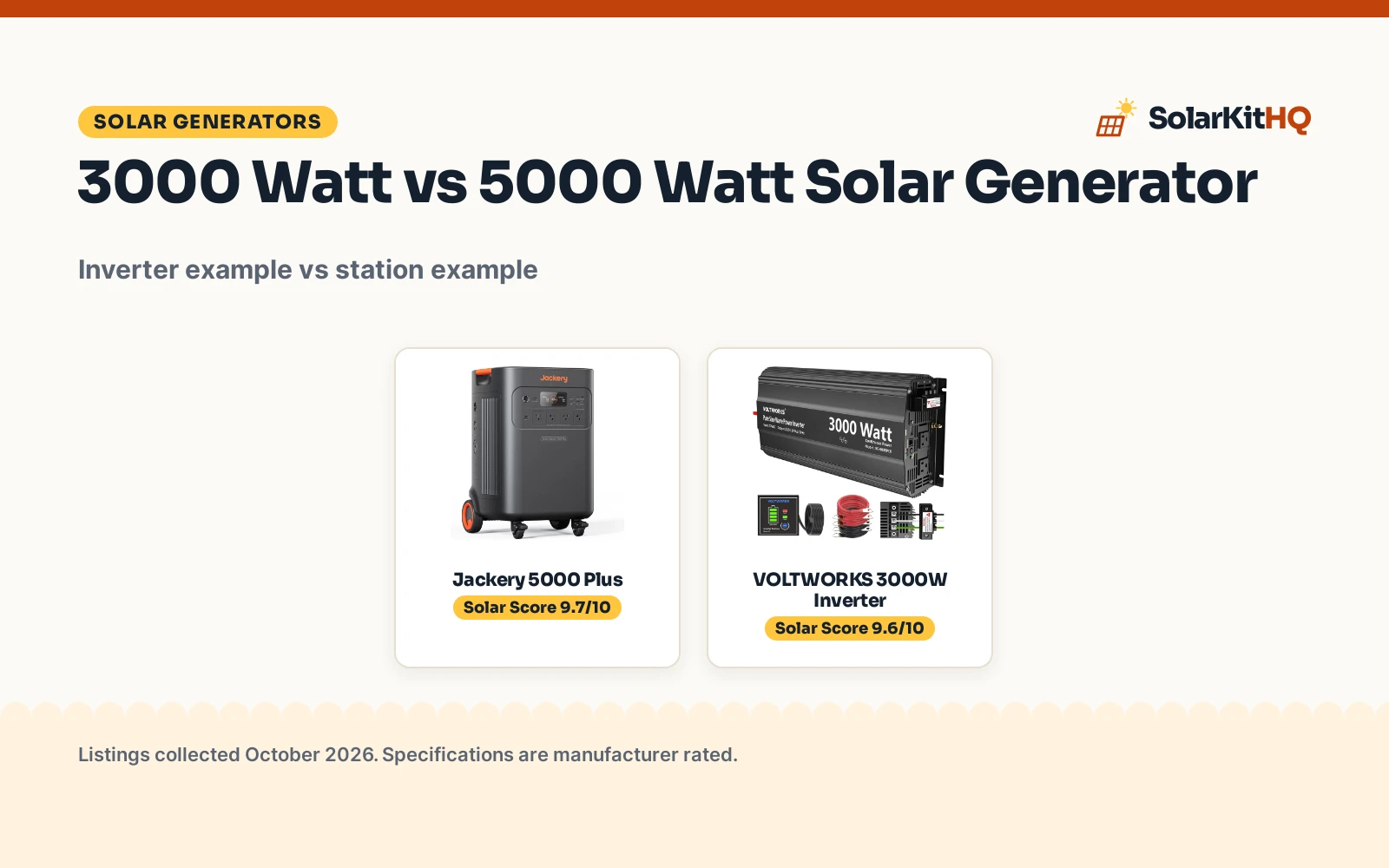
Verdict: Pick the 3000 watt side if you already own batteries and want to add AC power to them; the example is an inverter that turns 12V DC into AC. Pick the 5000 watt side if you want an all-in-one box with its own battery; the example is a power station with a stated 5040Wh capacity. Comparing a 3000 watt vs 5000 watt solar generator starts with knowing which kind of box each side is.
SolarKitHQ earns a commission when you buy through links on this page, at no extra cost to you. As an Amazon Associate I earn from qualifying purchases. Affiliate disclosure.
Compare the two sides
| Pick | Output | Battery | Warranty |
|---|---|---|---|
| VOLTWORKS 3000W Inverter | 3000W | Needs 12V battery | 18-month |
| Jackery 5000 Plus | 7200W | 5040Wh | 5 year manufacturer |
Specifications are manufacturer rated as listed, collected 21 October 2026.
The examples

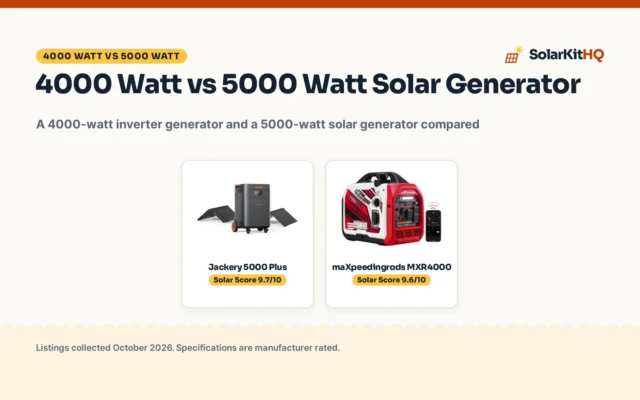
Jackery 5000 Plus
The 5000 watt side example: a 5040Wh power station with 7200W AC output.
Pros
- 7200W rated power with 14,400W surge stated
- 5040Wh LiFePO4, expandable to 60kWh stated
- 120V and 240V output stated
- 5 year manufacturer warranty stated
Cons
- 134.5 pounds stated
- Solar panels optional, not included stated
- 13 days backup depends on load stated
- 60A Smart Transfer Switch is a separate listing
Detailed Review
The listing states a power station with 5040Wh capacity, 7200W of rated AC power with 14,400W surge, 120V and 240V output, LiFePO4 cells with ChargeShield 2.0, up to 11 years of daily use, 4000W solar input for about 2 hours of recharging, expandability to 60kWh and 5 year manufacturer warranty.
Who it's for: buyers who want one box with its own battery. Who should skip it: anyone who wants a light box.
Its Solar Score of 9.7/10 comes from performance 35/35, build 22/25, value 20/25, safety 6/10 and warranty 3/5: 86 of 100 points, placed on our 9.2 to 9.8 scale.
Key Specifications
| Output | 7200W |
|---|---|
| Battery | 5040Wh |
| Voltage | 120V/240V |
| Warranty | 5 year |
Figures as published on the retailer listing, collected 21 October 2026. Performance figures are manufacturer rated.
Safety and Warranty
What this listing states. LiFePO4 and ChargeShield 2.0 stated, so safety scores 6 of 10. 5 year manufacturer warranty stated. It does not say everything a buyer needs, such as who pays return shipping, so warranty scores 3 of 5. See How We Pick.
Follow the manual. Connect and use the product as the maker describes, stay within every stated rating, and read the manual before first use.
This is general buying information, not professional advice. Follow each product manual and local rules, and see our Safety Disclaimer.

VOLTWORKS 3000W Inverter
The 3000 watt side example: a 3000W pure sine inverter for 12V batteries.
Pros
- 3000W pure sine wave stated, 3150W peak stated
- 30A AC hardwire terminal stated
- 30ft remote controller stated
- 18-month warranty stated
Cons
- Needs a 12V battery, not included
- 120V output only; no 240V stated
- Fan runs above 104F or 1400W load stated
- 2 AC outlets only
Detailed Review
The listing states a 3000W pure sine wave inverter with 12V DC to 120V AC power, 3150W peak, 2 AC outlets, an AC hardwire terminal, a 2.4A USB port, a 30ft remote controller, safety protections including short circuit, over-voltage, over-load, over-current and over-temperature, an aluminum housing and 18-month warranty. It needs a 12V battery.
Who it's for: buyers who own batteries and want AC output. Who should skip it: anyone who wants a complete generator box.
Its Solar Score of 9.6/10 comes from performance 30/35, build 19/25, value 20/25, safety 6/10 and warranty 2/5: 77 of 100 points, placed on our 9.2 to 9.8 scale.
Key Specifications
| Output | 3000W |
|---|---|
| Waveform | Pure sine |
| Input | 12V DC |
| Remote | 30ft |
Figures as published on the retailer listing, collected 21 October 2026. Performance figures are manufacturer rated.
Safety and Warranty
What this listing states. Safety protections stated, so safety scores 6 of 10. 18-month warranty stated. It does not say everything a buyer needs, such as who pays return shipping, so warranty scores 2 of 5. See How We Pick.
Follow the manual. Connect and use the product as the maker describes, stay within every stated rating, and read the manual before first use.
This is general buying information, not professional advice. Follow each product manual and local rules, and see our Safety Disclaimer.
As an Amazon Associate I earn from qualifying purchases.
How we scored them
The Solar Score weighs performance, build, value, safety and warranty. In this comparison, the 3000 watt side is an inverter and the 5000 watt side is a power station, so the scores compare each box against its own kind. Two listings state a warranty term. How we pick explains the weights.
| Product | Solar Score | Perf. /35 | Build /25 | Value /25 | Safety /10 | Warranty /5 |
|---|---|---|---|---|---|---|
| Jackery 5000 Plus | 9.7 | 35 | 22 | 20 | 6 | 3 |
| VOLTWORKS 3000W Inverter | 9.6 | 30 | 19 | 20 | 6 | 2 |
Scores run from 9.2 to 9.8: each product’s point total is placed on that range, so more points always means a higher score.
3000 watt vs 5000 watt solar generator: what separates them
Inverter vs power station
The 3000 watt example, the VOLTWORKS, is a pure sine wave inverter: it states 3000W of continuous 12V DC to 120V AC power, 2 AC outlets, an AC hardwire terminal and a 2.4A USB port. It needs a 12V battery, which is not included in the listing. The 5000 watt example, the Jackery Explorer 5000 Plus, is a power station: it states a 5040Wh LiFePO4 battery and 7200W of AC output with 14,400W surge, expandable to 60kWh. If you already have a battery bank, the inverter side adds AC cheaply; if you want one box, the power station side is the box. See portable power station vs power bank for a smaller-scale comparison.
Output and voltage
The VOLTWORKS states 3000 watts continuous with 3150 watts peak and 120V output. The Jackery states 7200W of rated power with 14,400W surge and both 120V and 240V output, enough for a 5-ton AC or a water heater per the listing. Only the Jackery states 240V; the VOLTWORKS does not, so no winner is named on voltage. For whole-home options, see best portable power station for home backup.
| If you need | Look at |
|---|---|
| AC from your own batteries | 3000 watt side, inverter, 12.6 pounds |
| One box with battery | 5000 watt side, 5040Wh station |
| 240V output | 5000 watt side, 120V and 240V stated |
Weight and portability
The VOLTWORKS states 12.6 pounds; the Jackery states 134.5 pounds. The inverter side is far easier to carry, but it is only part of a system: the battery it needs is extra weight the listing does not state. The Jackery is heavy because the battery is inside. Neither side states wheels, so the listings leave moving either one unclear beyond weight.
What the listings leave unclear
A few figures need a second look. The VOLTWORKS states its cooling fan starts only when the temperature reaches 104F or the load passes 1400W; that is stated, so it is counted. The Jackery states a 336 hour runtime, which depends on load and is not directly comparable to the inverter’s output figures. The VOLTWORKS title mentions fuses, but the script checks only what is clearly stated, so no fuse claim is counted. The Jackery states solar recharging in about 2 hours with up to 4000W of solar input; the VOLTWORKS states no solar figure because an inverter does not charge. For inverters on their own, see best power inverter for van life.
Sizing Notes
- Output as stated: 3000W continuous, 3150W peak (VOLTWORKS); 7200W rated, 14,400W surge (Jackery).
- Battery as stated: not included, needs 12V battery (VOLTWORKS); 5040Wh LiFePO4, expandable to 60kWh (Jackery).
- Voltage as stated: 120V (VOLTWORKS); 120V and 240V (Jackery).
- Weight as stated: 12.6 pounds (VOLTWORKS); 134.5 pounds (Jackery).
- Warranty terms stated: 18-month (VOLTWORKS), 5 year manufacturer (Jackery).
Frequently Asked Questions
Is the 3000 watt side a complete generator?
No. The 3000 watt example is an inverter that states 3000W of 12V DC to 120V AC power; it needs a 12V battery the listing does not include.
Which side runs 240V appliances?
The 5000 watt example states 120V and 240V output. The 3000 watt example states 120V only.
Which is easier to carry?
The VOLTWORKS states 12.6 pounds and the Jackery states 134.5 pounds, but the inverter needs a separate battery whose weight is not stated.
Which charges from solar?
The Jackery states recharging in about 2 hours with up to 4000W of solar input. The VOLTWORKS is an inverter and states no solar figure.
Which state a warranty?
The VOLTWORKS states 18-month and the Jackery states 5 year manufacturer.
Related guides
See every Solar Generators guide and all Power Stations and Generators guides.