On this page
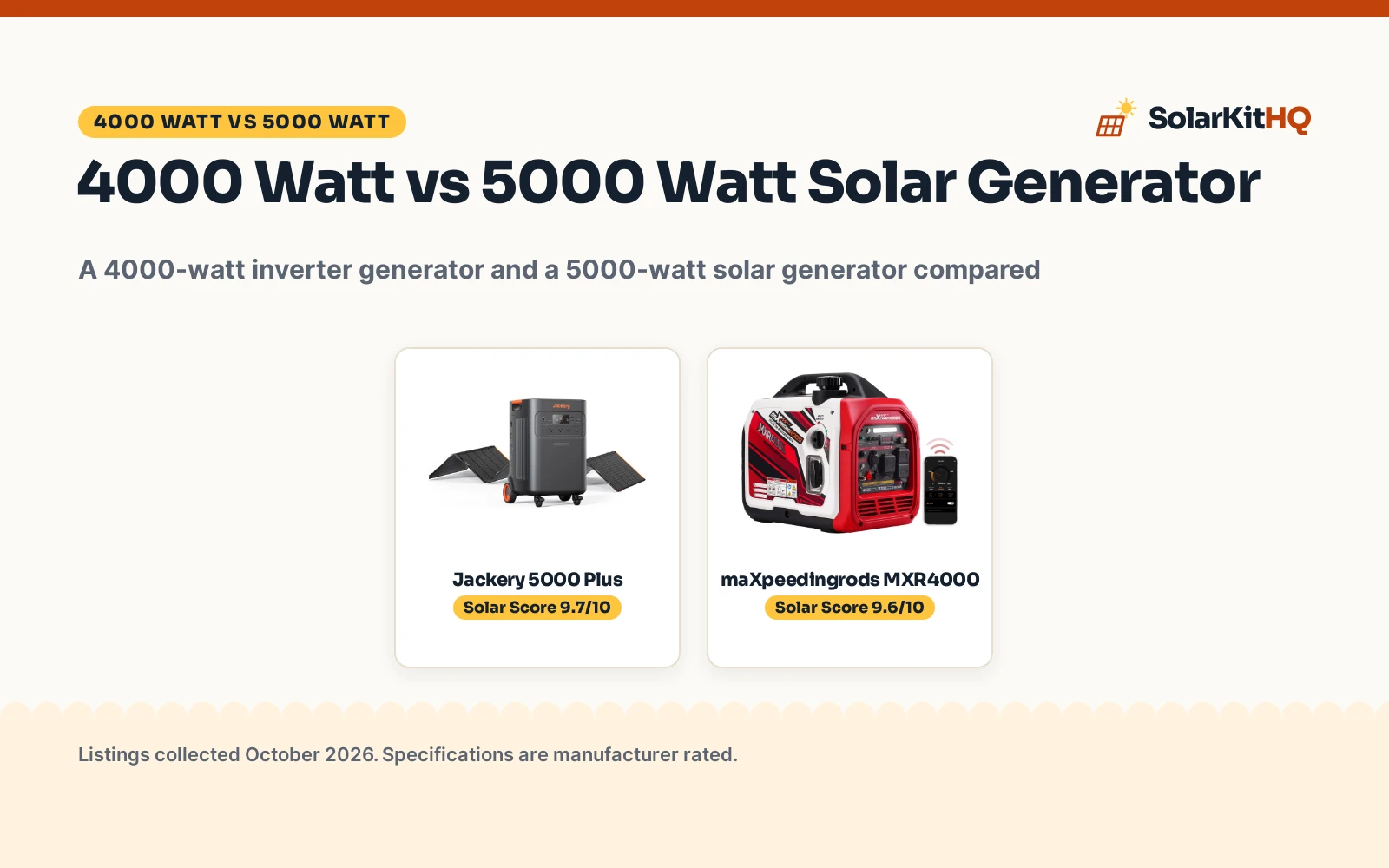
The lights went out just as dinner was going on the table, and the question of 4000 watt vs 5000 watt solar generator came up before the candles were lit. This comparison puts one 4000-watt example and one 5000-watt example side by side on what each listing states: rated output, stored energy, weight, outlets and warranty terms. The short verdict: the 5000-watt example is the home backup pick with 7200W rated and 5040Wh of storage, while the 4000-watt example is the portable pick at 48.5 pounds, though it runs on gas rather than solar.
SolarKitHQ earns a commission when you buy through links on this page, at no extra cost to you. As an Amazon Associate I earn from qualifying purchases. Affiliate disclosure.
4000 watt vs 5000 watt solar generator: side by side
| 4000 Watt vs 5000 Watt | Jackery 5000 Plus | maXpeedingrods MXR4000 | Notes |
|---|---|---|---|
| Power type | Solar generator, battery powered | Inverter generator, fuel powered | Per the power source fields |
| Rated output | 7200W rated | 4000 peak watts, 3200 running watts | Jackery surge figures conflict |
| Stored energy | 5040Wh, expandable to 60kWh | Not stated | The 4000-watt example is fuel powered |
| Output voltage | 120V/240V | 120 volts | Stated in both listings |
| Weight | 145 pounds | 48.5 pounds | Per the spec tables |
| Warranty stated | Not stated | 2 Year Manufacturer | Jackery warranty field lists 5 with no unit |
Specifications are manufacturer rated as listed, collected 22 October 2026.
Rated output and stored energy
The gap in output is wide. The Jackery 5000 Plus lists 7200W of rated power with 120V/240V output, while the maXpeedingrods MXR4000 lists 4000 peak watts and 3200 running watts at 120 volts. Stored energy is stated only on the Jackery side: 5040Wh, expandable to 60kWh. The maXpeedingrods is fuel powered, so it stores energy as gasoline in a 4 liter tank rather than in a battery.
Fuel and recharge
This is where the two examples diverge most. The Jackery recharges from the sun: the listing states about 2 hours with up to 4000W of solar input. The maXpeedingrods runs on gas with a 4 liter tank, a 145 cc 4 stroke engine and a recoil start. If the plan is silent indoor backup with no fuel storage, only the solar generator qualifies.
Size and weight
The maXpeedingrods is the portable one: 48.5 pounds and 18.89 by 12 by 17.32 inches per the bullets, with LED lights and parallel cables in the box. The Jackery is a stationary unit at 145 pounds and 14.1 by 14.7 by 18.6 inches. Both list 2 outlets; the maXpeedingrods adds an NEMA L5-30R RV outlet with an adapter for RV charging.
What the listings leave unclear
The Jackery’s bullets state a 14,400W surge while its spec table states 18000W of starting wattage; the title and bullets agree on 7200W rated, so compare on that figure. The Jackery’s warranty description field lists only 5 with no unit, so no warranty term is stated. On the maXpeedingrods, the bullets list 18.89 by 12 by 17.32 inches while the spec table lists 19 by 12 by 17.3 inches; use the bullets’ figures. The maXpeedingrods is also gas powered, which the comparison topic does not promise.
Build and monitoring
The Jackery’s case mixes metal, plastic, rubber and glass, with a digital display on the unit. The maXpeedingrods uses plastic and aluminum, also with a digital display plus LED lights. Monitoring differs: the Jackery relies on its built-in display, while the maXpeedingrods pairs its display with a Bluetooth app that shows power output, fuel level, voltage, frequency, single and accumulated run time, and lets you switch ECO mode on or off. Neither listing states an IP rating, a UL or ETL listing, or a battery management system by name.
Two examples

Jackery 5000 Plus
A 5040Wh LiFePO4 solar generator with 7200W of rated power, 120V/240V output and 500W panels in the bundle.
Pros
- 7200W rated output with 120V/240V, per the title and bullets
- 5040Wh LiFePO4 capacity, expandable to 60kWh
- Recharges in about 2 hours with up to 4000W of solar input
- 500W solar panels included in the bundle
Cons
- No warranty term is stated: the warranty field lists only 5 with no unit
- Bullets state a 14,400W surge while the spec table states 18000W starting wattage
- 145 pounds, per the spec table
- The spec table lists an 8-hour runtime with no load stated
Detailed Review
The listing states a 5040Wh LiFePO4 solar generator with 7200W of rated power, 120V/240V output, ChargeShield 2.0 technology and a claimed durability of up to 11 years of daily use. It recharges in about 2 hours with up to 4000W of solar input, expands from 5040Wh to 60kWh, and the bundle includes 500W panels. It weighs 145 pounds and measures 14.1 by 14.7 by 18.6 inches. The bullets state a 14,400W surge while the spec table states 18000W of starting wattage, so compare on the bullets' figure. The warranty description field lists only 5 with no unit, so no warranty term is stated.
Who it's for: homeowners who want a large battery backup for outages, with 240V output for bigger appliances. Who should skip it: anyone who needs a unit light enough to carry to a campsite.
Its Solar Score of 9.7/10 comes from performance 33/35, build 24/25, value 21/25, safety 8/10 and warranty 0/5: 86 of 100 points, placed on our 9.2 to 9.8 scale.
Key Specifications
| Rated output | 7200W, 120V/240V |
|---|---|
| Capacity | 5040Wh, expandable to 60kWh |
| Solar input | Up to 4000W, about 2 hours |
| Weight | 145 pounds, 14.1 x 14.7 x 18.6 in |
Figures as published on the retailer listing, collected 22 October 2026. Performance figures are manufacturer rated.
Safety and Warranty
What this listing states. LiFePO4 battery cells and ChargeShield 2.0 technology stated, with up to 11 years of daily use claimed, so safety scores 8 of 10. No warranty term, so warranty scores zero. See How We Pick.
Power station limits. Stay within the stated continuous output and solar input limits, keep the unit ventilated and dry, charge within the stated temperature range, and never connect it to home wiring except through equipment a licensed electrician installs.
This is general buying information, not professional advice. Follow each product manual and local rules, and see our Safety Disclaimer.

maXpeedingrods MXR4000
A gas-powered inverter generator with 4000 peak watts, 3200 running watts, a Bluetooth app monitor and a 2-year manufacturer warranty.
Pros
- 4000 peak watts and 3200 running watts of clean inverter power stated
- Bluetooth app shows power output, fuel level, voltage and run time, and toggles ECO mode
- NEMA L5-30R RV outlet with adapter included
- 48.5 pounds with LED lights and parallel cables in the box
Cons
- Gas powered, not a solar generator, per the fuel type and power source fields
- Bullets list 18.89 x 12 x 17.32 inches while the spec table lists 19 x 12 x 17.3 inches
- Recoil start is the only ignition type stated
- 2 outlets in total
Detailed Review
The listing states a gas-powered inverter generator with 4000 peak watts and 3200 running watts, a Bluetooth app that shows power output, fuel level, voltage, frequency and run time, an ECO mode the app can switch, a NEMA L5-30R RV outlet with an adapter, LED lights, a CO alarm and parallel cables in the box. It weighs 48.5 pounds. The bullets list 18.89 by 12 by 17.32 inches while the spec table lists 19 by 12 by 17.3 inches; use the bullets' figures. Note the fuel type and power source fields read gas and fuel powered, so this is a gas inverter generator rather than a solar generator, despite the comparison's topic.
Who it's for: RV owners and campers who want portable power with app monitoring and an RV outlet, and do not mind carrying fuel. Who should skip it: anyone shopping strictly for solar power with no engine.
Its Solar Score of 9.6/10 comes from performance 29/35, build 21/25, value 18/25, safety 6/10 and warranty 3/5: 77 of 100 points, placed on our 9.2 to 9.8 scale.
Key Specifications
| Output | 4000 peak watts, 3200 running watts |
|---|---|
| Fuel | Gas, 4 liter tank |
| Size | 18.89 x 12 x 17.32 in, 48.5 pounds |
| Outlets | 2 outlets, NEMA L5-30R RV outlet |
Figures as published on the retailer listing, collected 22 October 2026. Performance figures are manufacturer rated.
Safety and Warranty
What this listing states. CO alarm stated in the listing for outdoor camping use, so safety scores 6 of 10. Warranty description states 2 Year Manufacturer. It does not say everything a buyer needs, such as who pays return shipping, so warranty scores 3 of 5. See How We Pick.
Power station limits. Stay within the stated continuous output and solar input limits, keep the unit ventilated and dry, charge within the stated temperature range, and never connect it to home wiring except through equipment a licensed electrician installs.
This is general buying information, not professional advice. Follow each product manual and local rules, and see our Safety Disclaimer.
As an Amazon Associate I earn from qualifying purchases.
How we scored them
The Solar Score weighs performance, build, value, safety and warranty. For generators, safety means the safety features the listing names: the Jackery states LiFePO4 cells and ChargeShield 2.0, and the maXpeedingrods states a CO alarm. Only one of the two states a warranty term: the maXpeedingrods lists a 2-year manufacturer warranty, while the Jackery’s warranty field lists only 5 with no unit. How we pick explains the weights.
| Product | Solar Score | Perf. /35 | Build /25 | Value /25 | Safety /10 | Warranty /5 |
|---|---|---|---|---|---|---|
| Jackery 5000 Plus | 9.7 | 33 | 24 | 21 | 8 | 0 |
| maXpeedingrods MXR4000 | 9.6 | 29 | 21 | 18 | 6 | 3 |
Scores run from 9.2 to 9.8: each product’s point total is placed on that range, so more points always means a higher score.
4000 watt vs 5000 watt solar generator: which should you choose?
Choose the 5000-watt example, the Jackery 5000 Plus, for home backup: 7200W of rated power, 120V/240V output and 5040Wh that expands to 60kWh. Choose the 4000-watt example, the maXpeedingrods MXR4000, for portable and RV use: 48.5 pounds, an RV outlet and app monitoring, with the understanding that it is gas powered. For portable power at the campsite, see the best portable power station for camping; for panels to feed a station, see the best solar panel kit for RV.
| If you need | Look at |
|---|---|
| Home backup with 240V | Jackery 5000 Plus, 120V/240V output |
| A stated warranty term | maXpeedingrods MXR4000, 2 Year Manufacturer |
| The lightest unit | maXpeedingrods MXR4000, 48.5 pounds |
| The most stored energy | Jackery 5000 Plus, 5040Wh |
Sizing Notes
- Match the generator’s stated output to the loads: 7200W rated for the Jackery, 4000 peak and 3200 running watts for the maXpeedingrods.
- Match stored energy to the outage you plan for: the Jackery lists 5040Wh, expandable to 60kWh.
- Plan solar input against the station: the Jackery lists up to 4000W of solar input.
- Fuse and wire per the manual, and leave any connection to home wiring to a licensed electrician.
- Check weight and footprint before you haul: 145 pounds for the Jackery, 48.5 pounds for the maXpeedingrods.
Frequently Asked Questions
Is the maXpeedingrods MXR4000 a solar generator?
No. Its fuel type and power source fields read gas and fuel powered, so it is a gas inverter generator, not a solar generator.
How much power does the Jackery 5000 Plus put out?
The title and bullets state 7200W of rated power. The bullets also state a 14,400W surge while the spec table states 18000W of starting wattage.
How long does the Jackery take to recharge from solar?
The listing states about 2 hours with up to 4000W of solar input.
Can the Jackery run 240V appliances?
Yes. The listing states 120V/240V output.
Which one is lighter?
The maXpeedingrods at 48.5 pounds; the Jackery is listed at 145 pounds.
Related guides
See every Solar Generators guide and all Power Stations and Generators guides.
More picks: best portable power station for camping. best solar panel kit for RV. best 5000 watt power inverter for truck.