On this page
The batting cage at the far end of the field has no outlet, and the generator we hauled out there last season drowned out the coach. The best portable power station for pitching machine practice puts quiet battery power next to the machine, with no fuel and no cords back to the house. We compared four LiFePO4 stations on what each listing states: capacity, continuous and surge watts, outlets, recharge options and warranty. The Anker SOLIX S2000 bundle leads with 2,010Wh and 1,500W of output, while the DaranEner NEOX is the lightest at 5.84 pounds.
SolarKitHQ earns a commission when you buy through links on this page, at no extra cost to you. As an Amazon Associate I earn from qualifying purchases. Affiliate disclosure.
Quick picks
 Best Overall Anker SOLIX S2000 Station: 2,010Wh LiFePO4 with 1,500W output and 5-year term Check price on Amazon
 Best Small Pick SinKeu 300W Station: 256Wh station with 300W pure sine wave and 8 ports Check price on Amazon
 Best Mid-Size DaranEner Cubus 350L: 288Wh with 350W AC, 700W surge and MPPT stated Check price on Amazon
 Lightest Pick DaranEner NEOX 300W: 5.84-lb station with 192Wh and 60W USB-C PD stated Check price on Amazon
The picks
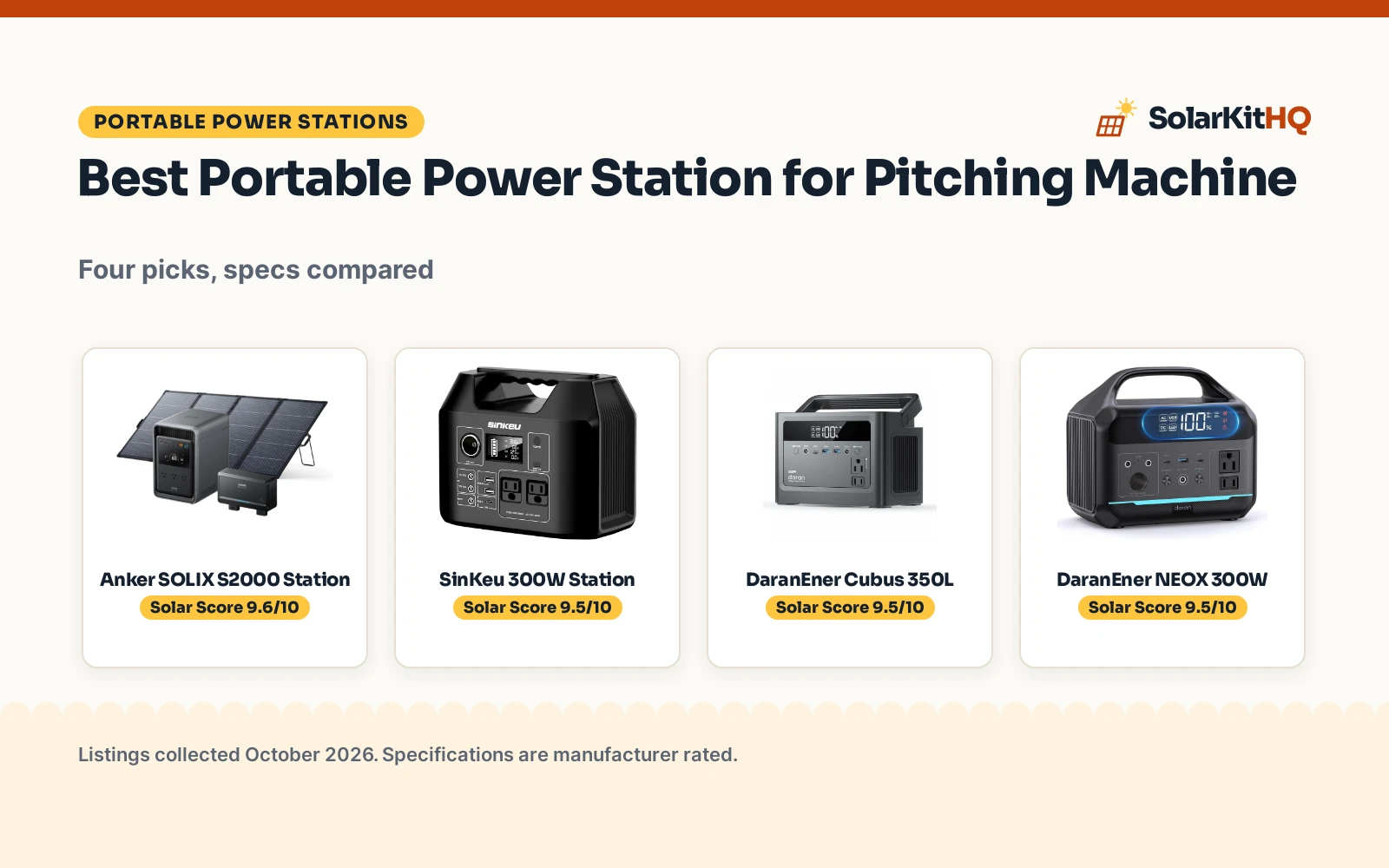
| # | Product | Solar Score | Buy |
|---|---|---|---|
| 1 | Anker SOLIX S2000 Station | 9.6/10 | Buy on Amazon |
| 2 | SinKeu 300W Station | 9.5/10 | Buy on Amazon |
| 3 | DaranEner Cubus 350L | 9.5/10 | Buy on Amazon |
| 4 | DaranEner NEOX 300W | 9.5/10 | Buy on Amazon |

Anker SOLIX S2000 Station
A 2,010Wh LiFePO4 bundle with 1,500W output, a 400W solar panel and an alternator charger in the box.
Pros
- 2,010Wh capacity with 1,500W continuous and 3,000W peak output stated
- 400W bifacial solar panel and alternator charger included
- 10,000 charge cycles stated, equal to a 15-year lifespan
- UPS switchover under 10 ms stated for home office gear
Cons
- No protection figures (BMS, certifications) are stated
- No 12V DC port is stated, only AC and other ports
- 35.7 pounds is the heaviest station here by far
- Bundle ships as separate parcels, which can arrive on different days
Detailed Review
The listing states a 2,010Wh LiFePO4 battery with 1,500W continuous and 3,000W peak output, up to 400W of solar input, a 400W bifacial solar panel and an alternator charger in the box, 8 outlets front and rear, a 6W idle power draw, 35 hours of fridge backup stated, and a UPS mode with under 10 ms switchover. The station measures 8.2 by 11.1 by 12.7 inches and weighs 35.7 pounds. Coverage is 5 years.
Who it's for: anyone who wants the most capacity and the only bundled solar panel here for long practice days. Who should skip it: buyers who need a light station to carry, or stated protection figures on the listing.
Its Solar Score of 9.6/10 comes from performance 33/35, build 22/25, value 20/25, safety 0/10 and warranty 4/5: 79 of 100 points, placed on our 9.2 to 9.8 scale.
Key Specifications
| Capacity | 2,010Wh LiFePO4 |
|---|---|
| AC output | 1,500W continuous, 3,000W peak |
| Solar | 400W panel included, 400W input |
| Weight | 35.7 lb |
Figures as published on the retailer listing, collected 21 October 2026. Performance figures are manufacturer rated.
Safety and Warranty
What this listing states. No UL, FCC or battery management statement is stated, so safety scores zero. 5 years warranty stated. It does not say everything a buyer needs, such as who pays return shipping, so warranty scores 4 of 5. See How We Pick.
Power station limits. Stay within the stated continuous output and solar input limits, keep the unit ventilated and dry, charge within the stated temperature range, and never connect it to home wiring except through equipment a licensed electrician installs.
This is general buying information, not professional advice. Follow each product manual and local rules, and see our Safety Disclaimer.

SinKeu 300W Station
A 6.5-pound station with 256Wh of LiFePO4, 300W of pure sine wave AC and 8 ports.
Pros
- 300W pure sine wave AC stated, right for small motors and chargers
- LiFePO4 battery with a stated BMS monitoring voltage, current and temperature
- 8 ports including USB-C PD, USB-A, DC 5521 and 2 AC outlets
- 5-year manufacturer coverage stated, the longest small-station term here
Cons
- Bullets state over 3,500 cycles but the tips say over 1,000 cycles; trust the headline 3,500 with caution
- 256Wh is the second smallest capacity here
- No separate surge figure is stated beyond 300W
- Solar panels and car charging need 60 to 100W panels and are not included
Detailed Review
The listing states a 256Wh (80,000mAh at 3.2V) LiFePO4 battery with 300W pure sine wave AC, 8 ports (1 DC 19V/3.42A input, 2 USB-A, 2 DC 5521, 1 USB-C PD, 2 AC), 3 recharge methods (AC in 3 hours, 60 to 100W solar in 5 hours, car outlet in 6 hours), a BMS with over 10 safety features and a built-in camping light. The bullets claim over 3,500 charge-discharge cycles while the user tips claim over 1,000 cycles; both are in the listing, so treat the higher figure with caution. Coverage is 5 years manufacturer with 30 days money back.
Who it's for: buyers who want the smallest full-featured station with a long stated warranty. Who should skip it: anyone whose pitching machine draws more than 300W, or who wants the cycle-life contradiction resolved.
Its Solar Score of 9.5/10 comes from performance 24/35, build 19/25, value 21/25, safety 5/10 and warranty 4/5: 73 of 100 points, placed on our 9.2 to 9.8 scale.
Key Specifications
| Capacity | 256Wh LiFePO4 |
|---|---|
| AC output | 300W pure sine wave |
| Ports | 8 (2 AC, USB-C PD, DC) |
| Weight | 6.5 lb |
Figures as published on the retailer listing, collected 21 October 2026. Performance figures are manufacturer rated.
Safety and Warranty
What this listing states. Advanced BMS with over 10 safety features stated, so safety scores 5 of 10. 5 years manufacturer coverage stated. It does not say everything a buyer needs, such as who pays return shipping, so warranty scores 4 of 5. See How We Pick.
Power station limits. Stay within the stated continuous output and solar input limits, keep the unit ventilated and dry, charge within the stated temperature range, and never connect it to home wiring except through equipment a licensed electrician installs.
This is general buying information, not professional advice. Follow each product manual and local rules, and see our Safety Disclaimer.

DaranEner Cubus 350L
A 288Wh LiFePO4 station with 350W pure sine wave AC, 700W surge and a built-in MPPT controller.
Pros
- 350W pure sine wave AC with a 700W surge figure stated
- Over 3,500 cycles to 80% capacity stated for the LiFePO4 cells
- Built-in MPPT controller with 0 to 80% charge in 3.2 hours stated
- 45W USB-C PD plus 18W USB-A QC ports stated
Cons
- Heading says 6 ports but the bullet list counts 7; trust the list of 7
- Solar panels are not included
- Spec table lists 7.2 pounds while bullets say 7.17 pounds; trust the bullets
- Only a 12-month warranty is stated
Detailed Review
The listing states a 288Wh LiFePO4 battery with 350W pure sine wave AC (700W surge), over 3,500 cycles to 80% capacity, a smart BMS against overcharging, overheating and short circuits, a built-in MPPT controller, 0 to 80% charging in 3.2 hours under optimal conditions, 2 AC outlets, 45W USB-C PD, 2 18W USB-A ports and 2 DC5521 ports. The '6 port' heading conflicts with the 7 ports the bullets actually list, so trust the list; the bullet weight of 7.17 pounds beats the spec table's 7.2 pounds. Coverage is 12 months.
Who it's for: buyers who want the clearest surge figure and MPPT solar charging here. Who should skip it: anyone who needs more than 350W continuous, or a longer stated warranty.
Its Solar Score of 9.5/10 comes from performance 28/35, build 20/25, value 20/25, safety 5/10 and warranty 3/5: 76 of 100 points, placed on our 9.2 to 9.8 scale.
Key Specifications
| Capacity | 288Wh LiFePO4 |
|---|---|
| AC output | 350W pure sine wave, 700W surge |
| Cycles | 3,500+ to 80% capacity |
| Weight | 7.17 lb |
Figures as published on the retailer listing, collected 21 October 2026. Performance figures are manufacturer rated.
Safety and Warranty
What this listing states. Smart BMS protection against overcharging, overheating and short circuits stated, so safety scores 5 of 10. 12-month warranty stated. It does not say everything a buyer needs, such as who pays return shipping, so warranty scores 3 of 5. See How We Pick.
Power station limits. Stay within the stated continuous output and solar input limits, keep the unit ventilated and dry, charge within the stated temperature range, and never connect it to home wiring except through equipment a licensed electrician installs.
This is general buying information, not professional advice. Follow each product manual and local rules, and see our Safety Disclaimer.

DaranEner NEOX 300W
A 5.84-pound station with 192Wh of LiFePO4, 300W AC and 60W USB-C PD fast charging.
Pros
- 5.84 pounds, the lightest station here
- 192Wh LiFePO4 with 300W continuous output stated
- 60W USB-C PD and 30W USB-C fast charging stated
- Smart BMS with overcharge, over-discharge, over-current, short-circuit and temperature protection
Cons
- 192Wh is the smallest capacity here
- Title states 8 ports but the spec table states 2 outlets; trust the title and bullets
- No surge figure is stated beyond 300W
- Solar panel is sold separately
Detailed Review
The listing states a 192Wh LiFePO4 battery with 300W continuous output, 2 300W AC outlets, a 120W 12V car socket, 2 DC5521 ports, 18W USB-A, 30W USB-C and 60W USB-C PD, 3 recharge methods (wall, car, solar panel sold separately) and a smart BMS with overcharge, over-discharge, over-current, short-circuit and temperature protection. The title's 8 ports beats the spec table's 2 outlets, so trust the title. It measures 8.41 by 5.28 by 7.44 inches and weighs 5.84 pounds. Coverage is 1 year manufacturer.
Who it's for: anyone who carries the station to the field and wants the lightest option with fast USB-C charging. Who should skip it: buyers who need more than 192Wh or a stated surge figure.
Its Solar Score of 9.5/10 comes from performance 24/35, build 20/25, value 20/25, safety 5/10 and warranty 3/5: 72 of 100 points, placed on our 9.2 to 9.8 scale.
Key Specifications
| Capacity | 192Wh LiFePO4 |
|---|---|
| AC output | 300W continuous |
| USB-C | 60W PD, 30W fast charging |
| Weight | 5.84 lb |
Figures as published on the retailer listing, collected 21 October 2026. Performance figures are manufacturer rated.
Safety and Warranty
What this listing states. Smart BMS with overcharge, over-discharge, over-current, short-circuit and temperature protection stated, so safety scores 5 of 10. 1 Year Manufacturer warranty stated. It does not say everything a buyer needs, such as who pays return shipping, so warranty scores 3 of 5. See How We Pick.
Power station limits. Stay within the stated continuous output and solar input limits, keep the unit ventilated and dry, charge within the stated temperature range, and never connect it to home wiring except through equipment a licensed electrician installs.
This is general buying information, not professional advice. Follow each product manual and local rules, and see our Safety Disclaimer.
As an Amazon Associate I earn from qualifying purchases.
Compare the picks
| Station | Solar Score | Capacity | AC output | Surge | Outlets | Warranty | Amazon |
|---|---|---|---|---|---|---|---|
| Anker SOLIX S2000 Station | 9.6/10 | 2,010Wh | 1,500W | 3,000W | 8 | 5 years | View on Amazon |
| SinKeu 300W Station | 9.5/10 | 256Wh | 300W | 300W | 8 | 5 years | View on Amazon |
| DaranEner Cubus 350L | 9.5/10 | 288Wh | 350W | 700W | 7 listed | 1 year | View on Amazon |
| DaranEner NEOX 300W | 9.5/10 | 192Wh | 300W | 300W | 8 | 1 year | View on Amazon |
Specifications are manufacturer rated as listed, collected 21 October 2026.
How we scored them
The Solar Score weighs performance, build, value, safety and warranty. For a portable power station, safety means stated protections such as a BMS, pure sine wave output or listed certifications; three of the four state BMS protection, and the Anker bundle states no protection figures. All four state a warranty term, from 1 year to 5 years. How we pick explains the weights.
| Product | Solar Score | Perf. /35 | Build /25 | Value /25 | Safety /10 | Warranty /5 |
|---|---|---|---|---|---|---|
| Anker SOLIX S2000 Station | 9.6 | 33 | 22 | 20 | 0 | 4 |
| SinKeu 300W Station | 9.5 | 24 | 19 | 21 | 5 | 4 |
| DaranEner Cubus 350L | 9.5 | 28 | 20 | 20 | 5 | 3 |
| DaranEner NEOX 300W | 9.5 | 24 | 20 | 20 | 5 | 3 |
Scores run from 9.2 to 9.8: each product’s point total is placed on that range, so more points always means a higher score.
How to choose the best portable power station for pitching machine practice
Match the machine’s watts to the station
Pitching machines run an AC motor, so compare the machine’s rated continuous watts with the station’s continuous AC output and its startup surge with the station’s peak. The Anker states 1,500W continuous and 3,000W peak, the Cubus states 350W continuous and 700W surge, and the SinKeu and NEOX each state 300W with no separate surge figure. Keep the combined AC load within the station’s continuous rating, and check the machine’s label before you buy. For broader station options, see our best portable power station for camping.
Check capacity against the session
Capacity is the energy reserve: 2,010Wh at the top, 192Wh at the low end. The Anker bundle states 2,010Wh and a 400W solar panel in the box, the Cubus states 288Wh with a built-in MPPT controller, the SinKeu states 256Wh with 60 to 100W solar panel support, and the NEOX states 192Wh. We report the listing figures without converting between units or estimating run times.
| Station | Capacity | AC output | Surge |
|---|---|---|---|
| Anker SOLIX S2000 Station | 2,010Wh | 1,500W | 3,000W |
| DaranEner Cubus 350L | 288Wh | 350W | 700W |
| SinKeu 300W Station | 256Wh | 300W | Not stated |
| DaranEner NEOX 300W | 192Wh | 300W | Not stated |
Count the outlets
The machine takes one AC outlet, and you may want another for a phone or speaker. The Anker states 8 outlets, the SinKeu states 8 ports, and the NEOX title states 8 ports (the spec table says 2 outlets; trust the title). The Cubus heading says 6 ports while its bullet list counts 7, so trust the list. The Anker notes it has no 12V DC port, so check the port list against your gear.
Plan the recharge between sessions
All four recharge from a wall outlet. The SinKeu adds car-outlet charging in 6 hours and 60 to 100W solar panels in 5 hours, the Cubus states 0 to 80% in 3.2 hours under optimal conditions, and the Anker bundle adds an alternator charger and a 400W solar panel in the box. For off-grid thinking beyond the field, see our best portable power station for off grid living.
Sizing Notes
- Match the machine’s continuous watts to the station’s continuous AC output: 1,500W at the top, 300W at the low end.
- Check the surge rating against the machine’s startup draw: 3,000W peak on the Anker, 700W surge on the Cubus, no surge figure on the other two.
- Count capacity in watt-hours against the length of the session: 2,010Wh at the top, 192Wh at the low end.
- Keep the combined AC load within the station’s rating; the Anker, SinKeu and NEOX each state 8 outlets or ports.
- Recharge between sessions: wall outlet on all four, solar input up to 400W stated on the Anker, alternator charger in the Anker box.
Frequently Asked Questions
Which station states the most capacity?
The Anker SOLIX S2000, at 2,010Wh of LiFePO4. The Cubus states 288Wh, the SinKeu states 256Wh and the NEOX states 192Wh.
Which stations state a 5-year warranty?
The Anker states 5 years, and the SinKeu states 5 years manufacturer coverage. The Cubus and NEOX each state 1 year.
Which station states UPS switchover?
The Anker states under 10 ms switchover in UPS mode for home office gear. None of the other three state a UPS figure.
Which is the lightest station?
The DaranEner NEOX at 5.84 pounds, followed by the SinKeu at 6.5 pounds and the Cubus at 7.17 pounds. The Anker is by far the heaviest at 35.7 pounds.
Can these charge from solar panels?
The Anker bundle includes a 400W solar panel and states 400W of solar input. The SinKeu works with 60 to 100W panels, and the Cubus and NEOX accept solar panels sold separately.
Which state pure sine wave AC?
The SinKeu states 300W pure sine wave and the Cubus states 350W pure sine wave. The Anker and NEOX do not state a sine wave type.
Related guides
See every Portable Power Stations guide and all Power Stations and Generators guides.
More picks: the UDPOWER S1200 (1,191Wh, 1,200W, 10 ms UPS switchover stated, 5-year term stated).