On this page
Monocrystalline vs polycrystalline solar panel is the oldest debate in solar, and the listings here settle it with numbers: the mono examples state 25% efficiency, the poly examples state 21.5 to 23.5% and 19.1%. We compared four listings, two monocrystalline and two polycrystalline, on wattage, efficiency, build and warranty, using each listing’s own figures. Verdict: monocrystalline for real power, polycrystalline for small jobs and DIY.
SolarKitHQ earns a commission when you buy through links on this page, at no extra cost to you. As an Amazon Associate I earn from qualifying purchases. Affiliate disclosure.
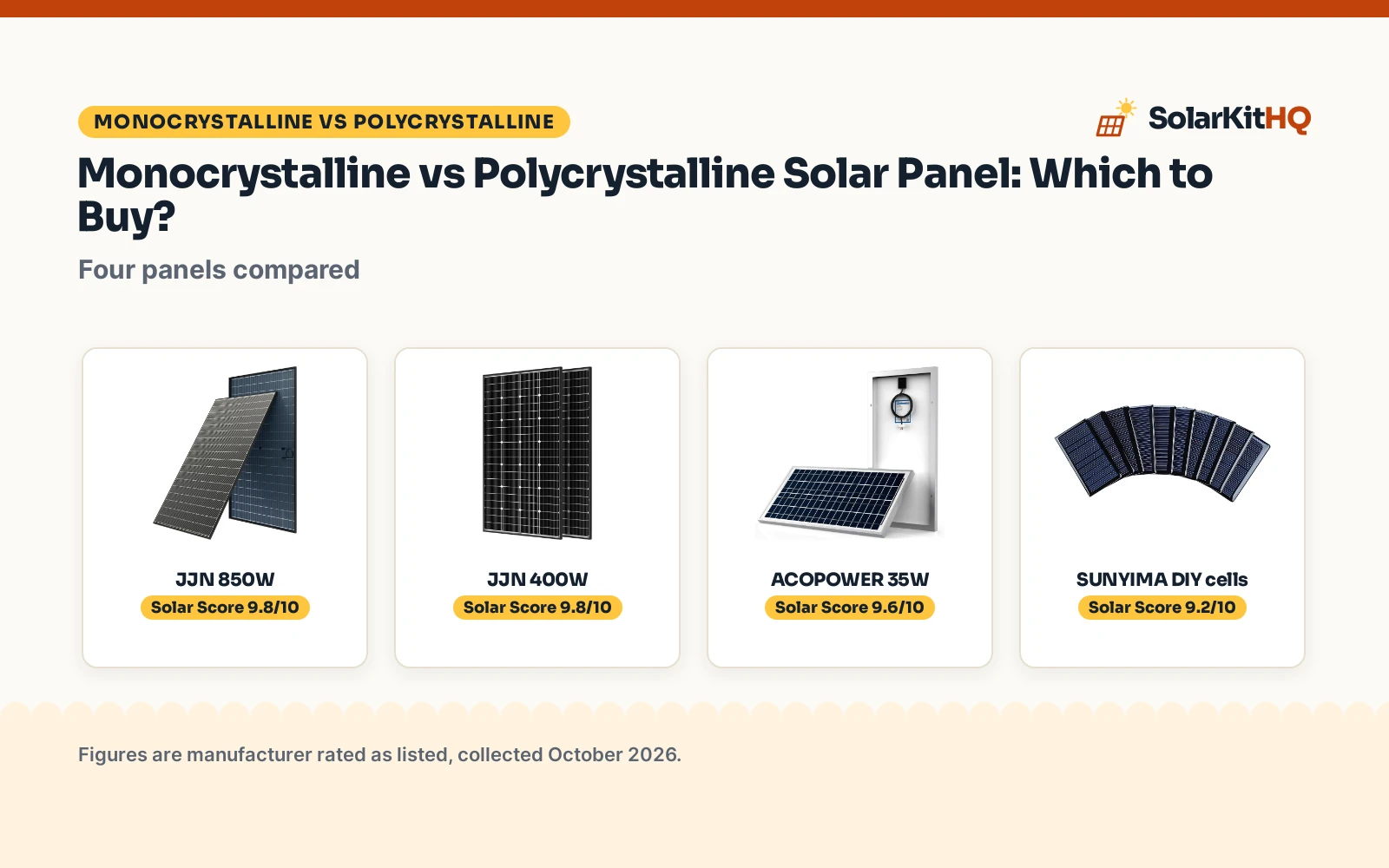
Monocrystalline vs polycrystalline solar panel: side by side
| Panel | Solar Score | Wattage | Efficiency | Build | Warranty | Amazon |
|---|---|---|---|---|---|---|
| JJN 850W | 9.8/10 | 850W | 25% | Bifacial, N-type | 30-year stated | View on Amazon |
| JJN 400W | 9.8/10 | 400W | 25% | Bifacial, N-type | 10+30-year stated | View on Amazon |
| ACOPOWER 35W | 9.6/10 | 35W | 19.1% | Poly, aluminum frame | 5+20-year stated | View on Amazon |
| SUNYIMA DIY cells | 9.2/10 | 5V 60mA | 21.5-23.5% | DIY cells | Not stated | View on Amazon |
Specifications are manufacturer rated as listed, collected 21 October 2026.
The contenders
| # | Product | Solar Score | Buy |
|---|---|---|---|
| 1 |  JJN 850W | 9.8/10 | Buy on Amazon |
| 2 |  JJN 400W | 9.8/10 | Buy on Amazon |
| 3 |  ACOPOWER 35W | 9.6/10 | Buy on Amazon |
| 4 |  SUNYIMA DIY cells | 9.2/10 | Buy on Amazon |

Pros
- 850W total at 25% efficiency stated
- UL 61730 stated
- IP65 junction, IP68 connectors
- 30-year transferable output warranty
Cons
- 94.6 pounds for the pair
- 425W each, overkill for small jobs
- Panel only, no mounting hardware
- Bifacial gain unstated
Detailed Review
The listing states two 425W bifacial monocrystalline solar panels totaling 850W, 25% high efficiency with 16BB N-type cells, UL 61730, IP65 junction box and IP68 connectors, 2400Pa wind and 5400Pa snowload ratings, pre-drilled mounting holes, and a 30-year transferable power output warranty, at 94.6 pounds and 44.7 by 1.2 by 67.8 inches per panel.
Who it's for: homes, farms and off-grid systems that need real wattage. Who should skip it: anyone who needs a lighter panel.
Its Solar Score of 9.8/10 comes from performance 34/35, build 24/25, value 22/25, safety 9/10 and warranty 5/5: 94 of 100 points, placed on our 9.2 to 9.8 scale.
Key Specifications
| Power | 850W total |
|---|---|
| Efficiency | 25% stated |
| Standard | UL 61730 |
Figures as published on the retailer listing, collected 21 October 2026. Performance figures are manufacturer rated.
Safety and Warranty
What this listing states. UL 61730, IP65 and IP68 stated, so safety scores 9 of 10. 30-year transferable output warranty stated, so warranty scores 5 of 5. See How We Pick.
Panels make voltage in daylight. Keep connectors covered until you connect them, check the panel's stated open circuit voltage and current against your controller or power station input limits, and use cables rated for the current. Roof and permanent mounts belong to a qualified installer.
This is general buying information, not professional advice. Follow each product manual and local rules, and see our Safety Disclaimer.

JJN 400W
Two 200W bifacial mono panels with 25% efficiency and strong warranties.
Pros
- 400W total at 25% efficiency stated
- 16BB N-type cells stated
- IP67 connectors, IP65 junction box
- 10-year workmanship warranty stated
Cons
- 46.3 pounds for the box
- Bifacial gain unstated
- Panel only, no mounting hardware
- Two-panel minimum buy
Detailed Review
The listing states two 200W bifacial monocrystalline solar panels totaling 400W, 25% high efficiency with 16BB N-type cells, transparent backsheet, IP67 solar connectors and IP65 junction box, 2400Pa wind and 5400Pa snowload ratings, 24.3 pounds per panel, a 10-year workmanship warranty and over 88.9% output warranty at 30 years.
Who it's for: RVs, boats and small off-grid systems at 24.3 pounds per panel. Who should skip it: anyone who needs just one panel.
Its Solar Score of 9.8/10 comes from performance 32/35, build 22/25, value 22/25, safety 9/10 and warranty 5/5: 90 of 100 points, placed on our 9.2 to 9.8 scale.
Key Specifications
| Power | 400W total |
|---|---|
| Efficiency | 25% stated |
| Cells | 16BB N-type |
Figures as published on the retailer listing, collected 21 October 2026. Performance figures are manufacturer rated.
Safety and Warranty
What this listing states. IP67 connectors, IP65 junction box stated, so safety scores 9 of 10. 10-year workmanship, 30-year output warranty stated, so warranty scores 5 of 5. See How We Pick.
Panels make voltage in daylight. Keep connectors covered until you connect them, check the panel's stated open circuit voltage and current against your controller or power station input limits, and use cables rated for the current. Roof and permanent mounts belong to a qualified installer.
This is general buying information, not professional advice. Follow each product manual and local rules, and see our Safety Disclaimer.

Pros
- 35W at 19.1% efficiency stated
- -40 to 176 F temperature range stated
- 2400Pa wind, 5400Pa snowload stated
- 5-year plus 20-year warranty stated
Cons
- 3.3 pounds but only 35W
- Weight row states 4.0 lb too
- Single small panel only
- No bifacial construction
Detailed Review
The listing states a 35W 12V polycrystalline solar panel at 19.1% conversion efficiency, anodized aluminum frame with 3.2mm coated glass, -40 to 176 F temperature range, 2400Pa wind and 5400Pa snowload ratings, pre-drilled holes, 28.7 by 14.2 by 1 inches, a 5-year workshop warranty, a 20-year output warranty and lifetime technical support. The weight row states 4.0 pounds while the item weight states 3.3; we trusted the item weight.
Who it's for: battery maintenance, gate openers and monitoring at 12V. Who should skip it: anyone who needs more than 35W.
Its Solar Score of 9.6/10 comes from performance 26/35, build 20/25, value 20/25, safety 7/10 and warranty 5/5: 78 of 100 points, placed on our 9.2 to 9.8 scale.
Key Specifications
| Power | 35W 12V |
|---|---|
| Efficiency | 19.1% stated |
| Warranty | 5+20-year |
Figures as published on the retailer listing, collected 21 October 2026. Performance figures are manufacturer rated.
Safety and Warranty
What this listing states. 2400Pa wind, 5400Pa snowload, -40 to 176 F stated, so safety scores 7 of 10. 5-year workshop, 20-year output warranty stated, so warranty scores 5 of 5. See How We Pick.
Panels make voltage in daylight. Keep connectors covered until you connect them, check the panel's stated open circuit voltage and current against your controller or power station input limits, and use cables rated for the current. Roof and permanent mounts belong to a qualified installer.
This is general buying information, not professional advice. Follow each product manual and local rules, and see our Safety Disclaimer.

Pros
- 10 cells for DIY projects
- 21.5-23.5% conversion claimed
- 5V 60mA, simple to wire
- 3.2 ounces, pocket size
Cons
- No warranty term is stated
- No water protection stated
- 0.15W max in spec table
- Not a real power panel
Detailed Review
The listing states ten polycrystalline DIY solar cells at 5V 60mA and 2.67 by 1.45 inches, 21.5 to 23.5% conversion claimed, epoxy construction, for toys, models, displays and string lights, at 3.2 ounces. The spec table lists 0.15W max power against 3W in another row; we trusted the 5V 60mA figure. No warranty term is stated.
Who it's for: hobbyists building solar toys and displays. Who should skip it: anyone who needs to charge a battery.
Its Solar Score of 9.2/10 comes from performance 19/35, build 15/25, value 18/25, safety 0/10 and warranty 0/5: 52 of 100 points, placed on our 9.2 to 9.8 scale.
Key Specifications
| Output | 5V 60mA |
|---|---|
| Cells | 10 DIY |
| Size | 2.67x1.45 in |
Figures as published on the retailer listing, collected 21 October 2026. Performance figures are manufacturer rated.
Safety and Warranty
What this listing states. No UL, TÜV or IEC listing and no weather rating is stated, so safety scores zero. No warranty term, so warranty scores zero. See How We Pick.
Panels make voltage in daylight. Keep connectors covered until you connect them, check the panel's stated open circuit voltage and current against your controller or power station input limits, and use cables rated for the current. Roof and permanent mounts belong to a qualified installer.
This is general buying information, not professional advice. Follow each product manual and local rules, and see our Safety Disclaimer.
As an Amazon Associate I earn from qualifying purchases.
How we scored them
The Solar Score weighs performance, build, value, safety and warranty. For panels, safety means stated standards and weather ratings; three of the four listings state some. Three of the four state a warranty term. How we pick explains the weights.
| Product | Solar Score | Perf. /35 | Build /25 | Value /25 | Safety /10 | Warranty /5 |
|---|---|---|---|---|---|---|
| JJN 850W | 9.8 | 34 | 24 | 22 | 9 | 5 |
| JJN 400W | 9.8 | 32 | 22 | 22 | 9 | 5 |
| ACOPOWER 35W | 9.6 | 26 | 20 | 20 | 7 | 5 |
| SUNYIMA DIY cells | 9.2 | 19 | 15 | 18 | 0 | 0 |
Scores run from 9.2 to 9.8: each product’s point total is placed on that range, so more points always means a higher score.
How to choose: monocrystalline vs polycrystalline solar panel
Efficiency: the stated gap
Both mono examples state 25% efficiency with 16BB N-type cells. The SUNYIMA poly cells claim 21.5 to 23.5% conversion, and the ACOPOWER poly panel states 19.1%. This is the one spec where both sides state the figure clearly, and it favors the mono side. But note the size mismatch: the mono examples are 200W and 425W panels, while the poly examples are 5V 60mA cells and a 35W panel, so efficiency is not the whole story. For panel kits, see our Renogy vs DOKIO solar panel kit comparison guide.
Wattage and use cases
The JJN 850W example is two 425W bifacial panels for homes, farms and RVs. The JJN 400W example is two 200W bifacial panels at 24.3 pounds each. The ACOPOWER example is a 35W 12V panel for battery maintenance, gate openers and monitoring. The SUNYIMA example is ten tiny DIY cells for toys and displays. The poly side wins on small jobs because that is where its examples live; the mono side wins on real power for the same reason.
Bifacial vs single-sided
Both mono examples are bifacial with transparent backsheets, generating from front and back. Neither poly example states bifacial construction. Do not call this a side-wide win: the listings only show what their makers chose to build.
Warranties
The JJN 850W example states a 30-year transferable output warranty. The JJN 400W example states a 10-year workmanship warranty with over 88.9% output at 30 years. The ACOPOWER example states a 5-year workshop warranty, a 20-year output warranty and lifetime technical support. The SUNYIMA example states no warranty term. Warranty strength favors the mono examples here.
Who should choose which?
Choose monocrystalline when the job is real power: the JJN 400W suits RVs and boats at 24.3 pounds per panel, and the JJN 850W suits homes and farms at 94.6 pounds for the pair. Choose polycrystalline when the job is small: the ACOPOWER 35W maintains 12V batteries and runs gate openers, and the SUNYIMA cells are for DIY toys and displays. Size, not ideology, decides this one.
Frequently Asked Questions
Which side states higher efficiency?
The mono side: both JJN examples state 25%. The poly examples state 21.5 to 23.5% and 19.1%.
Which panels here are bifacial?
The JJN 400W and 850W examples with transparent backsheets. Neither poly example states bifacial construction.
Which suits a DIY toy project?
The SUNYIMA 5V 60mA cells. They are sold for models, toys and displays.
Which states the longest warranty?
The JJN 850W example at 30 years transferable. The ACOPOWER states 5 years plus 20 years output, and the JJN 400W states 10 years plus 30-year output.
Which handles extreme temperatures?
The ACOPOWER example states -40 to 176 F and 2400Pa wind with 5400Pa snowload. The mono examples state 2400Pa wind and 5400Pa snowload.
Related guides
See every Solar Panels and Kits guide.
More guides: Renogy vs DOKIO solar panel kit comparison, solar panel wattage comparison and best flexible solar panels for van roof.