On this page
The short answer on solar power bank vs power bank: a solar power bank pairs a large battery with solar panels so it can recharge away from the grid and run appliances, while a USB power bank is a pocket-size recharge for phones and laptops. Pick the solar side if you want to back up a home, an RV or a campsite over multiple days; pick the power bank side if you travel light and your heaviest load is a laptop. We compared the 2 Jackery solar generators and the 2 Anker USB power banks on what each listing states: capacity, output, ports, recharge options and warranty. The solar pair wins on output and recharge paths; the power bank pair wins on weight and portability, and every figure below comes from the listings.
SolarKitHQ earns a commission when you buy through links on this page, at no extra cost to you. As an Amazon Associate I earn from qualifying purchases. Affiliate disclosure.
Solar power bank vs power bank: side by side
| Solar Power Bank vs Power Bank | Jackery HomePower 3000 | Jackery HomePower 3600 Plus | Anker 25,000mAh 165W | Anker 20,000mAh 87W | Amazon |
|---|---|---|---|---|---|
| Side | Solar power bank | Solar power bank | Power bank | Power bank | |
| Capacity | 3072Wh | 3584Wh | 25,000mAh | 20,000mAh | |
| Output | 3600W AC | 3600W AC | 165W USB | 87W USB | |
| Recharge | Solar, AC, car, gas | Solar, AC, car, gas | USB-C | USB-C | |
| Weight | 59.5 lb | 77.2 lb | 300 g | 15.5 oz | |
| Warranty | 5 years | 5 years | 18 months | 18 months |
Specifications are manufacturer rated as listed, collected 21 October 2026.
Capacity and output
This is the clearest gap. The Jackery HomePower 3000 states 3072Wh with 3600W AC output and 7200W surge, and the HomePower 3600 Plus states 3584Wh with 3600W AC output and 7200W in parallel. The Anker 25,000mAh states 165W total output with 100W max per USB-C port, and the Anker 20,000mAh states 87W max with 65W max to a single device. The Jackery listings name AC outlets for appliances; the Anker listings name USB ports for phones, tablets and laptops.
Recharging
The solar side recharges from more than the wall. The HomePower 3000 lists 2x200W SolarSaga panels, a 1.7-hour hybrid AC and DC recharge, a 2.2-hour AC recharge, 80% in 9 hours on solar, plus 12V car charger and gas generator charging. The HomePower 3600 Plus lists a 2-hour 0 to 100% hybrid AC and DC recharge, 2.5 hours on AC, 4 hours on solar and 2.5 hours on a gas generator. The Anker side recharges by cable only: the 25,000mAh lists 100% in 110 minutes with a 100W or higher charger, and the 20,000mAh lists 1.5 hours with a 65W charger. Neither Anker listing states solar input.
Size and portability
The power bank side wins on weight by a wide margin. The Jackery HomePower 3000 is listed at 59.5 pounds and 16 by 13 by 20 inches, and the HomePower 3600 Plus at 77.2 pounds and 15.2 by 12.2 by 19.3 inches, with wheels and a telescopic handle on the 3600 Plus. The Anker 25,000mAh is listed at 300 grams and 6.18 by 2.12 by 1.93 inches, and the Anker 20,000mAh at 15.5 ounces and 6.2 by 2.89 by 1.02 inches, with built-in USB-C cables on both. One side is luggage; the other side is a jacket pocket.
What the listings leave unclear
The HomePower 3000 spec table lists 30 amp_hours of battery capacity next to the 3072Wh title figure, and lists 1 for the number of ports next to the AC, USB-C, USB-A and DC ports in the bullets; trust the title and bullets on both. The Anker 25,000mAh spec table lists 5 volts and 5 amps next to the 165W and 100W title figures; trust the title and bullets. The Anker 20,000mAh spec table lists both a lithium polymer cell type and 1 lithium metal battery required, which do not match; the lithium polymer cell type line fits the rest of the listing. None of the 4 states IP weather protection.
Four examples
| # | Product | Solar Score | Buy |
|---|---|---|---|
| 1 |  Jackery HomePower 3000 | 9.7/10 | Buy on Amazon |
| 2 |  Jackery HomePower 3600 Plus | 9.7/10 | Buy on Amazon |
| 3 |  Anker 25,000mAh 165W | 9.6/10 | Buy on Amazon |
| 4 |  Anker 20,000mAh 87W | 9.5/10 | Buy on Amazon |

Jackery HomePower 3000
A 3072Wh solar generator with 3600W AC output, a UL-certified UPS and 2x200W panels, backed by a 5-year warranty.
Pros
- 3600W AC output with 7200W surge stated
- UL-certified UPS switches in 20ms or less
- 2x200W SolarSaga panels included with the unit
- 4,000 cycles retaining 70% capacity stated
Cons
- 59.5 pounds, the second heaviest unit here
- Spec table lists 30 amp_hours and 1 port, against the title and bullets
- Solar panels ship separately from the unit
- 16 by 13 by 20 inches, not a carry-on size
Detailed Review
The listing states a 3072Wh LiFePO4 solar generator with 3600W AC output and 7200W surge, bundled with 2x200W SolarSaga panels. It lists a UL-certified UPS that switches in 20ms or less, dual 100W PD USB-C ports, a TT-30 RV port, 4,000 cycles while retaining 70% capacity, and a 5-year manufacturer warranty. Recharge is listed as 1.7 hours via hybrid AC and DC, 2.2 hours via AC, 80% in 9 hours on solar, plus 12V car charger and gas generator charging. The spec table lists 30 amp_hours of battery capacity and 1 port, which do not match the 3072Wh title figure or the AC, USB-C, USB-A and DC ports in the bullets; trust the title and bullets. The panels ship separately from the unit.
Who it's for: homeowners and RVers who want solar-paired backup with a fast UPS for sensitive loads. Who should skip it: anyone who needs a unit light enough to carry by hand at 59.5 pounds.
Its Solar Score of 9.7/10 comes from performance 32/35, build 22/25, value 20/25, safety 8/10 and warranty 3/5: 85 of 100 points, placed on our 9.2 to 9.8 scale.
Key Specifications
| Capacity | 3072Wh, LFP |
|---|---|
| Output | 3600W AC, 7200W surge |
| Recharge | 1.7h hybrid, 80% in 9h solar |
| Size | 16 x 13 x 20 in, 59.5 lb |
Figures as published on the retailer listing, collected 21 October 2026. Performance figures are manufacturer rated.
Safety and Warranty
What this listing states. UL-certified UPS with 20ms or less switchover stated, so safety scores 8 of 10. 5-year manufacturer warranty stated. It does not say everything a buyer needs, such as who pays return shipping, so warranty scores 3 of 5. See How We Pick.
Battery safety. Charge with a charger and settings that match the stated chemistry, fuse the positive lead as the manual directs, cover terminals, keep within the stated temperature range, and never charge a damaged battery.
This is general buying information, not professional advice. Follow each product manual and local rules, and see our Safety Disclaimer.

Jackery HomePower 3600 Plus
A 3584Wh solar generator expandable to 21kWh per unit, with 6000 cycles, a 10-year lifespan and a 5-year warranty.
Pros
- 3584Wh expandable to 21kWh per unit, 43kWh with multiple units
- 6,000 cycles with a 10-year lifespan stated
- 0 to 100% in 2 hours via hybrid AC and DC
- Wheels and a telescopic handle for moving it
Cons
- 77.2 pounds, the heaviest unit here
- 7200W and 240V figures need the parallel setup
- Panels ship separately from the unit
- No UPS figure is stated, unlike the HomePower 3000
Detailed Review
The listing states a 3584Wh LiFePO4 solar generator with 3600W AC output, 7200W in parallel, dual 120V and 240V output in parallel, and expansion to 21kWh per unit or 43kWh with multiple units. It lists 6,000 cycles, a 10-year lifespan, high-temp resistant ceramic membrane battery cells associated with 302F heat resistance, 77.2 pounds at 15.2 by 12.2 by 19.3 inches, wheels and a telescopic handle, 4 outlets and 9 ports. Recharge is listed as 0 to 100% in 2 hours via hybrid AC and DC, 2.5 hours on AC, 4 hours on solar and 2.5 hours on a gas generator, with a 5-year manufacturer warranty. The 7200W and 240V figures apply to the parallel setup, not the single unit.
Who it's for: buyers planning multi-day outages who want expansion headroom and the longest stated cycle count here. Who should skip it: anyone who needs stated UPS switchover speed or a lighter single unit.
Its Solar Score of 9.7/10 comes from performance 33/35, build 22/25, value 20/25, safety 6/10 and warranty 3/5: 84 of 100 points, placed on our 9.2 to 9.8 scale.
Key Specifications
| Capacity | 3584Wh, expandable to 21kWh |
|---|---|
| Output | 3600W AC, 120V and 240V in parallel |
| Recharge | 0-100% in 2h hybrid, 4h solar |
| Size | 15.2 x 12.2 x 19.3 in, 77.2 lb |
Figures as published on the retailer listing, collected 21 October 2026. Performance figures are manufacturer rated.
Safety and Warranty
What this listing states. High-temp resistant ceramic membrane battery cells, 302F heat resistance stated, so safety scores 6 of 10. 5-year manufacturer warranty stated. It does not say everything a buyer needs, such as who pays return shipping, so warranty scores 3 of 5. See How We Pick.
Battery safety. Charge with a charger and settings that match the stated chemistry, fuse the positive lead as the manual directs, cover terminals, keep within the stated temperature range, and never charge a damaged battery.
This is general buying information, not professional advice. Follow each product manual and local rules, and see our Safety Disclaimer.
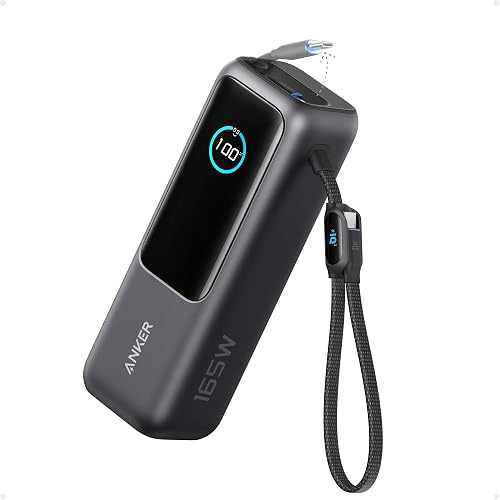
Anker 25,000mAh 165W
A 25,000mAh power bank with 165W total output, 100W per USB-C port and dual built-in cables.
Pros
- 165W total output with 100W max per USB-C port
- Charges 4 devices at once, cables included
- 100Wh airline compliance stated, flight-ready
- Dual built-in USB-C cables, one retractable to 2.3 ft
Cons
- No AC outlet, so no appliance loads
- No solar input is stated
- Spec table lists 5 volts and 5 amps, against the 165W title figures
- 300 grams with no per-cell breakdown stated
Detailed Review
The listing states a 25,000mAh power bank with 165W total output, 3 USB-C ports at 100W max each, and dual built-in USB-C cables, one extendable to 2.3 ft with 20,000 retractions and one at 0.98 ft that doubles as a carrying strap. It charges 4 devices at once, complies with 100Wh airline restrictions, and weighs 300 grams at 6.18 by 2.12 by 1.93 inches. Recharge is listed as 100% in 110 minutes with a 100W or higher charger, and the warranty is 18 months. The spec table lists 5 volts and 5 amps, which do not match the 165W and 100W figures in the title and bullets; trust the title and bullets.
Who it's for: laptop travelers who want 100W USB-C charging for phones, tablets and drones without a separate brick. Who should skip it: anyone who needs AC outlets or solar recharging.
Its Solar Score of 9.6/10 comes from performance 29/35, build 21/25, value 21/25, safety 3/10 and warranty 1/5: 75 of 100 points, placed on our 9.2 to 9.8 scale.
Key Specifications
| Capacity | 25,000mAh |
|---|---|
| Output | 165W total, 100W max per USB-C |
| Recharge | 100% in 110 min with 100W+ charger |
| Size | 6.18 x 2.12 x 1.93 in, 300 g |
Figures as published on the retailer listing, collected 21 October 2026. Performance figures are manufacturer rated.
Safety and Warranty
What this listing states. ANATEL certification code 04185-25-16934 stated, 100Wh airline compliance stated, so safety scores 3 of 10. 18-month warranty stated. It does not say everything a buyer needs, such as who pays return shipping, so warranty scores 1 of 5. See How We Pick.
Battery safety. Charge with a charger and settings that match the stated chemistry, fuse the positive lead as the manual directs, cover terminals, keep within the stated temperature range, and never charge a damaged battery.
This is general buying information, not professional advice. Follow each product manual and local rules, and see our Safety Disclaimer.

Anker 20,000mAh 87W
A 20,000mAh power bank with 87W max output, a built-in USB-C cable and an 18-month warranty.
Pros
- 87W max across 3 devices, 65W max to a single device
- Built-in USB-C cable rated for 10,000 bends
- Recharges in 1.5 hours with a 65W charger
- 15.5 ounces, approved for airline travel
Cons
- No AC outlet, so no appliance loads
- No solar input is stated
- Spec table lists both lithium polymer and lithium metal cells
- 65W single-device max, below the 100W laptop tier
Detailed Review
The listing states a 20,000mAh power bank with 87W max shared across 3 devices and 65W max to a single device, a built-in USB-C cable rated for 10,000 bends, and 15.5 ounces at 6.2 by 2.89 by 1.02 inches. It lists a 14-inch MacBook Pro to 50% in under 40 minutes, an iPhone 15 Pro to 58% in 30 minutes, a 1.5-hour recharge with a 65W charger, and an 18-month warranty. The spec table lists both a lithium polymer battery cell type and 1 lithium metal battery required, which do not match; the lithium polymer cell type line fits the rest of the listing.
Who it's for: travelers who want a lighter bank for phones, tablets and a Switch with a cable always attached. Who should skip it: buyers who need 100W laptop charging, which the 65W single-device max cannot deliver.
Its Solar Score of 9.5/10 comes from performance 28/35, build 21/25, value 21/25, safety 3/10 and warranty 1/5: 74 of 100 points, placed on our 9.2 to 9.8 scale.
Key Specifications
| Capacity | 20,000mAh |
|---|---|
| Output | 87W max, 65W max single |
| Recharge | 1.5h with 65W charger |
| Size | 6.2 x 2.89 x 1.02 in, 15.5 oz |
Figures as published on the retailer listing, collected 21 October 2026. Performance figures are manufacturer rated.
Safety and Warranty
What this listing states. ANATEL certification code 02386-25-16934 stated, so safety scores 3 of 10. 18-month warranty stated. It does not say everything a buyer needs, such as who pays return shipping, so warranty scores 1 of 5. See How We Pick.
Battery safety. Charge with a charger and settings that match the stated chemistry, fuse the positive lead as the manual directs, cover terminals, keep within the stated temperature range, and never charge a damaged battery.
This is general buying information, not professional advice. Follow each product manual and local rules, and see our Safety Disclaimer.
As an Amazon Associate I earn from qualifying purchases.
How we scored them
The Solar Score weighs performance, build, value, safety and warranty. For these units, safety means the protections and certifications the listing names: the UL-certified UPS on the Jackery HomePower 3000, the ceramic membrane cells on the 3600 Plus, and the ANATEL certification codes on the 2 Anker banks. All 4 state a warranty term, 5 years on the Jackery pair and 18 months on the Anker pair. How we pick explains the weights.
| Product | Solar Score | Perf. /35 | Build /25 | Value /25 | Safety /10 | Warranty /5 |
|---|---|---|---|---|---|---|
| Jackery HomePower 3000 | 9.7 | 32 | 22 | 20 | 8 | 3 |
| Jackery HomePower 3600 Plus | 9.7 | 33 | 22 | 20 | 6 | 3 |
| Anker 25,000mAh 165W | 9.6 | 29 | 21 | 21 | 3 | 1 |
| Anker 20,000mAh 87W | 9.5 | 28 | 21 | 21 | 3 | 1 |
Scores run from 9.2 to 9.8: each product’s point total is placed on that range, so more points always means a higher score.
Solar power bank vs power bank: which should you choose?
Choose a solar power bank if the load list includes anything with a plug: a fridge, a fan, a WiFi router, power tools. The Jackery HomePower 3000 suits home backup with its UL-certified UPS at 20ms or less, and the HomePower 3600 Plus suits longer outages with 3584Wh expandable to 21kWh per unit. Choose a USB power bank if the load list is USB only: the Anker 25,000mAh suits laptop travelers with 165W total and 100W per port, and the Anker 20,000mAh suits lighter kits with 87W max. For camp setups that mix both, see our best portable power station for camping and our best solar power bank for camping.
| If you need | Look at |
|---|---|
| Home backup with solar | Jackery HomePower 3000, 3072Wh, 3600W AC |
| Expandable multi-day backup | Jackery HomePower 3600 Plus, expandable to 21kWh |
| Laptop charging on the move | Anker 25,000mAh, 165W total, 100W per USB-C |
| Smallest pocket option | Anker 20,000mAh, 15.5 oz, 87W max |
Sizing Notes
- Match output to the load: 3600W AC on the 2 Jackery units against appliances; 165W or 87W USB on the 2 Anker banks against phones and laptops.
- Match capacity to the outage: 3072Wh and 3584Wh against multi-day backup; 25,000mAh and 20,000mAh against pocket charging.
- Check recharge paths: solar plus hybrid AC and DC, 12V car and gas generator on the Jackery units; USB-C cable only on the Anker banks.
- Check weight and size: 59.5 and 77.2 pounds on the Jackery units; 300 grams and 15.5 ounces on the Anker banks.
- Check warranty lines before ordering: 5 years on the 2 Jackery units, 18 months on the 2 Anker banks.
Frequently Asked Questions
Can a USB power bank run a mini fridge?
Not the Anker banks here, which offer USB ports only and no AC outlet. The Jackery HomePower 3000 lists mini fridge compatibility and states it keeps a refrigerator running for 1 to 2 days.
Which side recharges from the sun?
The solar side. The HomePower 3000 pairs with 2x200W panels and states 80% in 9 hours on solar, and the HomePower 3600 Plus states 4 hours on solar. The Anker banks recharge by USB-C only.
Can I take these on a plane?
The Anker 25,000mAh states 100Wh airline compliance and is listed as flight-ready, and the Anker 20,000mAh is listed as approved for airline travel. Neither Jackery listing states airline compliance.
Which has the longest warranty?
The 2 Jackery units state a 5-year manufacturer warranty. The 2 Anker banks state an 18-month warranty.
Which unit states a UPS mode?
The Jackery HomePower 3000, with a UL-certified UPS that switches in 20ms or less. None of the other 3 state a UPS mode.
Related guides
See every Portable Power Stations guide and all Power Stations and Generators guides. Also see our best portable power station for camping. Also see our best solar power bank for camping. Also see our portable power station vs power bank. Also see our best solar power bank with crank.