On this page
A winter cabin with the furnace blower silent, the lights out, and the temperature falling outside. That is the moment the best portable power station for cold weather earns its place: a battery that runs the essentials through a freezing night without a drop of fuel. We compared 5 portable power stations from the listings, from 292Wh to 3,072Wh, including three title-only listings ranked alongside the two full ones, and scored each only on what its listing states.
SolarKitHQ earns a commission when you buy through links on this page, at no extra cost to you. As an Amazon Associate I earn from qualifying purchases. Affiliate disclosure.
Quick picks
 Best Overall Anker SOLIX F3000 Station: 3,072Wh with 3,600W output and UPS stated Check price on Amazon
 Best UPS LIBRIDS C600 Station: 640Wh with 10ms UPS stated Check price on Amazon
 Best 1000Wh Jackery Explorer 1000 v2: 1070Wh LiFePO4 stated in the title Check price on Amazon
 Best 1800W BLUETTI AC180 Station: 1152Wh with 1800W stated in the title Check price on Amazon
 Best Compact Jackery Explorer 300: 292Wh LiFePO4 stated in the title Check price on Amazon
The picks
| # | Product | Solar Score | Buy |
|---|---|---|---|
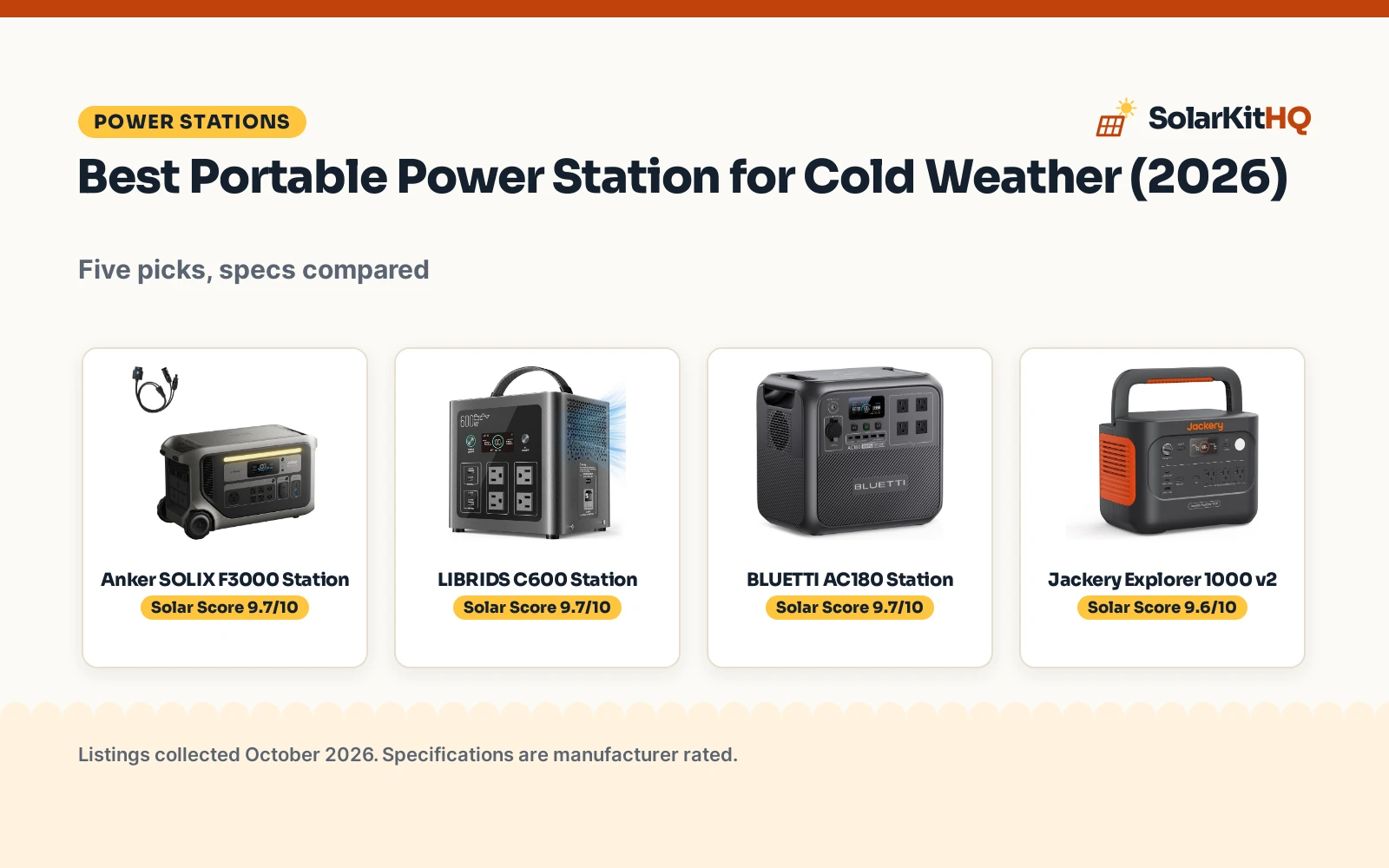
| 1 | Anker SOLIX F3000 Station | 9.7/10 | Buy on Amazon |
| 2 | LIBRIDS C600 Station | 9.7/10 | Buy on Amazon |
| 3 | BLUETTI AC180 | 9.7/10 | Buy on Amazon |
| 4 | Jackery Explorer 1000 v2 | 9.6/10 | Buy on Amazon |
| 5 | Jackery Explorer 300 | 9.5/10 | Buy on Amazon |

Anker SOLIX F3000 Station
An Anker SOLIX F3000 station with 3,072Wh LiFePO4, 3,600W output and 6,000W recharging.
Pros
- 3,072Wh capacity stated
- 3,600W output stated
- Expandable to 24kWh stated
- UPS stated
Cons
- No operating temperature is stated
- No solar panel is included in the box
- 91.5 pounds is the heaviest stated weight in the set
- Largest stated size in the set
Detailed Review
The listing states an Anker SOLIX F3000 portable power station with 3,072Wh LiFePO4 expandable to 24kWh, 3,600W output with 𝟭𝟮𝟬/𝟮𝟰𝟬𝗩, 2,400W solar recharging, solar ports at 165V or 60V, 125 hours of AC idle standby, 42 hours on a 190W fridge, and UPS, with a 5-year warranty stated. No operating temperature range is stated.
Who it's for: buyers who want the largest stated capacity with UPS for winter outages. Who should skip it: buyers who need stated cold-weather temperature limits.
Its Solar Score of 9.7/10 comes from performance 35/35, build 22/25, value 20/25, safety 5/10 and warranty 4/5: 86 of 100 points, placed on our 9.2 to 9.8 scale.
Key Specifications
| Capacity | 3,072Wh |
|---|---|
| Output | 3,600W |
| Recharge | 6,000W stated |
| Warranty | 5 Years |
Figures as published on the retailer listing, collected 20 October 2026. Performance figures are manufacturer rated.
Safety and Warranty
What this listing states. UPS with ultra-low idle power consumption stated, so safety scores 5 of 10. 5 Years. It does not say everything a buyer needs, such as who pays return shipping, so warranty scores 4 of 5. See How We Pick.
Power station limits. Stay within the stated continuous output and solar input limits, keep the unit ventilated and dry, charge within the stated temperature range, and never connect it to home wiring except through equipment a licensed electrician installs.
This is general buying information, not professional advice. Follow each product manual and local rules, and see our Safety Disclaimer.

LIBRIDS C600 Station
A LIBRIDS C600 station with 640Wh LiFePO4, 600W output, a 10ms UPS and 1.5-hour fast charging.
Pros
- 640Wh capacity stated
- 10ms UPS stated
- 1.5-hour fast charging stated
- 8 ports stated
Cons
- No operating temperature is stated
- 10-year service figure assumes normal usage conditions
- 640Wh against 3,072Wh on the Anker
- 600W limit on connected devices stated
Detailed Review
The listing states a LIBRIDS C600 portable power station with 640Wh LiFePO4, 600W AC output with 1200W surge, a 10ms UPS with pure sine wave output, 8 ports including 4 AC outlets, 1.5-hour fast charging, and recharge via AC, solar panel (XT60), car port. No operating temperature range is stated; a 5-year limited warranty backs the purchase.
Who it's for: buyers who want a stated 10ms UPS in a mid-size station. Who should skip it: buyers who need stated cold-weather temperature limits.
Its Solar Score of 9.7/10 comes from performance 30/35, build 20/25, value 21/25, safety 7/10 and warranty 4/5: 82 of 100 points, placed on our 9.2 to 9.8 scale.
Key Specifications
| Capacity | 640Wh |
|---|---|
| Output | 600W |
| UPS | 10ms |
| Warranty | 5-year limited warranty |
Figures as published on the retailer listing, collected 20 October 2026. Performance figures are manufacturer rated.
Safety and Warranty
What this listing states. 10ms UPS with pure sine wave output stated, so safety scores 7 of 10. 5-year limited warranty. It does not say everything a buyer needs, such as who pays return shipping, so warranty scores 4 of 5. See How We Pick.
Power station limits. Stay within the stated continuous output and solar input limits, keep the unit ventilated and dry, charge within the stated temperature range, and never connect it to home wiring except through equipment a licensed electrician installs.
This is general buying information, not professional advice. Follow each product manual and local rules, and see our Safety Disclaimer.

BLUETTI AC180
A 1152Wh LiFePO4 station with 1800W output, 2700W peak and a 20 ms UPS.
Pros
- 2700W peak output
- 1-hour full charge at 1440W AC
- 20 ms UPS stated
- 5-year warranty with cables included
Cons
- Outlet count conflicts: 8 in bullets vs 11 in spec table
- No expansion batteries stated
- 37.4 pounds, heavier than the Classic and S2000
- No BMS or certification stated
Detailed Review
The listing states a 1152Wh LiFePO4 station with 1800W output and 2700W peak, 0-80% in 45 minutes, a full charge in 1 hour at 1440W AC input and 2.8-3.3 hours on 500W solar. It lists a 20 ms UPS switchover, 8 outlets, 37.4 pounds, 13.39 by 9.72 by 12.48 inches and a 5-year warranty. The spec table gives 11 total power outlets against the 8 in the bullets, so trust the bullets.
Who it's for: homeowners who want 2700W peak output and a 20 ms UPS in a mid-size station. Who should skip it: anyone who wants under-10 ms UPS switchover or expansion batteries.
Its Solar Score of 9.7/10 comes from performance 30/35, build 21/25, value 21/25, safety 6/10 and warranty 4/5: 82 of 100 points, placed on our 9.2 to 9.8 scale.
Key Specifications
| Capacity | 1152Wh, LiFePO4 |
|---|---|
| Output | 1800W, 2700W peak |
| Charge | 1 hr AC, 2.8-3.3 hr solar |
| UPS | 20 ms |
Figures as published on the retailer listing, collected 20 October 2026. Performance figures are manufacturer rated.
Safety and Warranty
What this listing states. 20 ms UPS switchover stated, so safety scores 6 of 10. 5-Year Warranty stated. It does not say everything a buyer needs, such as who pays return shipping, so warranty scores 4 of 5. See How We Pick.
Power station limits. Stay within the stated continuous output and solar input limits, keep the unit ventilated and dry, charge within the stated temperature range, and never connect it to home wiring except through equipment a licensed electrician installs.
This is general buying information, not professional advice. Follow each product manual and local rules, and see our Safety Disclaimer.

Jackery Explorer 1000 v2
A 1070Wh LiFePO4 unit with 1500W AC output, a 3000W surge peak and three pure sine wave AC ports.
Pros
- 1070Wh capacity and 1500W AC output stated
- Three pure sine wave AC ports
- One hour full charge in app emergency mode, 1.7 hours by default
- Over 70% capacity after 4,000 cycles stated
Cons
- Solar charging works only with Jackery panels, per the listing
- No warranty term is stated in a readable form
- 23.8 pounds
- No safety certification is stated
Detailed Review
The listing states 1,070Wh of LFP capacity, 1,500W AC output with a 3,000W surge peak, three pure sine wave AC ports, two USB-C ports, one USB-A port, a DC car port and LED lights. It charges from 0% to 100% in one hour with emergency charging turned on in the Jackery App and defaults to 1.7 hours, keeps over 70% capacity after 4,000 cycles, and weighs 23.8 pounds. It also states the unit is compatible only with Jackery solar panels for solar charging, which narrows your panel choice.
Who it's for: campers who want a large battery for a fridge and already own or plan to buy Jackery panels. Who should skip it: anyone who wants to pair a third-party panel.
Its Solar Score of 9.6/10 comes from performance 34/35, build 24/25, value 22/25, safety 0/10 and warranty 0/5: 80 of 100 points, placed on our 9.2 to 9.8 scale.
Key Specifications
| Capacity | 1070Wh LFP |
|---|---|
| AC output | 1500W, 3000W surge |
| Weight | 23.8 lb |
| Solar | Jackery panels only |
Figures as published on the retailer listing, collected 19 October 2026. Performance figures are manufacturer rated.
Safety and Warranty
What this listing states. No UL, FCC or battery management statement is stated, so safety scores zero. No warranty term, so warranty scores zero. See How We Pick.
Power station limits. Stay within the stated continuous output and solar input limits, keep the unit ventilated and dry, charge within the stated temperature range, and never connect it to home wiring except through equipment a licensed electrician installs.
This is general buying information, not professional advice. Follow each product manual and local rules, and see our Safety Disclaimer.

Jackery Explorer 300
A 292Wh LiFePO4 unit at 7.5 pounds with two AC outlets, a 100W USB-C PD port and a 120W car port.
Pros
- 7.5 pounds, the lightest unit here
- 100W USB-C PD port
- Over 4,000 cycles to 70% capacity stated
- Maker states 80% in about 2.8 hours from a 100W panel
Cons
- Two AC outlets only
- 300W rated output
- Warranty listed only as 3+2 with no units
- Solar panel not included
Detailed Review
The listing states 292Wh of LiFePO4 capacity, 300W rated output with a 600W peak surge, two AC outlets, a 100W USB-C PD port, two USB-A ports and a 120W car port, over 4,000 cycles before reaching 70% capacity and a weight of 7.5 pounds. The maker says it reaches 80% in about 2.8 hours with a 100W panel. The spec table lists 7.1 pounds, and the warranty description reads only 3+2 without units, so we treat the term as not stated.
Who it's for: campers who carry their power station from the car to the site and charge small devices. Who should skip it: anyone who needs more than two AC outlets.
Its Solar Score of 9.5/10 comes from performance 30/35, build 22/25, value 22/25, safety 0/10 and warranty 0/5: 74 of 100 points, placed on our 9.2 to 9.8 scale.
Key Specifications
| Capacity | 292Wh LiFePO4 |
|---|---|
| AC output | 300W, 600W surge |
| Weight | 7.5 lb |
| USB-C | 100W PD |
Figures as published on the retailer listing, collected 19 October 2026. Performance figures are manufacturer rated.
Safety and Warranty
What this listing states. No UL, FCC or battery management statement is stated, so safety scores zero. No warranty term, so warranty scores zero. See How We Pick.
Power station limits. Stay within the stated continuous output and solar input limits, keep the unit ventilated and dry, charge within the stated temperature range, and never connect it to home wiring except through equipment a licensed electrician installs.
This is general buying information, not professional advice. Follow each product manual and local rules, and see our Safety Disclaimer.
As an Amazon Associate I earn from qualifying purchases.
Compare the picks
| Power Station | Solar Score | Capacity | AC output | UPS | Warranty | Amazon |
|---|---|---|---|---|---|---|
| Anker SOLIX F3000 Station | 9.7/10 | 3,072Wh | 3,600W | Stated | 5 Years | View on Amazon |
| LIBRIDS C600 Station | 9.7/10 | 640Wh | 600W | 10ms stated | 5-year limited warranty | View on Amazon |
| Jackery Explorer 1000 v2 | 9.6/10 | 1070Wh | 1500W | Not stated | Not stated | View on Amazon |
| BLUETTI AC180 Station | 9.7/10 | 1152Wh | 1800W | Not stated | Not stated | |
| Jackery Explorer 300 | 9.5/10 | 292Wh | 300W | Not stated | Not stated | View on Amazon |
Specifications are manufacturer rated as listed, collected 20 October 2026.
How we scored them
The Solar Score weighs performance, build, value, safety and warranty. For cold-weather stations, safety means a stated UPS, battery management or operating range: the LIBRIDS states a 10ms UPS with pure sine wave output, and the Anker states UPS with ultra-low idle power draw. None of the 5 listings states an operating temperature range, so no station wins on a stated cold-weather figure; compare them on stated capacity, output and recharge instead. How we pick explains the weights.
| Product | Solar Score | Perf. /35 | Build /25 | Value /25 | Safety /10 | Warranty /5 |
|---|---|---|---|---|---|---|
| Anker SOLIX F3000 Station | 9.7 | 35 | 22 | 20 | 5 | 4 |
| LIBRIDS C600 Station | 9.7 | 30 | 20 | 21 | 7 | 4 |
Scores run from 9.2 to 9.8: each product’s point total is placed on that range, so more points always means a higher score.
How to choose the best portable power station for cold weather
Match the capacity to the outage
The Anker listing states 3,072Wh expandable to 24kWh, running a 190W fridge for 42 hours and holding 125 hours of AC idle standby. The BLUETTI title states 1152Wh, the Jackery 1000 v2 title states 1070Wh, the LIBRIDS states 640Wh, and the Jackery 300 title states 292Wh. Cold nights mean heaters and blowers that drink power, so size up: the Anker’s stated 3,072Wh covers a full night of essentials, while the 292Wh Jackery suits phones and lights. A station that runs out at 3 a.m. in a cold house is worse than no station, because it lulls you into not preparing. Browse the portable power stations roundups for more capacity options.
Check the output and the UPS
The Anker title states 6,000W with 3,600W output and 𝟭𝟮𝟬/𝟮𝟰𝟬𝗩. The BLUETTI title states 1800W, the Jackery 1000 v2 title states 1500W, the LIBRIDS states 600W with 1200W surge, and the Jackery 300 title states 300W. The LIBRIDS states a 10ms UPS for routers, CPAP machines and computers, and the Anker states UPS as well. In a winter outage, a stated UPS keeps the furnace controls and medical devices running through the switchover. The LIBRIDS states 10 milliseconds, which covers computers and routers; the Anker states UPS without a figure, so assume it suits less sensitive loads until the manual says otherwise. Either way, a stated UPS is the feature that separates outage-ready stations from camping-only ones.
| Pick | Capacity | AC output | UPS stated |
|---|---|---|---|
| Anker SOLIX F3000 Station | 3,072Wh | 3,600W | Yes |
| LIBRIDS C600 Station | 640Wh | 600W | 10ms |
| Jackery Explorer 1000 v2 | 1070Wh | 1500W | Not stated |
| BLUETTI AC180 Station | 1152Wh | 1800W | Not stated |
| Jackery Explorer 300 | 292Wh | 300W | Not stated |
Ask about cold-weather figures before you buy
None of the 5 listings states an operating temperature range, a low-temperature charge cutoff or a cold-weather capacity figure, which is the gap to watch in every cold-weather station roundup. The Anker states LiFePO4 with 3000+ cycles to 80% in the RIVER 2 listing family, and the LIBRIDS states LiFePO4, but neither states how the battery behaves at freezing. Since the listings leave it unclear, check the manual for each station’s stated temperature limits before relying on it in the cold. Lithium batteries charge poorly below freezing, so a station left in an unheated garage overnight may refuse to recharge until it warms up.
Check the recharge speed and ports
The Anker title states 6,000W recharging with 1-hour fast charging and solar ports at 165V or 60V. The LIBRIDS states 1.5-hour fast charging with AC, solar panel (XT60), car charging port inputs, plus 8 ports with 4 AC outlets. The other three titles state no recharge figures. After a cold night drains the station, a stated fast recharge gets it ready for the next one.
Check the chemistry and the warranty
The Anker, LIBRIDS and both Jackery listings state LiFePO4, the longest-lived stated chemistry here. The BLUETTI title does not state a chemistry. Two of the 5 listings state a concrete warranty term: the Anker states 5 Years and the LIBRIDS states a 5-year limited warranty. LiFePO4 with a stated cycle count is the best longevity signal; the LIBRIDS and Anker state it, the others do not. The BLUETTI title states no chemistry at all, so its longevity cannot be compared on the listing.
Sizing Notes
- Match the stated capacity, 292Wh to 3,072Wh here, to the watt-hours your essentials need overnight.
- Match the stated output, 300W to 3,600W here, to your largest cold-weather load.
- Match the stated UPS, 10ms on the LIBRIDS, to devices that cannot lose power.
- Check each manual for stated temperature limits, since no listing here states them.
Frequently Asked Questions
Which of these states a UPS?
The LIBRIDS states a 10ms UPS, and the Anker states UPS. The other three listings state no UPS.
Which of these states the largest capacity?
The Anker states 3,072Wh expandable to 24kWh. The BLUETTI title states 1152Wh, the Jackery 1000 v2 states 1070Wh, the LIBRIDS states 640Wh and the Jackery 300 states 292Wh.
Do any of these state cold-weather temperature limits?
No. None of the 5 listings states an operating temperature range or low-temperature cutoff. Check each station’s manual before cold-weather use.
Which of these has the quickest stated recharge?
The Anker title states 6,000W recharging with 1-hour fast charging. The LIBRIDS states 1.5-hour fast charging. The others state no recharge figure.
Which chemistry do these use?
The Anker, LIBRIDS and both Jackery listings state LiFePO4. The BLUETTI title does not state a chemistry.
Related guides
See every Portable Power Stations guide and all Power Stations and Generators guides.
More picks: best portable power station for camping, best portable power station for home backup and best solar generator for backpacking.