On this page
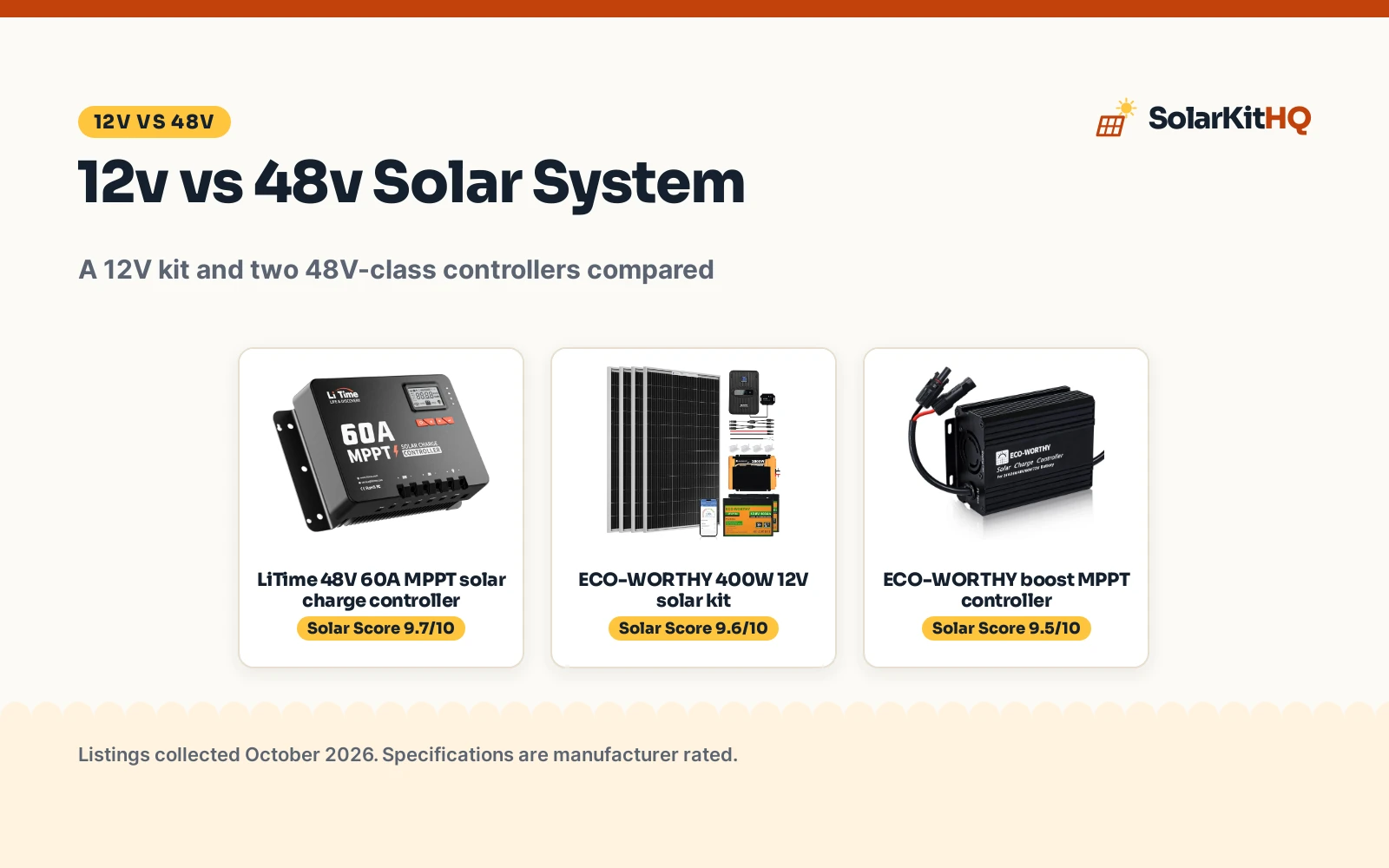
The 12v vs 48v solar system choice comes down to scale: a lower-voltage setup suits an RV, shed or cabin running modest AC loads, while a higher-voltage setup suits larger battery banks with higher panel wattage. This comparison uses the listings as concrete examples: a complete kit on the lower-voltage side against two controllers built for higher-voltage systems, scored on what each listing states about voltage range, panel input limits, protections, monitoring and warranty. Choose the ready-to-run kit for modest loads, and the controller side when the battery bank and the panel array grow.
SolarKitHQ earns a commission when you buy through links on this page, at no extra cost to you. As an Amazon Associate I earn from qualifying purchases. Affiliate disclosure.
12v vs 48v solar system: side by side
| 12v vs 48v solar system | ECO-WORTHY 400W 12V solar kit | ECO-WORTHY boost MPPT controller | LiTime 48V 60A MPPT controller | Amazon |
|---|---|---|---|---|
| Side | 12v | 48v solar system | 48v solar system | |
| What it is | Complete solar panel kit | Boost MPPT charge controller | 60A MPPT charge controller | |
| Voltage range | 12V | Charges 24/36/48/60/72V batteries | 48V, 150V max PV input | |
| Max PV input stated | 400W panels | 216W at 12V, 432W at 24V | 900W at 12V, 1800W at 24V, 2600W at 36V, 3200W at 48V | |
| Inverter or battery included | 2000W inverter, 2x12V 100Ah lithium | Not stated | Not stated | |
| Monitoring | Bluetooth 5.0 module | LED digital display | Bluetooth, LCD screen | |
| Certifications stated | None | None | CE, FCC ID, RoHS | |
| Warranty | Not stated | Not stated | 2 Years Warranty |
Specifications are manufacturer rated as listed, collected 22 October 2026.
What each side actually includes
The two sides are different kinds of products, which is the first thing to get straight. The 12V example is a complete kit: the ECO-WORTHY listing bundles 4 100W bifacial solar panels, a 40A MPPT controller, a 2000W pure sine wave inverter, 2 12V 100Ah lithium batteries and a Bluetooth 5.0 module, with an ideal daily output of 1.6KWH under 4 hours of sunlight stated. The 48V examples are charge controllers only: the ECO-WORTHY boost controller steps the voltage of 12V or 24V solar panels up to charge 24, 36, 48, 60 or 72V batteries, and the LiTime is a 48V 60A MPPT controller with a 150V max PV input. Neither controller listing includes panels or batteries, so the 48V side here describes the charging brain of a system, not the whole system.
Voltage and panel wattage
Voltage decides the wiring. The 12V kit runs at 12 volts throughout: 12V panels, a 12V 2000W inverter and 2 12V 100Ah lithium batteries. The ECO-WORTHY boost controller exists to bridge voltages: it takes 12V or 24V panel input, with max capable panel input of 216W at 12V and 432W at 24V, and charges 24, 36, 48, 60 or 72V batteries, with the note that the selected panel’s voltage should be lower than the battery voltage. The LiTime goes further up the scale: it accepts PV input within 12V at 900W, 24V at 1800W, 36V at 2600W or 48V at 3200W, with charging kept under 60A and load under 20A per its warning. Do not read this as the 48V side being better at everything: the listings on the two sides describe different products, so compare panel input limits only where both listings state them. For a smaller step up, see our 12V vs 24V solar system comparison.
Protection and monitoring
Protections are where the listings are most detailed. The ECO-WORTHY 12V kit states a built-in BMS protecting the lithium batteries, with the batteries claimed at more than 3000 deep cycles. The ECO-WORTHY boost controller states overcharge, reverse current, overheating and reverse polarity protections with an LED digital display of charging current and voltage. The LiTime states CE, FCC ID and RoHS certification plus safeguards against PV night backflow, PV reverse polarity, MPPT over-temp, battery over-voltage and battery reverse polarity, backed by a 2-year warranty and AIG product liability insurance effective May 22, 2026. On monitoring, the 12V kit includes a Bluetooth 5.0 module, the LiTime has built-in Bluetooth stated to pair reliably up to 50 feet in open space, 33 feet with wooden barriers, 16 feet with an iron leather box and 3 feet through walls, plus an LCD screen, while the boost controller has only the LED display. Note the LiTime warning: its listing rules out marine use such as boats, ships, yachts and trolling motors.
What the listings leave unclear
Each listing has figures that need care. The ECO-WORTHY 12V kit bullets claim an ideal daily output of 1.6KWH under 4 hours of sunlight and also state 400Wh per day of panel generation; the two figures differ, so compare on the 400Wh panel figure when sizing panels. The same listing claims up to 99% tracking efficiency and 98% peak conversion efficiency, then mentions 95% high conversion efficiency: three efficiency figures for one kit. Its spec table lists an amperage capacity of 3.76 A, which does not match the 40A MPPT controller in the title, so trust the title for the controller. The boost controller’s spec table gives an input voltage of 24 volts while its bullets describe boosting 12V or 24V panels, so the bullets’ range is the one to shop by. None of the ECO-WORTHY listings states a warranty term or a certification mark, while the LiTime states both.
Three examples
| # | Product | Solar Score | Buy |
|---|---|---|---|
| 1 |  LiTime 48V 60A MPPT solar charge controller | 9.7/10 | Buy on Amazon |
| 2 |  ECO-WORTHY 400W 12V solar kit | 9.6/10 | Buy on Amazon |
| 3 |  ECO-WORTHY boost MPPT controller | 9.5/10 | Buy on Amazon |

LiTime 48V 60A MPPT solar charge controller
A 48V 60A MPPT charge controller with a 150V max PV input, Bluetooth monitoring, an LCD screen and a 2-year warranty.
Pros
- 99% MPPT tracking with up to 97% peak conversion efficiency stated
- PV input within 12V at 900W through 48V at 3200W stated
- CE, FCC ID and RoHS certification stated
- 2-year warranty stated
Cons
- Listing rules out marine use such as boats and yachts
- 10 pounds, the heaviest controller here
- Charging must stay under 60A and load under 20A
- No panels or batteries included
Detailed Review
The listing states a 48V 60A MPPT solar charge controller with a 150V max PV input for LiFePO4, gel and AGM batteries, with advanced MPPT tracking of 99% and up to 97% peak conversion efficiency. It states PV input within 12V at 900W, 24V at 1800W, 36V at 2600W or 48V at 3200W, and warns to keep charging under 60A and load under 20A. Monitoring comes from built-in Bluetooth, stated to pair reliably up to 50 feet in open space, 33 feet with wooden barriers, 16 feet with an iron leather box and 3 feet through walls, plus an LCD screen with LED indicators. The box measures 12.13 by 4.04 by 8.27 inches at 10 pounds. The listing states CE, FCC ID and RoHS certification, safeguards against PV night backflow, PV reverse polarity, MPPT over-temp, battery over-voltage and battery reverse polarity, a 2-year warranty and AIG product liability insurance effective May 22, 2026.
Who it's for: builders of 48V-class systems who want the highest stated PV input limits here with certifications and a warranty. Who should skip it: anyone who needs panels or batteries in the box, or marine use.
Its Solar Score of 9.7/10 comes from performance 30/35, build 21/25, value 20/25, safety 8/10 and warranty 2/5: 81 of 100 points, placed on our 9.2 to 9.8 scale.
Key Specifications
| Type | 48V 60A MPPT |
|---|---|
| Max PV input | 150V |
| PV limits | 12V@900W, 24V@1800W, 36V@2600W, 48V@3200W |
| Monitoring | Bluetooth, LCD screen |
| Size | 12.13 x 4.04 x 8.27 in |
| Weight | 10 pounds |
Figures as published on the retailer listing, collected 22 October 2026. Performance figures are manufacturer rated.
Safety and Warranty
What this listing states. CE, FCC ID and RoHS certified; reverse polarity and over-voltage protections stated, so safety scores 8 of 10. 2 Years Warranty. It does not say everything a buyer needs, such as who pays return shipping, so warranty scores 2 of 5. See How We Pick.
Stay under the input limit. Keep your panels' combined open circuit voltage, with cold weather margin, under the controller's stated maximum PV input, connect the battery first unless the manual says otherwise, and fuse both sides as the manual directs.
This is general buying information, not professional advice. Follow each product manual and local rules, and see our Safety Disclaimer.
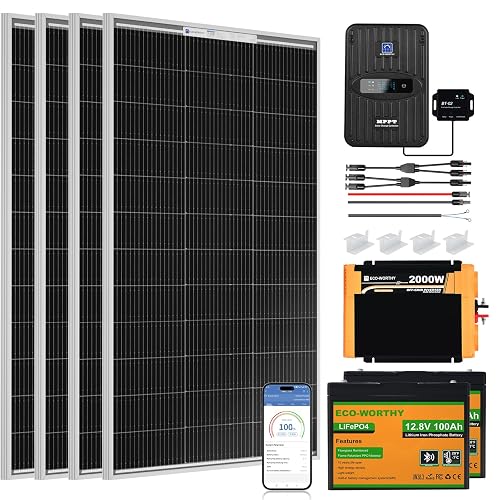
ECO-WORTHY 400W 12V solar kit
A complete 12V solar kit with 4 100W bifacial panels, a 40A MPPT controller, a 2000W inverter, 2 12V 100Ah lithium batteries and a Bluetooth module.
Pros
- Complete kit: panels, controller, inverter, batteries and Bluetooth
- 2 12V 100Ah lithium batteries with built-in BMS stated
- 40A MPPT controller with up to 99% tracking efficiency stated
- 2000W pure sine wave inverter for AC 110V devices under 2000W
Cons
- No warranty term is stated
- No certification is stated
- Spec table lists 3.76 A amperage, which does not match the 40A controller
- Bullets claim both 1.6KWH ideal daily output and 400Wh per day panel generation
Detailed Review
The listing states a 400W 12V complete solar panel kit with 4 100W bifacial solar panels using 12BB cells at a 23% conversion rate, a 40A MPPT controller, an upgraded 2000W pure sine wave inverter, 2 12V 100Ah lithium batteries with a built-in BMS and a Bluetooth 5.0 module. It claims an ideal daily output of 1.6KWH under 4 hours of sunlight and 400Wh per day of panel generation under ideal conditions, more than 3000 deep cycles on the batteries, up to 99% tracking efficiency and 98% peak conversion efficiency. The panels measure 35.63 by 23.03 by 1.18 inches and use aluminum and tempered glass with MC4 connectors. The spec table lists an amperage capacity of 3.76 A, which does not match the 40A MPPT controller in the title, so trust the title for the controller.
Who it's for: RV, shed or cabin owners who want a full 12V system in one listing. Who should skip it: buyers who want a stated warranty term or a certification mark.
Its Solar Score of 9.6/10 comes from performance 32/35, build 21/25, value 21/25, safety 7/10 and warranty 0/5: 81 of 100 points, placed on our 9.2 to 9.8 scale.
Key Specifications
| Panels | 4 x 100W bifacial, 12BB cells |
|---|---|
| Controller | 40A MPPT |
| Inverter | 2000W pure sine wave |
| Batteries | 2 x 12V 100Ah lithium |
| Daily output | 1.6KWH ideal, 400Wh panel generation |
| Panel size | 35.63 x 23.03 x 1.18 in |
Figures as published on the retailer listing, collected 22 October 2026. Performance figures are manufacturer rated.
Safety and Warranty
What this listing states. Built-in BMS with stated battery protections, so safety scores 7 of 10. No warranty term, so warranty scores zero. See How We Pick.
Stay under the input limit. Keep your panels' combined open circuit voltage, with cold weather margin, under the controller's stated maximum PV input, connect the battery first unless the manual says otherwise, and fuse both sides as the manual directs.
This is general buying information, not professional advice. Follow each product manual and local rules, and see our Safety Disclaimer.

ECO-WORTHY boost MPPT controller
A 12A boost MPPT controller that steps 12V or 24V panel voltage up to charge 24 to 72V batteries, with an LED digital display.
Pros
- Boosts 12V or 24V panel voltage to charge 24/36/48/60/72V batteries
- Overcharge, reverse current, overheating and reverse polarity protections stated
- LED digital display of charging current and voltage
- 13.28 ounces stated
Cons
- No warranty term is stated
- No certification is stated
- Max panel input of 216W at 12V and 432W at 24V
- No monitoring beyond the LED display
Detailed Review
The listing states a 12A boost MPPT solar charge controller that boosts the voltage of 12V or 24V solar panels to charge 24, 36, 48, 60 or 72V lead-acid, lithium, GEL or flooded batteries in golf carts, electric vehicles and solar systems. It states a max capable solar panel input of 216W at 12V and 432W at 24V, up to 95% charging efficiency and 93% conversion efficiency, with overcharge, reverse current, overheating and reverse polarity protections and an LED digital display. The item weight is 13.28 ounces. Its note says the voltage of the selected panel should be lower than the battery voltage.
Who it's for: owners who want to charge a 24 to 72V battery bank from existing 12V or 24V panels. Who should skip it: anyone building a large new array, given the 216W and 432W panel input limits.
Its Solar Score of 9.5/10 comes from performance 27/35, build 19/25, value 20/25, safety 6/10 and warranty 0/5: 72 of 100 points, placed on our 9.2 to 9.8 scale.
Key Specifications
| Type | 12A boost MPPT |
|---|---|
| Panel input | 12V or 24V |
| Max panel power | 216W at 12V, 432W at 24V |
| Battery range | 24/36/48/60/72V |
| Display | LED digital |
| Weight | 13.28 ounces |
Figures as published on the retailer listing, collected 22 October 2026. Performance figures are manufacturer rated.
Safety and Warranty
What this listing states. Overcharge, reverse current, overheating and reverse polarity protections stated, so safety scores 6 of 10. No warranty term, so warranty scores zero. See How We Pick.
Stay under the input limit. Keep your panels' combined open circuit voltage, with cold weather margin, under the controller's stated maximum PV input, connect the battery first unless the manual says otherwise, and fuse both sides as the manual directs.
This is general buying information, not professional advice. Follow each product manual and local rules, and see our Safety Disclaimer.
As an Amazon Associate I earn from qualifying purchases.
How we scored them
The Solar Score weighs performance, build, value, safety and warranty. For system-voltage gear, safety means stated protections, certifications and a battery management system; the LiTime states CE, FCC ID and RoHS plus a full protection list, the boost controller states four protections, and the 12V kit states a built-in BMS. Only the LiTime states a warranty term, at 2 years. Neither ECO-WORTHY listing states a certification mark.
| Product | Solar Score | Perf. /35 | Build /25 | Value /25 | Safety /10 | Warranty /5 |
|---|---|---|---|---|---|---|
| LiTime 48V 60A MPPT solar charge controller | 9.7 | 30 | 21 | 20 | 8 | 2 |
| ECO-WORTHY 400W 12V solar kit | 9.6 | 32 | 21 | 21 | 7 | 0 |
| ECO-WORTHY boost MPPT controller | 9.5 | 27 | 19 | 20 | 6 | 0 |
Scores run from 9.2 to 9.8: each product’s point total is placed on that range, so more points always means a higher score.
12v vs 48v solar system: which should you choose?
Choose the 12V side if you want a complete, ready-to-run package for an RV, shed or cabin: the ECO-WORTHY kit bundles panels, controller, inverter, lithium batteries and a Bluetooth module in one listing, with a 2000W pure sine wave inverter for AC loads. Choose the 48V side if you are building or upgrading a larger system around a 48V-class battery bank: the LiTime 48V 60A MPPT controller suits PV arrays up to 3200W at 48V with stated certifications and a 2-year warranty, and the ECO-WORTHY boost controller suits charging 24 to 72V batteries from existing 12V or 24V panels. For the panel side of a build, see our best solar panel kit for RV picks.
| If you need | Look at |
|---|---|
| A complete 12V kit in one box | ECO-WORTHY 12V kit: 4x100W panels, 40A MPPT, 2000W inverter, 2x12V 100Ah lithium |
| A controller for a 48V battery bank | LiTime 48V 60A MPPT, 150V max PV input, 2-year warranty |
| Charging 24 to 72V batteries from 12V panels | ECO-WORTHY boost controller, 12A, LED display |
| Stated certifications | LiTime, CE, FCC ID and RoHS stated |
| Phone monitoring | LiTime Bluetooth, up to 50 feet in open space |
Sizing Notes
- Match the controller to the panel array: the LiTime lists 12V at 900W through 48V at 3200W; the boost controller lists 216W at 12V and 432W at 24V.
- Keep the battery voltage within the controller’s stated range: 24 to 72V on the boost controller, auto voltage detection on the LiTime.
- The boost controller’s note says the selected panel’s voltage should be lower than the battery voltage.
- Respect the LiTime warning: keep charging under 60A, load under 20A, and PV input within the stated per-voltage limits.
- The 12V kit’s 2000W inverter covers AC 110V devices under 2000W per its listing; size loads to the inverter, not to the panel figure.
- Note the LiTime’s marine exclusion: its listing rules out boats, ships, yachts and trolling motors.
Frequently Asked Questions
Can a 12V solar kit charge a 48V battery?
The 12V kit itself is a 12V system, but the ECO-WORTHY boost controller listing states it steps 12V or 24V panel voltage up to charge 24, 36, 48, 60 or 72V batteries.
How many watts can the LiTime 48V controller take?
Per its warning: PV input within 12V at 900W, 24V at 1800W, 36V at 2600W or 48V at 3200W, with charging kept under 60A and load under 20A.
What protections do these controllers state?
The boost controller states overcharge, reverse current, overheating and reverse polarity protections. The LiTime states PV night backflow, PV reverse polarity, MPPT over-temp, battery over-voltage and battery reverse polarity safeguards, plus CE, FCC ID and RoHS certification.
Does the 12V kit include batteries?
Yes, per the listing: 2 12V 100Ah lithium batteries with a built-in BMS, claimed at more than 3000 deep cycles.
Related guides
See every best solar panel kit for RV guide and all Solar Panels and Kits guides. Also see our 12V vs 24V solar system comparison and the Deep Cycle and RV Batteries category.