On this page
The short answer on weather alert radio vs emergency radio: pick a weather alert radio when you want automatic NOAA alerts at home or on the job site, and pick an emergency radio when you want multiple power sources and rescue features in a kit. When the sky turns dark and the power goes out, the difference between guessing and knowing is a radio that keeps talking. We compared four radios on what each listing states: NOAA reception, power sources, phone charging and warranty terms. The short verdict: the weather alert side suits always-on NOAA monitoring with charging convenience, while the emergency side suits portable survival gear with crank, solar and SOS features.
SolarKitHQ earns a commission when you buy through links on this page, at no extra cost to you. As an Amazon Associate I earn from qualifying purchases. Affiliate disclosure.
Weather alert radio vs emergency radio: side by side
| Weather vs Emergency Radio | Sangean U4 Weather Alert Radio | Midland ER310PRO Emergency Radio | PRUNUS J161 Emergency Radio | Emerson WBS12 Weather Clock Radio | Amazon |
|---|---|---|---|---|---|
| Side | Weather alert | Emergency | Emergency | Weather alert | |
| NOAA reception | 7 NOAA channels | 7 WX channels, scan + alert | 7 NOAA bands, no auto alert | NOAA Weather Band stated | |
| Power | Rechargeable battery | 10,000 mAh, solar + crank | 2 AA batteries | Corded electric | |
| Phone charging | 5V/1A USB-A out | USB cable included | Not stated | 15W wireless, USB-C and USB-A | |
| Extra features | Bluetooth, IP64 | SOS flashlight, dog siren | Lanyard, earphone jack | Dual alarms, 32-140°F sensor | |
| Warranty stated | 1 Year | Not stated | 1 Year Seller | 90 day |
Specifications are manufacturer rated as listed, collected 22 October 2026.
NOAA reception and alerts
All four receive NOAA weather bands, but the alert behavior differs. The Sangean receives all 7 NOAA weather channels with AM/FM-RBDS digital tuning and 20 presets across 5 FM1, 5 FM2, 5 AM and 5 WB. The Midland scans 7 WX channels automatically and locks onto the strongest one to announce severe weather updates. The PRUNUS covers 7 NOAA bands from 162.40 to 162.55 kHz plus FM 87-108 MHz and AM 520-1710 kHz, but its listing carries an explicit note: no automatic notification for NOAA alerts. The Emerson bullets state a built-in NOAA Weather Band with real-time emergency alerts, though its spec table marks weather band as “no data”; the bullets win.
Power and charging
Power is where the emergency side pulls ahead. The Midland states a 10,000 mAh power bank with 200 hours of battery during radio use, recharged by solar panel or hand crank, and includes a USB cable to charge phones and tablets. The Sangean runs on a rechargeable battery and offers a DC out 5V/1A USB-A socket for charging a mobile phone or MP3 player. The PRUNUS runs on 2 AA batteries, which the listing frames as the reliable option when the power fails. The Emerson is corded electric with 15W wireless charging plus USB-C and USB-A ports, and a button-cell battery that maintains clock and alarm settings during interruptions.
What the listings leave unclear
The Emerson bullets state an easy-to-read 0.6″ backlit LCD while the spec table says 0.9″ LED in jade green; the bullets win. The Emerson bullets also promise a built-in NOAA Weather Band while the spec table marks weather band as “no data” and radio as AM/FM only. The PRUNUS bullets state 4.7 x 2.8 x 1.2 inches and 0.24 lb excluding the battery, while the spec table says 3.7 x 1.7 x 6.1 inches and 0.9 lb; again the bullets win. The Midland listing states no warranty term at all. Only the Sangean states a weather resistance certification, so the other three earn no safety points.
Four examples
| # | Product | Solar Score | Buy |
|---|---|---|---|
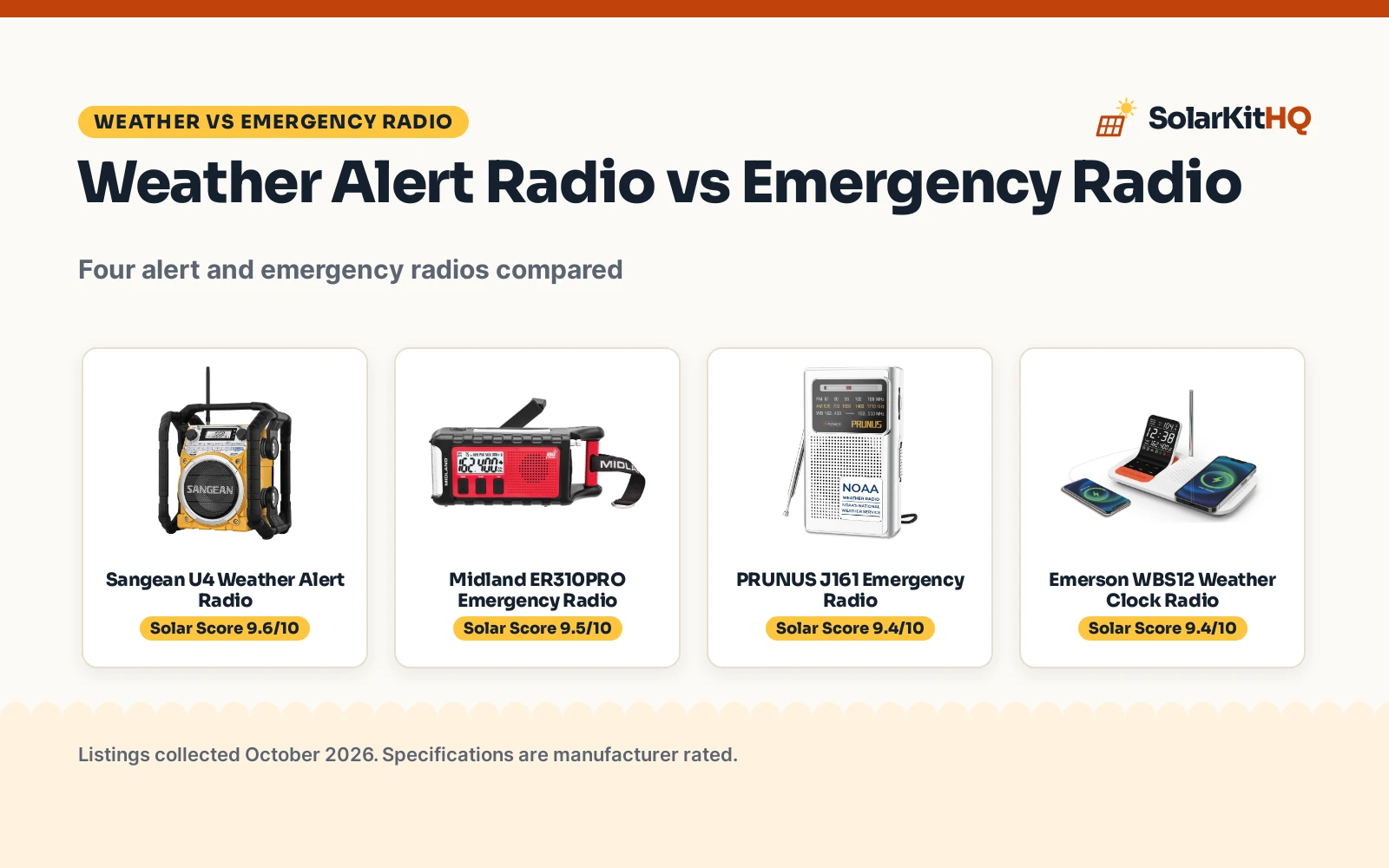
| 1 |  Sangean U4 Weather Alert Radio | 9.6/10 | Buy on Amazon |
| 2 |  Midland ER310PRO Emergency Radio | 9.5/10 | Buy on Amazon |
| 3 |  PRUNUS J161 Emergency Radio | 9.4/10 | Buy on Amazon |
| 4 |  Emerson WBS12 Weather Clock Radio | 9.4/10 | Buy on Amazon |

Sangean U4 Weather Alert Radio
A rugged NOAA weather alert radio with 7 NOAA channels, Bluetooth streaming, IP64 resistance and a USB port to charge a phone.
Pros
- 7 NOAA weather channels with 20 presets stated
- IP64 certification for rain, dust and shock resistance stated
- 5V/1A USB-A output charges a phone or MP3 player
- 1 Year warranty stated
Cons
- 10.7 pounds stated, heavy for a go-bag
- No hand crank or solar charging stated
- Plastic enclosure stated
- No SOS flashlight stated
Detailed Review
The listing states a rugged weather alert radio receiving all 7 NOAA weather channels with AM/FM-RBDS digital tuning and 20 presets, Bluetooth with NFC pairing and aptX decoding, plus an Aux-In port. It carries an IP64 certification for rain, dust and shock resistance, runs on a rechargeable battery, and includes a DC out 5V/1A USB-A socket to charge a mobile phone or MP3 player. A real-time clock with two alarm timers, Nap, Sleep and Snooze functions rounds it out; the speaker output is 7 watts in stereo and the warranty is 1 Year.
Who it's for: anyone who wants NOAA alerts in a rugged radio that can also top up a phone. Who should skip it: anyone who wants crank or solar backup power.
Its Solar Score of 9.6/10 comes from performance 30/35, build 21/25, value 20/25, safety 5/10 and warranty 2/5: 78 of 100 points, placed on our 9.2 to 9.8 scale.
Key Specifications
| NOAA channels | 7 |
|---|---|
| Certification | IP64 |
| USB output | 5V/1A USB-A |
| Weight | 10.7 pounds |
Figures as published on the retailer listing, collected 22 October 2026. Performance figures are manufacturer rated.
Safety and Warranty
What this listing states. IP64 certification: rain-resistant, dust-resistant and shock-resistant stated, so safety scores 5 of 10. 1 Year stated. It does not say everything a buyer needs, such as who pays return shipping, so warranty scores 2 of 5. See How We Pick.
Follow the manual. Connect and use the product as the maker describes, stay within every stated rating, and read the manual before first use.
This is general buying information, not professional advice. Follow each product manual and local rules, and see our Safety Disclaimer.

Midland ER310PRO Emergency Radio
An emergency radio with a 10,000 mAh power bank, solar and hand crank charging, NOAA scan with alert, and an SOS flashlight.
Pros
- 200 hours of battery during radio use stated
- Solar panel and hand crank recharging stated
- NOAA scan locks the strongest of 7 WX channels stated
- SOS flashlight beacon and 130-lumen CREE LED stated
Cons
- No warranty term is stated
- No weather resistance certification is stated
- Ultrasonic dog siren has no stated range
- Dimensions 8.1 x 2.8 x 3.4 inches, larger than the handheld
Detailed Review
The listing states a portable emergency radio with a 10,000 mAh power bank, 200 hours of battery during radio use, solar panel and hand crank recharging, and Bluetooth streaming. NOAA Weather Scan sweeps 7 WX channels and locks onto the strongest to announce severe weather updates. The SOS flashlight beacon flashes Morse code with a bright CREE LED of 130 lumens, and an ultrasonic rescue dog siren assists search teams; a USB charging cable is included for charging phones and tablets.
Who it's for: go-bag builders who want the longest stated battery life with crank, solar and SOS features. Who should skip it: anyone who wants a stated warranty term or weather certification.
Its Solar Score of 9.5/10 comes from performance 32/35, build 21/25, value 21/25, safety 0/10 and warranty 0/5: 74 of 100 points, placed on our 9.2 to 9.8 scale.
Key Specifications
| Power bank | 10,000 mAh |
|---|---|
| Battery life | 200 hours |
| Charging | Solar + hand crank |
| Flashlight | 130 lumens SOS |
Figures as published on the retailer listing, collected 22 October 2026. Performance figures are manufacturer rated.
Safety and Warranty
What this listing states. No safety listing, protection or rating is stated, so safety scores zero. No warranty term, so warranty scores zero. See How We Pick.
Follow the manual. Connect and use the product as the maker describes, stay within every stated rating, and read the manual before first use.
This is general buying information, not professional advice. Follow each product manual and local rules, and see our Safety Disclaimer.

PRUNUS J161 Emergency Radio
A handheld emergency radio covering 7 NOAA bands, FM and AM on 2 AA batteries with a stereo earphone jack.
Pros
- 7 NOAA bands plus FM 87-108 MHz and AM 520-1710 kHz stated
- Runs on 2 AA batteries stated
- 0.24 lb handheld size with a lanyard stated
- 1 Year Seller warranty stated
Cons
- Listing notes no automatic NOAA alert notification
- No phone charging is stated
- No weather resistance certification is stated
- Bullets and spec table disagree on size and weight
Detailed Review
The listing states a handheld NOAA radio covering 7 NOAA bands from 162.40 to 162.55 kHz, FM 87-108 MHz and AM 520-1710 kHz, running on 2 AA batteries with 3 controls for power, volume, tuning and band. The bullets describe a 4.7 x 2.8 x 1.2 inch body at 0.24 lb excluding the battery with a lanyard, while the spec table says 3.7 x 1.7 x 6.1 inches and 0.9 lb; the bullets win. An explicit note says it does not support automatic notification for NOAA alerts. A stereo earphone jack and internal speaker are stated, with a 1 Year Seller warranty.
Who it's for: anyone who wants the lightest handheld NOAA radio for a kit or a walk. Who should skip it: anyone who expects the radio to wake them with an alert.
Its Solar Score of 9.4/10 comes from performance 24/35, build 20/25, value 21/25, safety 0/10 and warranty 1/5: 66 of 100 points, placed on our 9.2 to 9.8 scale.
Key Specifications
| NOAA bands | 7 |
|---|---|
| Power | 2 AA batteries |
| Size | 4.7 x 2.8 x 1.2 in |
| Weight | 0.24 lb |
Figures as published on the retailer listing, collected 22 October 2026. Performance figures are manufacturer rated.
Safety and Warranty
What this listing states. No safety listing, protection or rating is stated, so safety scores zero. 1 Year Seller stated. It does not say everything a buyer needs, such as who pays return shipping, so warranty scores 1 of 5. See How We Pick.
Follow the manual. Connect and use the product as the maker describes, stay within every stated rating, and read the manual before first use.
This is general buying information, not professional advice. Follow each product manual and local rules, and see our Safety Disclaimer.

Emerson WBS12 Weather Clock Radio
A weather alert alarm clock radio with NOAA weather band, 15W wireless charging and a temperature sensor.
Pros
- NOAA Weather Band with real-time alerts stated
- 15W wireless charging plus USB-C and USB-A ports stated
- SmartSet automatic time setting stated
- Temperature sensor displays 32°F to 140°F stated
Cons
- Bullets state 0.6" LCD, table states 0.9" LED
- Spec table marks weather band as "no data"
- Corded electric, needs an outlet
- 90 day warranty is the shortest here
Detailed Review
The listing states a SmartSet weather band dual alarm clock radio with built-in NOAA Weather Band for real-time emergency alerts, 15W wireless charging plus USB-C and USB-A ports, dual alarms and a temperature sensor displaying 32°F to 140°F. Digital PLL FM radio stores up to 20 stations, and a button-cell battery keeps clock and alarm settings during power interruptions. The bullets describe an easy-to-read 0.6" backlit LCD with three brightness levels while the spec table says 0.9" LED in jade green; the bullets win. The spec table marks weather band as "no data" against the bullets' NOAA claim, and the warranty is 90 day from date of purchase.
Who it's for: anyone who wants NOAA alerts on the nightstand with phone charging built in. Who should skip it: anyone who needs a portable radio for outages away from an outlet.
Its Solar Score of 9.4/10 comes from performance 26/35, build 20/25, value 19/25, safety 0/10 and warranty 1/5: 66 of 100 points, placed on our 9.2 to 9.8 scale.
Key Specifications
| Alerts | NOAA Weather Band |
|---|---|
| Wireless charging | 15W |
| Temp sensor | 32°F to 140°F |
| Warranty | 90 day |
Figures as published on the retailer listing, collected 22 October 2026. Performance figures are manufacturer rated.
Safety and Warranty
What this listing states. No safety listing, protection or rating is stated, so safety scores zero. 90 day warranty stated. It does not say everything a buyer needs, such as who pays return shipping, so warranty scores 1 of 5. See How We Pick.
Follow the manual. Connect and use the product as the maker describes, stay within every stated rating, and read the manual before first use.
This is general buying information, not professional advice. Follow each product manual and local rules, and see our Safety Disclaimer.
As an Amazon Associate I earn from qualifying purchases.
How we scored them
The Solar Score weighs performance, build, value, safety and warranty. For emergency radios, safety means a certification the listing names: only the Sangean states one, with IP64 rain, dust and shock resistance. Three of the four state a warranty term: 1 Year on the Sangean, 1 Year Seller on the PRUNUS and 90 day on the Emerson. How we pick explains the weights.
| Product | Solar Score | Perf. /35 | Build /25 | Value /25 | Safety /10 | Warranty /5 |
|---|---|---|---|---|---|---|
| Sangean U4 Weather Alert Radio | 9.6 | 30 | 21 | 20 | 5 | 2 |
| Midland ER310PRO Emergency Radio | 9.5 | 32 | 21 | 21 | 0 | 0 |
| PRUNUS J161 Emergency Radio | 9.4 | 24 | 20 | 21 | 0 | 1 |
| Emerson WBS12 Weather Clock Radio | 9.4 | 26 | 20 | 19 | 0 | 1 |
Scores run from 9.2 to 9.8: each product’s point total is placed on that range, so more points always means a higher score.
Weather alert radio vs emergency radio: which should you choose?
Choose the weather alert side for set-and-forget monitoring: the Sangean suits job sites and campsites with 7 NOAA channels, IP64 resistance and a USB port for your phone, while the Emerson suits the nightstand with dual alarms, SmartSet time and 15W wireless charging. Choose the emergency side for the go-bag: the Midland offers 200 hours of radio use with crank, solar and an SOS flashlight, and the PRUNUS is the lightest handheld option on 2 AA batteries, though it will not alert you by itself. For more radio picks, see our best emergency radio for tornado season and best emergency radio with power bank guides.
| If you need | Look at |
|---|---|
| Automatic NOAA channel scan | Midland ER310PRO Emergency Radio, scans 7 WX channels |
| Rugged weather resistance stated | Sangean U4 Weather Alert Radio, IP64 |
| Longest stated battery life | Midland ER310PRO Emergency Radio, 200 hours |
| Lightest handheld option | PRUNUS J161 Emergency Radio, 0.24 lb |
| Bedside alerts with phone charging | Emerson WBS12 Weather Clock Radio, 15W wireless |
Sizing Notes
- Match the power to the outage plan: rechargeable on the Sangean, corded electric on the Emerson, 2 AA batteries on the PRUNUS, solar and hand crank on the Midland.
- Check the NOAA behavior: the PRUNUS listing notes no automatic notification; the Midland scans and locks the strongest of 7 WX channels.
- Check the charging outputs: 5V/1A USB-A on the Sangean; 15W wireless plus USB-C and USB-A on the Emerson; a USB cable included on the Midland for charging devices.
- Match the size to the kit: the PRUNUS bullets state 4.7 x 2.8 x 1.2 inches and 0.24 lb excluding the battery; the Sangean states 10.7 pounds.
Frequently Asked Questions
Which radios here pick up NOAA alerts on their own?
The Midland scans 7 WX channels and locks onto the strongest for severe weather updates, and the Sangean receives all 7 NOAA channels. The PRUNUS covers 7 NOAA bands but its listing states no automatic notification.
Can these radios charge a phone?
Three of them. The Sangean states a 5V/1A USB-A output, the Emerson states 15W wireless charging plus USB-C and USB-A ports, and the Midland includes a USB cable for charging external devices. The PRUNUS states no phone charging.
How long does the Midland run on battery?
The listing states 200 hours of battery during radio use from its 10,000 mAh power bank, with solar and hand crank to recharge.
Which radio is weather resistant?
The Sangean states an IP64 certification for rain, dust and shock resistance. None of the other three listings states a weather code.
Which of these state a warranty?
The Sangean at 1 Year, the PRUNUS at 1 Year Seller and the Emerson at 90 day. The Midland listing states no warranty term.
Related guides
See every Camping and Emergency Gear guide and all Power Stations and Generators guides.
More picks: best emergency radio for tornado season, best emergency radio with power bank, NOAA vs shortwave emergency radio, best emergency radio for bedside table.