On this page
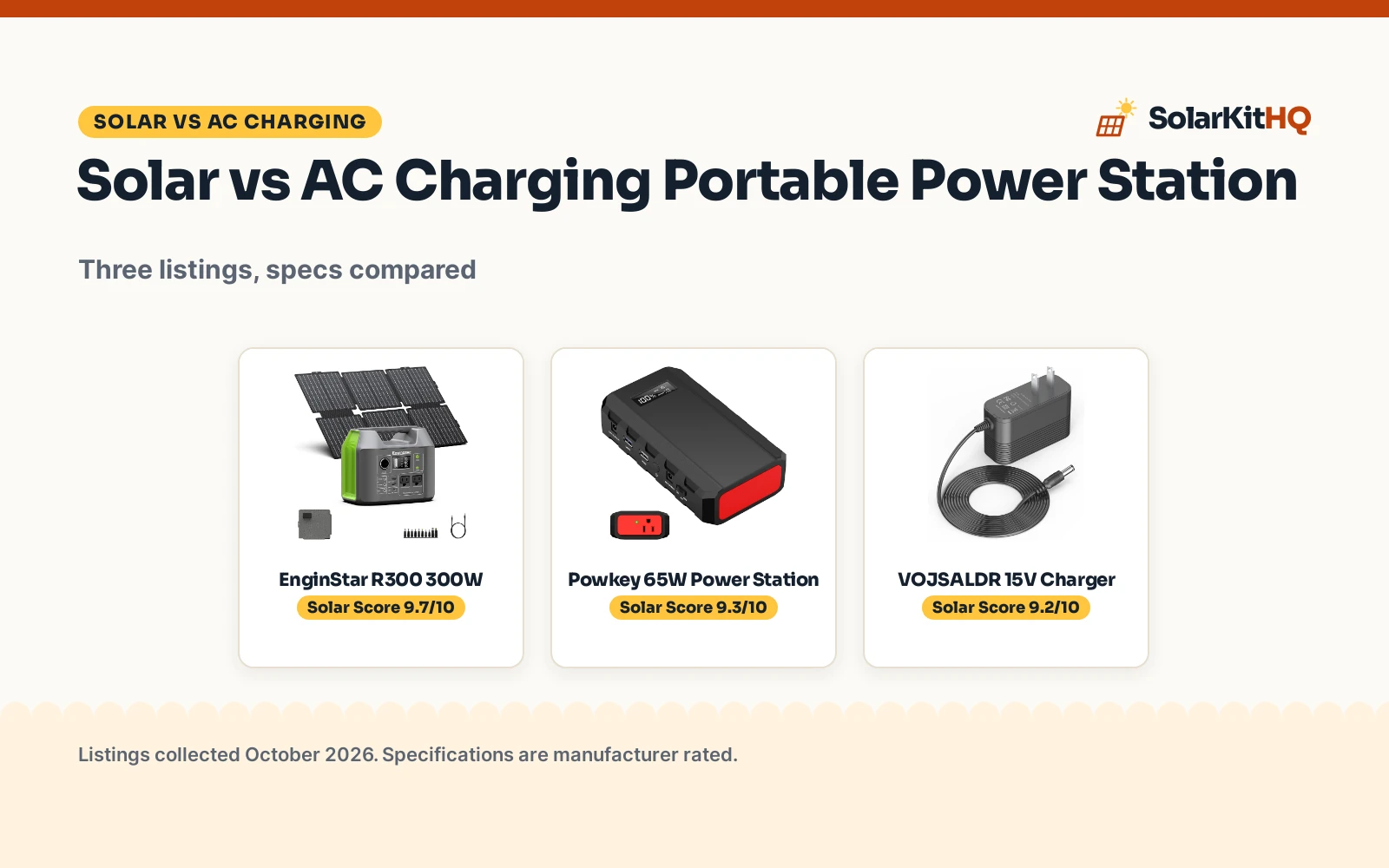
The short answer on solar vs ac charging portable power station setups: solar charging keeps a station topped up where there is no outlet, while AC charging from a wall outlet gives the quickest stated recharge at home. We compared three listings, two small solar-capable stations and one AC charging cable, on what each listing states about panel watts, charge inputs, charge times, capacity and warranty terms. The EnginStar R300 leads because it includes a 60W panel and states three charging ways; the Powkey is the smallest stated station; the VOJSALDR is a replacement AC cable for listed Dewalt models, not a station.
SolarKitHQ earns a commission when you buy through links on this page, at no extra cost to you. As an Amazon Associate I earn from qualifying purchases. Affiliate disclosure.
Solar vs AC charging: side by side
| Solar vs AC charging | EnginStar R300 300W | Powkey 65W Power Station | VOJSALDR 15V Charger | Amazon |
|---|---|---|---|---|
| Side | Solar | Solar | AC charging | |
| Capacity stated | 296Wh | 88.8Wh | Not a station | |
| AC output | 300W | 65W | Not applicable | |
| Solar panel | 60W included | Not included | Not applicable | |
| Full charge stated | 3 hours at 65W max | Under 4 hours at 30W | Not stated | |
| Weight | 6.5 pounds | 1.1 pounds | Not stated | |
| Warranty term | 1 year | Not stated | 1 year |
Specifications are manufacturer rated as listed, collected 22 October 2026.
What solar charging gives you
The two solar-side listings charge from a panel as well as from other sources. The EnginStar R300 includes a 60W foldable panel stated at 23% conversion efficiency, and accepts any compatible 12-25V panel. The Powkey accepts a 13V-16V panel, sold separately. Both also charge from a wall outlet and a 12V car socket, so solar is an addition rather than the only input.
What AC charging gives you
AC charging means a wall outlet. The EnginStar states a maximum charging speed of 65W and a full charge in 3 hours; the Powkey recharges in under 4 hours on its 30W DC input. The VOJSALDR listing is the purest AC example here: a 15V charging cable that connects listed Dewalt power stations to AC 100V-240V outlets, with a 6.0ft cord. It charges nothing by itself; it is the cable between a station and the wall.
What the listings leave unclear
EnginStar’s bullets say the 60W panel is included in one place and not included in another; the title and the package list say included. Its spec table lists 2 total power outlets against 8 output ports in the bullets. Powkey’s title says 86Wh while its bullets say 88.8Wh, and its spec table says 80 watts output against 65W in the title. The VOJSALDR spec table lists 110 watts next to a stated DC 15V 1A output; the input and output figures are the ones to trust.
Three examples
| # | Product | Solar Score | Buy |
|---|---|---|---|
| 1 |  EnginStar R300 300W | 9.7/10 | Buy on Amazon |
| 2 |  Powkey 65W Power Station | 9.3/10 | Buy on Amazon |
| 3 |  VOJSALDR 15V Charger | 9.2/10 | Buy on Amazon |

EnginStar R300 300W
A 300W, 296Wh power station with a 60W foldable solar panel included, 8 output ports and three charging ways.
Pros
- 60W foldable solar panel included, 23% conversion efficiency stated
- 300W AC output with two 110V pure sine wave outlets
- Battery management system with voltage and temperature control stated
- Three charging ways: solar, wall outlet and 12V car socket
Cons
- Bullets say both panel included and panel not included
- Spec table lists 2 total outlets against 8 ports in the bullets
- 6.5 pounds plus a 4 pound panel to carry
- Full charge in 3 hours needs the 65W maximum input
Detailed Review
The listing states a 300W power station with 296Wh capacity, an 80000mAh lithium-ion battery, 6.5 pounds and 9 x 5.5 x 7.5 inches, with two 110V pure sine wave AC outlets, two regulated DC outputs (12V/24V), USB 5V/3.1A and USB-C 18W across 8 output ports. It lists a battery management system with voltage and temperature control protecting against short circuit, overcharging and overload, more than 1000 charge cycles and a 1 year manufacturer warranty. The included 60W foldable panel is stated at 23% conversion efficiency, 4 pounds, folding to 10.2 x 9.4 x 1.2 inches. Two contradictions: one bullet says the panel is included while another says it is not, and the spec table lists 2 total power outlets against 8 ports in the bullets; the title and bullets win on both.
Who it's for: campers who want a station plus panel in one box with three charging ways. Who should skip it: anyone put off by the panel-included contradiction who wants a cleaner listing.
Its Solar Score of 9.7/10 comes from performance 30/35, build 21/25, value 21/25, safety 8/10 and warranty 3/5: 83 of 100 points, placed on our 9.2 to 9.8 scale.
Key Specifications
| Output | 300W AC, 296Wh |
|---|---|
| Solar panel | 60W foldable, 23% efficiency |
| Ports | 8 output ports |
| Charge | 65W max, full in 3 hours |
Figures as published on the retailer listing, collected 22 October 2026. Performance figures are manufacturer rated.
Safety and Warranty
What this listing states. Battery management system with voltage and temperature control, short circuit, overcharging and overload protection stated, so safety scores 8 of 10. 1 Year Manufacturer warranty stated. It does not say everything a buyer needs, such as who pays return shipping, so warranty scores 3 of 5. See How We Pick.
Power station limits. Stay within the stated continuous output and solar input limits, keep the unit ventilated and dry, charge within the stated temperature range, and never connect it to home wiring except through equipment a licensed electrician installs.
This is general buying information, not professional advice. Follow each product manual and local rules, and see our Safety Disclaimer.

Powkey 65W Power Station
A 1.1 pound, 88.8Wh portable station with a 65W 120V AC outlet and three charging ways, solar panel not included.
Pros
- 1.1 pounds, the lowest stated weight in this group
- 65W 120V AC outlet plus QC3.0 USB and DC outputs
- Three charging ways: wall, car and solar (panel not included)
- LED display for battery level
Cons
- Title says 86Wh while the bullets say 88.8Wh
- Spec table lists 80 watts output against 65W in the title
- No protection features are stated
- Warranty type is Limited with no term stated
Detailed Review
The listing states a 24000mAh portable power station at 1.1 pounds and 6.8 x 3.8 x 1.8 inches, with a 120V/65W AC outlet, QC3.0 9V/2A and 5V/3A USB outputs and a DC 9~12.6V/10A output across 4 ports. It lists three charging ways: wall outlet at DC 15V/2A (30W), 12V car adapter and solar at 13V-16V with the panel not included, recharging in under 4 hours, and advises keeping power at or above 30% and recharging every 3 months. Two contradictions: the title says 86Wh while the bullets say 88.8Wh, and the spec table lists 80 watts output against 65W in the title; the title and bullets win.
Who it's for: travelers who want the smallest stated station with an AC outlet for phones and laptops. Who should skip it: anyone who wants a solar panel in the box or stated protections.
Its Solar Score of 9.3/10 comes from performance 23/35, build 19/25, value 20/25, safety 0/10 and warranty 0/5: 62 of 100 points, placed on our 9.2 to 9.8 scale.
Key Specifications
| Capacity | 24000mAh, 88.8Wh |
|---|---|
| AC output | 65W, 120V |
| Weight | 1.1 pounds |
| Solar input | 13V-16V, panel not included |
Figures as published on the retailer listing, collected 22 October 2026. Performance figures are manufacturer rated.
Safety and Warranty
What this listing states. No UL, FCC or battery management statement is stated, so safety scores zero. No warranty term, so warranty scores zero. See How We Pick.
Power station limits. Stay within the stated continuous output and solar input limits, keep the unit ventilated and dry, charge within the stated temperature range, and never connect it to home wiring except through equipment a licensed electrician installs.
This is general buying information, not professional advice. Follow each product manual and local rules, and see our Safety Disclaimer.

VOJSALDR 15V Charger
A 15V AC charging cable for listed Dewalt power station models, the AC-charging example in this group.
Pros
- AC 100V-240V input with DC 15V output stated
- 6.0ft / 1.8M cord length stated
- 1 year warranty stated
- 30 day refund stated
Cons
- A replacement cable, not a power station
- Only fits the Dewalt models listed
- No protection features are stated
- No charging speed figure is stated
Detailed Review
The listing states a 15V AC charging cable for the Dewalt DXAEJ14, DXAEPS14, DXAEPS14CA, 1600 and 1400 models, with AC 100V-240V input, DC 15V output and a 6.0ft / 1.8M cord. It states a 30 day refund and 12 months exchange, and the spec table gives a 1 year warranty description. It is a replacement charging cable, not a power station, so it represents the AC-charging side only as the cable that connects a station to a wall outlet.
Who it's for: owners of the listed Dewalt models who need a replacement AC charging cable. Who should skip it: anyone shopping for a power station itself.
Its Solar Score of 9.2/10 comes from performance 16/35, build 18/25, value 18/25, safety 0/10 and warranty 3/5: 55 of 100 points, placed on our 9.2 to 9.8 scale.
Key Specifications
| Input | AC 100V-240V |
|---|---|
| Output | DC 15V |
| Cord | 6.0ft / 1.8M |
| Warranty | 1 year stated |
Figures as published on the retailer listing, collected 22 October 2026. Performance figures are manufacturer rated.
Safety and Warranty
What this listing states. No UL, FCC or battery management statement is stated, so safety scores zero. 1 year warranty stated. It does not say everything a buyer needs, such as who pays return shipping, so warranty scores 3 of 5. See How We Pick.
Power station limits. Stay within the stated continuous output and solar input limits, keep the unit ventilated and dry, charge within the stated temperature range, and never connect it to home wiring except through equipment a licensed electrician installs.
This is general buying information, not professional advice. Follow each product manual and local rules, and see our Safety Disclaimer.
As an Amazon Associate I earn from qualifying purchases.
How we scored them
The Solar Score weighs performance, build, value, safety and warranty. For charging setups, safety means a battery management system or stated protections on the charging path; only the EnginStar states these. Two of the three listings state a 1 year warranty term. How we pick explains the weights.
| Product | Solar Score | Perf. /35 | Build /25 | Value /25 | Safety /10 | Warranty /5 |
|---|---|---|---|---|---|---|
| EnginStar R300 300W | 9.7 | 30 | 21 | 21 | 8 | 3 |
| Powkey 65W Power Station | 9.3 | 23 | 19 | 20 | 0 | 0 |
| VOJSALDR 15V Charger | 9.2 | 16 | 18 | 18 | 0 | 3 |
Scores run from 9.2 to 9.8: each product’s point total is placed on that range, so more points always means a higher score.
Solar vs ac charging portable power station: which should you choose?
Choose solar charging if the station will spend its time away from outlets: the EnginStar R300 includes the 60W panel, and the Powkey accepts a 13V-16V panel. Choose AC charging if the station lives at home and recharges between outings: the EnginStar states a full charge in 3 hours at 65W max, and the VOJSALDR cable exists for owners of its listed Dewalt models who charge from the wall. For a closer look at small stations, see our best portable power station for camping.
| If you need | Look at |
|---|---|
| Off-grid charging with the panel in the box | EnginStar R300 300W, 60W panel included |
| The smallest stated station | Powkey 65W Power Station, 1.1 pounds |
| Quickest stated full charge | EnginStar R300 300W, 3 hours at 65W max |
| A replacement wall-charging cable | VOJSALDR 15V Charger, 6.0ft cord for listed Dewalt models |
Sizing Notes
- Match panel voltage to the station input: 12-25V on the EnginStar, 13V-16V on the Powkey.
- Keep the load under the stated AC output: 300W on the EnginStar, 65W on the Powkey.
- EnginStar advises a full charge every 2-3 months; Powkey advises keeping power at or above 30% and recharging every 3 months.
- The VOJSALDR cable only fits the Dewalt models its listing names.
Frequently Asked Questions
Can the EnginStar station charge from solar?
Yes. It includes a 60W foldable panel and accepts any compatible 12-25V solar panel. It also charges from a wall outlet and a 12V car socket.
Does the Powkey station include a solar panel?
No. The listing states the panel is not included and requires a 13V-16V output panel. It charges from a wall outlet at 15V/2A and from a 12V car adapter.
What is the VOJSALDR listing?
A 15V AC charging cable for listed Dewalt power station models, not a power station. It connects the station to an AC 100V-240V outlet.
Which listing states the quickest full charge?
The EnginStar, at 3 hours with 65W maximum input. The Powkey states under 4 hours on its 30W input.
Which listings state a warranty term?
The EnginStar and the VOJSALDR both state 1 year. The Powkey lists a Limited warranty type with no term.
Related guides
See every Power Stations and Generators guide. Also see our best portable power station for camping. Also see our best solar panel kit for RV. Also see our best solar generator for a shed. Also see our best portable power station for home backup.