On this page
A campsite at dusk with a dead phone is the wrong time to learn the controller cannot keep up. The short answer on renogy rover vs wanderer: pick a Rover for a larger array with higher current needs and included Bluetooth monitoring, and pick the Wanderer for a small RV or marine setup where a USB charging port and a compact case matter more. The Rover pair uses MPPT tracking, while the Wanderer uses PWM charging, and the sections below show what each side states.
SolarKitHQ earns a commission when you buy through links on this page, at no extra cost to you. As an Amazon Associate I earn from qualifying purchases. Affiliate disclosure.
Renogy Rover vs Wanderer: side by side
| Rover vs Wanderer | Renogy Rover 40A | Renogy Rover 20A | Renogy Wanderer 10A | Amazon |
|---|---|---|---|---|
| Type | MPPT | MPPT | PWM | |
| Current | 40A | 20A | 10A | |
| PV input | 100V | 95V | 50V | |
| Battery voltage | 12V/24V | 12V/24V | 12V/24V | |
| Bluetooth | Module included | Module included | Sold separately | |
| Display | LCD | LCD | LCD | |
| Load control | 5 load modes | Optional load terminals | Manual, automatic, timed modes | |
| Warranty | 3-year | 2-year | 2-year |
25 October 2026
Current and PV input
Current separates the sides clearly, since all 3 listings state it. The Rover 40A states 40A, the Rover 20A states 20A and the Wanderer states 10A. PV input follows the same order: 100V for the Rover 40A, 95V for the Rover 20A and 50V for the Wanderer. All 3 state 12V/24V battery systems, with AGM, Gel and Flooded on automatic detection and lithium on manual activation. Charging type is the deeper split: both Rovers state MPPT tracking with 99% tracking efficiency and 98% peak conversion efficiency, while the Wanderer states PWM charging with 4-stage Bulk, Boost, Float and Equalization charging. The Wanderer listing states no efficiency figure for its PWM charging, so this guide does not rank the sides on efficiency.
Protection and monitoring
Protection is stated on all 3 listings, but only the Rover 40A states UL certification. The Rover 40A lists protection against reverse polarity, overcharging, over-discharging, overload, short-circuiting, overheating and reverse current, plus an integrated heat sink with 0 dB operation. The Rover 20A lists protection against reverse polarity, overcharging, over-discharging, overload, short-circuiting and reverse current, in a die-cast aluminium case. The Wanderer lists protection against overcharge, over-discharge, overload, short-circuit and reverse polarity, plus temperature compensation. Monitoring splits the sides: both Rovers include a Bluetooth module with an LCD screen and LED indicators, while the Wanderer needs a BT-1 Bluetooth module sold separately and adds an RS232 port and a 5V/2A USB port. The Rover 40A also states battery activation from 0 volts and 5 load modes, while the Rover 20A states optional load terminals with timer controls and the Wanderer states manual, automatic and timed load control modes.
What the listings leave unclear
The Wanderer listing leaves its size unclear: the bullets describe a compact size, while the spec table lists dimensions of 4.69 x 2.95 x 1.08 inches. This guide follows the bullets. Weights are also hard to compare across the listings: the Rover 40A spec table lists 4.58 ounces, the Rover 20A spec table lists 1.72 kg, and the Wanderer listing states no weight. The Wanderer listing claims 30% longer battery lifespan compared to basic charge controllers, which is a claim against basic controllers, not a measured comparison with the Rover pair. The Rover 40A states battery activation from 0 volts, while the Rover 20A listing states no such figure, so that feature belongs to the 40A listing alone, not to the Rover side as a whole.
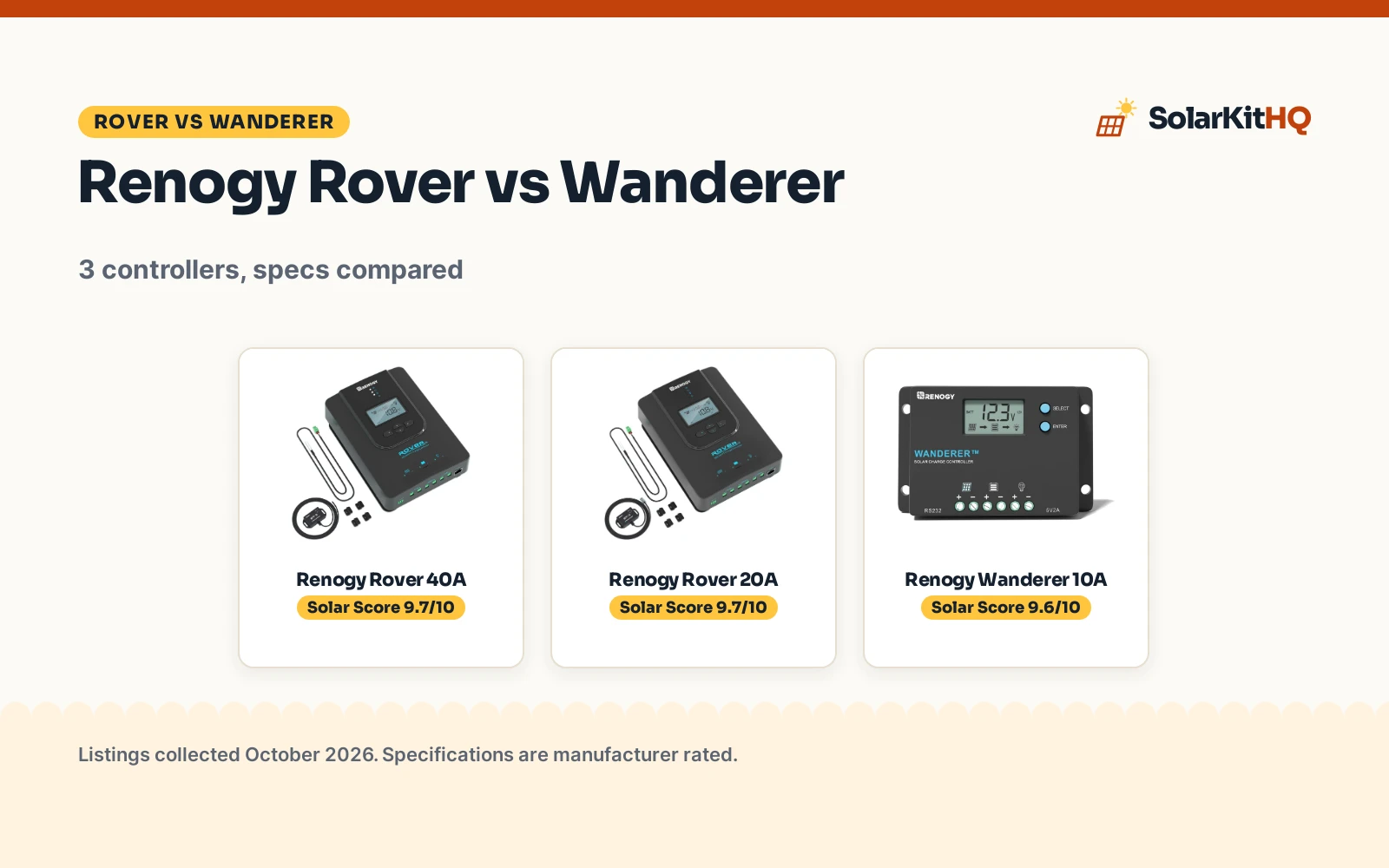
3 controllers
| # | Product | Solar Score | Buy |
|---|---|---|---|
| 1 |  Renogy Rover 40A | 9.7/10 | Buy on Amazon |
| 2 |  Renogy Rover 20A | 9.7/10 | Buy on Amazon |
| 3 |  Renogy Wanderer 10A | 9.6/10 | Buy on Amazon |

Renogy Rover 40A
A 40A MPPT charge controller with 100V PV input, 99% tracking efficiency stated and an included Bluetooth module for 12V/24V systems.
Pros
- 40A current rating stated
- 100V PV input stated
- 99% tracking efficiency and 98% peak conversion efficiency stated
- Bluetooth module included with LCD screen and LED indicators
Cons
- Plastic shell stated, not die-cast aluminium
- No USB charging port stated
- No IP rating stated
- Lithium charging needs manual activation
Detailed Review
The Rover 40A listing states a 40A MPPT controller for 12V/24V systems with 100V PV input, 99% tracking efficiency and 98% peak conversion efficiency, a Bluetooth module, an LCD screen with LED indicators, and 5 load modes. The listing states 4-stage charging for lead-acid batteries and 2-stage charging for lithium, lithium reactivation, battery activation from 0 volts, an integrated heat sink with 0 dB operation, and UL certification with protection against reverse polarity, overcharging, over-discharging, overload, short-circuiting, overheating and reverse current. The spec table lists dimensions of 2.85 x 6.81 x 9.37 inches, a weight of 4.58 ounces and a plastic shell, with mounting brackets included.
Who it's for: solar setups that need 40A of charging current, 100V PV input and included Bluetooth monitoring. Who should skip it: anyone who needs a USB charging port or a stated IP rating.
Its Solar Score of 9.7/10 comes from performance 32/35, build 21/25, value 21/25, safety 8/10 and warranty 3/5: 85 of 100 points, placed on our 9.2 to 9.8 scale.
Key Specifications
| Type | MPPT |
|---|---|
| Current | 40A |
| PV input | 100V |
| Bluetooth | Module included |
Figures as published on the retailer listing, collected 25 October 2026. Performance figures are manufacturer rated.
Safety and Warranty
What this listing states. UL certified with protection against reverse polarity, overcharging, over-discharging, overload, short-circuiting, overheating and reverse current, so safety scores 8 of 10. 3-year material and workmanship warranty. It does not say everything a buyer needs, such as who pays return shipping, so warranty scores 3 of 5. See How We Pick.
Stay under the input limit. Keep your panels' combined open circuit voltage, with cold weather margin, under the controller's stated maximum PV input, connect the battery first unless the manual says otherwise, and fuse both sides as the manual directs.
This is general buying information, not professional advice. Follow each product manual and local rules, and see our Safety Disclaimer.

Renogy Rover 20A
A 20A MPPT charge controller with 95V PV input, 99% tracking efficiency stated, a die-cast aluminium case and an included Bluetooth module.
Pros
- 20A current rating stated
- 95V PV input stated
- Die-cast aluminium case stated
- Bluetooth module included with LCD screen and LED indicators
Cons
- No UL certification stated
- No USB charging port stated
- No IP rating stated
- Lithium charging needs manual activation
Detailed Review
The Rover 20A listing states a 20A MPPT controller for 12V/24V systems with 95V PV input, 99% tracking efficiency and 98% peak conversion efficiency, a Bluetooth module, an LCD screen with LED indicators, and optional load terminals with timer controls. The listing states 4-stage charging for lead-acid batteries and 2-stage charging for lithium, lithium reactivation, and protection against reverse polarity, overcharging, over-discharging, overload, short-circuiting and reverse current. The spec table lists dimensions of 5.94 x 2.34 x 8.27 inches, a weight of 1.72 kg and a die-cast aluminium case.
Who it's for: solar setups that need 20A of MPPT charging with an included Bluetooth module and a die-cast aluminium case. Who should skip it: anyone who needs UL certification, a USB charging port or a stated IP rating.
Its Solar Score of 9.7/10 comes from performance 30/35, build 22/25, value 20/25, safety 7/10 and warranty 3/5: 82 of 100 points, placed on our 9.2 to 9.8 scale.
Key Specifications
| Type | MPPT |
|---|---|
| Current | 20A |
| PV input | 95V |
| Bluetooth | Module included |
Figures as published on the retailer listing, collected 25 October 2026. Performance figures are manufacturer rated.
Safety and Warranty
What this listing states. Protection against reverse polarity, overcharging, over-discharging, overload, short-circuiting and reverse current, so safety scores 7 of 10. 2-year material and workmanship warranty. It does not say everything a buyer needs, such as who pays return shipping, so warranty scores 3 of 5. See How We Pick.
Stay under the input limit. Keep your panels' combined open circuit voltage, with cold weather margin, under the controller's stated maximum PV input, connect the battery first unless the manual says otherwise, and fuse both sides as the manual directs.
This is general buying information, not professional advice. Follow each product manual and local rules, and see our Safety Disclaimer.

Renogy Wanderer 10A
A 10A PWM charge controller with 50V PV input, an LCD display, a 5V/2A USB port and temperature compensation for 12V/24V systems.
Pros
- 10A current rating stated
- 5V/2A USB port stated
- RS232 port stated
- Temperature compensation stated
Cons
- Bluetooth module sold separately, not included
- Bullets describe a compact size while the spec table lists 4.69 x 2.95 x 1.08 inches
- No UL certification stated
- Lithium charging needs manual activation
Detailed Review
The Wanderer 10A listing states a 10A PWM controller for 12V/24V systems with 50V PV input, 4-stage PWM charging for AGM, Gel, Flooded and lithium batteries, an LCD display, temperature compensation, a 5V/2A USB port and an RS232 port. The listing states protection against overcharge, over-discharge, overload, short-circuit and reverse polarity, manual, automatic and timed load control modes, and self-consumption under 10 mA. The bullets describe a compact size, while the spec table lists dimensions of 4.69 x 2.95 x 1.08 inches; this guide follows the bullets.
Who it's for: small RV or marine setups that need 10A of PWM charging, a USB charging port and temperature compensation. Who should skip it: anyone who needs included Bluetooth monitoring or a higher PV input.
Its Solar Score of 9.6/10 comes from performance 28/35, build 20/25, value 19/25, safety 7/10 and warranty 3/5: 77 of 100 points, placed on our 9.2 to 9.8 scale.
Key Specifications
| Type | PWM |
|---|---|
| Current | 10A |
| PV input | 50V |
| USB | 5V/2A port |
Figures as published on the retailer listing, collected 25 October 2026. Performance figures are manufacturer rated.
Safety and Warranty
What this listing states. Protection against overcharge, over-discharge, overload, short-circuit and reverse polarity and temperature compensation, so safety scores 7 of 10. 2-year material and workmanship warranty. It does not say everything a buyer needs, such as who pays return shipping, so warranty scores 3 of 5. See How We Pick.
Stay under the input limit. Keep your panels' combined open circuit voltage, with cold weather margin, under the controller's stated maximum PV input, connect the battery first unless the manual says otherwise, and fuse both sides as the manual directs.
This is general buying information, not professional advice. Follow each product manual and local rules, and see our Safety Disclaimer.
As an Amazon Associate I earn from qualifying purchases.
How we scored them
The Solar Score weighs performance, build, value, safety and warranty. For charge controllers, safety means a stated protection feature or certification; all 3 controllers state protections, and only the Rover 40A states UL certification. All 3 state a warranty term, from 2-year to 3-year.
| Product | Solar Score | Perf. /35 | Build /25 | Value /25 | Safety /10 | Warranty /5 |
|---|---|---|---|---|---|---|
| Renogy Rover 40A | 9.7 | 32 | 21 | 21 | 8 | 3 |
| Renogy Rover 20A | 9.7 | 30 | 22 | 20 | 7 | 3 |
| Renogy Wanderer 10A | 9.6 | 28 | 20 | 19 | 7 | 3 |
Scores run from 9.2 to 9.8: each product’s point total is placed on that range, so more points always means a higher score.
Renogy Rover vs Wanderer: which should you choose?
Choose a Rover if the array needs higher current or higher PV input, or if included Bluetooth monitoring matters: the Rover 40A states 40A with 100V PV input and the Rover 20A states 20A with 95V PV input, and both include a Bluetooth module. Choose the Rover 40A over the Rover 20A for UL certification and 5 load modes, and choose the Rover 20A for a die-cast aluminium case at a lower current rating. Choose the Wanderer for a small RV or marine setup where 10A and 50V PV input are enough, and where a 5V/2A USB port matters more than included Bluetooth: the Wanderer needs a BT-1 Bluetooth module sold separately. Either side covers 12V/24V systems with AGM, Gel, Flooded and lithium batteries, so battery type alone does not settle the choice.
Sizing Notes
- Match panel voltage to the stated PV input: 100V for the Rover 40A, 95V for the Rover 20A and 50V for the Wanderer.
- Match battery voltage: all 3 state 12V/24V systems, with lithium on manual activation.
- Match current: 40A, 20A and 10A across the 3 controllers, so size the array to the controller.
- Check Bluetooth: included with both Rovers, sold separately for the Wanderer.
- Check the load terminals: 5 load modes on the Rover 40A, optional terminals on the Rover 20A, manual, automatic and timed modes on the Wanderer.
Frequently Asked Questions
What is the difference between MPPT and PWM charge controllers?
Both Rovers state MPPT tracking with 99% tracking efficiency and 98% peak conversion efficiency. The Wanderer states PWM charging with 4-stage Bulk, Boost, Float and Equalization charging. The Wanderer listing states no efficiency figure, so this guide does not rank MPPT and PWM on efficiency.
Do Rover controllers include Bluetooth?
Yes. Both Rover listings include a Bluetooth module, and the Rover 40A listing names BT-2 or BT-1 versions. The Wanderer needs a BT-1 Bluetooth module sold separately.
What battery types do these controllers support?
All 3 state AGM, Gel and Flooded batteries on automatic detection, with lithium on manual activation. The Rovers also state lithium reactivation.
What PV input do Rover and Wanderer controllers accept?
The Rover 40A states 100V PV input, the Rover 20A states 95V PV input and the Wanderer states 50V PV input. All 3 state 12V/24V battery systems.
Do these controllers have a USB port?
Only the Wanderer states a USB port, a 5V/2A port for charging phones and tablets. The Rover listings state load terminals instead, with no USB port stated.
Related guides
See every Charge Controllers guide and all Controllers and Inverters guides. Also see our best MPPT solar charge controller for RV guide. Also see our best PWM charge controller for 12V battery guide. Also see our best solar charge controller for boat guide. Also see our best MPPT solar charge controller for lithium batteries guide.