On this page
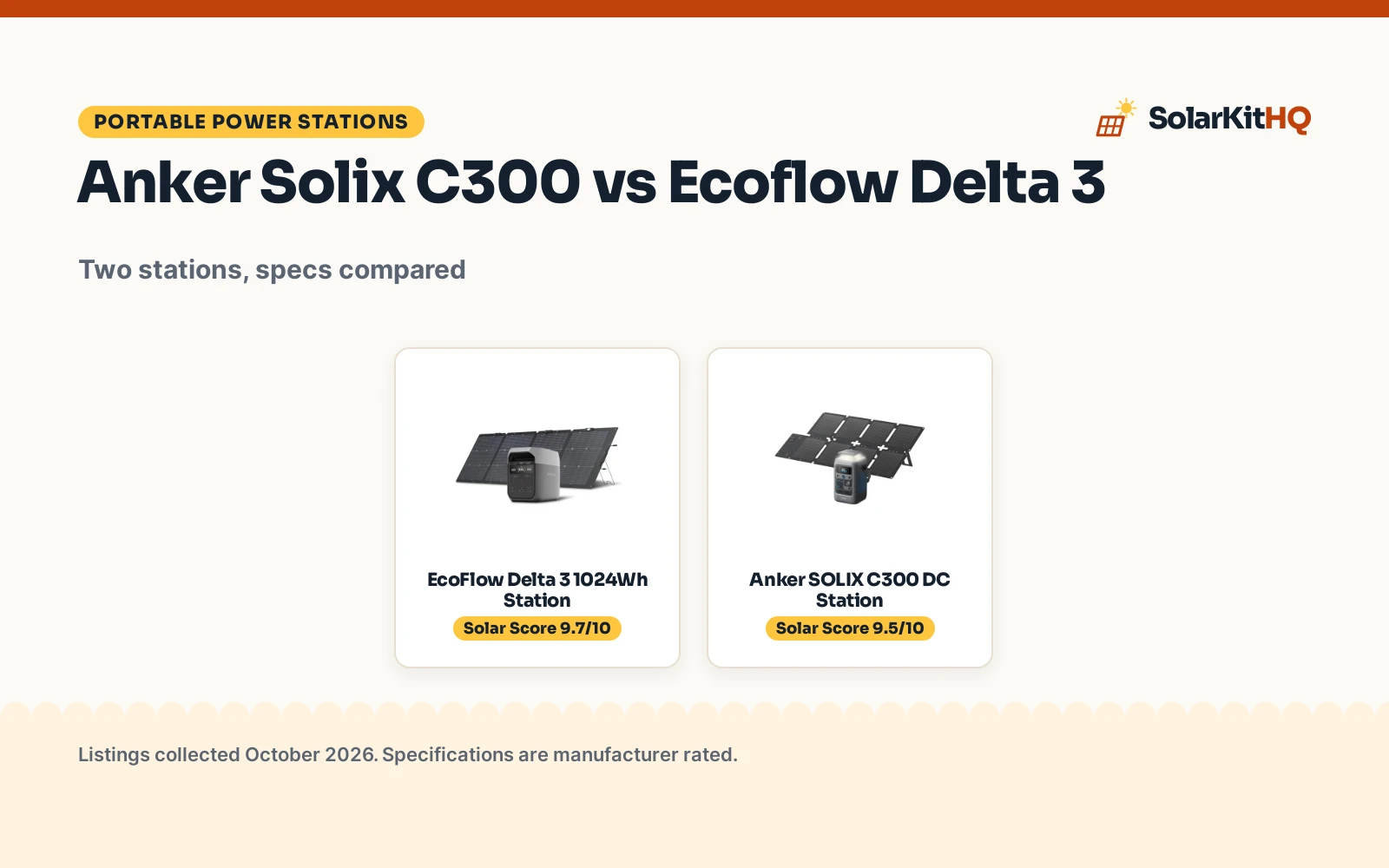
The short answer on anker solix c300 vs ecoflow delta 3: pick the Anker side for a compact DC station that travels light and charges phones, laptops and car-socket gear, and pick the EcoFlow side for home backup and RV use where AC output and a larger battery matter. We compared what each listing states: capacity, output, ports, solar panels, recharge times and warranty terms. The smaller station suits camping, travel and emergency use, while the larger station suits home backup, camping and RVs.
SolarKitHQ earns a commission when you buy through links on this page, at no extra cost to you. As an Amazon Associate I earn from qualifying purchases. Affiliate disclosure.
Side by side
| Station | EcoFlow Delta 3 1024Wh Station | Anker SOLIX C300 DC Station | Gap |
|---|---|---|---|
| Capacity | 1024Wh | 288Wh | Larger station states more capacity |
| AC output | 1800W | Not stated, DC ports only | Only Delta 3 states AC output |
| USB-C output | 100W | 140W | Anker listing states higher USB-C watts |
| Solar panel | 220W bifacial | 60W | Delta 3 panel states more watts |
| Recharge | 56 minutes full | 80% in 50 minutes | Different recharge figures stated |
| Warranty | 5 Year | 3 years | Delta 3 states a longer term |
Specifications are manufacturer rated as listed, collected 29 October 2026.
Capacity and output
Capacity and output separate the two clearly. The EcoFlow listing states 1024Wh with 1800W AC output and 100W USB-C output, while the Anker listing states 288Wh with 300W output and DC ports only, with no AC outlet stated. The EcoFlow listing also states X-Boost support for resistive appliances over 2600W continuously, and power for 13 appliances at once. The Anker listing states 7 device charging ports, including a 120W car socket and USB-C ports at 140W, 100W and 15W, plus USB-A ports at 12W. On stated watts alone, the EcoFlow station covers larger loads, while the Anker station covers phones, laptops and DC gear.
Solar panels and recharge
Solar input and recharge times also differ. The EcoFlow listing bundles a 220W bifacial panel with 25% conversion efficiency and states up to 28% more energy from the dual-sided design, with a full charge in 56 minutes from combined solar and AC input, 80% in 30 minutes, 5.8 hours with one 220W panel and 2.9 hours with two panels. The Anker listing bundles a 60W solar panel and states recharge to 80% in 50 minutes from a wall outlet, or in about 4 hours with the 60W solar panel, plus car charging and PD 3.1 USB-C charging. The EcoFlow panel states more watts, and the Anker panel suits topping up a smaller battery.
Battery life and expansion
Battery detail favors the larger station as well. The EcoFlow listing states LiFePO4 cells retaining 80% capacity after 4000 cycles, a 10-year lifespan for daily use, an IP65 battery pack, and expansion up to 5kWh with extra battery packs. The Anker listing states LiFePO4 batteries, smart temperature control and impact resistance, with a 3-year warranty, and notes that the station is not compatible with Anker SOLIX PS30, PS200 or PS400 panels. See our best portable power station for camping for more station comparisons.
What the listings leave unclear
The Anker listing states no AC outlet, so AC-powered gear is out of scope for that side: its ports are DC, USB-C, USB-A and a car socket. The Anker listing also states a 30% smaller design than similar power stations without naming the comparison models. The EcoFlow listing states that the station and panel arrive in separate packages, and states no weight figure. Treat the Anker side as a DC-only portable station and the EcoFlow side as a larger AC station, and compare only the specs both listings state.
Two examples

EcoFlow Delta 3 1024Wh Station
Portable power station with 1024Wh capacity, 1800W AC output, a 220W bifacial panel, an IP65 battery pack, and a 5 Year Manufacturer warranty.
Pros
- 1024Wh with 1800W AC output stated
- 220W bifacial panel with 25% conversion efficiency stated
- Full charge in 56 minutes stated from combined inputs
- Expandable capacity up to 5kWh stated
Cons
- Station and panel arrive in separate packages
- No weight is stated
- No car socket is stated
- Solar recharge of 5.8 hours with one panel is slower than the 56-minute combined-input figure
Detailed Review
The listing states a 1024Wh station with 1800W AC output, 100W USB-C output, and a 220W bifacial panel with 25% conversion efficiency and up to 28% more energy from the dual-sided design. It states a full charge in 56 minutes from 500W solar input and 1500W max AC input, 80% in 30 minutes, 5.8 hours with one 220W panel and 2.9 hours with two panels. It states LiFePO4 cells retaining 80% capacity after 4000 cycles, a 10-year lifespan, an IP65 battery pack, power for 13 appliances at once, X-Boost support over 2600W, a size of 15.7 by 8.0 by 11.2 inches, and a 5 Year Manufacturer warranty.
Who it's for: home backup, camping and RV use where AC output, a larger battery and fast recharge matter. Who should skip it: buyers who want a compact DC-only station or a stated weight before ordering.
Its Solar Score of 9.7/10 comes from performance 33/35, build 22/25, value 21/25, safety 7/10 and warranty 4/5: 87 of 100 points, placed on our 9.2 to 9.8 scale.
Key Specifications
| Capacity | 1024Wh |
|---|---|
| AC output | 1800W |
| Solar | 220W bifacial panel |
| Battery | LFP, 80% after 4000 cycles |
Figures as published on the retailer listing, collected 29 October 2026. Performance figures are manufacturer rated.
Safety and Warranty
What this listing states. IP65 battery pack stated, so safety scores 7 of 10. 5 Year Manufacturer warranty stated. It does not say everything a buyer needs, such as who pays return shipping, so warranty scores 4 of 5. See How We Pick.
Power station limits. Stay within the stated continuous output and solar input limits, keep the unit ventilated and dry, charge within the stated temperature range, and never connect it to home wiring except through equipment a licensed electrician installs.
This is general buying information, not professional advice. Follow each product manual and local rules, and see our Safety Disclaimer.

Anker SOLIX C300 DC Station
DC portable power station with 288Wh capacity, 300W output, 7 device charging ports, a 60W solar panel, and a 3-year warranty.
Pros
- 7 device charging ports stated
- 140W two-way USB-C ports stated
- Recharge to 80% in 50 minutes from a wall outlet stated
- 60W solar panel included in the box
Cons
- No AC outlet is stated
- Shoulder strap sold separately and not included
- Not compatible with PS30, PS200 or PS400 panels stated
- No IP code is stated
Detailed Review
The listing states a 288Wh LiFePO4 station with 300W output, 7 device charging ports including a 120W car socket, 2 USB-C ports at 140W, 1 USB-C port at 100W, 1 USB-C port at 15W and 2 USB-A ports at 12W, plus a 60W solar panel. It states recharge to 80% in 50 minutes from a wall outlet, about 4 hours with the 60W solar panel, car charging, PD 3.1 USB-C charging, a 30% smaller design than similar power stations, smart temperature control, impact resistance, and a 3-year warranty. It states no AC outlet and no IP code.
Who it's for: camping, travel and emergency use where a compact DC station with USB-C, USB-A and car socket charging fits. Who should skip it: buyers who need AC output, a stated weather code or a larger battery.
Its Solar Score of 9.5/10 comes from performance 28/35, build 21/25, value 20/25, safety 3/10 and warranty 3/5: 75 of 100 points, placed on our 9.2 to 9.8 scale.
Key Specifications
| Capacity | 288Wh |
|---|---|
| Output | 300W |
| Ports | 7 device charging ports |
| Solar | 60W solar panel |
Figures as published on the retailer listing, collected 29 October 2026. Performance figures are manufacturer rated.
Safety and Warranty
What this listing states. Smart temperature control and impact resistance stated, so safety scores 3 of 10. 3 years warranty stated. It does not say everything a buyer needs, such as who pays return shipping, so warranty scores 3 of 5. See How We Pick.
Power station limits. Stay within the stated continuous output and solar input limits, keep the unit ventilated and dry, charge within the stated temperature range, and never connect it to home wiring except through equipment a licensed electrician installs.
This is general buying information, not professional advice. Follow each product manual and local rules, and see our Safety Disclaimer.
As an Amazon Associate I earn from qualifying purchases.
How we scored them
The Solar Score weighs performance, build, value, safety and warranty. For power stations, safety means weather codes, battery chemistry and stated protections; the EcoFlow listing states an IP65 battery pack, while the Anker listing states smart temperature control and impact resistance without a code. The EcoFlow listing states a 5 Year Manufacturer warranty, while the Anker listing states 3 years. How we pick explains the weights.
| Product | Solar Score | Perf. /35 | Build /25 | Value /25 | Safety /10 | Warranty /5 |
|---|---|---|---|---|---|---|
| EcoFlow Delta 3 1024Wh Station | 9.7 | 33 | 22 | 21 | 7 | 4 |
| Anker SOLIX C300 DC Station | 9.5 | 28 | 21 | 20 | 3 | 3 |
Scores run from 9.2 to 9.8: each product’s point total is placed on that range, so more points always means a higher score.
Anker solix c300 vs ecoflow delta 3: which should you choose?
Choose the Anker side if portability matters, if the gear charges over USB-C, USB-A or a car socket, and if a 60W solar panel suits topping up a smaller battery. Choose the EcoFlow side if the job needs AC output, a larger battery, faster recharge from combined inputs, or expansion toward 5kWh with extra battery packs. Either way, confirm the station output matches the devices before ordering.
| If you need | Look at |
|---|---|
| Compact DC station | Anker SOLIX C300 DC Station, 288Wh, 300W |
| AC output and larger battery | EcoFlow Delta 3 1024Wh Station, 1024Wh, 1800W |
| Higher USB-C watts | Anker SOLIX C300 DC Station, 140W USB-C ports |
| Longest stated warranty | EcoFlow Delta 3 1024Wh Station, 5 Year |
| Expandable capacity | EcoFlow Delta 3 1024Wh Station, up to 5kWh |
Sizing Notes
- Match capacity to the loads: 288Wh on the Anker side, 1024Wh on the EcoFlow side, with expansion up to 5kWh on the EcoFlow side.
- Match output to the devices: DC, USB-C, USB-A and car socket on the Anker side, with no AC outlet stated; 1800W AC and 100W USB-C on the EcoFlow side.
- Match the solar panel to the recharge plan: 60W on the Anker side, 220W bifacial on the EcoFlow side.
- Check the warranty term on the listing before ordering: 3 years on the Anker side, 5 Year Manufacturer on the EcoFlow side.
Frequently Asked Questions
Which station here states more capacity?
The EcoFlow listing states 1024Wh, while the Anker listing states 288Wh.
Does the Anker station have AC outlets?
No AC outlet is stated. Its ports are DC, USB-C, USB-A and a car socket.
How fast does each station recharge?
The EcoFlow listing states a full charge in 56 minutes from combined inputs and 80% in 30 minutes. The Anker listing states 80% in 50 minutes from a wall outlet, or about 4 hours with its 60W solar panel.
Which station states a longer warranty?
The EcoFlow listing states a 5 Year Manufacturer warranty, while the Anker listing states 3 years.
Can the EcoFlow station expand capacity?
Yes, the listing states expansion up to 5kWh with extra battery packs.
Related guides
See every Portable Power Stations guide and all Power Stations and Generators guides. Also see our best portable power station for camping. Also see our best portable power station for road trip.