On this page
The short answer on dji power 2000 vs ecoflow delta pro 3: pick the DJI side if a foldable panel combo and a station with a stated noise figure fit the job, and pick the EcoFlow side if whole-home backup with a dual fuel generator fits the job. This article compares the two listings on capacity, output, charging methods, fuel options, size, safety features and warranty terms, using only figures the listings state. A figure from one listing describes that listing only, and a missing figure is treated as unclear, not as a win for the other side.
SolarKitHQ earns a commission when you buy through links on this page, at no extra cost to you. As an Amazon Associate I earn from qualifying purchases. Affiliate disclosure.
Dji Power 2000 vs Ecoflow Delta Pro 3: side by side
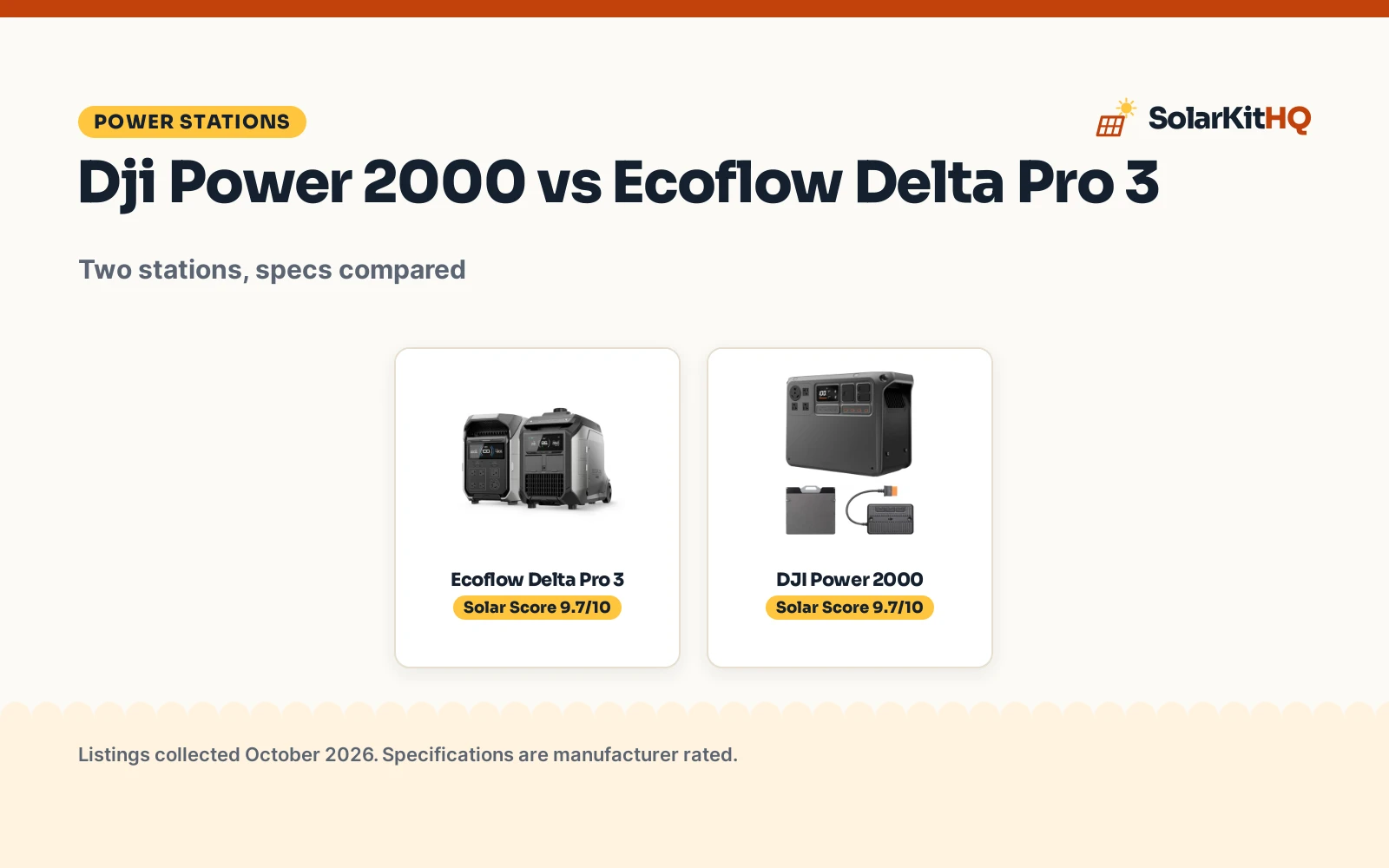
| Station | Solar Score | Capacity | Output | Warranty |
|---|---|---|---|---|
| Ecoflow Delta Pro 3 | 9.7/10 | 4096Wh | 3200W generator | 3 years |
| DJI Power 2000 | 9.7/10 | 2048Wh | 3000W | Up to 5 years |
Specifications are manufacturer rated as listed, collected 30 October 2026.
Capacity and output
Capacity is the clearest stated gap between the two listings. The DJI listing states a 2048Wh LFP battery and a 3000W stable output, with a 200W foldable solar panel with MPPT in the combo. The EcoFlow listing states a 4096Wh LFP battery capacity, expandable to 48kWh with extra batteries or smart generators, and pairs the station with a 3200W dual fuel generator. Both listings state an LFP battery, and both state a capacity figure clearly, so the capacity comparison rests on stated figures on both sides. The EcoFlow listing also states 2 to 4 days of whole-home backup power, while the DJI listing states no whole-home backup figure, so that claim belongs to the EcoFlow listing alone.
Charging, fuel and backup time
Charging and fuel separate the two listings more than capacity does. The DJI listing states a recharge to 80% in 55 minutes and a seamless UPS with a 10 ms switch time. The EcoFlow listing states 7 unique and 18 combo charging methods, including AC wall outlets, solar panels, gas generators, EV charging piles and the EcoFlow Smart Home Panel 2. On fuel, the EcoFlow listing is a dual fuel listing with LPG and gasoline, and it states a 20 lb propane tank for up to 24kWh of power, a gasoline tank producing 8kWh, and 8 hours of power for home appliances at 25% load. The DJI listing names no fuel generator and no propane or gasoline figure, so the fuel comparison is one-sided: EcoFlow states fuel options, DJI does not.
Size, noise and safety features
Size and safety features are stated unevenly across the two listings. The DJI listing gives dimensions of 17.64 by 8.86 by 12.76 inches, runs as low as 30 dB, and states a smart BMS, a sub-nano coating and a flame-retardant housing. The EcoFlow listing gives dimensions of 16.16 by 13.43 by 27.38 inches, and states app alerts for CO concentration, high and low temperature warnings, engine oil alerts and overload alerts, with automatic shutdowns for enhanced safety, excluding fuel alerts. The EcoFlow listing states no noise figure, so noise cannot be compared across both sides: DJI states 30 dB, and the EcoFlow listing leaves that figure unclear. Safety, in this comparison, means the BMS, housing and alert features each listing actually states, not a shared safety code.
What the listings leave unclear
The EcoFlow warranty needs care. Its bullets state a 3-year warranty period, while its spec table states a 5 Year Manufacturer warranty, so the two parts of the same listing disagree, and this article uses the bullet figure. The DJI spec table states up to 5 years of warranty, with no warranty figure in its bullets. The DJI listing also carries a maker claim that it runs 99% of appliances, including kettles, cookers, projectors, electric saws and impact drills, which is reported here as the maker claim, not as a measured result. Neither listing states a shared output figure in the same terms: DJI states a 3000W stable output for the station, while EcoFlow states 3200W for the dual fuel generator, so the two watt figures describe different parts of each listing.
Two examples

Ecoflow Delta Pro 3
A 4096Wh LFP power station paired with a 3200W dual fuel generator, expandable to 48kWh with extra batteries or smart generators.
Pros
- 4096Wh LFP capacity, expandable to 48kWh with extra batteries or smart generators
- Dual fuel generator using LPG and gasoline, with a 20 lb propane tank for up to 24kWh
- 7 unique and 18 combo charging methods, including AC wall outlets, solar panels and EV charging piles
- App alerts for CO concentration, temperature warnings, engine oil alerts and overload alerts, with automatic shutdowns
Cons
- Warranty figures disagree: bullets state 3 years, while the spec table states 5 years
- Station output watts are not stated separately from the 3200W generator figure
- No noise figure is stated
- Station and generator arrive in individual packages, not as one unit
Detailed Review
The listing states a 4096Wh LFP battery capacity, expandable to 48kWh with extra batteries or smart generators, and 2 to 4 days of whole-home backup power. It states 7 unique and 18 combo charging methods, a dual fuel generator with LPG and gasoline, a 20 lb propane tank for up to 24kWh, a gasoline tank producing 8kWh, and 8 hours of power for home appliances at 25% load. It states app alerts for CO concentration, high and low temperature warnings, engine oil alerts and overload alerts, with automatic shutdowns excluding fuel alerts. Its bullets state a 3-year warranty period, while its spec table states a 5 Year Manufacturer warranty, so this article uses the bullet figure.
Who it's for: owners who want whole-home backup with a dual fuel generator and many charging methods. Who should skip it: owners who want a panel in the box, a stated noise figure, or a single warranty figure with no disagreement.
Its Solar Score of 9.7/10 comes from performance 32/35, build 22/25, value 21/25, safety 9/10 and warranty 2/5: 86 of 100 points, placed on our 9.2 to 9.8 scale.
Key Specifications
| Capacity | 4096Wh, expandable to 48kWh |
|---|---|
| Generator | 3200W dual fuel |
| Fuel | LPG and gasoline |
| Size | 16.16 x 13.43 x 27.38 in |
Figures as published on the retailer listing, collected 30 October 2026. Performance figures are manufacturer rated.
Safety and Warranty
What this listing states. App alerts for CO, temperature, engine oil and overload, with automatic shutdowns stated, so safety scores 9 of 10. 3-year warranty period stated. It does not say everything a buyer needs, such as who pays return shipping, so warranty scores 2 of 5. See How We Pick.
Power station limits. Stay within the stated continuous output and solar input limits, keep the unit ventilated and dry, charge within the stated temperature range, and never connect it to home wiring except through equipment a licensed electrician installs.
This is general buying information, not professional advice. Follow each product manual and local rules, and see our Safety Disclaimer.

DJI Power 2000
A 2048Wh LFP station with a 3000W stable output, a 200W foldable solar panel with MPPT, and a stated 30 dB noise figure.
Pros
- 2048Wh LFP battery with a 3000W stable output stated
- 200W foldable solar panel with MPPT included in the combo
- Recharge to 80% in 55 minutes stated, with a seamless UPS and a 10 ms switch time
- Runs as low as 30 dB, with a smart BMS, a sub-nano coating and a flame-retardant housing
Cons
- No fuel generator is listed
- No expansion figure is stated
- No whole-home backup figure is stated
- Warranty is stated only as up to 5 years in the spec table, with no figure in the bullets
Detailed Review
The listing states a 2048Wh LFP battery, a 3000W stable output, a 200W foldable solar panel with MPPT, a recharge to 80% in 55 minutes, a seamless UPS with a 10 ms switch time, and a noise figure as low as 30 dB. It states a smart BMS, a sub-nano coating and a flame-retardant housing, and dimensions of 17.64 by 8.86 by 12.76 inches. It carries a maker claim that it runs 99% of appliances, including kettles, cookers, projectors, electric saws and impact drills.
Who it's for: owners who want a panel combo with a fast recharge figure and a stated noise figure for camping, RV use or outage backup. Who should skip it: owners who want a fuel generator, a stated expansion figure, or whole-home backup figures.
Its Solar Score of 9.7/10 comes from performance 30/35, build 21/25, value 20/25, safety 8/10 and warranty 3/5: 82 of 100 points, placed on our 9.2 to 9.8 scale.
Key Specifications
| Capacity | 2048Wh LFP |
|---|---|
| Output | 3000W stable |
| Panel | 200W foldable with MPPT |
| Noise | As low as 30 dB |
Figures as published on the retailer listing, collected 30 October 2026. Performance figures are manufacturer rated.
Safety and Warranty
What this listing states. Smart BMS, sub-nano coating and flame-retardant housing stated, so safety scores 8 of 10. Up to 5 Years of Warranty stated. It does not say everything a buyer needs, such as who pays return shipping, so warranty scores 3 of 5. See How We Pick.
Power station limits. Stay within the stated continuous output and solar input limits, keep the unit ventilated and dry, charge within the stated temperature range, and never connect it to home wiring except through equipment a licensed electrician installs.
This is general buying information, not professional advice. Follow each product manual and local rules, and see our Safety Disclaimer.
As an Amazon Associate I earn from qualifying purchases.
How we scored them
The Solar Score weighs performance, build, value, safety and warranty. For a power station, safety means a BMS, housing features, app alerts and shutdown features the listing actually states; both listings state safety features, and neither states a shared safety code. Both listings state a warranty term, with DJI stating up to 5 years and EcoFlow stating 3 years in its bullets. How we pick explains the weights.
| Product | Solar Score | Perf. /35 | Build /25 | Value /25 | Safety /10 | Warranty /5 |
|---|---|---|---|---|---|---|
| Ecoflow Delta Pro 3 | 9.7 | 32 | 22 | 21 | 9 | 2 |
| DJI Power 2000 | 9.7 | 30 | 21 | 20 | 8 | 3 |
Scores run from 9.2 to 9.8: each product’s point total is placed on that range, so more points always means a higher score.
Dji Power 2000 vs Ecoflow Delta Pro 3: which should you choose?
Choose the DJI side if the job is camping, RV use or outage backup with a foldable panel in the box, a stated 30 dB noise figure and a fast recharge figure of 80% in 55 minutes. Choose the EcoFlow side if the job is whole-home backup, with a 4096Wh capacity expandable to 48kWh, a dual fuel generator, and a long list of charging methods. If fuel matters, the choice is already made by the listings: only the EcoFlow listing names LPG and gasoline. If a panel in the box matters, the choice is also made by the listings: only the DJI listing names a 200W foldable panel in the combo.
| If you need | Look at |
|---|---|
| A foldable panel in the box | DJI Power 2000, 200W panel with MPPT |
| Whole-home backup stated | Ecoflow Delta Pro 3, 4096Wh expandable to 48kWh |
| A dual fuel generator | Ecoflow Delta Pro 3, LPG and gasoline |
| A stated noise figure | DJI Power 2000, 30 dB |
| A fast recharge figure | DJI Power 2000, 80% in 55 minutes |
Sizing Notes
- Match station capacity against the loads you plan: DJI states 2048Wh, and EcoFlow states 4096Wh expandable to 48kWh.
- Match stated output against the appliances you plan: DJI states a 3000W stable output, and EcoFlow states a 3200W dual fuel generator.
- Check charging methods before ordering: EcoFlow lists 7 unique and 18 combo charging methods, and DJI lists a 200W foldable panel with MPPT.
- Any connection to home wiring is a job for a licensed electrician, and no wiring steps are given here.
Frequently Asked Questions
Which station lists the larger capacity?
The EcoFlow listing, at 4096Wh, against the DJI listing at 2048Wh, with EcoFlow expandable to 48kWh with extra batteries or smart generators.
Which listing includes a solar panel?
The DJI listing, which names a 200W foldable solar panel with MPPT in the combo. The EcoFlow listing names solar panels only as a charging method, not as an included panel.
What warranty terms are stated here?
The DJI spec table states up to 5 years. The EcoFlow bullets state a 3-year warranty period, while its spec table states 5 years, so the EcoFlow term is unclear between those two figures.
Which listing includes a fuel generator?
The EcoFlow listing, with a 3200W dual fuel generator using LPG and gasoline. The DJI listing names no fuel generator.
Related guides
See every Power Stations and Generators guide. For portable power, see the best portable power station for camping, and for the panel side, the best solar panel kit for RV.