On this page
When the lights go out at dinner time and the fridge, router and laptop all need power at once, jackery 1000 v2 vs ecoflow delta 3 classic is the comparison that sorts the two sides. The verdict is split by load: the EcoFlow Delta 3 Classic side fits a larger continuous AC load and a bundled solar panel, while the Jackery Explorer 1000 V2 side fits a long cycle claim and a stated full charge in 50 minutes with Emergency Charging.
SolarKitHQ earns a commission when you buy through links on this page, at no extra cost to you. As an Amazon Associate I earn from qualifying purchases. Affiliate disclosure.
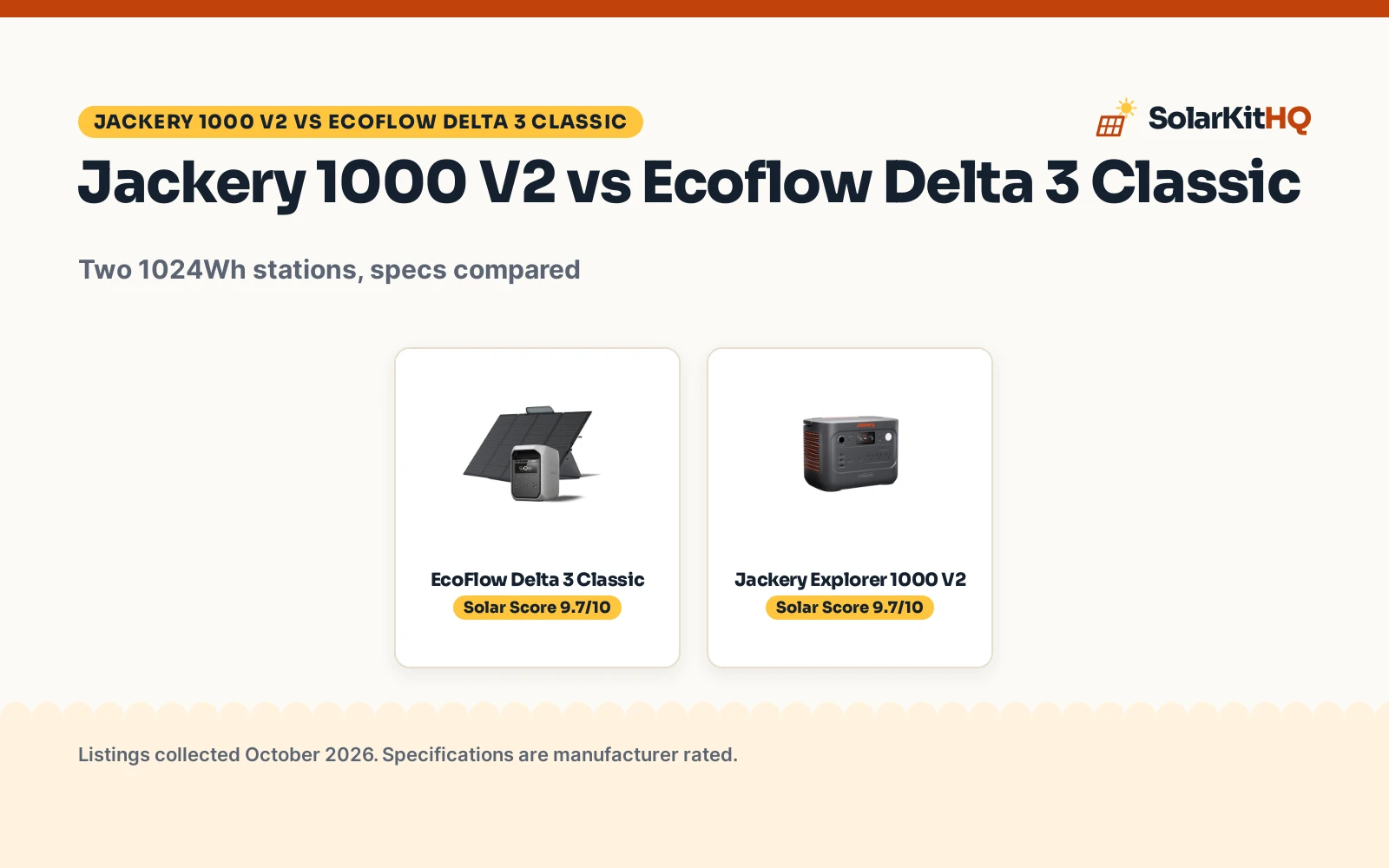
Jackery 1000 V2 vs Ecoflow Delta 3 Classic: side by side
| Portable power station | Solar Score | Capacity | AC output | UPS switch |
|---|---|---|---|---|
| EcoFlow Delta 3 Classic | 9.7/10 | 1024Wh | 1800W | <10ms |
| Jackery Explorer 1000 V2 | 9.7/10 | 1024Wh | 1500W | 10ms |
Specifications are manufacturer rated as listed, collected 30 October 2026.
AC output and surge figures
Continuous AC output is the clearest stated gap. The EcoFlow Delta 3 Classic listing states 1800W of continuous output, while the Jackery Explorer 1000 V2 listing states 1500W of pure sine wave AC across three outlets. The EcoFlow listing also states 3600W surge and X-Boost support up to 2600W, while the Jackery listing states 3kV surge resistance and lightning protection. Those surge figures are different kinds, one an output figure and one a protection figure, so the surge lines do not give a direct winner. For a load that needs a high continuous figure, the EcoFlow figure is higher; for a load that fits inside 1500W, the Jackery figure is ample on paper.
Charging and solar input
Charge claims also differ in kind, so read them as separate claims. The Jackery listing states a full charge in 50 minutes with Emergency Charging in the Jackery App, and a default 1.25-hour mode to protect long-term battery health. The EcoFlow listing states 0 to 80% charge in 45 minutes using X-Stream AC charging, and solar recharge in 3.2 hours with a 400W solar panel. The Jackery listing states up to 400W of solar input, while the EcoFlow listing includes a 400W solar panel in the bundle. A full charge time for the EcoFlow station is not given as a single figure in the bullets, and the title line about a 1 Hr Fast Charge does not say which charge level it covers, so a direct full charge comparison stays unclear.
Battery life and cycle claims
Battery life is stated in different units on each side, so the two claims do not convert into one another. The Jackery listing states a LiFePO4 battery rated for 6000+ charge cycles while retaining over 70% of original capacity, and a lifespan claim of 16 years of daily use. The EcoFlow listing states LiFePO4 battery cells rated for 10+ years of daily use, with an EV-grade CTC design and a Battery Management System, and it states no cycle count. The Jackery bullets also claim roughly 50% more cycles than typical LFP stations, but the listing gives no typical figure to check that claim against, so treat it as a maker claim. Neither listing states a station weight, so weight cannot decide this pair; only the EcoFlow panel weight, at 35.3 lb, is stated.
Outlets, ports and the bundled panel
Port counts are fuller on the Jackery side. The Jackery listing states two USB-C ports with 100W PD fast charging, one USB-A port, one DC car port, three pure sine wave AC outlets and built-in LED lighting. The EcoFlow listing states 100W USB-C output and a 400W solar panel that is foldable, with an IP68 code stated for the panel and a case stated for the panel. The EcoFlow listing also states app control, with Storm Alert and Self-Powered Mode named as backup modes. The Jackery listing names no included solar panel, while the EcoFlow listing is a bundle with a panel, so a buyer who wants a panel in the box and a buyer who already owns a panel face different starting points.
What the listings leave unclear
Names vary inside the Jackery listing: the title uses Jackery Explorer 1000 v2 and HP1000V2, while the bullets use HomePower 1000 v2 for the same listing. The EcoFlow title line about a 1 Hr Fast Charge sits beside bullets that give a partial charge figure, 0 to 80% in 45 minutes, and a solar recharge figure, 3.2 hours with the 400W panel, without a single full charge figure. Station weight is not stated for either station, and a cycle count is not stated for the EcoFlow station. Those gaps do not change the stated capacity or AC figures, but they do mean a buyer should check the manual for the figures the listings leave out.
Two examples

EcoFlow Delta 3 Classic
A 1024Wh LiFePO4 portable power station bundled with a 400W solar panel, stating 1800W continuous AC output and 3600W surge.
Pros
- 1800W continuous AC output with 3600W surge stated, plus X-Boost support up to 2600W
- 400W solar panel included in this listing, with solar recharge in 3.2 hours stated
- 0 to 80% charge in 45 minutes with X-Stream AC charging stated
- IP68 code stated for the panel, with a Battery Management System stated for the station
Cons
- Panel weight is 35.3 lb stated, so the bundled panel adds carry weight
- Cycle count is not stated; the listing states 10+ years of daily use instead
- Station dimensions are 7.9 by 11.1 by 15.7 inches, so check the space available
- Surge protection figure for the station itself is not stated; the IP68 code covers the panel
Detailed Review
The listing states a 1024Wh LiFePO4 portable power station bundled with a 400W solar panel, 1800W continuous AC output with 3600W surge, X-Boost support up to 2600W, 100W USB-C output, a Battery Management System, app control with Storm Alert and Self-Powered Mode, and a 5 Year Manufacturer warranty. The title line about a 1 Hr Fast Charge sits beside bullets that give 0 to 80% in 45 minutes and solar recharge in 3.2 hours with the 400W panel, without a single full charge figure, so use the bullet figures when comparing charge claims. The panel is stated as foldable, with an IP68 code and a case, at 35.3 lb.
Who it's for: buyers who want a higher continuous AC figure, a bundled 400W panel and app control with named backup modes. Who should skip it: buyers who want a stated cycle count or a single full charge figure in the listing.
Its Solar Score of 9.7/10 comes from performance 32/35, build 21/25, value 22/25, safety 7/10 and warranty 4/5: 86 of 100 points, placed on our 9.2 to 9.8 scale.
Key Specifications
| Capacity | 1024Wh, LiFePO4 |
|---|---|
| AC output | 1800W continuous, 3600W surge |
| UPS switch | Under 10ms |
| Solar | 400W panel included, 3.2 hours solar recharge |
Figures as published on the retailer listing, collected 30 October 2026. Performance figures are manufacturer rated.
Safety and Warranty
What this listing states. Battery Management System stated, IP68 panel stated, UPS switch under 10ms stated, so safety scores 7 of 10. 5 Year Manufacturer warranty stated. It does not say everything a buyer needs, such as who pays return shipping, so warranty scores 4 of 5. See How We Pick.
Power station limits. Stay within the stated continuous output and solar input limits, keep the unit ventilated and dry, charge within the stated temperature range, and never connect it to home wiring except through equipment a licensed electrician installs.
This is general buying information, not professional advice. Follow each product manual and local rules, and see our Safety Disclaimer.
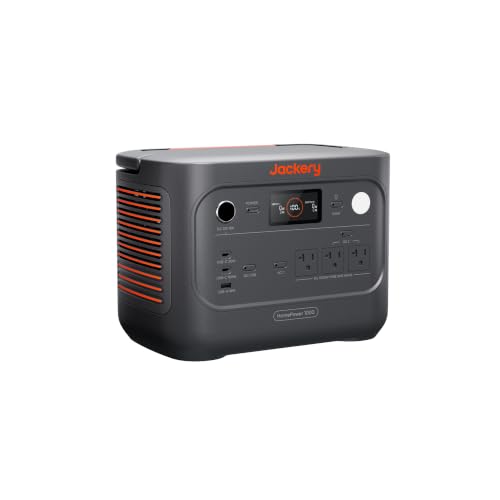
Jackery Explorer 1000 V2
A 1024Wh LiFePO4 portable power station stating 1500W pure sine wave AC, a 10ms UPS switch and a full charge in 50 minutes with Emergency Charging.
Pros
- 1024Wh LiFePO4 capacity with 1500W pure sine wave AC across three outlets stated
- Full charge in 50 minutes with Emergency Charging in the Jackery App stated
- 6000+ charge cycles while retaining over 70% of original capacity stated
- 3kV surge resistance and lightning protection stated
Cons
- Solar input is capped at 400W in the listing, so solar recharge is limited to that figure
- Included solar panel is not stated in this listing
- Default recharge mode takes 1.25 hours, not 50 minutes
- Only one USB-A port is listed, beside two USB-C ports and one DC car port
Detailed Review
The listing states a 1024Wh LiFePO4 portable power station with 1500W pure sine wave AC across three outlets, a 10ms UPS switch, 3kV surge resistance with lightning protection, ChargeShield charging, up to 400W of solar input, two USB-C ports with 100W PD fast charging, one USB-A port, one DC car port, built-in LED lighting and a 5-Year Warranty. The title uses Jackery Explorer 1000 v2 and HP1000V2 while the bullets use HomePower 1000 v2 for the same listing, so the Explorer name from the title is used here. The 50 minute figure covers Emergency Charging, while the default mode is 1.25 hours, so compare charge claims by mode.
Who it's for: buyers who want a 6000+ cycle claim, a stated full charge in 50 minutes with Emergency Charging and stated surge protection. Who should skip it: buyers who want an included solar panel named in the listing or a higher continuous AC figure.
Its Solar Score of 9.7/10 comes from performance 30/35, build 21/25, value 21/25, safety 8/10 and warranty 4/5: 84 of 100 points, placed on our 9.2 to 9.8 scale.
Key Specifications
| Capacity | 1024Wh, LiFePO4 |
|---|---|
| AC output | 1500W pure sine wave |
| UPS switch | 10ms |
| Solar input | Up to 400W |
Figures as published on the retailer listing, collected 30 October 2026. Performance figures are manufacturer rated.
Safety and Warranty
What this listing states. 3kV surge resistance and lightning protection stated, ChargeShield charging stated, so safety scores 8 of 10. 5-Year Warranty stated. It does not say everything a buyer needs, such as who pays return shipping, so warranty scores 4 of 5. See How We Pick.
Power station limits. Stay within the stated continuous output and solar input limits, keep the unit ventilated and dry, charge within the stated temperature range, and never connect it to home wiring except through equipment a licensed electrician installs.
This is general buying information, not professional advice. Follow each product manual and local rules, and see our Safety Disclaimer.
As an Amazon Associate I earn from qualifying purchases.
How we scored them
The Solar Score weighs performance, build, value, safety and warranty. For portable power stations, safety means UPS switching, surge protection, a Battery Management System and an IP code where the listing states one. Both stations state a warranty term of 5 years. How we pick explains the weights.
| Product | Solar Score | Perf. /35 | Build /25 | Value /25 | Safety /10 | Warranty /5 |
|---|---|---|---|---|---|---|
| EcoFlow Delta 3 Classic | 9.7 | 32 | 21 | 22 | 7 | 4 |
| Jackery Explorer 1000 V2 | 9.7 | 30 | 21 | 21 | 8 | 4 |
Scores run from 9.2 to 9.8: each product’s point total is placed on that range, so more points always means a higher score.
How to choose jackery 1000 v2 vs ecoflow delta 3 classic
Choose the EcoFlow Delta 3 Classic side for a larger continuous AC load, for X-Boost support up to 2600W, and for a bundle that includes a 400W solar panel with solar recharge in 3.2 hours stated. Choose the Jackery Explorer 1000 V2 side for a 6000+ cycle claim, for a stated full charge in 50 minutes with Emergency Charging, and for 3kV surge resistance with lightning protection stated. For background on UPS use, see solar generator vs ups, and for a larger group at this capacity, see best 1000wh power station for rv.
| If you need | Look at |
|---|---|
| Higher continuous AC output | EcoFlow Delta 3 Classic, 1800W |
| A bundled solar panel | EcoFlow Delta 3 Classic, 400W panel |
| A stated full charge in 50 minutes | Jackery Explorer 1000 V2, Emergency Charging |
| A 6000+ cycle claim | Jackery Explorer 1000 V2 |
Sizing Notes
- Match planned loads to the stated continuous AC output: 1500W for the Jackery listing and 1800W for the EcoFlow listing, with surge and X-Boost figures kept separate.
- Match the load plan to the stated capacity: both listings state 1024Wh.
- Match solar plans to the stated solar figures: up to 400W of solar input for the Jackery listing, and a 400W panel with solar recharge in 3.2 hours for the EcoFlow listing.
- Check the stated dimensions against the space available: 12.4 by 7.9 by 9.2 inches for the Jackery listing and 7.9 by 11.1 by 15.7 inches for the EcoFlow listing.
Frequently Asked Questions
Which station states higher continuous AC output?
The EcoFlow Delta 3 Classic, at 1800W, against 1500W for the Jackery Explorer 1000 V2. Both listings state 1024Wh of capacity.
Which listing includes a solar panel?
The EcoFlow listing includes a 400W solar panel, with solar recharge in 3.2 hours stated. The Jackery listing states up to 400W of solar input and names no included solar panel.
How do the charge claims compare?
They are different kinds of claim. The Jackery listing states a full charge in 50 minutes with Emergency Charging and a default 1.25-hour mode, while the EcoFlow listing states 0 to 80% in 45 minutes with X-Stream AC charging.
What warranty term does each station state?
Both state 5 years: the Jackery listing states a 5-Year Warranty and the EcoFlow listing states a 5 Year Manufacturer warranty.
Related guides
See every Portable Power Stations guide and all Power Stations and Generators guides.
More picks: best portable power station for camping and best power station with usb c.