On this page
Bifacial solar panels meaning: a bifacial panel is a solar panel that makes power from the front face and from the back face, so light that reaches the back adds to the power the front already makes. A standard panel has cells on the front only, with a sealed back that makes no power. A bifacial panel leaves the back open to light, which means the surface under the panel and the height of the mount decide how much the back face adds. The sections below explain how the back face works, what it needs, and where it helps most.
SolarKitHQ earns a commission when you buy through links on this page, at no extra cost to you. As an Amazon Associate I earn from qualifying purchases. Affiliate disclosure.
Bifacial solar panels meaning: the quick answer
A bifacial solar panel turns sunlight into power on the front face and on the back face. The front face takes direct sun, just like a standard panel. The back face takes light that bounces off the ground, a roof, or a nearby surface, and turns that light into extra power. The gain from the back face is not fixed: it rises over bright ground and falls over dark ground, and it rises when the panel sits high enough for light to reach the back. A panel mounted flat against a dark roof gets little from the back, while the same panel raised over pale gravel gets far more.
How a bifacial panel works
A solar cell makes power when light hits it. A standard panel puts cells under glass on the front and seals the back with a backsheet, so light that hits the back is wasted. A bifacial panel puts cells where light can reach them from the front and from the back, with glass on the back face instead of a backsheet, so light that passes around the panel or bounces off the surface below can reach the cells from behind.
The back face does not replace the front face. The front face does the main work, and the back face adds power on top of it. The amount the back adds depends on how much light reaches it, which depends on the surface below, the height of the mount, the tilt of the panel and the spacing between rows. A panel in open ground with room around it gives the back face far more light than a panel packed tight against a dark surface.
| Panel type | Front face | Back face | Best mounting |
|---|---|---|---|
| Monofacial panel | Makes power from direct sun | Sealed back, no power from behind | Roof or ground mount |
| Bifacial panel | Makes power from direct sun | Makes power from reflected light | Raised mount over bright ground |
The table shows the core difference: the back face is sealed or open to light. Everything else about the panel, the cells, the glass and the frame, follows from that choice.
What the back face needs
Light has to reach the back face, and the surface under the panel, the height of the mount and the tilt decide how much gets there. Pale gravel, sand, snow and light concrete bounce far more light upward than dark soil, grass or asphalt. A panel raised on a tall mount lets light spread under it and reach the back, while a panel set low and flat leaves the back in shadow. Tilt matters because a tilted panel leaves a gap under its lower edge where reflected light can enter.
Row spacing matters too. Panels set in tight rows shade each other’s backs, while panels with room between rows let light reach the ground and bounce back up. The same logic applies to roof mounts: a panel flush on a dark roof gets little from the back, while a panel raised on a tilt mount over a light roof surface gets more. See pole mount vs ground mount solar panel for how mount height changes what the back face sees.
Where bifacial panels help most
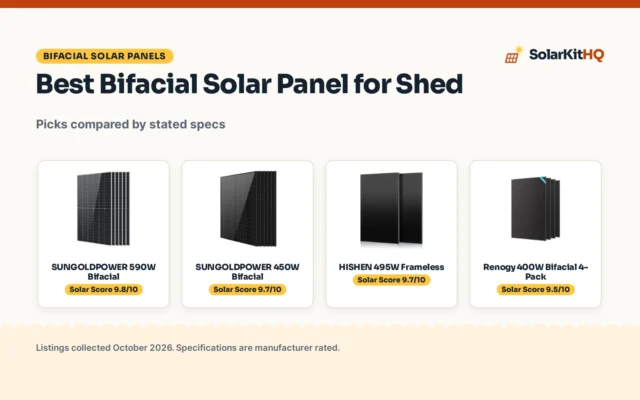
Bifacial panels help most where the back face sees bright, open ground. Ground mounts over pale gravel or sand, carports over light concrete, and snowy sites all give the back face plenty of reflected light. A ground mount in an open field is the classic case: the panel sits high, the ground is bright, and light reaches the back all day. See best bifacial solar panel for shed for panels suited to a shed roof or yard mount.
They help least where the back face stays dark. A panel flush on a dark shingle roof, a panel set low over dark soil, and a panel shaded by a wall or a tree all give the back face little to work with. In those spots a standard panel costs less and gives up little, because the back face would have added little anyway. The choice comes down to the site, not the panel alone.
What to check before you buy
A bifacial panel is only worth the extra cost when the site gives the back face light. Check the points below against the listing and the site before you order.
- Front and back output: read the output the maker states for the front face and the output it states for the back face, and check how the maker measured the back-face figure.
- Mount height: check the height of the mount the listing states, and whether the mount leaves room for light to reach the back.
- Ground surface: check what sits under the panel, and whether it reflects light or swallows it.
- Controller input: check the panel watts and voltage against the controller or power station input, so the extra output from the back face stays inside the input limit.
- Warranty term: check the warranty term the maker states for the panel, and what it covers.
- Frame and glass: check whether the panel has glass on the back face or a backsheet, and whether the frame suits the mount.
FAQ: power away from the grid
Do bifacial panels work on a roof?
They can, but the back face needs light, and a roof mount sits close to the roof, so the back adds little over a dark roof surface. A raised mount over a light roof surface helps the back face more.
Do bifacial panels need a special controller?
No special controller type is needed. Match the panel watts and voltage to the controller or power station input the maker states.
Are bifacial panels heavier than monofacial panels?
Bifacial panels often use glass on the back face as well as the front, which adds weight compared with a panel that has a backsheet. Check the weight the maker states before you plan the mount.
Can a bifacial panel work in shade?
Shade on the front face cuts output, and shade on the back face cuts the extra the back adds. A site with open sky and a bright surface under the panel gives the back face the most light.
What ground cover works best under a bifacial panel?
Light surfaces reflect more light to the back face: pale gravel, sand, snow and light concrete. Dark soil and grass reflect less, so the back face adds less over those surfaces.
Related solar guides
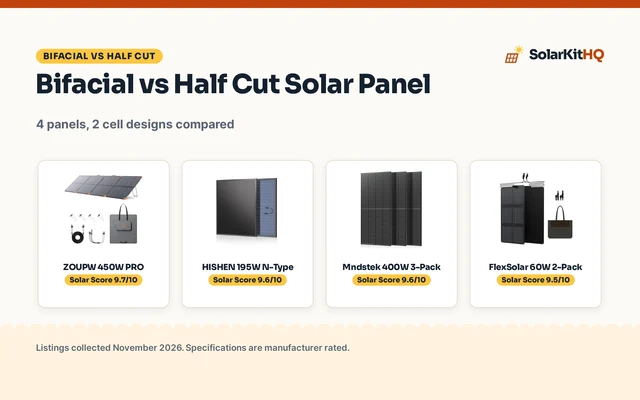
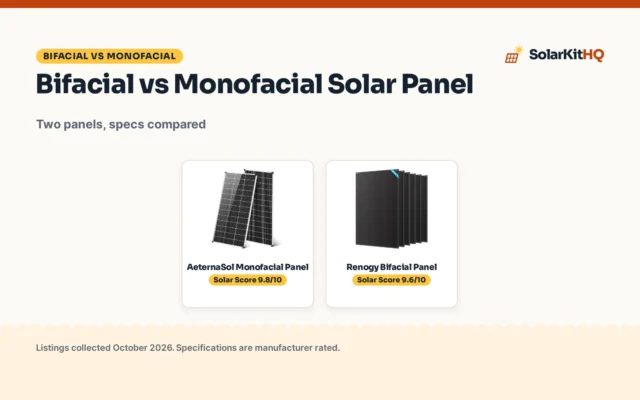
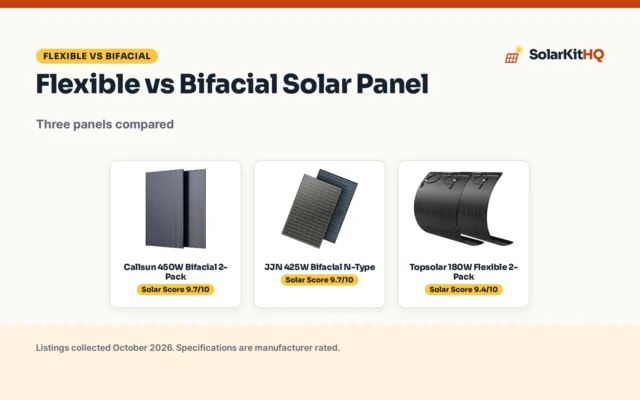
See the best bifacial solar panels, the bifacial vs monofacial solar panel, the flexible vs bifacial solar panel and the best solar panel ground mount.