On this page
The short answer on bifacial vs monofacial solar panel use: choose the bifacial example for a reflective roof or ground surface where back-side light is available, and choose the monofacial example for a straightforward panel where a long stated output warranty and a slightly higher stated efficiency figure matter. The two examples below were compared on what each listing states: watts, efficiency, busbars, enclosure code, size, weight and warranty terms, with the comparison built around what separates the two sides rather than around either listing alone.
SolarKitHQ earns a commission when you buy through links on this page, at no extra cost to you. As an Amazon Associate I earn from qualifying purchases. Affiliate disclosure.
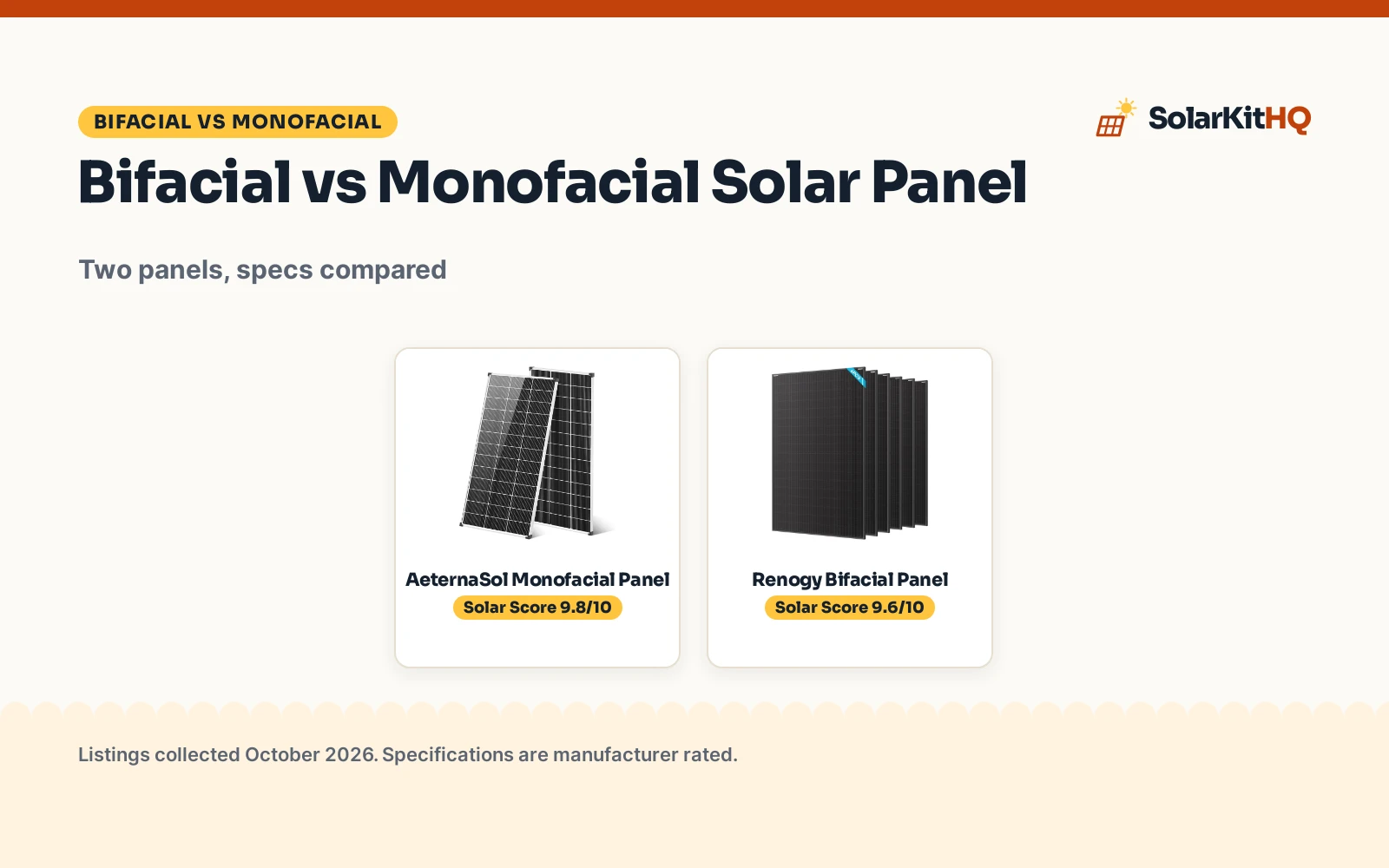
Bifacial vs monofacial solar panel: side by side
| Panel | Solar Score | Watts | Efficiency | Warranty |
|---|---|---|---|---|
| AeternaSol Monofacial Panel | 9.8/10 | 400W title, 200W bullets | 25.6% | 5-year, 25-year output |
| Renogy Bifacial Panel | 9.6/10 | 400W | 25% | Not stated |
Specifications are manufacturer rated as listed, collected 29 October 2026.
Front and back light
This is the clearest design gap. The Renogy bifacial example captures direct sunlight on the front and reflected light on the back, with the listing stating up to 30% more energy in reflective settings such as snow, sand, concrete, white gravel, and light-colored roofs. The AeternaSol monofacial example states no back-side figure, so its output rests on front-side light alone as listed. A reflective surface under or beside the panel is therefore the condition that makes the bifacial design relevant, while a dark or shaded surface leaves that back-side claim with no stated benefit in the listing.
Efficiency and cell detail
Both examples state N-type monocrystalline silicon cells, so the cell detail comparison rests on busbars and efficiency figures both listings state clearly. The Renogy example lists 16BB N-type cells at 25% cell efficiency, while the AeternaSol example lists 18BB N-type cells at 25.6% conversion efficiency. On stated efficiency alone, the monofacial example states the higher figure. The Renogy example also lists two independently working power zones to reduce the impact of partial shade, while the AeternaSol example lists a low temperature coefficient for stable output under high-temperature exposure, with no figure stated for that coefficient.
Size, weight and enclosure
Size and weight differ in ways that matter for a roof or ground mount. The Renogy example lists dimensions of 44.7 by 1.4 by 67.8 inches and a weight of 45.4 pounds, for a panel listed at 400 watts, with 6 panels in the set. The AeternaSol example lists dimensions of 56.69 by 26.38 by 1.18 inches, with no weight figure stated, and its power figure is left unclear as noted below. Both examples list an IP68 code: the Renogy example lists IP68 in its special features, and the AeternaSol example lists an IP68 junction box with sealed MC4 connectors and a corrosion-resistant silver anodized aluminum frame.
What the listings leave unclear
The AeternaSol listing leaves its per-panel power unclear. Its title and spec table list 400 watts, while its bullets describe a panel at 200W with a larger footprint, so the two figures cannot both describe the same panel in the same way. The Renogy listing, by contrast, lists 400 watts per panel and 6 panels in the set, with a title total of 2400W. The Renogy listing also states no warranty term, while the AeternaSol listing states a 5-year term for materials and workmanship plus a 25-year linear power output term. Neither listing states a UL listing, so no certification beyond IP68 is compared here.
Two examples

AeternaSol Monofacial Panel
A monofacial panel with 18BB N-type cells at 25.6% efficiency, an IP68 junction box, and a 5-year plus 25-year output warranty term.
Pros
- 25.6% conversion efficiency with 18BB N-type cells stated
- IP68 junction box with sealed MC4 connectors and an aluminum frame
- Anti-backflow diode to prevent reverse power drain at night
- 5-year materials term plus a 25-year linear power output term
Cons
- Title and spec list 400 watts while bullets describe a 200W panel
- No weight figure is stated in the listing
- No temperature coefficient figure is stated, only a low coefficient claim
- Included components list 2 panels, which adds to the power confusion
Detailed Review
The listing states a monofacial panel with 18BB N-type monocrystalline silicon cells at 25.6% conversion efficiency, support for 12V and 24V systems with PWM or MPPT controllers, an IP68 junction box with sealed MC4 connectors, a corrosion-resistant silver anodized aluminum frame, an anti-backflow diode, a low temperature coefficient, pre-drilled mounting holes, dimensions of 56.69 by 26.38 by 1.18 inches, and a 5-year materials and workmanship term plus a 25-year linear power output term. The title lists 400 watts and the spec table lists maximum power as 400 watts, while the bullets describe a panel at 200W, so the per-panel power figure is left unclear here.
Who it's for: owners who want a front-side panel with a long stated output warranty and a higher stated efficiency figure. Who should skip it: owners who need a clear per-panel watt figure before ordering.
Its Solar Score of 9.8/10 comes from performance 32/35, build 22/25, value 21/25, safety 8/10 and warranty 5/5: 88 of 100 points, placed on our 9.2 to 9.8 scale.
Key Specifications
| Efficiency | 25.6% |
|---|---|
| Busbars | 18BB |
| Enclosure | IP68 |
| Size | 56.69 x 26.38 x 1.18 inches |
Figures as published on the retailer listing, collected 29 October 2026. Performance figures are manufacturer rated.
Safety and Warranty
What this listing states. IP68 junction box, sealed MC4 connectors, anti-backflow diode stated, so safety scores 8 of 10. 5-year materials and workmanship, 25-year linear power output stated, so warranty scores 5 of 5. See How We Pick.
Panels make voltage in daylight. Keep connectors covered until you connect them, check the panel's stated open circuit voltage and current against your controller or power station input limits, and use cables rated for the current. Roof and permanent mounts belong to a qualified installer.
This is general buying information, not professional advice. Follow each product manual and local rules, and see our Safety Disclaimer.

Renogy Bifacial Panel
A bifacial panel with 16BB N-type cells at 25% efficiency, back-side light capture, and IP68 for home, RV, farm and off-grid use.
Pros
- 400 watts per panel with back-side capture in reflective settings
- Up to 30% more energy stated in snow, sand, concrete and gravel settings
- Two independently working power zones for partial shade
- 16BB N-type cells at 25% cell efficiency stated
Cons
- No warranty term is stated in the listing
- Back-side gain depends on a reflective surface, which is not always present
- Title total of 2400W covers 6 panels, not a single panel
- No voltage figure is stated in the spec table for this panel
Detailed Review
The listing states a bifacial panel with 16BB N-type cells at 25% cell efficiency, 400 watts per panel in a set of 6 panels with a title total of 2400W, back-side capture of reflected light with up to 30% more energy stated in reflective settings such as snow, sand, concrete, white gravel, and light-colored roofs, two independently working power zones for partial shade, dimensions of 44.7 by 1.4 by 67.8 inches, a weight of 45.4 pounds, monocrystalline silicon material, and IP68 in its special features. No warranty term is stated in the listing, so no term is counted for this panel.
Who it's for: owners with a reflective roof or ground surface who want back-side light capture. Who should skip it: owners who need a stated warranty term or a single-panel purchase.
Its Solar Score of 9.6/10 comes from performance 30/35, build 21/25, value 21/25, safety 7/10 and warranty 0/5: 79 of 100 points, placed on our 9.2 to 9.8 scale.
Key Specifications
| Watts per panel | 400W |
|---|---|
| Efficiency | 25% |
| Busbars | 16BB |
| Enclosure | IP68 |
Figures as published on the retailer listing, collected 29 October 2026. Performance figures are manufacturer rated.
Safety and Warranty
What this listing states. IP68 stated, so safety scores 7 of 10. No warranty term, so warranty scores zero. See How We Pick.
Panels make voltage in daylight. Keep connectors covered until you connect them, check the panel's stated open circuit voltage and current against your controller or power station input limits, and use cables rated for the current. Roof and permanent mounts belong to a qualified installer.
This is general buying information, not professional advice. Follow each product manual and local rules, and see our Safety Disclaimer.
As an Amazon Associate I earn from qualifying purchases.
How we scored them
The Solar Score weighs performance, build, value, safety and warranty. For solar panels, safety means the enclosure code and protection features the listing states; both examples state IP68, and the AeternaSol example also states an anti-backflow diode. Only 1 example states a warranty term, and the other states none. How we pick explains the weights.
| Product | Solar Score | Perf. /35 | Build /25 | Value /25 | Safety /10 | Warranty /5 |
|---|---|---|---|---|---|---|
| AeternaSol Monofacial Panel | 9.8 | 32 | 22 | 21 | 8 | 5 |
| Renogy Bifacial Panel | 9.6 | 30 | 21 | 21 | 7 | 0 |
Scores run from 9.2 to 9.8: each product’s point total is placed on that range, so more points always means a higher score.
bifacial vs monofacial solar panel: which should you choose?
Choose the bifacial example if the panel will sit over a reflective surface such as snow, sand, concrete, white gravel, or a light-colored roof, where the listing states a back-side gain. Choose the monofacial example if a long stated output warranty matters, if the higher stated efficiency figure matters, or if a simpler front-side panel fits the mount. A licensed electrician should handle installation of any panel in this set, and no connection steps are given here.
| If you need | Look at |
|---|---|
| Back-side light in reflective settings | Renogy Bifacial Panel, up to 30% more energy stated |
| Long stated output warranty | AeternaSol Monofacial Panel, 25-year linear power output |
| Higher stated efficiency figure | AeternaSol Monofacial Panel, 25.6% |
| Two independently working power zones | Renogy Bifacial Panel, dual-module design stated |
Sizing Notes
- Match panel watts to the system: 400 watts per panel stated for the Renogy example, with the AeternaSol power figure left unclear between 400 watts and 200W.
- Match efficiency figures: 25% for the Renogy example, and 25.6% for the AeternaSol example.
- Match enclosure code to outdoor use: IP68 stated for both examples.
- Check panel size against the mount: 44.7 by 1.4 by 67.8 inches for the Renogy example, and 56.69 by 26.38 by 1.18 inches for the AeternaSol example.
- Check the warranty line: 5-year and 25-year output terms stated for the AeternaSol example, and no term stated for the Renogy example.
Frequently Asked Questions
Does the bifacial example capture back-side light?
Yes, as listed. The Renogy example captures direct sunlight on the front and reflected light on the back, with up to 30% more energy stated in reflective settings.
Which example states the higher efficiency figure?
The AeternaSol example, at 25.6%, against 25% for the Renogy example.
Which example states a warranty term?
The AeternaSol example, with a 5-year term for materials and workmanship plus a 25-year linear power output term. The Renogy example states no warranty term.
Is the AeternaSol panel 400 watts or 200W?
The listing leaves it unclear. Its title and spec table list 400 watts, while its bullets describe a panel at 200W, so compare on that uncertainty rather than on either figure alone.
Related guides
See every Solar Panels and Kits guide. Also see Best Bifacial Solar Panels. Also see Flexible vs Bifacial Solar Panel. Also see Bifacial vs Thin Film Solar Panel.